Tourism

Amid Trump’s tariffs and annexation talk, some Canadians see visiting Alaska as a ‘diplomatic mission’

Skiers take off at the start of the 2025 Buckwheat International Ski Classic in British Columbia, Canada. (Avery Ellfeldt/KHNS)

On Saturday morning, Tom Morphet – the mayor of Haines, Alaska — played “O Canada” on a trumpet as cars streamed into a parking lot along the Klondike Highway. Temperatures were hovering in the mid-teens as Alaskans and Canadians got ready for a Nordic ski race.

Carmen Gustafson, from White Horse in Yukon Territory, was among them. Decked out in Canadian swag, she said making the trip this year felt more important than ever – despite a burgeoning movement among Canadians to boycott the U.S.

“Our idea was to still come,” Gustafson said. “But we thought we’d wear some flags and be patriotic and just let everybody know that things aren’t really okay right now.”

Whitehorse resident Carmen Gustafson prepares for the race. (Avery Ellfeldt/KHNS)

The Buckwheat International Ski Classic is a themed event that’s been around for decades. The races – a 5K, 10K, 16K and 32K – happen in British Columbia. And the awards ceremony and afterparty are held just across the border, in Skagway.

But the run-up to this year’s event looked a little different. President Donald Trump has called multiple times for the annexation of Canada – conducted by, quote, “economic force.” He’s also sparked a global trade war, in part by imposing 25% tariffs on some Canadian imports. 

The ordeal has led some Canadians to decide against spending money in or visiting the U.S. for the time being. According to a survey of more than 1,500 Canadians by Canadian market research firm Leger, 36% have canceled pre-planned trips to the U.S.

And U.S. Customs and Border Patrol data shows that about 2.2 million travelers crossed land borders from Canada into the U.S. in February of this year – roughly 500,000 fewer than last year, CBC reported this week. That’s the fewest since April of 2022, when some Canadian travel restrictions were still in place after the COVID-19 pandemic.

For months, that’s been top of mind for many in Alaskan border towns, including Jaime Bricker, Skagway’s tourism director.

“We’ve received a lot of correspondence from potential Canadian visitors that have expressed their frustration with the current situation, and that they may not be able to visit Skagway until this has resolved itself,” Bricker said.

The situation has pushed some local government officials to write letters and take other steps, both to show supportfor Canadians and to encourage visits to Alaska amid escalating hostility.

The week before the Buckwheat ski race, organizers said the turmoil might lead fewer Canadians to register or to attend post-race events in Skagway. But roughly the same number of participants – around 270 – registered this year as last year. And nearly 70% were Canadian.

Which means on race day, the parking lot was bustling. Many people arrived dressed to this year’s theme: “creatures of the deep, enchantment of the ski.” Skiers took off from the start dressed as mermaids, jellyfish, sea monsters – and a can of tuna.

Not long after the final skiers started their race, a party at an aid station was in full swing. Music blared as volunteers served burgers and beer from inside a giant snow fort carved with sea creatures.

Whitehorse resident Ghislain de Laplante was busy chasing his kids around the sculpture after he finished the race. But he stopped for a minute to chat. He said Canadians are ‘“right pissed” at the U.S. government.

“The tariffs obviously feel like a slap in the face,” de Laplante said. “And then the talk about annexation and military intervention is absolutely disrespectful and not welcome.”

But de Laplante also noted that nobody at the race seemed to be talking politics at all. He thought that was because people were more interested in unity than antagonism – and that they understand federal policy has little to do with their friends in Alaska.

“We love our American neighbors, which is why this comes as such a shock and an offense,” de Laplante said. “It is an offense.”

Race participants arrive at the main aid station dressed to the 2025 theme. (Avery Ellfeldt/KHNS)

Ed Gillis, also a Whitehorse resident, acknowledged the boycott movement, but thought it might pertain more to the Lower 48 than Alaska. He didn’t change his plans to attend Buckwheat this year, as he has for much of the last decade.

“We weren’t going to miss it again this year, just because of everything going on,” Gillis said. “We were saying it’s like a diplomatic mission, we’re coming up to get to see our neighbors and chat and just show support for each other.”

Gillis said he would go to the awards ceremony in Skagway, as he always does.

Later that evening, the emcee announced race winners and other awards to a noisy crowd. Among them was best costume. The prize: a free weekend in a cabin near Skagway, and a helicopter shuttle to get there and back.

This year, the award went to a Whitehorse resident – who raced as a floating island of trash.

Unalaska museum eyes possible drop in revenue as tourists bail amid tense foreign relations

Unalaska’s 2025 cruise ship season is from May till October. (Laura Kraegel/KUCB)

Some international visitors are halting their summer travel to Unalaska as political tensions between countries rise. The Museum of the Aleutians has already received cancellations from international visitors, months before the cruise season begins in May.

Two cruise guests cited “the evolving political situation” between their home countries and the U.S. as reasons for their on-island tour cancellations.

From May to September, many international cruise ships make port calls in Unalaska, allowing visitors to explore the island before they sail off to their next destination.

The Museum of the Aleutians has a gift shop and offers historical tours to those visitors. That can be a significant business for the museum, according to Director Virginia Hatfield.

“The cruise ship season is really important for us,” she said. “Each cruise ship brings in about $5,000 minimum, almost, with admissions and what they purchase. But it depends on the cruise ship.”

Hatfield said the smaller cruise ships generate around $2,000.

“We make $2,000 the whole month of January, right? So having that in one day is amazing,” she said.

Hatfield said many of the cruise ship visitors are foreign tourists. She worries about the organization’s financial survival if there’s a drop in international tourism on the island.

“If they decide that they need to make a point about how the rest of the world is being impacted by American policies and in tariffs, that’s going to be a big impact to our earned revenue,” Hatfield said. “And I don’t know how we’ll make that one up.”

According to the Unalaska Visitors Bureau, the amount of cruises stopping in Unalaska is growing. In 2008, just five cruise ships visited the island. Prior to the COVID-19 pandemic, those numbers had been steadily increasing. This summer, the island expects 19 port calls from cruise ships – 16 of which are international.

But not all local organizations are currently worried about international tourism declining on the island.

Katherine McGlashan, executive director of the Unalaska Visitors Bureau, wrote in an email to KUCB that the tourism trend so far has been positive. She said she’s “feeling confident it will be another good season for UVB.”

Meanwhile, museum staff are waiting to see if cancellations continue to increase as the cruise season approaches.

Sitka residents to vote on cruise limits in special election

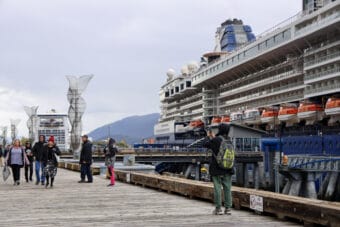
In May, Sitkans will vote on a ballot measure to limit cruise tourism in Sitka. Pictured: the Nieuw Amsterdam ties up in Sitka. (Tash Kimmell/KCAW)

Enough signatures have been gathered to put a cruise limit ballot out to Sitka voters in a special election this spring.

If approved by the voters, the ordinance would set an annual cap of 300,000 cruise passengers, a daily cap of 4,500 passengers, and limit port calls to six days a week. It would also require permits for cruise ships and require the city to administer permits and fine cruise ships for violating the new rules.

Municipal Clerk Sara Peterson said her office certified the petition on Thursday afternoon. The city’s charter says that if enough signatures are gathered, a special election must be called within 40 to 90 days.

“So the 40 to 90-day clock starts as of yesterday,” she said. “In order to have that special election according to the charter, 613 valid signatures were required, and they did get more than 613.”

The special election will be similar to a typical municipal election, with both precincts voting at Harrigan Centennial Hall and the same early and absentee voting options available.

Peterson has tentatively set the date for the election for Friday, May 30, pending Sitka Assembly approval. She said she chose that date because it works for code, and she worked with building staff to find a day when Harrigan Centennial Hall would be less busy. The building also serves as the delivery point for cruise ship passengers in the summer months.

“Both of our voting precincts are at Harrigan Centennial Hall, and in looking at all of this, I was looking at voter accessibility — where our voters are used to voting in Sitka,” she said. “Obviously, for the regular election each year, I’m reserving those rooms and everything. As soon as we’ve certified the October election, I’m already planning for the next one. So obviously, with this, we didn’t have any rooms reserved at Harrigan, and so I worked with staff there, we determined some dates that might work, and ultimately, the driving force behind choosing May 30 was to ensure that we could have the greatest voter accessibility at Harrigan Centennial Hall.”

In a press release Friday, the petition organizers said they were unclear whether the May 30 date aligned with charter requirements and said they were “looking to clarify” the city’s interpretation of code.

The initiative to limit cruise tourism was the fourth proposed by a local advocacy group, Small Town SOUL, in December. The first three failed to make it through the city’s legal review process.

Sitka has seen record numbers of cruise passengers over the last three years. With the unprecedented growth have come community frustrations over congestion, safety, and environmental impact.

The industry growth also brought an economic boom – new businesses have cropped up in response to the growth, and the city’s sales tax revenue is up. In response to the initiative, a pro-tourism group, Safeguard Sitka’s Future, formed, ran a “Decline to Sign” campaign, and hosted information sessions throughout the signature-gathering process.

Until now, those groups have been advocating without the requirement to register with the state. Now that the election is certified, any advocacy group must register with the Alaska Public Offices Commission.

The assembly will hold a special meeting on Tuesday, March 18 to consider approving the ballot ordinance, which will require two readings.

British Columbia introduces toll measure to counter tariffs; Sullivan suggests acting against BC

Marker for the U.S.-Canadian border between Skagway, Alaska, and Stikine Region, British Columbia. (Photo by Philip Yabut/Getty Images)

The government of British Columbia filed legislation Thursday that would permit the province to levy tolls on vehicles between the Lower 48 and Alaska.

The bill, known formally as the Economic Stabilization (Tariff Response) Act, had been expected since BC Premier David Eby announced his intentions last week.

Introducing the bill at the British Columbia Legislative Assembly in Victoria, Deputy Premier Niki Sharma said the bill “provides a range of authorities to enable the government to quickly respond to the recent unprecedented threats to our province from the United States.”

The bill does not automatically impose fees on vehicles traveling to and from Alaska, but it “just gives BC the tools to do so down the road if Trump continues to escalate his threats towards BC and Canada,” according to a statement from the provincial Ministry of Transportation and Transit.

“This is not something British Columbia wants to do, but we need to have this tool if the U.S. does not back away from their unjust tariffs,” the ministry said.

In addition to threatening tariffs on trade with Canada, President Donald Trump has threatened military action against the country and has said that it should be annexed to the United States in order to avoid economic consequences.

Sharma, speaking to the Legislative Assembly, said that if enacted, the bill would “allow government to impose a system of tolls, fees or other charges on vehicles using certain BC infrastructure, such as highways and coastal ferries. It will provide a broad, flexible power to government to address challenges to BC arising from the actions of a foreign jurisdiction to support inter-provincial cooperation.”

According to the text of the bill, the amount of the tolls and their application would be decided by governmental officials.

The legislation would expire May 28, 2027, Sharma said.

“We did not ask for this trade war, but we will fight for BC’s economy, we will fight for BC’s workers, and we will fight for this province with every tool that we have. We will take a ‘Team Canada’ approach in our response, and I hope that every member of this House supports this bill,” she said.

The bill is expected to advance in the legislative process no sooner than March 31, after the Legislative Assembly returns from a weeklong spring recess.

Meanwhile, in Alaska, Republican U.S. Sen. Dan Sullivan has threatened to take economic action against British Columbia.

In a talk radio interview on Tuesday, Sullivan said he would seek to waive a federal law that requires foreign-registered cruise ships to stop in Canada when sailing between Washington state and Alaska.

All but a handful of the megaships that carry tourists to Alaska in the summer are registered to foreign countries, and the United States has already waived the law once before — in 2021, amid the COVID-19 pandemic emergency.

“You know, Canada, you don’t want to mess with Alaska,” Sullivan said in the radio interview. “If you do, we’re going to work hard on having our cruise ships bypass your ports, and that’ll help our economy tremendously, it’ll help our tourism industry tremendously, and it’ll really hurt their tourism.”

The British Columbia transport ministry said the cruise ship industry “employs thousands of people and supports hundreds of BC businesses who benefit from the arrival of ships.”

“We know that people want to experience British Columbia cities as part of their cruise experience,” the ministry said.

Fired Forest Service staffers in Juneau are uncertain about their futures — and the safety of visitors at the glacier

Maria Diaz, Hillary Hunter and Mason Hearn all worked as rangers at Mendenhall Glacier Visitor Center, until they were fired in the mass Forest Service terminations earlier this month. (Photo by Clarise Larson/KTOO)

On Valentine’s Day Maria Diaz was delivering flowers — her winter job — when she got a call from the District Ranger’s office. The call was short. She was told she was “laid off” from her seasonal job with the U.S. Forest Service effective immediately. She got her termination letter later, over email. 

“And then I had to go continue delivering flowers, and it looked like I just got broken up with on Valentine’s Day,” she said. “But it was just the Forest Service breaking up with me instead.”

Diaz worked at the glacier for two seasons — one as an intern and one as a ranger. She said the job was her future, and it made Juneau her home. 

“This isn’t a summer job,” she said. “It was supposed to be a career for me. I was expecting, fully expecting, to stay in Juneau for years and continue moving my way up. And they didn’t give us a choice to do that.”

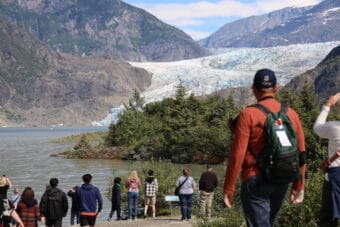
The roughly one million visitors coming to the Mendenhall Glacier Visitor Center in Juneau this summer will have less staff monitoring their experience – including their safety. That’s after the U.S. Forest Service fired nearly all the visitor center staff, mostly rangers. Instead of a dozen employees, only two public-facing staff are left ahead of this tourist season.

Officials with the Trump administration say the workers were laid off to increase government efficiency and reduce spending. But a Forest Service official confirmed that the recreation area’s revenue in visitor fees and permits exceeds its operating costs by more than a million dollars – in other words, the park earns enough to pay employees and more.  

Diaz is one of more than a dozen employees recently terminated from the visitor center, leaving only two public-facing staff and a few maintenance staff. 

She and other fired staff expect the people left behind will have to do multiple jobs to keep things running. They’re worried about what this will mean for the future of the glacier — and the people who love to go there.  

Diaz said boots-on-the-ground roles like hers are essential. Rangers enforce safety on the trails near the glacier. That’s critical at the Mendenhall Glacier where visitors from across the country may see bears for the first time. Visitors often don’t know how to react when they encounter a bear — sometimes crowding it instead of moving away.

“And there’s been plenty of times throughout the past two years that I have seen people really put themselves in dangerous situations,” she said. “And the only reason why something bad didn’t happen was because there was somebody there. There was a ranger there.”

Visitors walk back from viewing the Mendenhall Glacier on Friday, Feb. 21, 2025. (Photo by Clarise Larson/KTOO)

The visitor center recently added new positions: cultural ambassadors who are tribal citizens. The roles are part of a 2023 co-stewardship agreement between the Central Council of the Tlingit and Haida Indian Tribes of Alaska and the Forest Service. These ambassadors educate tourists on the connection between the landscape and Lingít history and culture. At this point, these jobs, which are funded by the tribe, haven’t been included in the firings. 

When asked about the firings, the tribe responded with a statement that said it remains committed to co-stewardship with the Forest Service. It said they are actively recruiting cultural ambassador positions for the summer season.

Mason Hearn worked at the glacier as a ranger, too. He was also fired. He said he thinks that even if the Forest Service can keep the visitor center open with volunteers and reallocated staff, the visitors will feel the effects of the cut jobs. 

“They’re going to have to make a sacrifice somewhere, and I think it’s going to mainly be the user experience,” he said.

Hearn said he hopes the Forest Service can continue to provide safety precautions, even if there won’t be Forest Service staff out speaking with tourists about the landscape, local flora and fauna. 

Hillary Hunter said rangers frequently use their first responder training to treat patients on the trail while they wait for an emergency medical team, which could take as long as an hour. Hunter is another Forest Service ranger at the visitor center who’s been terminated. 

“There have been heart attacks at the visitor center before, and we have people go into diabetic shock,” she said.

Like the others, Hunter’s termination letter cited poor performance as the reason for being fired. But, she said, there was no performance review to inform that.

“And the person who the email is signed from is someone in Washington who has not met us,” she said. 

Hunter grew up in Petersburg. Her dad worked on trails there, and she learned about the natural world around her and how to safely enjoy it from an early age. 

“I didn’t realize what a privilege that was as a child until I got older, and then that made it more important to me to increase access to others,” she said. 

Isabel Dziak has been working at the Mendenhall Glacier since her summer internship in 2019. She was fired, too, but she’s going to do whatever she can to get her job back. 

“I am not going anywhere,” she said. “I’m not gonna be quiet.”

Dziak plans to appeal her firing, arguing that the basis — her alleged poor performance — isn’t valid. 

She said she’s known since she started that this job isn’t about the money. 

“When I was an intern, I was talking to a wiser, older ranger, and they said, ‘If you’re in this field, you get paid in sunsets,’” Dziak said. “You’re here because you love your national forests, you love your national parks, and to serve your community and your nation.”

Forest Service officials have not released a plan to staff the visitor center. 

Ketchikan repeals sales tax exemption for cruise ships

A view of downtown Ketchikan, seen from the cruise ship Veendam. (Photo by Leila Kheiry/KRBD)

Ketchikan is joining other Southeast Alaska communities like Sitka, Juneau, and Skagway in collecting sales tax on goods and services purchased on board cruise ships while they’re docked in the First City. Ketchikan’s city and borough governments recently passed laws to repeal their preexisting exemption on sales tax for cruise ships.

At their meeting on Monday, the Ketchikan borough assembly discussed if cruise ships should pay sales tax. Up to this point, the dozens of cruise ships that dock in Ketchikan every year carrying millions of passengers are exempt from paying local sales tax in their onboard shops and restaurants and Borough Attorney Glenn Brown said it’s been a “burr under the saddle” for local businesses.

“It’s been a longstanding inequity for local brick-and-mortar businesses that sell similar items to what is sold aboard the vessel, where you have essentially one one operating tax-free and one not,” Brown said.

Brown explained that this borough ordinance would repeal that exemption, subjecting the cruisers to the same sales tax as everyone else in the Ketchikan area. Brown’s report estimated the additional sales tax revenue to the borough would be between $200,000 and $300,000.

“This is drafted so when they are in the territorial waters of the borough, its taxable sales aboard the vessel,” said Brown.

Assembly member Glen Thompson brought up the question of compliance. How do you enforce that a cruise ship is actually following the rules? Brown said, basically, you audit them.

But even then, Brown said there are other ways a cruise ship could skirt paying the tax.

“There is some anecdotal evidence from Juneau that some of the cruise lines in response to the removal of the exemption closed their stores, closed their restaurants aboard the vessel. So it’s really hard to tell what the market will do in response to the removal of this. There may be some sales that no longer occur,” he said.

Assembly member Jaimie Palmer owns a small business in town. She said that if cruisers can’t spend money at the on-board store and have to buy local, that’s even better.

“I just want to let everyone know we’ve already been called idiots online for considering this,” she said. “There was an article today I saw that said we were really dumb to do this, and it’s going to make all the ships bypass us, which clearly its not because the other communities north have been doing it for a while. And I fully support this, and think it’s about time. And if there’s other exemptions like this out there that I hope that we find them and remove them also.”

Assembly member Sharli Arntzen said that the onboard tax levels the playing field for local businesses serving tourists.

The ordinance passed the borough assembly 6-1.

The vote came just four days after the Ketchikan City Council approved their ordinance to repeal the same exemption. City Manager Delilah Walsh said in a letter that the intergovernmental initiative was borne out of council members Riley Gass and Mark Flora saying that Ketchikan needs to maximize visitor revenue to help the city’s struggling finances.

The ordinance passed through the city council with very little debate.

Site notifications
Update notification options
Subscribe to notifications