Tourism

Juneau Assembly nears decision on whether to allow another cruise ship dock downtown

Assembly member Alicia Hughes-Skandijs speaks at an Assembly Committee of the Whole meeting on Monday, Feb. 26, 2025. (Photo by Clarise Larson/KTOO)

In less than two months the Juneau Assembly is expected to vote on a proposal that would allow the construction of a fifth cruise ship dock downtown to move forward.

Huna Totem Corporation has been trying to build a fifth cruise ship dock in downtown Juneau for years. But, to accomplish a feat of that magnitude, it has needed to jump through a lot of procedural hoops.

But now, the Alaska Native village corporation is at a point where it faces what is essentially its last major hurdle: tidelands, or the submerged land in the channel where the dock will be. Huna Totem needs to lease the city-owned tidelands in order to build the dock.  

And it’s up to the Juneau Assembly to approve or deny the lease — without one, the dock project as it stands can’t happen. 

At a committee of the whole meeting Monday night, Assembly members approved the introduction of an ordinance that will ultimately decide whether or not to approve leasing the tidelands. Members are expected to vote on it on April 7. 

Cruise ship tourism and its growth are contentious for residents and business owners in town. There’s a push and pull between the economic benefits of tourism’s growth and the impacts that growth has on the well-being of people who live here.

Residents testified about the proposed tidelands lease at an Assembly Lands, Housing and Economic Development meeting earlier Monday evening. 

Chalyee Éesh Richard Peterson, the president of the Central Council of the Tlingit and Haida Indian Tribes of Alaska, asked the Assembly to approve the lease. He said the tribe would benefit from the project. 

“This is a significant investment in Juneau’s economy. It’ll create jobs during construction and operation,” he said. “It will generate revenue for local businesses, and this project represents a major step towards greater economic self-sufficiency for Juneau.”

He said the dock would help disperse visitors downtown. He also applauded the corporation’s plan to highlight Alaska Native culture with the project. 

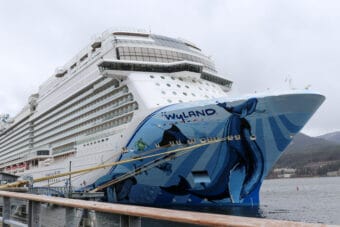
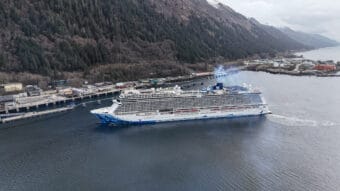
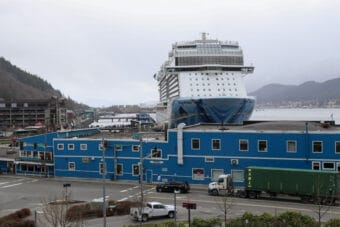
The dock’s proposed location is along Egan Drive near Juneau’s U.S. Coast Guard station and across the street from KTOO’s building. It would be accompanied by a waterfront development called Áak’w Landing, which would include things like underground parking, retail space and a culture and science center. 

Another advocate for the project was Craig Dahl, the interim executive director for the Juneau Chamber of Commerce. He sees a lot of benefits.

“The reduction of bus traffic downtown, the expansion of the seawalk, the additional parking that’s going to be available to Juneau residents, more job opportunities throughout the season, and certainly the future connectivity to shore power to further reduce emissions — these are all significant attributes of this project,” he said.

Some testifiers didn’t feel the same way. Kathy Coghill, a North Douglas resident, said she’s concerned about the environmental effect of the project among other issues. 

“There are some really exciting opportunities for this piece of land that I believe the lease right now is premature,” she said. “I’m most excited about the cultural center, but I feel that local people’s concerns are not being weighed adequately in comparison to the commercial.”

Karla Hart, a longtime activist against the growth of tourism, also shared her opposition to the project. In 2023 she filed an appeal of the planning commission’s approval of a conditional use permit for the dock, citing health and safety issues among other concerns. 

“The health harms, the pollution from the cruise ships is phenomenal, and the city has never directly taken that on to protect the community or even to educate the community on the harms,” she said on Monday. 

Last month, the city held two public meetings to allow residents to ask questions and offer comments on the plan. There will still be another chance for people to give testimony on the topic at the April meeting before the Assembly votes.

Assembly members already shared some concerns, like whether the dock will get in the way of plans for a Coast Guard icebreaker set to be homeported in Juneau. These topics and more will likely be discussed at the Assembly’s next committee of the whole meeting next month. 

Juneau’s tourism sector unsure what will happen at Mendenhall Glacier as summer season approaches

Visitors view Mendenhall Glacier on Friday, Feb. 21, 2025. (Photo by Clarise Larson/KTOO)

Most of the staff at the Mendenhall Glacier Visitor Center were fired earlier this month, leaving city tourism leaders worried that one of Juneau’s most popular visitor destinations may reduce services, or even close for the cruise season.

Listen:

Last week, Juneau’s Visitor Industry Director Alix Pierce said she’s been fielding calls from tour operators who want to know what the lack of staff at the glacier means for their businesses. 

“Everybody has a lot of questions about what the next steps are,” she said. “I think the Forest Service staff that remain from what I understand are kind of in triage mode trying to figure out how to best allocate resources.”

The visitor center at the glacier sees about a million visitors per year. It’s run by the U.S. Forest Service, which saw about 2,000 job cuts nationwide in the last two weeks under a Trump administration plan to reduce the federal workforce.

The Tongass National Forest’s spokesperson is directing media requests to the U.S. Department of Agriculture, which says it doesn’t have location-specific information about staffing. 

As it stands now, Pierce said the city isn’t getting information about how the glacier recreation area will operate. The dramatic staff reductions come after the city and the visitor center have spent a decade planning improvements to the visitor center. Pierce says there isn’t information about that either.

“We have no idea,” she said. “We have no idea whether those types of improvements will be funded. We have no idea about anything.”

Travel Juneau is the city’s destination marketing organization. Liz Perry is the director, and she said these firings come at an especially bad time as visitors are finalizing their plans for the summer. City leaders expect more than 1.6 million people will come to Juneau on cruise ships this summer. 

“Knowing whether or not the Mendenhall Glacier Visitor Center is going to be able to operate, or how it’s going to operate, is going to be a key piece to a lot of those plans,” Perry said. “Because it’s one of the number one things for people to do when they get in town.”

Perry works with 260 businesses, many of which are permitted by the Forest Service to run tours at the glacier. She’s heard from tourism operators who say they’re worried about their business investments if the glacier is off-limits for the season. 

Snow surrounds the Mendenhall Glacier Visitor Center on Friday, Feb. 21, 2025. (Photo by Clarise Larson/KTOO)

Other small business owners are worried as well. Shawn Eisele is the executive director of Discovery Southeast, a nonprofit that offers natural education programs for kids in Juneau and operates the bookstore in the visitor center. It stocks items from local artists and authors, and funds half of Discovery Southeast’s budget. 

“It is, in my mind, one of the best success stories of local tourism in Southeast and in Juneau,” he said.

Eisele said the partnership between his organization and the Forest Service allows for locals to have a hand in educating tourists, and benefit from the high numbers of visitors who come to see the glacier. 

Now, he’s not sure what the firings mean for the bookstore this summer and he’s worried about the broader implications too. 

“It’s a scary and dire situation,” Eisele said. “That’s true for the individuals who are fired. It’s true for the individuals who remain. It’s true for Discovery Southeast, and I think it’s probably true for our community too.”

But some businesses aren’t as worried. Juneau Tours buses run to Mendenhall Glacier five to 10 times each day during cruise season. Serene Hutchinson said her company has the second largest tourism operations permit for the glacier.  

“It is a foundation of our business, to bring people to the Mendenhall Glacier,” she said. 

But Hutchinson has seen government shutdowns and other obstacles to the visitor center’s operations before, and she’s optimistic the Forest Service will have a plan for the season.

“This is not completely unfamiliar territory for us as an operator, and every other time it’s been figured out,” she said. 

If the visitor center shuts down, she at least wants her customers to see the glacier from viewpoints near the parking lot. 

“Obviously, we want full service, but if they have to, I hope that at the very least we can keep the views open,” she said. “And the bathrooms, because they’re just as important as the views.”

Juneau’s first cruise ship of the season is scheduled to arrive April 14. 

More cruise traffic in Alaska is followed by more wastewater violations, officials say

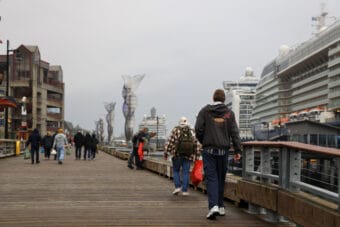
Tourists walk along Juneau’s harbor on April 26, 2024, next to the docked Carnival Spirit, a ship operated by Carnival Cruise Line. Cruise ship visitation to Alaska has increased in recent years, and so have measured violations of wastewater standards. (Photo by Yereth Rosen/Alaska Beacon)

As cruise ship visitation has increased, so have water-quality violations, state officials told lawmakers last week.

Alaska Department of Environmental Conservation representatives presented a summary of this data on Thursday to the environmental subcommittee of the House Finance Committee. In addition to tracking the raw numbers, it shows a contrast in the number of violations — also known as “exceedances” — between the time when onboard observers called “ocean rangers” monitored wastewater discharges and the period after that program was abolished in 2019.

“We are seeing an increase in exceedances, but we’re also seeing an increase in compliance response, post-ocean ranger,” Gene McCabe, director of the Division of Water, told the subcommittee.

Compliance actions, which range from letters of warning to enforcement steps, more closely tracked the number of wastewater violations after the ocean ranger program ended, McCabe said. That is because the ocean rangers did not have enforcement powers and could merely forward information to enforcement agencies, he said.

For cruise ships, pollution limits are set for what is known as graywater, which is runoff from sinks, kitchens and showers, and for blackwater, which is generally treated sewage. Monitoring is done through water samples, which typically number between about 1,400 and 1,800 each year, according to the DEC presentation. Large ships, with space for 250 or more passengers, are regulated differently than smaller ships, but wastewater from both categories is tracked, according to the presentation.

From 2015 to 2018, while the ocean ranger program was in place, there were generally about 20 to 25 exceedances a year found in samples from both large and small ships, and generally about 10 compliance actions a year, according to the DEC information. But in the past few years, total detected exceedances ranged from about 60 to about 75 a year, according to the DEC information.

Cruise traffic has increased dramatically over the past decade.

There were a little under 1 million cruise passengers who visited Alaska in 2015. That number grew to about 1.1 million in 2018, according to the DEC presentation.

After cruise traffic to Alaska ground to a halt in the COVID-19 pandemic year of 2020, numbers started to climb again. In 2023, a record 1.65 million cruise passengers visited Southeast Alaska, the state’s main cruise destination. Numbers last year were similar, and bookings this year indicate another record, with about 1.9 million cruise passengers expected, according to the DEC presentation.

The Cruise Lines International Association “does propose that Alaska is North America’s No. 1 destination, and the numbers are proving that out,” McCabe told the committee.

The ocean ranger program was created as part of a 2006 ballot initiative imposing a per-passenger fee and a set of environmental regulations on the cruise industry. Money to employ the ocean rangers came from that fee.

The program was abolished after Gov. Mike Dunleavy in 2019 vetoed its funding.

Mendenhall Glacier Visitor Center left with minimal staff amid federal layoffs

The Mendenhall Glacier Visitor Center dusted with snow on Saturday, Oct. 19, 2024. (Clarise Larson/KTOO)

Roughly three-quarters of the staff at the Mendenhall Glacier Visitor Center have been laid off, according to former employees with knowledge of the situation. 

Most people who lost their jobs were U.S. Forest Service rangers. Their role is to interface with visitors, respond to medical events and maintain trail and wildlife safety. 

About 700,000 tourists per year visit the Mendenhall Glacier Visitor Center in the Tongass National Forest. 

A spokesperson for the Tongass National Forest, which oversees visitor center operations, referred questions to the U.S. Forest Service’s national media office.

A spokesperson from the U.S. Department of Agriculture, which oversees the Forest Service, could not give location-specific numbers for how many people have been laid off. Instead they sent a statement of support of the Trump administration’s decision to cut 2,000 Forest Service jobs nationwide.

This is a developing story. Check back for continued coverage.

Are you a federal worker in Juneau? Share your perspective with KTOO. 

Positive perception of tourism benefits in Juneau is waning, local survey shows

Cruise ship visitors exit a ship in downtown Juneau on Monday, June 10, 2024. (Photo by Clarise Larson/KTOO)

Cruise ship tourism in Juneau made international headlines last fall after voters were asked whether the city should ban all large cruise ships on Saturdays. Voters said no, but the conversation about the future of tourism’s growth is far from over.

On Tuesday, Juneau’s Visitor Industry Director Alix Pierce shared data from an annual tourism survey during a panel at the Southeast Alaska Conference’s Mid-Session Summit. 

According to the survey of people who lived in Juneau during the 2024 summer season, nearly 30% said they think the positive impacts of tourism outweigh the negatives, compared to 13% who said the opposite. More than 40% said tourism has both positive and negative impacts, and 15% said they felt no impacts at all.

Pierce said the positive perception of tourism is waning. 

“Support is eroding over time, and impacts are increasing,” Pierce said. “With the amount of growth that we’ve seen from 2018 frankly, I’m surprised that that slope isn’t steeper.”

The city-commissioned survey of 500 random residents took place in December. It asked them various questions about the recent tourism season and the industry as a whole.

Last summer, about 1.7 million cruise ship passengers visited Juneau. That’s a slight increase compared to the year before. In the last 30 years, the number of cruise ship visitors coming to Juneau each year has more than tripled.

Respondents reported that tourism affects them the most in downtown vehicle congestion, crowding on sidewalks and at the Mendenhall Glacier. More than half of them said they think the city is not doing enough to manage tourism’s impacts on residents. 

Pierce said the input from the survey will help guide the city’s response to those issues. She said the city needs to do a better job communicating what it’s already doing to mitigate tourism impacts – and correcting any misinformation. 

“It’s difficult to see a letter come through my email for the Assembly that’s in support or opposition of anything for reasons that are blatantly untrue — whether I agree with the sentiment of the letter or not,” she said. 

The survey also touched on what residents think of two active proposals to build new cruise ship docks in Juneau — one that has been in the works for a few years and one that was announced just last fall. 

Huna Totem Corporation is proposing to build a fifth cruise ship dock along with a waterfront development downtown. Goldbelt Incorporated is proposing to build a cruise ship port on the backside of Douglas Island. Both are Alaska Native corporations that have ties to other tourism ventures in Southeast Alaska. Neither dock project has full approval yet.

According to the data, more people were supportive or very supportive of both proposed docks than those who were opposed or very opposed. Roughly a third of those asked said they needed more information on the projects.

Huna Totem’s cruise ship dock proposal heads to Juneau Assembly, with public comments in tow

Juneau residents write comments about the plan for Áak’w Landing, Huna Totem Corporation’s proposed cruise ship dock in Juneau at a public meeting on Jan. 22, 2025. (Photo by Yvonne Krumrey/KTOO)

Juneau residents had a chance to ask questions and offer comments on a proposed fifth cruise ship dock at two public meetings this week. The city will soon decide whether or not to approve a tidelands lease to Huna Totem Corporation for the project.

Juneau Tourism Manager Alix Pierce said these meetings give the city a sense of what the community wants and doesn’t want to see in a fifth cruise dock. 

“The lease is the Assembly’s ultimate opportunity to approve or deny the project,” she said. “And right now, our job and goal as staff is to bring something to the Assembly for final consideration that provides our best attempt at something that’s going to be good for the community.”

Huna Totem Corporation is an Alaska Native village corporation. The project is called Áak’w Landing, named after the original inhabitants of the Juneau area, the Áak’w Ḵwáan. 

On Wednesday at City Hall, the plan for the project was laid out with renderings of the proposed building, graphs of marine traffic in the area and a timeline of the project so far, including next steps. The dock would be built on the edge of the downtown area at the corner of Egan Drive and Whittier Street.

The proposal includes spaces for retail and a 40,000-foot Indigenous knowledge, science and cultural center. 

This rendering depicts Huna Totem Corp.’s proposed new downtown development project. (City and Borough of Juneau)

Attendees were given sheets with prompts like “how could the project support and create a more vibrant waterfront for Juneau?”

Concerns ranged from blocked views of the channel to the proposed dock’s distance from downtown businesses.

Attendee Kathy Coghill said it’s important that those leading this decision consider how the project affects the lives of Juneau residents.

“But I think there’s a lot of fear that we can’t ask for a fair shake, because we’re going to scare away the tourists,” she said. “We are not going to scare them away.”

Huna Totem’s Susan Bell said the meetings offered a chance for residents to get reacquainted with the proposal, after an appeal filed in the summer of 2023 stalled it for months. That appeal argued that the proposal didn’t do enough public outreach on the project, among other concerns — especially the availability of shore power.

In 2023, the planning commission approved permits for the dock and the waterfront development. 

“The pace of the project will be at the discretion of the city,” Bell said. “So I think having good turnout and good feedback, they’ll feel like they’re doing their job and making sure that the people have a chance to be informed and engaged.”

Next, the Assembly will review the proposed lease at a future Committee of the Whole meeting, using feedback given this week. There will be further opportunities to give public testimony at that meeting. Comments can also be emailed to assembly@juneau.gov.

Clarification: This story was updated to better reflect the scope of the 2023 appeal and the next steps in the process. 

Site notifications
Update notification options
Subscribe to notifications