Education

Former NFL player kicks off Pillars series by talking about the right choices

Shawn Harper
Motivational Speaker and former NFL offensive lineman Shawn Harper with Floyd Dryden Middle School Student Cody Weldon on his back. Harper was the first speaker in this year’s annual Pillars of America speakers series, sponsored by the Glacier Valley Rotary Club. Photo by Casey Kelly/KTOO.
We’re not born winners and losers. We’re born choosers.

That was the message former NFL offensive lineman turned motivational speaker Shawn Harper had for an audience of young people Wednesday at the Glacier Valley Rotary Club’s annual Pillars of America speakers series.

Harper told his personal story of growing up poor with a single mom in Columbus, Ohio, where he overcame abuse, learning disabilities, and other people’s doubts about whether he could go to college and play professional football.

“So, I could never become wealthy, because in my mind I’m seeing poverty. I could never have success, because all I’m seeing is myself failing from the first grade,” Harper said. “My identity was imprinted with destruction.”

Harper rolls up a frying pan to kick off his talk. (Photo by Heather Bryant/KTOO)

Instead of accepting that, Harper says he developed some keys to achieving success. They include having a dream and chasing it; having the vision to spot obstacles; and making the right choices.

He says the right choices led him to playing football at junior college and Indiana University, which he graduated from in 1992. His professional career ultimately included stops in the NFL and NFL Europe.

He says one of the most important choices a young person can make is the choice to not do drugs.

“My best friend right now is doing 25 years flat time. Another one is dead,” he said. “Because of drugs, because of choices. You’re not born winners and losers, you’re born choosers.”

The 6 foot 4 inch, 320 pound former lineman invited 14-year-old Cody Weldon onto the stage to demonstrate how drugs can weigh a person down. Harper lifted Weldon onto his shoulders, and held him there while he talked, until he grew tired.

Weldon – a student at Floyd Dryden Middle School – says he met Harper at a pre-talk reception, where the speaker asked him to be part of the speech. He says he was a little nervous at first, but quickly got over it.

“I’m a little bit shy,” Weldon admits. “But I went up I guess, and it wasn’t that bad. It was pretty fun.”

Weldon says he liked Harper’s message and thinks it will change how he makes choices in the future.

“Probably going to try a little bit harder at some of the things I do,” he said. “Probably will get on top of some things that I’ve procrastinated over. Overall, just probably going to make my life a little bit better.”

Hundreds of Juneau middle and high school students attend the Pillars of America series every year. Students from the Hoonah School District are scheduled to attend this year thanks to a grant from the Rotary club and Sealaska Corporation. However, the Hoonah students missed Harper’s talk after getting weathered out of Capital City Wednesday morning.
District plans use of one-time state education funds

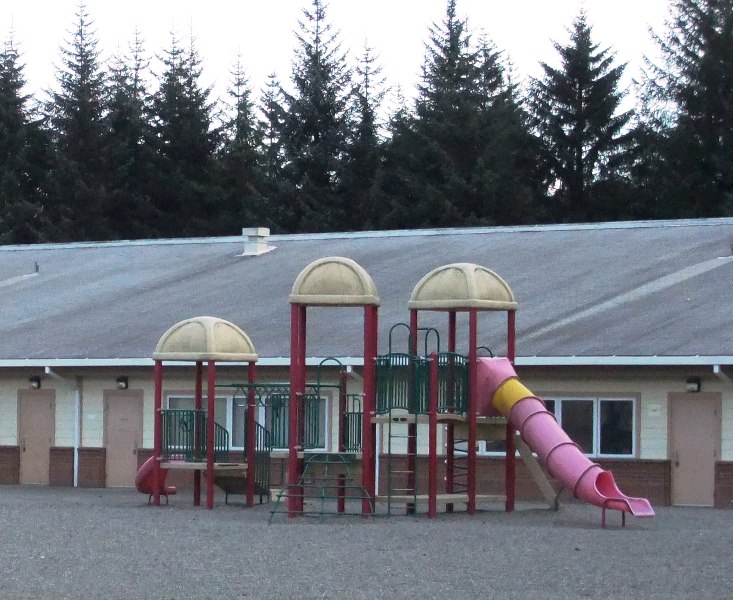
The state capital budget includes funds for additional playground equipment for pre-school aged children at Riverbend Elementary School.

With no additional school operating funds on the horizon, Juneau school district budget meetings scheduled for  Monday and Tuesday have been canceled.

Instead, school officials are looking at how to spend some one-time money appropriated by the state legislature for energy, pupil transportation, security, technology and curriculum materials.

Juneau will realize about $900,000 from the energy grant, which is already in next year’s budget.

For the next three years, school districts also will get increased transportation funds, tied to the Anchorage Consumer Price Index.  District Administrative Services Director David Means estimates Juneau schools could get up to $20,000 more a year toward transportation, depending on the CPI, which rose about 2 percent in 2012.

Means says school security dollars embedded in the capital budget will give Juneau $762,000 for the next year to be used only to enhance school security.

“This is capital money and can be used to improve infrastructure and to strengthen and invest in our safety and security procedures here,” Means explained. “This is a multiple year grant; it will not be just one year money, so we will be able to spend this as we need to improve our safety and security measures here in the Juneau School District.”

Lawmakers did not increase the Base Student Allocation, the amount of money districts get to educate each student enrolled.  That means the operating budget  adopted last month for Juneau schools will be implemented with no changes, and about $1.7 million  in reductions. Most of those are in staff support, outside the classroom.  Means doesn’t anticipate any teacher layoffs and says some jobs simply will not be filled when the person in them retires.

School board president Sally Saddler says the cuts taken over the past three years have been exhausting.

It’s been about 10 percent of our budget and unfortunately we’ve had to cut some very valuable programs that have a lot of constituency support in this community and that really do positively impact kids’ lives,” she says. “It’s agonizing to have to let go of these.”

But Saddler says the district is grateful for funds earmarked for technology and curriculum materials because few funds have been available to  invest in those areas in recent years.

“Part of what we intend to do is with those curriculum dollars in invest some math curriculum and to make sure our faculty have the tools they need to be offering our students classes to meet the graduation requirements that we upped a couple years, and the governor’s performance scholarship requirements,” she says.

Saddler says the district also plans to purchase more high school English materials with the curriculum funds.

Juneau’s portion of statewide technology dollars is about $30,000.  The district had requested more than $400,000.   The capital budget also includes funds for playground equipment for pre-school students at Riverbend Elementary School.

Of course the projects are not guaranteed; Gov. Sean Parnell must still review the budget and can veto the funds.


Measure Changing School District Health Plans Speeding Through Legislature

Carl Rose, Executive Director of the Alaska Association of School Boards, testified in favor of the bill
Carl Rose, Executive Director of the Alaska Association of School Boards, testified in favor of the bill. (Image courtesy of Gavel Alaska)

A measure that would put the state in charge of school districts’ health plans is speeding through the legislature.

Right now, school districts negotiate their own health insurance plans. This bill would change that by allowing a state commissioner to select a plan for all districts, essentially putting all educators into one big insurance pool. The idea is that the larger the pool, the lower the rates.

A number of school districts have offered their initial support for the bill. On Thursday, the Mat-Su School District testified that such a change could save them over $5 million. Bruce Johnson, director of the Alaska Council of School Administrators, also called in to say he likes the proposal.

“If there’s a means to create efficiencies, we stand behind the effort. SB90 provides a vehicle creating a large pool of employees from all school districts, with the state administering the program on behalf of school districts.”

But opinion on the bill isn’t universally positive. The Unalaska City School District is opposed to the idea of a mandate, and a group representing 350 employees from the Anchorage School District have said that the change could actually raise rates for those people.

There are also concerns that the bill has been moving too quickly, and that the legislature has not studied the full costs to school districts or the state. Companion bills were introduced in the House and Senate two weeks ago. While they had been assigned to the education committees in both chambers for review, those referrals were removed.

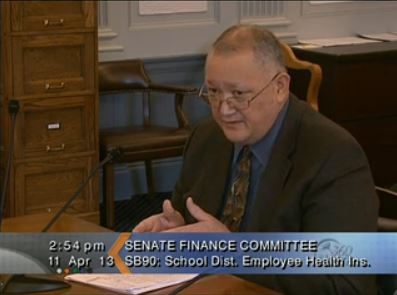
The pacing of the bill came up during a finance committee meeting when Sen. Mike Dunleavy, a Wasilla Republican who sponsored the bill, asked National Education Association representative Rhonda Kitter for her group’s take on the bill.

DUNLEAVY: Is your group against the bill? Is your group against what you perceive the speed at which the bill is progressing? Could you clarify that for me?

KITTER: Our group is against the bill because of the speed at which it is progressing. We do not feel there has been sufficient notification to the employees or sufficient research into the impact.

The legislation is now in its final committee of review in both chambers. With the legislature scheduled to gavel out on Sunday, the bill could be held over until next year’s session.

Tenure bill passes the Alaska House

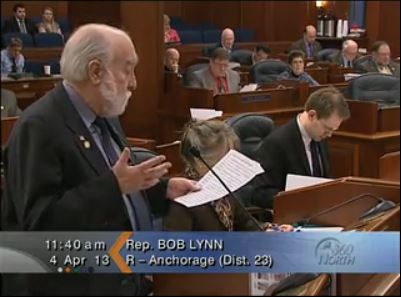
Representative Bob Lynn speaks during the House Floor session
Representative Bob Lynn says that Alaska needs more teachers, not less. (Image courtesy of Gavel Alaska)

The Alaska House passed legislation that would change the tenure system for urban teachers, extending their probationary period from three years to five.

During the probationary period, teachers can be let go without cause. But if they stay in a district long enough, they’re automatically granted the right to be put on an improvement plan before they can be dismissed.

For many in the legislature, the issue of tenure is a personal. A number have been employed as teachers or have family members who work in the education system. Rep. Bob Lynn, an Anchorage Republican, falls into both of those categories. He voted against the bill and he sponsored an amendment striking language that would have allowed schools to revisit a teacher’s tenure periodically.

“We need more teachers in Alaska, not less,” said Lynn. “Why would any teacher who is smart enough to teach want to apply for a job teaching in Alaska when the only thing we can hope for is a phony-baloney tenure on top of a less than good state retirements system?”

While teachers unions have come out against it, supporters of the bill believe that changes to the tenure system are needed to give school districts more flexibility in hiring and firing.

“I taught in a private and public institution, and I wasn’t cut out for it. So I do have a deep admiration [for them],” said Rep. Shelley Hughes, a Palmer Republican. “This is definitely not an attack on teachers, Mr. Speaker. It’s about our children.”

Because of the difficulty of attracting teachers to rural schools, the bill was amended to make an exception for districts with fewer than 5,500 residents. Bush teachers there would only need to work three years in their districts before earning tenure. That amendment was introduced by Rep. Bob Herron of Bethel, and it was supported by a bipartisan mix legislators, both rural and urban.

Rep. Les Gara, an Anchorage Democrat, also tried to attach an amendment to the bill that would have increased the base student allocation by 2 percent. That would have forced a floor debate on the issue of education funding, but the majority voted to table that amendment from consideration.

The bill ultimately passed 28 to 10, with three Republicans joining the minority Democrats in opposition. Rep. Jonathan Kreiss-Tomkins of Sitka was the lone minority member to vote for the measure. It will now go to the Senate.


See Original Post

Tenure bill passes the Alaska House

Former legislators Davis, Croft handily win Anchorage School Board seats

There were two Anchorage School Board seats on Tuesday’s municipal election ballot, and former state lawmakers Bettye Davis and Eric Croft won both of them.

Davis beat out incumbent Don Smith for seat A on the School Board. Davis said the Board needs to put children first.

“They’re our greatest resources,” Davis said. “If we educate them early, we keep them from getting in trouble later — that’s why we have high dropouts. So those are the areas that I’m going to be working on.”

“I don’t have a concern about looking for efficiencies in the school district that they might be able to save money,” Davis said. “But I’ll do what I can to make sure we get what we can for our children.”

Davis says she believes her experience in the legislature will assist the board in securing funding for the district. Smith had held seat A since 2010.

Attorney and former legislator Eric Croft beat out two other candidates for Seat B. He says his first priority will be rearranging the school board chambers.

“It sounds funny but, the administration’s back is to the public in the actual meeting room,” Croft said. “And, while it’s a small point, I want to change that. I want to have it so they’re looking at us. I think listening to people is a big message of this night on the assembly races and on this. And then really diving into the budget numbers and figuring out how we focus all that energy on the classroom.”

Davis beat Smith by more than 3,000 votes. She served on the School board during the 80′s and 90′s.

Croft garnered nearly 60 percent of votes in his race.

Another new board member joined the school board this week to replace Gretchen Guess. Kameron Perez-Verdia, who heads an education non-profit was appointed and sworn in Monday.

Board members represent the entire city.

Presentation about Romeo tonight at Egan Library

Photo of Romeo from the flyer

A decade ago, during the winter of 2003, a lone black wolf appeared near Juneau’s Mendenhall Glacier. He soon captured the hearts of many in the community.

He was seen more and more, and began to seek the companionship of humans and domestic dogs. Someone gave him the name Romeo and for several winters he was regularly seen around the glacier to the delight of many Juneau residents and visitors.

But in the fall of 2009, Romeo was killed. It was believed two trophy hunters shot the beloved wolf.

Park Myers III of Juneau was sentenced in 2010 to two years’ probation and a fine for unlawfully taking big game and bear baiting. His hunting partner, Jeffery Peacock, of Lebanon, Pennsylvania, was later sentenced to three years’ probation and a fine for his role in the illegal hunting activities. Prison time for both was suspended.

Many in the capital city reacted with outrage over the death of the wolf. But that was not the reason former University of Alaska Southeast Professor Alex Simon decided to analyze the case.

“As a sociologist what I think is important to do is step away from individual personality traits and to look at the larger social context,” he says.

Simon has done that, in the February journal Capitalism Nature Socialism. His article looks at the reasons why many trophy hunters are hostile toward wolves and people who advocate for wolves.

Simon is a hunter, but not for trophies. He admits he was personally outraged by Romeo’s death and the way the case was handled in the courts. But for him it’s a chance to identify the social factors that may help explain Myers, Peacock and others’ animosity toward the wolf.

“Over the last couple of decades the public’s perception of wolves has become increasing positive and the perception of hunters, particularly trophy hunters, has become particularly negative,” Simon says. “So even in a hunting state like Alaska, the majority of the public actually has a negative view of trophy hunters.”

Simon says it is common for some groups to feel threatened by those who regard wolves and other wildlife. His research indicates that certain segments of the hunting population suffer from what he calls out-group anxiety.

“The groups that are suffering from this out-group anxiety, a lot of times what they want to do is step in and punish the groups that they feel have had rewards unjustly conferred upon them,” he says.

Hence, shooting the beloved wolf.

“You know in the past it might be in the U.S. maybe burning down an African-American store because they’re seen as too prosperous, so to restore the morale order of white superiority,” he says.

In this case, stories, books and pictures were sold about Romeo; the wolf became a symbol of living with wildlife in Alaska. After his death, a community tribute was held on the shore of Mendenhall Lake.

“With some people in this community they really see that as an inversion of the moral order. There was certainly a lot of outrage about the crime, but there also were certainly a lot of people who really approved of those actions,” he says.

Simon taught sociology at UAS for five years when the black wolf was getting a lot of attention. Simon is now teaching at Utah Valley University in Orem, but is back in Juneau to present his paper.

He is speaking at 7 p.m. Friday at UAS Egan Library.

He’s already presented his thesis at the University of Alaska Fairbanks and Anchorage. He says he hopes the Juneau talk will attract some critics:

“There’s a lot of self-selection of people who up to these things. And in both Fairbanks and Anchorage I was essentially preaching to the choir. I suspect this will attract a wider audience hopefully it will attract some people who are critical of my position.”

He says he’s looking forward to a lively discussion.

Click to Read the article
Site notifications
Update notification options
Subscribe to notifications