Education

Native health group testing online sex-ed course for students

Screenshot of the new website.

The nation’s first online sexual health curriculum aimed at American Indians and Alaska Natives is in the final stages of development in Anchorage.

Sex education begins when parents provide age-appropriate information to their children about their bodies but ages 11 to 14 is a good time to talk with kids about dealing with peer pressure about sex, drugs, and alcohol. That’s according to an HIV/Sexually transmitted disease, or STD program manager, Connie Jessen.

Jessen, with the Alaska Native Tribal Health Consortium, is testing “Natives: It’s Your Game,” the nation’s first computer-based sexual health curriculum targeting Alaska Native and American Indian middle school students:

“In middle school is when there’s quite a few students that are already become sexually active and sometimes when you look at high school students, they’re so much older and already had a lot of these experiences that puts them at risk for these various health outcomes, that it’s important to do it earlier so they have the skills before they actually need them.”

Jessen says the Consortium is in the third year of a 3-year project with the Northwest Portland Area Indian Health Board, Indian Health Council of Arizona, and the University of Texas to develop the program. She says “Natives: It’s Your Game” uses games and music, and encourages creativity, while teaching students about abstinence, sexual health, and good decision-making.

“It also addresses healthy relationships, healthy friendships, sexual behaviors, HIV-STD prevention, alcohol and drug abuse, Internet safety, and a whole host of different topics.”

The Consortium is putting together groups of middle-school students to see how well the program works. Some will go through a science-based course on sexual and behavioral health. The other group will take part in the “It’s Your Game” curriculum. Both will be tested to find out how much they learned. For more information online, go to www.iknowmine.org/iyg


2013 Southeast Alaska Music Fest

Schools from around Southeast Alaska brought their music to the capital city earlier this month at the annual Southeast Music Festival. The three day event featured concert bands, jazz bands, choral music, and instrumental and vocal solos. Each performance was judged and received either written comments or a “superior” rating. Check out this audio postcard from Music Fest.

We heard “Old Churches,” performed by the Craig Concert Band; “Festivo,” from the Juneau Douglas High School Symphonic Band; “Three Ayres From Gloucester,” played by the Petersburg Concert Band; “Vesuvius,” performed by  Sitka Symphonic Band; “Inchon,” Thunder Mountain High School Symphonic Band; and “Celebration for Wind and Percussion,” played by the Wrangell High School Band.

We interviewed Kelsey Trojan, a junior percussionist at Craig High School; Mizani Rawhani, a senior bassist and tenor from Petersburg High School; Slush not Snow, a rock band in Juneau; Matt Lenhard, music instructor at Petersburg High School; John Depalatis, music instructor at Sitka High School; Tyree Pini, music instructor at Thunder Mountain High School; and Tasha Morse, music instructor at Wrangell High School.

Our thanks to the JDHS Video crew for helping with this story.

UPDATE: JSD, JEA reach another impasse, JDHS principal candidates announced

Juneau Douglas High School sign
Juneau Douglas High School. File photo.

The Juneau School District and Juneau Education Association teachers union have reached another impasse in negotiations for a long term contract.

Teachers are currently working on a one-year deal negotiated through a mediator after contract talks broke down last year.

The two sides have apparently agreed to another round of mediated negotiations in hopes of reaching the teachers’ first three-year contract since 2009.

In a release from the school district late Friday afternoon, Superintendent Glen Gelbrich said he remains optimistic about the process.

District Spokeswoman Kristin Bartlett says both sides hope to begin the mediation process before the end of the school year.

Officials from JEA could not be reached for immediate comment.

JDHS Principal Candidates Announced

In other school news, the district announced three finalists for the Juneau Douglas High School principal job late Friday.

They are Paula Casperson from Juneau, Kari Dendurent from Big Lake, Alaska*, and Larry Walsh from North Haverhill, New Hampshire.

All three will be interviewed next week. An open house for the community to meet the candidates will be held Thursday May 2nd from 5:15 to 6:45 at the JDHS Library. Public interviews will be held the following day at 1:30 p.m. in room 206 at JDHS. The interview panel includes school staff members, district administrators, and members of the JDHS Site Council. The public can fill out comment cars, which the interview panel will consider in its deliberations.

Resumes for the candidates are available online at juneauschools.org.

Current JDHS Principal Ryan Alsup announced recently that he would resign at the end of this school year, citing “personal reasons.”

*UPDATE: According to Bartlett, Dendurent has withdrawn from consideration after accepting another principal job.

UAS expects large graduating class

UAS is expecting a large graduating class in May.  (Photo by Heather Bryant/KTOO)

The University of Alaska Southeast campus in Juneau is planning to award 349 degrees, certificates and occupational endorsements in May. That’s 60 more than the previous year. The graduation ceremonies will recognize students who finished their programs during the Summer and Fall of 2012 and in the Spring of 2013.

The Ketchikan and Sitka campuses will each be awarding 18 and 25 respectively.

UAS’s graduation weekend starts Friday, May 3 in Sitka and moves to Ketchikan on Saturday, May 4. Juneau’s ceremony will be held the next day on Sunday, May 5.

The University of Alaska system plans to hand out about 4,400 total degrees, certificates and endorsements this spring.

UA, in a news release, says it’s seen a steady increase in numbers over the past five years.

UA says there’s growing demand from parents and students to know how much earning a degree will cost. UA has a program aimed at educating students on the benefit of graduating in fewer years for less money, but says that requires students pick programs or majors early and stick with them.

UA also says it’s working with Alaska high schools and helping develop a database to track students so that any concerns can be addressed before they graduate.

Kenny Petrini representing Alaska in National Geographic Bee finals

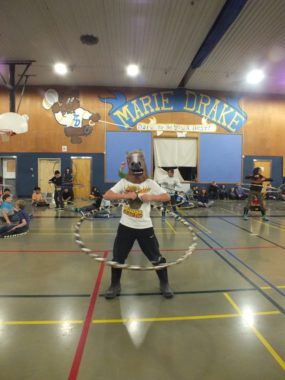
News anchors Kate and Kenny rehearsing for morning announcements while Hunter sets up technical equipment. Photo by Alexander Duerre.

On May 20-22, 54 students across the US will assemble and compete in the 25th Annual National Geographic Bee in Washington D.C. Each year thousands students across the nation compete to win an opportunity to represent their state in the national championship.

Alaska hosted the 25th National Geographic Bee State Finals on April 5th. One hundred students in 3rd through 8th grade from across the state assembled at the Egan Center in downtown Anchorage to compete. Five groups of twenty students competed during the preliminary round to move forward to the State finals. A Central Middle School 8th grader won this year’s contest.

“My name is Kenny Petrini. You know I grew up here for a while; but I am originally from Thailand. So, I consider myself an Anchorage person,” he said.

Kenny has competed in the State Geography Bee for several years and described his studying strategy for each competition.

“I study probably at least…at least an hour a night. I do online quizzes and I look at atlases. I work with my dad…he…he asks me questions…he gets me materials to study with and my mom does too,” Kenny said.

When studying geography, Kenny enjoys learning about Alaska. And he believes geography is an important subject for all students to learn.

“Cause in today’s world everything is changing a lot…you know new countries um…revolutions you know like Africa North Africa that stuff. So, geography is pretty important,” he said.

Besides geography, Kenny plays the trombone, runs for the school’s track and field team and is a news anchor for Central’s News Broadcasting Channel.

As the State winner, Kenny received: $100. He’ll represent Alaska in the National Championship in Washington, D.C. on May 20-22.

Middle East exchange students reflect on their time in Juneau

Ayah Tafesh is from Gaza City. Hadi Kamj is from Lebanon. Mohammed Qabani is from Israel.

Three exchange students from the Middle East are wrapping up their time in Juneau. They came here as part of the Kennedy-Lugar Youth Exchange and Study program under the wing of Juneau People for Peace and Justice. JPPJ leadership knew the three students would twice become young ambassadors – first in their new communities, and again when they return home.

Ayah Tafesh of Gaza City says it was a miracle she made it to Juneau at all. Her homeland borders Israel and Egypt, and travel from the region is difficult.

Tafesh’s uncle works for the government. He helped her secure a route from Gaza Strip through Egypt to Juneau because it would have been too tough to travel across the Israeli border.

She got up early on a hot summer day in August, ate a light breakfast and left home on a bus to head to the Hamas checkpoint.

 “The police officer working with Hamas asked me where I was going, I told him America,” Tafesh says. “Somehow he heard Egypt and he asked me ‘What are you going to do in Egypt?’ so I told him just, ‘study.’ So they let me in. If they saw my visa to America they wouldn’t have let me in.”

Tafesh says the Palestinian government doesn’t approve of exchange programs that send children to America.

“The Palestinian side called the Egyptian side and told them to send me back but I already submitted my passport to the officers in Egypt and they accepted me to go in,” Tafesh says.

The 16-year-old arrived at Thunder Mountain High School two weeks late. Tafesh says in addition to being a high school student, she tries to be the best ambassador she can.

She expected her classmates to be mean and ignore her, but found them to be loving. She says only once, a student who did not know she was Muslim made derogatory remarks about Muslims but she stood up to him and a teacher backed her up.

“I want to take back the good view and the good picture about America that all, most of the people in my country have it wrong about America,” Tafesh says.

Seventeen-year-old junior Hadi Kamj from Lebanon is studying at Juneau-Douglas High School. He says every American city offers a different experience, and he’s glad he ended up in Juneau.

“It’s not like what you see in TV or in the movies, where it’s all about shopping and fast food, it’s more than that.” Kamj says. “Here in Juneau, Alaska, there’s not much shopping but everyone just enjoys nature and is fit.”

Kamj says he’s glad he comes from Lebanon, too, but he often has to explain where his home country is.

“And the people who think, if you tell them about the Middle East, they would also think that it’s all sand, deserts, and camels. And that’s not true at all. We don’t have deserts in Lebanon,” Kamj says.

Lebanon is north of Israel and has plenty of cedar trees, coastland and mountains.

Kamj misses the food back home. Kamj and Tafesh went to Washington, D.C. for the Civic Education Workshop to learn about the U.S. government and civic organizations. Kamj says travel to big cities like Washington and Portland, Oregon gave him the opportunity to eat Middle Eastern food again.

Still, there’s a lot the students miss while in Juneau. Kamj learns about news from Lebanon by talking with his parents on Skype.

“There is always something going on. Every few years there’s something big that happens,” Kamj says. “Seven years ago we had a war with Israel, now three years ago, four years ago, there’s the Gaza war. Now there’s this Syrian thing.”

Sixteen-year-old Mohammed Qabani is a junior at Thunder Mountain. He says he’s enjoyed playing soccer, which has taken him around the state. His father fills him in on news from his home country of Israel, which borders the Jordan River and Mediterranean Sea.

“It was the elections and what’s happening in Syria and the Middle East and why is it happening, and he tries to explain to me why is it happening,” Qabani says.

When Tafesh calls her family, they tell her about life on the Gaza Strip. Tafesh’s host mom Alex Pastorino says the Skype calls to Gaza are humbling.

“They basically just entrusted their daughter to our care and were so trusting and so humble and so gracious,” Pastorino says.

Tafesh says living in Gaza is difficult and there is a lot of death. During missile strikes in November her family told her they slept away from windows in their apartment for extra protection. She says her family can afford necessities such as water only because both her parents work. Her sister also was a YES student and is now attending college in Chambersburg, Penn.

One evening in her Juneau home, Tafesh put it into perspective. Pastorino’s granddaughter Zan leaned back on a new chair and it broke.

“My granddaughter felt really, really bad about it and my jaw was about to hit the table. I didn’t know what to say, and Ayah immediately saw how upset Zan was, and just looked at her and said ‘It’s okay, Zan, no one’s dead,’” Pastorino says. “And so for me, that was perspective. Her world, versus our world, you know, a broken chair is really nothing.”

The students go back to their home schools when the school year ends.

Site notifications
Update notification options
Subscribe to notifications