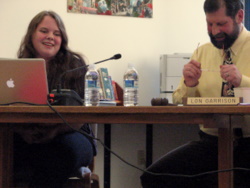
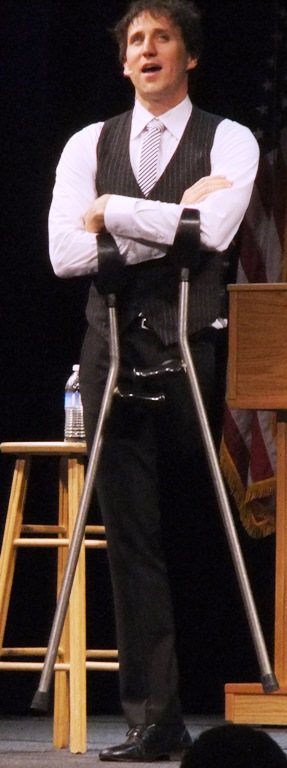
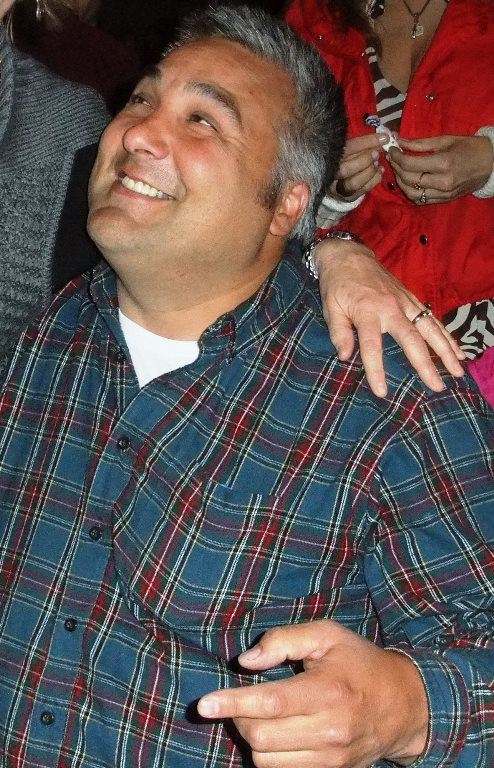
Sitka school board president Lon Garrison (r) congratulates student representative Jesseca Bartelds on her year of service on the board. The two agreed in principle — if not in practice — that absenteeism due to travel was a problem. (KCAW photo/Robert Woolsey)
The high cost of travel for extracurricular activities in Sitka’s schools has been an ongoing debate for years. Now, the school board is going to take a hard look at whether travel costs students and parents more than just money.
At its regular meeting Monday night (5-6-13), the board officially opened the question of whether Sitka’s students — and the teachers who coach them — spend too much time away from class.
For some kids, it’s a trip here and a trip there. For junior Ryan Apathy, who participates in Cross Country in the fall, and then in Drama, Debate, and Forensics through early spring, it can be consecutive weekends of competition. If those events are out of town, Apathy and his teammates will likely miss Thursday and Friday of school for travel.
And Apathy is also in Music, which accounts for three out of a total of:
“Ten trips this year, and missed 22 days.”
Nevertheless Apathy is succeeding in school, and excelling in the activities he’s involved in. Sitka’s school board is concerned that Apathy, and kids like him, are the exception, rather than the rule.
“We had a math audit that said that by the time a high school student is a junior, they’re already a year behind in Math. In terms of the amount of time they have been in class if they’re involved in activities,” said board president Lon Garrison, who’s interested in exploring a policy implemented recently in the Unalaska School District. The policy limits students to twenty absences from school per year for activities.
See the full story and hear from the students here:
Paula Casperson. Photo courtesy Juneau School District.
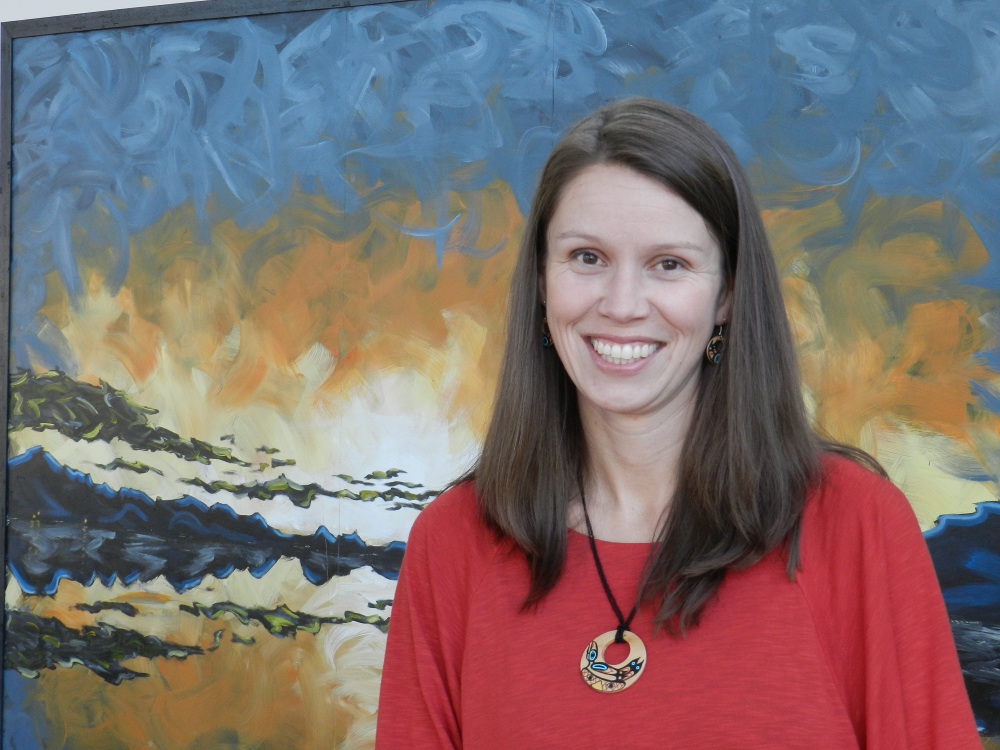
Paula Casperson is the new principal of Juneau-Douglas High School.
The Juneau School Board approved her hiring at its meeting Tuesday night.
Casperson is currently assistant principal, and was one of two finalists for the top job. A third candidate dropped out before the interview process.
According to a statement from the Juneau School District, Casperson has been assistant principal for the last nine years. She also worked as a high school social studies teacher for eight years in Alaska and California.
She has a Bachelor’s degree in Anthropology and a Masters in Education from Stanford University. She also completed an administrative program in Education Leadership at the University of Alaska Anchorage.
UAA awarded Casperson the 2012 William Demmert Leadership Award for significant contributions to the education of Alaska Native youth.
She replaces outgoing principal Ryan Alsup who has lined up another high school principal position in his home state of Colorado.
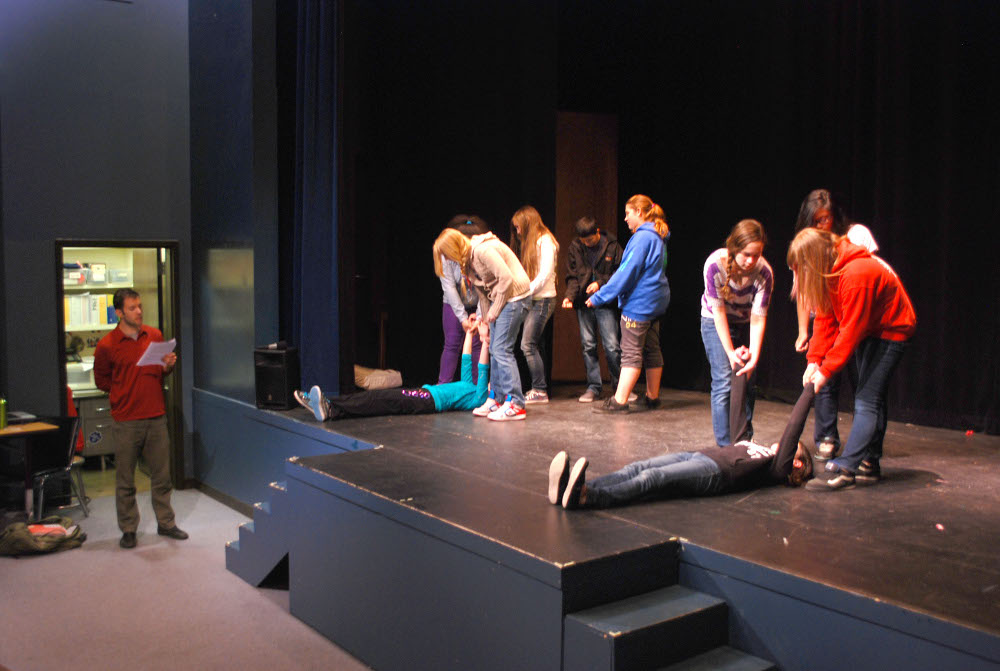
Kodiak Middle School students participated in at theatrical storytelling workshop last week led by Juneau actor, director and performing artist Ryan Conarro (far left). Photo by Brianna Gibbs/KMXT.
A Juneau actor, director and performing artist taught Kodiak students theatrical storytelling last week. Ryan Conarro completed a two week artist in schools program that culminated with a presentation on Thursday.
The foyer of the Gerald C. Wilson Auditorium was abuzz with students from Kodiak Middle School. Groups of 7th graders put the finishing touches on a series of tableaux – the final product of two weeks working with visiting teaching artist Conarro.
“I am here as a theater teaching artist and we’re doing a project with middle high and high school classrooms on using drama-based activities for integrating with academic content,” he says.
Conarro has a rich background in theater, both as a teacher and performer. He has worked with the Alaska State Council on the Arts’ Artist in Schools Program for about ten years and taught in districts across the last frontier.
In Kodiak, Conarro had middle school students interview family members about their first job as part of the program.
“That’s related to their unit that’s happening this spring on career preparation,” he says. “And we’ve taken some of the stories from those interviews and dramatizing them.”
The students reenacted the stories through a series of tableaux. But what exactly is a tableau?
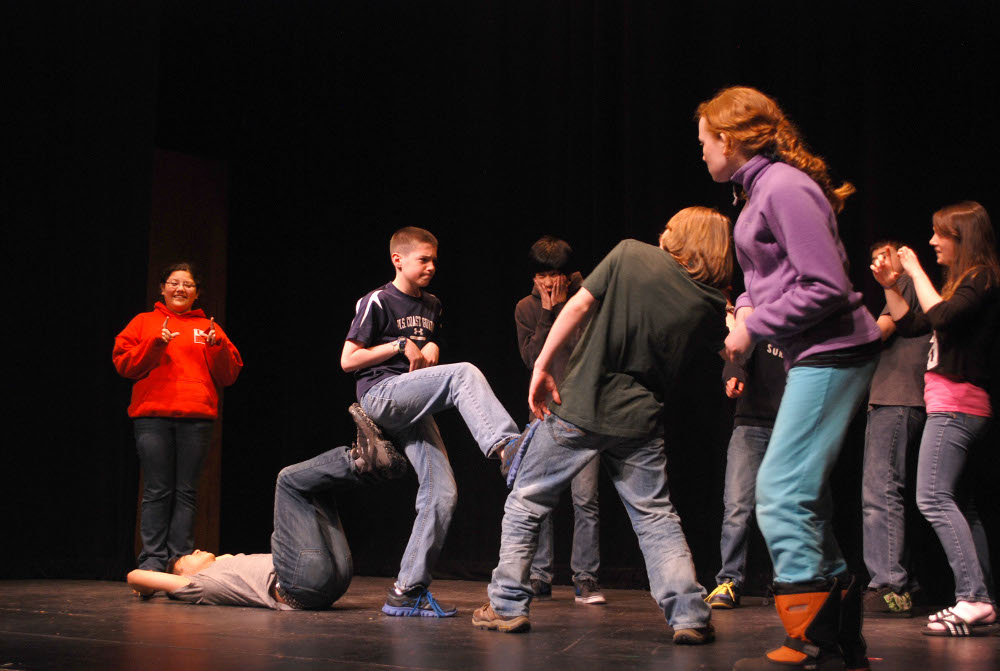
“A tableau is basically a picture formed with actors,” says 7th grader Eli Griffin. “It’s still besides the fact that you switch between scenes. You’ll have usually four or five people and you’ll take elements from the story and you’ll act them out silently in a picture.”
Griffin interviewed his dad, Kodiak Island Borough Assemblyman Aaron Griffin.
“He worked at Papa John’s Pizzeria. And then he went into the Air Force,” Eli says.
Griffin said his dad’s past with Papa John’s isn’t the topic of his group’s tableau.
“We’re doing one about a paper boy’s first job,” he says. “I’m a newspaper. I think that I play it awesomely. I just get to sit there.”
The students learned about tableaux and maintaining a solid position. Photo by Brianna Gibbs/KMXT.
After a few final tweaks, the students hit the stage and their interviews came to life. Conarro narrated the first job accounts as the students shuffled into intricate positions.
For Griffin, the experience opened his eyes to a new form of acting. He said he’s always been a part of theater, but he didn’t realize the power of a solid position.
“I think it’s really cool to be able to act without actually moving and speaking,” he says. “It seems to me like it’s a lot more powerful.”
The Artist in Schools program is funded through the Partners in Education program of the John F. Kennedy Center for the Performing Arts, the Alaska State Legislature, the Rasmuson Foundation and the National Endowment for the Arts, with help from the Kodiak Island Borough School District.
Conarro wrapped up his two week artist residency on Friday. During his time in Kodiak he also worked with high school students on dramatic representations of personal essays.
Cultural Heritage Guide Faith Grant discusses Tlingit heritage with cruise ship visitors. Courtesy Alaska Native Voices.
A Southeast village Native corporation wants to export its cultural tourism expertise. It’s opened a consulting business to build on more than a dozen years in the business.
Huna Totem Corporation has more than 1,300 shareholders with ties to the Tlingit village of Hoonah, about 40 miles west of Juneau.
It places cultural interpreters onboard cruise ships sailing the ancestral homeland of Glacier Bay. It also presents educational programs at the national park’s lodge, the jumping-off point for many visitors.
Now, those efforts have a different name and goals.
“Alaska Native Voices is going to be an expansion of what we are currently working on,” says Mark McKernan, who heads up what Huna Totem used to call its Interpretive Services Department.
“We’re going to now provide consulting services for other cultural interests, Native groups, small communities and what have you. We’ll provide these services to them to help them answer the big questions of how do they start, where do they start and what goals should they be aiming for,” he says.
A number of other Alaska Native corporations and tribal entities use cultural tourism to make money and employ shareholders or members. (Scroll down for links to some other cultural tours.)
But McKernan says others are looking for help.
Cultural Heritage Guide Irene Lampe explains the construction and use of a bentwood box. Courtesy Alaska Native Voices.
“What we have learned and what we can pass on is just as relevant in Southeast Alaska as it would be in Costa Rica or somewhere on the East Coast or the Midwest,” he says.
Alaska Native Voices began operations early this month.
McKernan says it has no formalized consulting agreements. But several groups have expressed interest and are discussing options.
Rosita Worl, president of the Juneau-based Sealaska Heritage Institute, says Hoonah Totem is well-equipped for the business.
“I think they have the experience. They’ve got the professional background and business experience in it. And I think they’ve done a great job in terms of trying to educate people about their culture and their history and meanwhile making a profit,” Worl says.
Huna Totem’s heritage guides are scheduled to be on about 200 cruise ships this year. That includes the Holland America Line, which sails large ships, and Alaskan Dream and Lindblad Expeditions, which operate much smaller vessels.
McKernan says cultural tourism programs need to tap traditional knowledge — and not just be another stop on the road.
“We do consult regularly with elders and others in the community and develop resources for these cultural guides to be able to grow and expand their knowledge base,” he says.
Huna Totem operates its own attraction, Icy Strait Point, which expects about 135,000 cruise passengers this year. Traditional culture is part of most of its excursions and programs.
McKernan says Icy Strait managers could also consult with other businesses interested in similar developments.
Learn about some other Alaska Native cultural tourism programs:
The University of Alaska Southeast held commencement ceremonies at its three campuses in Sitka, Ketchikan and Juneau over the weekend.
At the Juneau campus on Sunday, Chancellor John Pugh said UAS would award nearly 700 degrees, certificates and occupational endorsements in 2013. He said the regional university model benefits communities throughout Southeast and around the state.
“UAS has been able to reach out to communities throughout Alaska with e-learning programs to provide access to hundreds of students who would not have had the opportunity to attend college if there were not these programs that reach out all over Alaska, and the Lower 48, and even the world,” Pugh said.
This year’s commencement keynote speaker was former KTOO General Manager Charles Northrip, who received an honorary doctorate from the university for his accomplishments in the field of broadcasting. Northrip is currently working to set up independent media operations in war-torn Sudan and South Sudan with the Education Development Center’s Sudan Radio Service. He previously did similar work in the Balkan countries of Bosnia and Herzegovina.
Northrip quoted comedian George Carlin in his message to graduates: “George said, ‘People who dance are considered insane by people who can’t hear the music.'”
Northrip challenged graduates to hear their own music.
“Not everyone’s music is the same,” he said. “Mine seems to lead me into building stations, or networks, or to places where somebody needs help or even a rescue. I’ve had many colleagues who’ve stayed in the same place for a long time, but have done pioneering research, or created works of art or performance.”
This year’s student speaker was Forest Haven, a Social Science major who graduated with a 3.99 grade point average. Originally from Metlakatla, Haven earned an Associate’s degree from the UAS Ketchikan campus before transferring to Juneau to earn her Bachelor’s degree.
In preparing for her speech, she asked classmates what graduation means to them. She noted that the common theme seemed to be that getting an education allows graduates to be better people and do something for others.
“One of the greatest things that I will take away from the educational experience here is the knowledge that we can affect change beyond ourselves,” Haven said. “I don’t mean we have to be Ghandi or Mother Theresa. But I am saying we, all of us, must remember that we are part of a community, whether you see that community as Juneau, as the United States, or even as humanity.”
Haven said her post-graduation plans include fishing, hunting and pursuing a PhD in Anthropology.
Other speakers at UAS commencement included University of Alaska Student Regent Mari Freitag and UA System President Pat Gamble.
The University of Alaska Anchorage also held its graduation ceremony on Sunday. University of Alaska Fairbanks commencement is this coming Sunday.
Josh Sundquist was the second speaker of three for the 2013 Pillars of America series.
At 20-something, Josh Sundquist has already written a memoir. It’s a national best seller with a title that implies some struggles: Just Don’t Fall.
“We all have some sort of problem, some thing, some disability if you will. I happen to be missing one leg,” he said. “What are you missing?”
Sundquist lost his left leg to cancer when he was 9-years old. He’s fallen a number of times since then, but knows how to get up.
“I think we have a choice about the way we want to look at things,” he told an audience of hundreds of Juneau middle and high school students and Hoonah High School at the Pillars of America luncheon, hosted by area Rotary Clubs.
His choice is to overcome his disability. In fact, he said it’s because he’s an amputee that he’s gotten to do many things he never would have imagined when he had two legs.
“That’s not to say that I wouldn’t prefer to have two legs, but that is to say now that I do have one leg, I’m happy to try to look for the good things that come out of this,” he said.
Sundquist uses forearm crutches to get around, but most of the time during his talk they hung from his arms as he stood perfectly balanced on his right leg. Some of his speech sounded like a comedy routine as he regaled the audience with stories about living with his disability.
He says laughter has helped him deal with many of the issues that come up.
“I would suggest that if I can laugh about having one leg then maybe there are some daily annoyances, some problems in your life that you can laugh about as well,” he said.
Sundquist had a number of somber stories, too, like when he first tried hitting a baseball on one leg. He was 10-years old.
Each time, he’d strike, lose the bat and fall down. He was allowed to keep swinging, but on the ninth pitch, the little boy was in tears.
“I would not let my friends see me cry. So I picked up my crutches again and started to march off the field,” he said. “And this time my dad called out to me from behind the chain link fence. He said, ‘You almost had that last one.’”
If the proverbial pin had dropped as he told the story it would have been heard in the silence of the room.
“My dad was my hero and I knew if he were up to bat, he would keep swinging. So I went back over, took another swing, another strike, another and another. And finally on the 13th pitch I felt the ball bounce off the bat. I watched it roll up the infield. By the time it reached the short stop’s glove, my friend and designated runner named Tim was already on first base.”
When Sundquist was 16 years old, he started ski racing with the objective of making the U.S. Paralympic Ski Team.
Paralympian Joe Tompkins, of Juneau, gets a hug from some friends after Sundquist’s speech.
It was at the training center in Colorado that he met Juneau’s Paralympian Joe Tompkins. He called him “Big Joe.”
“When you’re starting out in a new endeavor like that, whether it’s a goal, or some adversity you’re trying to overcome, there’s nothing more powerful than having a hero that you can look up to, somebody who’s has already traveled that path that you are pursuing,” he said.
Sundquist made the team and in 2006 competed in the Paralympics in Turino, Italy. He described himself as a determined, but not decorated racer like Tompkins.
Joe Tompkins was in the audience for Sundquist’s speech. Like the younger man, he has a story to tell about his paralysis. After the speech, he said his advice to the audience would have been similar:
“One more swing, never give up. There’s going to be trials and tribulations that you’re going to go through the rest of your life, and if you’re that young you just don’t ever give up,” Tompkins said.
As Sundquist closed out his speech, he put it this way:
“Keep swinging,” he said. “Those would be the last two words that I would leave with you this afternoon: To keep swinging.”
Close
Update notification options
Subscribe to notifications
Subscribe
Get notifications about news related to the topics you care about. You can unsubscribe anytime.