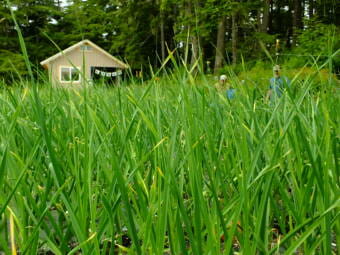
Sam Bertoni and Joe Orsi of Orsi Organic Produce harvest the scapes of nearly 2,500 garlic plants that are already 3-4 feet high. In this picture taken in early July, the tips of some of the leaves are just beginning to turn yellow. Orsi says when half of the leaves are yellow, then it’s time to harvest the entire garlic plant. (Photo by Matt Miller/KTOO)
When half of your garlic plants’ leaves turn yellow, then that’s the signal to harvest.
Joe Orsi follows that guideline for his small commercial operation located out the road.
In the latest edition of Gardentalk, Orsi described how he uses a special tool to harvest a lot of garlic at one time. But most gardeners can simply dig down to the bulb to carefully harvest the bulb. Never pull them up by the leaves.
Orsi also soaks or washes the soil off the garlic bulbs before peeling or removing the first few layers of wrappers or the skin surrounding it. Then, he chokes or gathers them up in bunches of five to hang for several weeks to dry out.
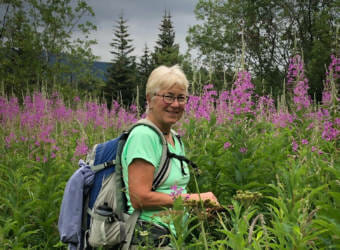
Deb Rudis among the fireweed at Pt. Bridget State Park. (Photo courtesy Deb Rudis)
Wildflowers are in full bloom around Juneau and Southeast Alaska this month. In the latest edition of Gardentalk, wildflower enthusiast Deb Rudis tells us her favorite spots for viewing them.
“I think my very best favorite is the Cowee Meadows, which is accessed through Point Bridget State Park,” Rudis said. “That’s about 38 miles off on the Glacier Highway.”
She also likes the Eagle Beach area and up the Eaglecrest road, where she said she can find some really nice pockets of flowers.
“And then the Brotherhood Bridge meadow, and that’s such an accessible place for anyone,” she said.
River Beauty or Dwarf Fireweed (Photo courtesy Deb Rudis)
Lupine (Photo courtesy Deb Rudis)
Wild Iris or Blue Flag (Photo courtesy Deb Rudis)
Avens (Photo courtesy Deb Rudis)
Board Petaled Gentian (Photo courtesy Deb Rudis)
Swertia (Photo courtesy Deb Rudis)
Wild Geranium (Photo courtesy Deb Rudis)
White Bog Orchid (Photo courtesy Deb Rudis)
Chocolate Lily (Photo courtesy Deb Rudis)
Marsh Marigold (Photo courtesy Deb Rudis)
Cow Parsnip (Photo courtesy Deb Rudis)
Western Columbine (Photo courtesy Deb Rudis)
Dwarf Dogwood (Photo courtesy Deb Rudis)
High elevation Shooting Star (Photo courtesy Deb Rudis)
For homeowners who may want the same wildflowers in their own yard, Rudis says gathering seeds is best. But it can be hard to get wildflower seeds to germinate.
Rudis said you can gather whole plants for transplantation, but she suggests first considering their original habitat.
“You have to make sure you have appropriate habitat,” she said. “Because you don’t want to put something that requires a wet spot into a dry spot. It just won’t thrive.”
Rudis says new housing developments just off the side of the road — or other wildflower patches that are not on state refuge or state park land — are perfect places to gather whole wildflowers.
“There’s lots of places out around Eagle Beach. There’s lots of places in Cowee Meadows where you could take some plants or (that are) up on the Eaglecrest road,” Rudis said. “I don’t think you could put much of a dent in the population of plants in those places.”
River beauty/dwarf fireweed in Granite Basin (Photo courtesy Deb Rudis)
Sam Bertoni checks the garlic at Orsi Organic Produce for any scapes that are beginning to loop on themselves. He will eventually pick the scape in the foreground that is already bending over. (Photo by Matt Miller/KTOO)
If you’re a Juneau area gardener who is growing garlic, you may have noticed that the plant’s scapes are bending over. Pick them now.
In the latest edition of Gardentalk, Joe Orsi explains that softneck garlic usually sold in stores is missing a central scape or seed stalk when it grows, while hardneck garlic has a round, bulbous central stem or scape that curls into a loop in the early summer.
“They will keep growing and form a flower stock, and they’ll twist up and then untwist and form a flower,” Orsi said. “And if you don’t pull the scapes off the hard neck, it pulls all the energy away from the bulb and you end up with a very small bulb.”
He said that you have go through your garlic crop and physically snap off the scapes when they start to bend over.
Orsi is a former master gardener and owner of Orsi Organic Produce, a small commercial operation in Juneau that grows garlic, rhubarb, squash and other vegetables.
He said he likes using diced up garlic scapes in omelettes or soups any other dish where he wants to add a garlic flavor.
Orsi also makes pesto with minced garlic scapes, pine nuts, a little olive oil, basil, salt and parmesan cheese.
“And they keep a long time too,” Orsi said. “You can keep scapes for months in the refrigerator. They just hold really well.”
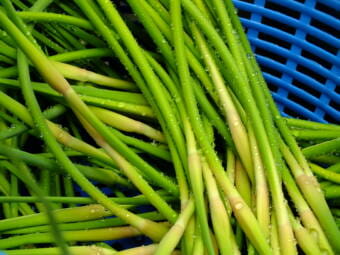
Freshly picked garlic scapes get a light washing. (Matt Miller/KTOO)
Slow developing raspberries in a Douglas Island yard in early July 2021. (Matt Miller/KTOO)
Juneau area berrypickers and gardeners may be wondering, “Where are the berries this year?”
In this week’s edition of Gardentalk, Master Gardener Ed Buyarski explains they’ve been slow — even compared to last year’s cold and wet season.
Buyarski said blueberries are late, even the early April bloomers. Raspberry plants are behind at least 10 days or more.
“So, definitely late,” Buyarski said. “Apples and cherries, likewise, late two to three weeks or more.”
He said there is really nothing that can be done other than crossing your fingers for more sunshine and warm weather.
But for cherry and apple trees, Buyarski suggests doing some thinning.
“I think because of last year’s poor cold wet weather, that there may not be a lot of energy stored in the roots of the plants to ripen all those fruits,” Buyarski said. “So, thinning may be especially important this year.”
Buyarski said fertilization of trees and woody shrubs with seaweed and compost should be wrapping up right now.
He recommends watching out for bursting and cracking cherries if the weather suddenly goes from wet to dry. Also, it might be worthwhile to lightly cover or shelter developing raspberries to prevent the rapid onset of mold.
“Blackberries seem to be resistant to a lot of the molds,” he said. “Currants and gooseberries are great in that way, too, and are much less affected by them.”
Slowly developing blueberries in a Douglas Island yard in early July 2021. (Matt Miller/KTOO)
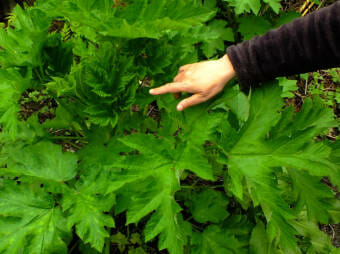
Yéilk’ Vivian Mork points to a wild celery plant’s new leaves, which along with the stalks, are edible. She says the plant usually tastes best when new, young growth develops in the early spring. She recommends picking wild celery – sometimes known as cow parsnip – during cloudy, cool days to avoid an allergic skin reaction to the photosensitive chemical furanocoumarins that are part of the plant’s sap or found on the hairs. (Photo by Matt Miller/KTOO)
You may not realize it, but there may be plenty of edible plants already growing in your yard or off the trail. Just be sure that you already know what it is that you’re picking.
“Don’t harvest what you don’t know so you don’t die,” said Yéilk’ Vivian Mork, a traditional foods and medicine educator.
In this week’s edition of Gardentalk, Mork explains that a good starting place for new harvesters is going after edible invasive species like the dandelion.
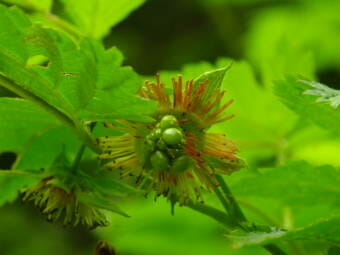
Roots of broadleaf avens can be used as a flavoring for wild game or as a tea. Yéilk’ Vivian Mork does not recommend eating plants growing in parking lots or near roads, and even suggests washing plants found off a trail. (Photo by Matt Miller/KTOO)
“Of course, take it home and wash it off if you’re harvesting next to a trail,” Mork said.
She does not recommend eating plants growing in a parking lot or near a road.
Other common edible plants in the Juneau area include broadleaf plantain, broadleaf avens, chickweed, sourdock, tips of fireweed, salmonberry stalks, and wild celery.
“You actually have a pretty great salad in a very short amount of space,” Mork said.
Mork said you can eat wild celery’s stalks, leaves, flower buds, and even use the seeds as a seasoning. She says older plants are usually pretty fiberous and not quite as tasty.
“All spring greens taste better in the early spring,” Mork said.
Broadleaf plantain, broadleaf avens, and chickweed are fairly common edible plants that are usually dismissed as weeds. (Photo by Matt Miller/KTOO)
If someone wants to learn more about identifying edible plants, Mork suggests seeking out knowledgeable, local experts.
She tells people to avoid online blogs that may contain misinformation.
Instead, she recommends publications from author Janice Schofield Eaton or from any reputable institution like the University of Alaska Fairbanks’ Cooperative Extension Service or the U.S. Forest Service, especially if they cite their sources.
When it comes to devil’s club tips or buds, Mork said they have enormously more medicinal value than any nutritional value as a food item.
“I’m hoping that this foodie trend for harvesting devil’s club tips and sautéing them and pickling them and harvests (of) large quantities starts to fade a little bit and it gets respected for the medicinal plant that it is,” Mork said.
Mork said each tip or bud can produce as many as ten leaves, and picking the tip actually deprives the plant of the ability to photosynthesize and survive.
The devil’s club stalk in front has at least seven leaves at the top. Yéilk’ Vivian Mork says each devil’s club tip can produce as many as ten leaves, and picking the tip actually deprives the plant of the ability to photosynthesize. She says it is more suitable as a medicinal plant rather than as a food item. (Photo by Matt Miller/KTOO)
In a commercial operation like Juneau Composts in Lemon Creek, items are sorted out before they are mixed into a compost pile. (Photo by Matt Miller/KTOO)
Adding compost to your garden adds nutrients back into the soil while improving its physical properties. With a little patience, gardeners can make their own compost by recycling ingredients found in the kitchen and in the yard. Making compost also helps cut down on the waste stream to the local landfill.
“You just want to make sure that you’re setting yourself up for a good time rather than a bad time. Bears are the big thing to think about (for) a bad time,” said Lisa Daugherty who runs Juneau Composts, a commercial composting operation in Lemon Creek.
“If you’re composting food scraps, you want to make sure you have plenty of carbon (like cardboard) on hand at all times so that no food scraps are ever exposed to the air,” Daugherty said. “If you can see them, if you can smell them, then you’re just kind of asking for trouble.”
Those exposed food scraps can attract flies, squirrels, ravens and bears.
For home composting, she said she creates a pallet bin with four wooden pallets standing up on end and tied together at the corners. A cover is placed over the top of the bin so the compost is not saturated by rain.
The front pallet is split in half so she can open up the bin and use a pitchfork or shovel to turn the compost or aerate the pile. Turning the pile on a regular basis provides oxygen for the microbes which will help them break everything down faster.
“People tend to think about greens and browns or carbons versus nitrogens,” Daugherty said. “But basically, you’re just trying to have a diversity of material. So, food scraps, yard debris, leaves, shredded paper, cardboard, sawdust, (and) moss.”
“I think the more diverse your inputs are, the better your compost is going to be.”
A sample handful of compost ready to be added to a garden. (Photo by Matt Miller/KTOO)
Daughtery admits that she’s not a big fan of the composting drum turners that are sold by retailers because they are hard to crank and attract a lot of flies.
“Flies are going to fly out at you from the opening and to me, that’s not a very pleasant experience,” Daugherty said. “I think of composting as you should feel like you’re working in your garden. You shouldn’t feel like you’re working at the dump.”
Daugherty said things like spent grains from home brewing are great for the compost pile.
But she doesn’t recommend that novice composters put in weeds, seafood, meat, or dog poop, especially if they’re not sure if their compost pile is getting hot enough.
Close
Update notification options
Subscribe to notifications
Subscribe
Get notifications about news related to the topics you care about. You can unsubscribe anytime.