Gardentalk

Gardentalk – How to top tomatoes and get the most out of hardy, cold-tolerant greens

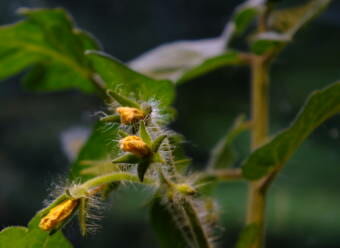
Cherry tomato flowers
Close up view of tiny heirloom cherry tomato flowers that are preparing to bloom in an indoor aeroponic garden in September 2020. For tomato plants growing outside or in a greenhouse, such flowers should trimmed off now so the plant can devote its remaining energy for ripening of existing tomato fruit. (Photo by Matt Miller/KTOO)

If you have tomato plants flowering in your greenhouse right now, now is the time to top them off.

Master Gardener Ed Buyarski says tomato plants need to devote any remaining energy to ripening fruit that has already emerged instead of wasting it on flowers that are unlikely to mature or produce any fruit later this fall.

Just use nail clippers or your fingers to trim or pinch off any new flowers.

Buyarski also says it’s the last call for harvesting cucumbers and zucchini. This summer’s prolonged rains have set up perfect conditions for a severe spreading of fungus.

“To the point that removal (of those plants and vegetables) is the best option,” Buyarski says.

Also, the gardening season is not over.

You can plant lettuce, mustard greens, spinach, kale, and radishes in your greenhouse right now. They will either be ready for a fall harvest or will tolerate the winter’s cooler conditions and have a head start next spring.
Buyarski says he has nine-month-old lettuce in his greenhouse that is just now beginning to bolt.

Gardentalk – Planning ahead for a springtime splash of color

Bulbs
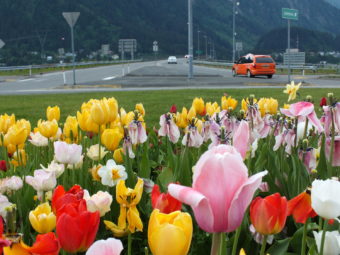
Bulbs bloom in the middle of the Douglas roundabout in Spring 2015. (Photo by Matt Miller/KTOO)

Bulbs are already appearing in Juneau stores right now. But Master Gardener Ed Buyarski says don’t plant them just yet.

Instead, set them aside in a cool, dark place like your garage. Then wait to plant them until at least the middle or end of October, when temperatures are really dropping.

Buyarski says that for best root growth, bulbs should get at least 90 to 120 days in cool soil of about 40 degrees.

“Last year was kind of weird,” Buyarski remembers.

He recalls his flower and garlic bulbs started sprouting their green top growth too early during last December’s mild conditions.

“Then, temperatures on New Year’s Day dropped about 30 degrees,” Buyarski says. The new period of cold temperatures postponed any further top growth.

He says you can start preparing any well-drained soil now. If the soil is too moist, then mix in some sand.

Bulbs come in all varieties, colors and heights and may be specified as early or mid-season bloomers.

Tulips might only bloom well for their first season, but other varieties might bloom year after year.

Unprotected tulip buds are a favorite browsing snack for deer in the higher elevation neighborhoods of Juneau and Douglas. But deer seem to stay away from daffodils, snowdrops and alliums.

Gardentalk – Should you plant mystery seeds? Should you squish woolly bear caterpillars?

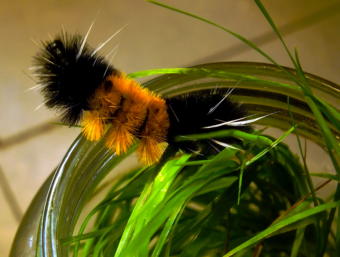
Woolly bear caterpillar tries to escape its glass prison located in a North Douglas kitchen in August 2019. (Photo by Matt Miller/KTOO)
A woolly bear caterpillar tries to escape its glass prison in a North Douglas kitchen in August 2019. (Photo by Matt Miller/KTOO)

Alaskans say they’ve been getting unsolicited packets of seeds in the mail. Or seeds that Alaskans think they ordered from U.S. seed retailers, but they ended up coming from China or other places overseas instead.

Don’t plant them, says Master Gardener Ed Buyarski. They have not been inspected for disease and may be an invasive species. They also may have not been approved for importation into the U.S.

“There’s rules for that too,” Buyarski says. “Some things are not allowed because of crop seed protection.”

Tomato seeds from Uzbekistan
U.S. Department of Agriculture, Animal and Plant Health Inspection Service botanists examine tomato seeds sent to U. S. residents from Uzbekistan to determine if they harbor any plant pests or disease. (USDA photo)

Dave Schade, head of the Alaska Division of Agriculture, encourages Alaskans to call his office at 745-7200 if they get any mystery seeds from overseas. He says his staff will ask questions about the packages and how the seeds arrived in the mail. They’ll also ask you to send the packages to their office in Palmer. From there, the mystery seeds will go to the U.S. Department of Agriculture for further examination and investigation.

“Tell us what you have. We’ll tell you how to get it to us,” says Schade. “We’ll collect the information of what you think happened”

Schade also said the agriculture division would love to get the original packaging — and don’t open the little plastic bags with the seeds.

Buyarski advises gardeners to stick with known varieties from reputable U.S. seed companies.

If you do know where your seeds came from, now is the perfect time for a second planting of fast-growing greens like lettuce, mustard greens and kale.

Buyarski also warns that the root maggot may be infesting root vegetables in Juneau. Do not put root maggot-infested vegetable remains into your compost. Buyarski says gardeners may be able to keep the main portion of the vegetable, but they should get rid of the roots and surrounding soil by burning them or putting them in a bag for the dump.

Also, the woolly bear caterpillar is back in Juneau, chewing on trees, bushes, vegetables and herbs. They’ve been seen feasting on apple trees, alders, parsley and berry plants.

Buyarski encourages gardeners to squish the caterpillars and throw them in the trash.

He advises against letting children play with the caterpillars because their white hairs can irritate the skin.

Gardentalk – Collecting and planting your own flower and vegetable seeds

SawmillCreek060118
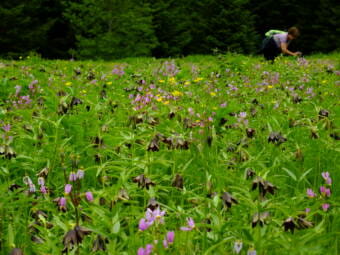
A kaleidoscope of Alaskan wildflowers in a meadow off Sawmill Creek, near Berners Bay. (Photo by Matt Miller/KTOO)

If you’ve ever coveted your neighbor’s prize cucumbers or wanted to duplicate an Alaskan wildflower meadow in your backyard, there’s a way you can do that. Just collect the seeds and plant them yourself.

Master Gardener Ed Buyarski says he collects seeds from kale, radish, parsnips and spinach in his garden. He’s also tried growing shooting stars, wild columbine and chocolate lily flowers from collected seeds. But timing is key.
“Those can all be collected once the seed pods, the stems finish blooming, turn brown — and then some of those seed pods will start to open up,” Buyarski says. “If you wait too long, they will seed themselves out across your garden. Kind of like in my garden, I’ve got kale growing everywhere where it has gone to flower over many years.”

Shooting star flower
Purple or mountain shooting star near Juneau. (Photo by Matt Miller/KTOO)

Buyarski says he’s now growing primrose seedlings from seeds that he collected in April from the plant’s tall stem.

Lupines and geraniums have seed pods that explode to spread their seeds out further away from the plant. Buyarski recommends picking the pods before they burst, while they’re still a little bit green. Put them into a cardboard box and store them in a dry place, like a garage.

Seeds can be dried over the winter or planted immediately. In the latter case, they will become dormant with this winter’s cold weather before naturally sprouting in the spring.

Seeds
Kale, columbine and mustard seed pods selected by Ed Buyarski from KTOO’s Agricultural Test Station and Garden of Science. (Photo by Matt Miller/KTOO)

Gardentalk – How to thin out apples and veggies, and when to pick peonies

Apples
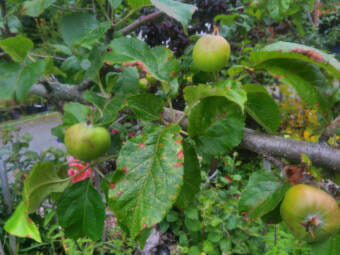
This locally grown apple tree has already been thinned of extra fruit. (Photo courtesy Ed Buyarski)

It may seem a little counter-intuitive at first. But you have to get rid of some apples now to get bigger and better tasting ones at the end of the season.

Master Gardener Ed Buyarski says gardeners should thin out clusters of four or five apples to a reasonable leaf-to-apple ratio.

“Somebody who’s being really obsessive, they say forty leaves to one fruit,’ Buyarski said.

He prefers leaving one per cluster so that the remaining apples are spaced out along a branch.

Thinning apples will allow more color and sugars to develop in the remaining fruit. It will also extend the life of the tree because it removes extra weight that could break limbs and branches.

Any scabby or wormy apples should be thrown in the garbage, not in the compost.

Buyarski is also thinning out beets and carrots to about an inch apart before starting with mid-season planting. It’s also time to start planting  lettuce, radish and turnips seeds.

Peony flowers and stems should be picked before they bloom. For proper timing, Buyarski says buds should feel like a marshmallow just before all the flower petals open up. This way, peonies will last much longer than if you waited for the flowers to fully open before picking them.

Gardentalk – Time to harvest garlic, but watch out for mold

Garlic
Freshly harvested garlic (Photo courtesy of Ed Buyarski)

After nine months of patiently waiting, this is the moment many Southeast Alaska gardeners have been anticipating. Garlic is probably ready for harvest, right now.

Garlic harvest
Master Gardener Ed Buyarski with a bunch of freshly harvested garlic in front of a garlic planter. (Photo courtesy of Ed Buyarski)

Master Gardener Ed Buyarski reminds gardeners of the key signals for harvest — the unfurling of bulbous scapes and the yellowing of the lowest leaves of the garlic plant.

Carefully check if the garlic bulbs in the soil are big enough for harvest, with intact skins that are free of mold.

Moldy garlic (see photo below) should be removed immediately so that other garlic is not infected.

Plants with moldy garlic stems or skins should be cleaned and processed separately to avoid transmitting mold spores.

Dispose or throw out the moldy parts in the trash, not in your compost bin, where they will contaminate other organic matter.

For mold-free garlic, you can cut the stems to about 6 inches, remove the roots and use the leaves in soups and salads.

Clean off the dirt and then store and dry the garlic for about two weeks in a warm, dry place — like a furnace room — where temperatures may be 70 to 80 degrees.

But you don’t have to harvest everything right now.

“That is the game I’m playing,” says Buyarski.

He says he’s leaving other a few other garlic plants in the ground so they can get bigger in any warm and dry weather that comes over the next few weeks.


Moldy garlic and good garlic
Garlic with white or gray mold (left) and healthy garlic (right). Gardeners should clean and process moldy garlic separately and dispose of the moldy skins and the stems in the trash, not in the compost. (Photo courtesy of Ed Buyarski)
Site notifications
Update notification options
Subscribe to notifications