Gardentalk

Gardentalk – How to reuse your kitchen food waste as nutrients for your garden

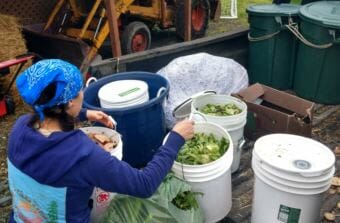
Lisa Daugherty, owner of Juneau Composts!, unloads residential food scraps in 2017. (Photo by Jacob Resneck/KTOO)

Instead of dumping food waste into garbage cans that may be emptied in a landfill with a limited life span, many gardeners reduce their waste stream by composting food scraps and garden debris. The materials decompose or break down into basic nutrients that benefit a flower or vegetable garden.
Master Gardener Ed Buyarski says the bigger you can make your compost bin or pile, the better.

“Size matters,” Buyarski said.

Food scraps and dead leaves will get hotter and break down faster in a big compost bin, especially if you chop the organic matter up into very small pieces.

Adding horse, chicken or other livestock manure will generate the worms and microorganisms that will accelerate the decomposition process.

How do you know how much of a certain material to put into your compost pile? Buyarski says most gardeners follow a green-to-brown ratio of 30 to 1.

Greens are usually green leaves and grass that may be higher in nitrogen and moisture.

Browns are typically materials that are drier and higher in carbon like sawdust, paper, and dead leaves.

Buyarski cautions against using materials that may contaminate a compost bin. They include colored paper, wood or sawdust from treated lumber, and grass clippings from a lawn that has had weed-and-feed applied to it.

Also, do not compost any diseased or infested plants or invasive weeds. Just throw those out into the garbage.

Gardentalk – Pick your garlic scapes when they curl

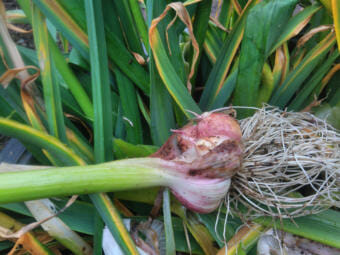
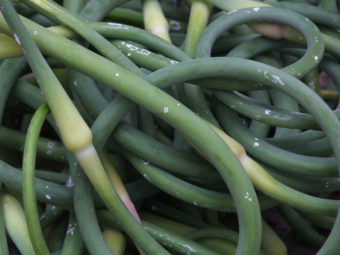
Recently harvested garlic scapes.
Recently harvested garlic scapes. (Photo by Matt Miller/KTOO)

It’s a key moment for gardeners who have been patiently waiting since they planted garlic as much as nine months ago. The garlic scapes — the round, bulbous, center stem-like part of the plant — are now curling into loops.

That’s a big sign for gardeners that their garlic bulbs will soon be ready for harvesting, perhaps within a few weeks.

Garlic scape is all curled up in a North Douglas garden.
Garlic scape is all curled up in a North Douglas garden. (Photo by Matt Miller/KTOO)

Master Gardener Ed Buyarski suggests gardeners snap off the scapes and use them like green onions or make a garlic scape pesto. The garlic plant will then devote the remainder of its energy into the bulb’s growth instead.

Buyarski says he harvests most of the scapes, but leaves just a few remaining in his garlic patch to provide another clue about harvesting the bulbs.

“Timing is important,” he says.

When the scapes fully uncurl and the plant’s lower leaves turn yellow, then that’s the signal to carefully dig into the soil to see if any of the bulbs are big enough to harvest.

It’s also a good idea to check the bulb’s skins to make sure they have not peeled off or gotten moldy.

Hundreds of garlic plants waiting to be harvested.
Hundreds of garlic plants waiting to be harvested. (Photo courtesy of Ed Buyarski)

Buyarski also answered a question from a listener.

Patte writes, “Is there any reason I shouldn’t mulch with tree needles, cones, and other natural materials? We get a lot of it. I layer cardboard first.”

“Certainly. Go for it,” Buyarski says.

Buyarski urges caution because the needles and cones will make the soil more acidic.

That may be ideal for rhododendrons, azaleas, and evergreens.

But not for peonies and lilacs, for example, which prefer sweeter soil. Buyarski says adding lime or wood ash will keep the acidity down.

Gardentalk – Your best tools for this summer’s slugs

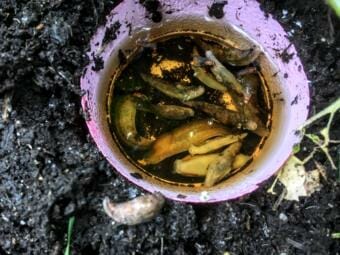
Beer trap
Beer trap improvised from a discarded plastic cup attracts a whole bunch of slugs in a North Douglas garden. (Photo by Matt Miller/KTOO)

Where there’s rain, there are also slugs.

June 2020 just tied with June 1949 for 25 days of measurable rain, the most ever for the month of June in Juneau. June 2020 is also the second-wettest June ever with 7.3 inches of rain at the Juneau International Airport.

With so much moisture, Master Gardener Ed Buyarski knows that gardeners may feel that their battle with slugs is never ending. Slugs like to hide under vegetation and prefer feeding on beets, lettuce, cabbage and other leafy greens.

But Buyarski says gardeners can use several techniques to make their garden nearly slug-free.

  • Use two fingers or pair of bricks to squish them
  • Spray a solution of half ammonia and half water on the slugs
  • Set out slug and snail bait like Sluggo
  • Make beer traps that will attract slugs and drown them in a drunken stupor

Of all the methods, the squish and spray methods probably take the most effort.

Slug!
Intruder Alert! – Invader spotted in a raised bed of bolting spinach in a North Douglas garden. (Photo by Matt Miller/KTOO)

Slug bait and beer traps usually require minimal maintenance other than cleaning out dead slugs and refreshing the bait. Ideally, the traps should have some sort of cover or be placed under plants to protect them from the rain.

Beer bottles with about an inch of beer inside work great as traps with the bottle laying on it’s side. The bottle’s closed end should be slightly buried while the mouth should be level with the soil.

Other slug mitigation techniques include mini-hoop houses over plants to keep them relatively dry during constant rains.

Cleaning up old leaves and other yard debris can also eliminate much of the slugs’ hiding places and egg-laying spots.

Listener Debby also asked about another pest: “How do I get rid of fungus gnat infestation on indoor plants?”

Buyarski says the gnats feed on the organic matter in the potting soil.

He recommends keeping the surface of the potting soil as dry as possible or covering it with a half-inch layer of play sand.

Buyarski also says the biological larvicide Gnatrol will work. It should be diluted before pouring it on the soil and plants.

Slugs on radish leaves
Holes in these radish leaves are the tell-tale bite marks of slugs. (Photo by Matt Miller/KTOO)

Gardentalk – Your fruit, vegetables and flowers thank you for your support

KTOO Kiwi
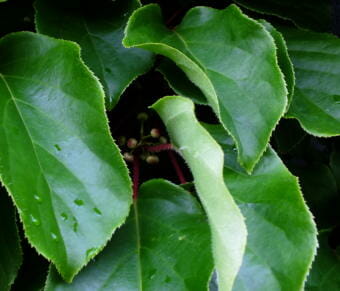
A kiwi plant climbs up the side of the building at the KTOO Agricultural Test Station and Garden of Science! (Photo by Matt Miller/KTOO)

Many garden plants get too tall or too heavy to support themselves over the entire season.

That’s why Master Gardener Ed Buyarski says it’s important that we do our best to lift them up as they grow.

Keeping plants off the ground helps with pollination, air circulation, and prevents slugs from chewing up the leaves.
“And, to make it easier for us to pick them,” Buyarski said.

Buyarski says he may use alder sticks, reclaimed fencing poles, string and netting, a trellis and tomato cages to support plants.

Without any support, tomato plants will get too heavy and fall over when they start fruiting out.

Other plants, like peas, kiwi and cucumbers, will actually twine themselves around another support or have tendrils that reach out to climb higher.

“They keep going up and up,” Buyarski said. “If (peas) are not given support, then they flop (over) or they grab onto each other and you get this tangled mass.”

Buyarski also uses old t-shirts to make slings for his cucumbers so they can grow long and straight. Cucumber fruit may curl and become susceptible to fungus if they rest on the ground.

Even flowers need a little help staying upright. Buyarski says delphiniums and peonies will fall over if too much rain accumulates in the flowers.

Gardentalk – Now is the time to do mid-season pruning of maples, azaleas and rhododendrons

Maple
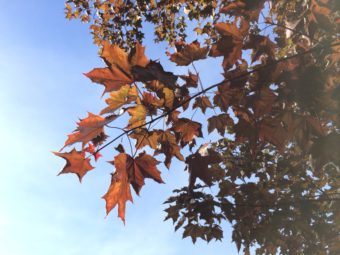
North Douglas maple tree. (Photo by Matt Miller/KTOO)

Pruning trees and bushes can be a perennial activity for any active gardener.

Master Gardener Ed Buyarski answers more pruning questions in the latest episode of Gardentalk.

Richard writes: “When is the best time to prune your tree? I’ve got a sugar maple.”

And, Helen writes: “When is it OK to prune and shape a Japanese maple? I live in central New Jersey.”

Buyarski said now and into July is actually a good time to prune maples for shaping because it will not stimulate a lot of new growth.

“If it’s too tall and people might want to prune for branches going wider,” Buyarski explains.

For Japanese maples, he says there are a variety of YouTube and other video tutorials on creative shaping of trees.

For maples, don’t leave any stubs and cut as close to the main branch as you can.

Buyarski also suggests making sure that all of your pruning tools are sharp. It will be easier to make nice, clean cuts.

If you are pruning a tree way up high, then he also recommends recruiting someone to help as a safety person and as a ground-level spotter on the best branches to cut.

Annette writes: “When is the best time to prune azaleas and gardenias?”

Buyarski said azaleas and rhododendrons, a somewhat-related shrub, should be pruned right after they’re done blooming and when new shoots start emerging which will flower next year.

“The fading flower remnants, which we would also want to clean off, snap off those, deadhead basically, that we will want to do that while we’re pruning,” Buyarski says. “So, that timing is good.”

Buyarski says pruning azaleas and rhododendrons is exactly the opposite of avoiding leaving stubs while pruning maples. Hidden buds will later pop out on a bare azalea and rhododendron branch.

He said he has no experience with gardenias and is not able to provide advice for that shrub.

Gardentalk – Your best defense for currant worms and rhododendron root weevils

Zucchini sprouts
Zucchini sprouts grow in KTOO’s Agricultural Test Station and Garden of Science (Photo by Matt Miller/KTOO)

The gardener’s battle against pests is never ending.

In this episode of Gardentalk, Master Gardener Ed Buyarski has some advice for dealing with a few of this spring’s pesky bugs.

Listener Mary writes: “What insect control measures are recommended to control insect predation on currant bushes (aside from safer soap)?

Products like Bacillus Thuringiensis or BT are effective for controlling caterpillars, but Buyarski said, so far, it appears that it is only available on-line.

Buyarski said a solution of one to two tablespoons of safer soap or dish soap to a quart of water is usually most available and easiest. A shake of Tabasco can add a little repellant.

“Spray the topside and underside of leaves,” Buyarski said. “You need to get this stuff on the little caterpillars to kill them.”

Buyarski also said notched rhododendron leaves can signify the presence of rhododendron root weevils. They usually crawl up the trunk and move out to the branches to chew on the leaves.

He recommends trimming up the lower branches so they don’t touch the ground and don’t allow the larvae to have easy access to the leaves.

Products like Tanglefoot Tangle-Trap are available on line. But he also suggests a DIY alternative of wrapping the trunk with tape and coating it with something sticky and gooey like vaseline to trap the bugs.

As is the case with slugs, cleaning up dead vegetation and other debris in the yard and garden can remove the pests’ hiding places.

Buyarski also answered a question about the use of old tires as garden planters.

Tires may be fine for non-edible flowers. But he doesn’t recommend them for growing vegetables because chemicals used in the tire-making process could leach out into the soil and be taken up by the plants.

Site notifications
Update notification options
Subscribe to notifications