Outdoors

Gov. Dunleavy vetoes $10.5M in funds for Alaska Long Trail project

The Alaska Long Trail would connect Seward and Fairbanks through a 500-mile multi-use trail. It’s modeled after other long trails, like the Appalachian Trail on the East Coast. (Sabine Poux/KDLL)

Gov. Mike Dunleavy’s vetoes to the state budget last week included slashing roughly $10.5 million in funding for the Alaska Long Trail project.

The project would span about 500 miles and connect Seward to Fairbanks by what’s called a braided trail, mixing a series of walkable paths as well as paths accessible by four wheelers and snowmachines. Some pieces of the trail already exist, but some still need to be built.

Mariyam Medovaya works with Alaska Trails, a nonprofit trail building group that’s been spearheading the project for more than a year. She said her group put a proposal to the Legislature for $14 million that would fund 15 projects along the main trail route.

Seven of those projects, totaling about $4 million, survived the governor’s vetoes, she said. The funds will go to several Anchorage land managers.

“They will include a lot of trail improvements, trail construction, some planning money for connections between Anchorage and the Mat-Su,” Medovaya said.

The projects that were vetoed were outside Anchorage and included pieces of the trail in the Mat-Su, Denali and Fairbanks North Star boroughs.

In a statement, Dunleavy spokesman Jeff Turner said the governor felt many Alaskans had little information about the project.

“The Governor decided to veto some of the funding so discussions can take place this year about the trail’s potential impacts and benefits for Alaska’s tourism industry,” Turner wrote.

Medovaya said she understands the governor’s hesitation and reasoning for the cuts. She said she remains optimistic since almost half of the Alaska Long Trail projects remained in the budget.

“And we already see a lot of support and momentum from many bipartisan entities and agencies across the state,” Medovaya said. “But, that said, a lot of people don’t know about it and there’s still a lot of hesitation and some concerns and fears of losing access.”

Medovaya said Alaska Trails looks forward to working with the state to get the remaining projects funded in the next budget.

Garden Talk: How to harvest garlic scapes, and some things you can do with them

Outdoor garden beds with full grown garlic plants. (Photo by Sheli DeLaney/KTOO)

Garlic bulbs planted last fall are now full grown and producing scapes. In this week’s episode of Garden Talk, Ed Buyarski talks about what they are and how to use them.

“This garlic in front of us was planted last September or October — covered it over with plastic for the winter and rested till it starts to grow roots, just like tulips and daffodils do in the fall.” Buyarski said. “So they’ve grown almost to their maximum height.”

At this point they have formed scapes, which Buyarski says are “weird-looking curly growth out of the center of the plant.”

Beginner gardeners often have questions about what to do with the strange-looking, coiled scapes. If they’re not harvested, scapes will straighten and grow up to five feet tall. Eventually they’ll form rice-sized baubles that could potentially be used to reproduce the plant, in a few years’ time. 

Close-up of a garlic scape growing from the center of a garlic plant (Photo by Sheli DeLaney/KTOO)

But Buyarski believes most people will get the best use out of scapes by eating them. He says they “can be chopped into stir fries, into pasta sauce, you can make chimichurri, pesto.”

He compares them to green onions but garlicky and says “some are spicier than others.”  

Buyarski adds that removing scapes also helps the garlic form bigger cloves by redirecting energy into the bulbs.

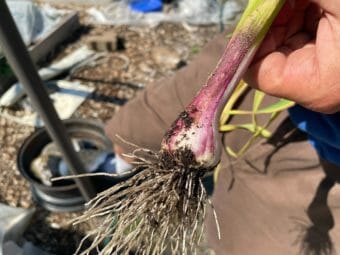
Ed Buyarski holds a garlic scape that is ready to harvest (photo by Sheli DeLaney/KTOO)

Garlic scapes can simply be cut or snapped off the plant near the base of the shoot. Buyarkski usually likes to leave them until they just start to curl. However, one day he was out of fresh garlic. 

“So, some of them were cut just as immediately as I saw them.” 

Sitka’s Search and Rescue team rescues hiker after fall from footbridge

An image of a narrow footbridge over a stream. A section of railing is gone where the hiker fell through it.
Sitka Trail Works, on Friday, published this photo of the bridge where the hiker fell along Indian River Trail (Kaasda Héen) with a warning to use caution when hiking the trail, as the rest of the railing may not be structurally sound (Photo courtesy of Lee House/Sitka Trail Works)

Sitka’s Search and Rescue team rescued an injured hiker on the evening of June 23 after he fell while hiking the Indian River Trail (Kaasda Héen).

According to Assistant Fire Chief David Johnson, 911 dispatchers received a call around 3:45 p.m. A fellow hiker made the 911 call and said they believed the man had broken his ankle.

Search and Rescue Captain Matthew Hunter said the hiker had been crossing the first bridge on the trail when the railing gave way and the hiker fell.

Hunter said ten volunteers and two fire hall staff responded to the call. They found the hiker around a mile and a half down the trail and brought him back to the trailhead on a rolling litter.

“The litter wheel is basically one big ATV tire that is underneath the center of the litter,” Hunter said. “So it allows us to go over anything from large rocks to boardwalk steps, if it makes a relatively cushy right in the litter and then allows us put most of the weight on that tire.”

Hunter said it took nine people carrying the litter around two-and-a-half hours to make it back to the trailhead. Still, the relatively flat trail made it a bit easier — rescues can be much more challenging on other hikes.

“If someone gets hurt on Gavin or Verstovia, it’s going to be hours and require more people, because it is exhausting work,” Hunter said. “Thankfully, we have a great crew, and working as a team we can do stuff that can’t be done individually, so it’s fulfilling to help someone and not just train.”

The rescue team made it back to the trailhead shortly after 7 p.m., where an ambulance met them to take the hiker to Mt. Edgecumbe Medical Center.

Site notifications
Update notification options
Subscribe to notifications