Environment

Federal funds may be available for avalanche mitigation

As we reported yesterday, a new study says avalanches from Mt. Juneau pose an “unacceptable risk” to Capital City residents and property. The study also recommends the city buyout at risk homes. KTOO’s Casey Kelly reports.

Consultants from the Swiss Institute for Snow and Avalanche Research looked at Mt. Juneau’s Behrends Avenue and White Subdivision avalanche paths last year.

Over the centuries, slides have carved out huge swaths of hillside on the 35-hundred foot peak overlooking a pair of neighborhoods near downtown Juneau.

The report makes clear it’s only a matter of time before the next large avalanche impacts one of those neighborhoods, says the city’s Emergency Programs Manager Tom Mattice.

“They looked at the history from the early 1900s all the way to present and in the Behrends path they found three avalanches reaching tidewater, in 1890, 1926, and 1962. In 1962 only the wind event reached the tidewater. But in the other two events, snow mass reached the tidewater in great amounts,” said Mattice.


Computer model of a 30 year dry powder avalanche with a 1.4 meter depth in the Mount Juneau starting zones. Video courtesy of City and Borough of Juneau Emergency Programs.

The report says the most effective way to reduce the risk of avalanches from the Behrends path is to have the city buyout homes in the neighborhood below and prohibit development there.

Other measures – such as snow dams and retaining walls near houses, or snow supporting structures on the hillside – are too expensive and might not protect the neighborhood. The report says they could be effective in the White subdivision, which contains fewer homes, but there would need to be more study.

Likewise, Mattice says the consultants do not recommend using explosives to artificially release snow on Mt. Juneau.

“With a mean inclination of 34 and 35 degrees, those are very, very active avalanche paths,” Mattice said. “The worst case scenario is, we’d try and start a small avalanche, the avalanche zones connect to one another, we’d end up with a large avalanche and we’d be buying the houses.”

The report recommends the buyout, which would include at least 28 homes, be done in phases, targeting the most at-risk properties first. Mattice says the same Federal Emergency Management Agency grant that paid for the avalanche mitigation report could pay for a buyout.

“At this point in time, the recommendation would be after to approach the residents in area one, determine their level of interest, and after you’ve gained level of interest you could determine fair market value on those properties. Then use that fair market value to form cost-benefit analysis to apply for the grants for that first step,” said Mattice.

The buyout idea has been floated to city officials in the past. And while the assembly did not commit to any course of action, Assemblywoman Karen Crane said she hopes this report will not be ignored.

“I just hope this doesn’t end up another report – we’ve had several along the way – that ends up on the shelf, and that we can find a path to take some action here,” Crane said.

At a minimum, the report recommends mandatory evacuations and road closures when avalanche danger is most severe.

The consultants say Juneau Douglas High School, which is near the bottom of the Behrends path, would not sustain any damage even from the largest possible avalanche.

Link:
WSL Institute for Snow and Avalanche Research Report

Mt. Juneau avalanche risk “unacceptable,” report says

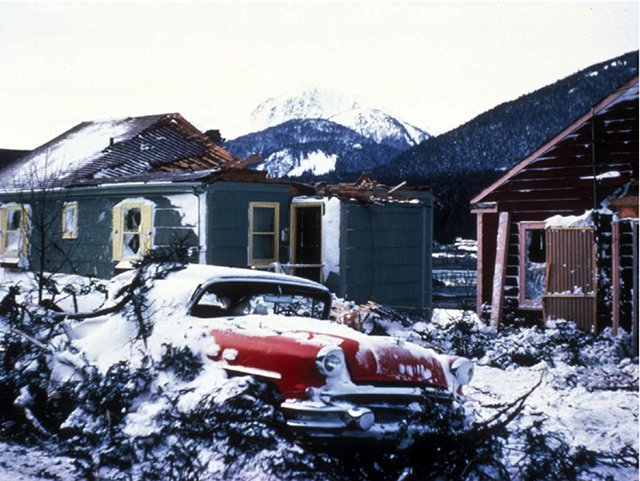
A 1962 avalanche on Mt. Juneau damaged cars and homes along Behrends Avenue. Photo courtesy City and Borough of Juneau.

Avalanches from Mt. Juneau pose an “unacceptable” risk to Capital City residents and property, according to a report being presented to the Juneau Assembly tonight (Monday).

Consultants from the Switzerland-based WSL Institute for Snow and Avalanche Research were hired by CBJ Emergency Programs Manager Tom Mattice to examine the Behrends Avenue and White Subdivision paths and recommended mitigation strategies.

The report says the most effective way to reduce avalanche risk from the Behrends path is to have the city buy at least 28 homes in the neighborhood below, and prohibit future development there – a recommendation the Assembly has heard before. The report says the buyout should be done in phases, targeting the most at-risk homes first.

In the meantime, it recommends mandatory evacuations and closure of Glacier Highway and Egan Drive when avalanche danger is most severe.

The consultants concluded that Juneau Douglas High School would not sustain any damage, even from the largest possible avalanches.

Also tonight (Monday), the Assembly will receive the first draft of an AJ Mine related water study.

The Assembly directed the CBJ Engineering Department to do the study last year after a citizens committee looked at what it would take to re-open the old mine near downtown. The AJ ore body, which is partially owned by the city, sits beneath and adjacent to Juneau’s main source of drinking water – Gold Creek in Last Chance Basin. If the city moves forward with efforts to re-open the mine, the AJ committee recommended efforts to reduce the risk to the water system.

The study discusses five scenarios, ranging from no action – meaning no mining and no change to the water system – to efforts to make the city’s secondary water source, Salmon Creek, into a year round supply. One option is to abandon the Gold Creek supply and build a new system. But the study says this is the most expensive scenario and the city would have difficulty identifying an acceptable alternative source of drinking water.

Moving forward with an initial decision on re-opening the AJ Mine is one of the Assembly’s priorities this year.

CBJ Engineering Director Rorie Watt will be available tonight to answer Assembly questions. The next step will be to gather public comment, due March 28th. Comments can be submitted to the Engineering Department, and Watt will hold a public meeting to discuss the study next Wednesday, March 7th.

The Assembly will receive both reports tonight (Monday) at a Committee of the Whole work session scheduled to start at 6:30 in City Hall Assembly Chambers.

Links:

Behrends Avenue and White Subdivision Avalanche Mitigation Report

AJ Mine Related Water Study

Alaska Shield scenario like real winter

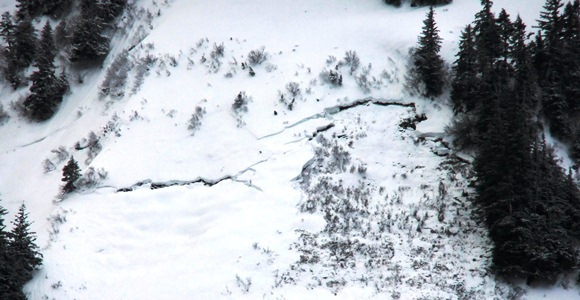
Snow fracture on avalanche path above Fish Creek Road. Photo by Rosemarie Alexander

Powerful winter storms, extreme cold, heavy snow, freezing rain and avalanches – that’s the winter Alaska has already had.

So last week most communities were prepared for table-top exercises testing the statewide coordination and communications capabilities of federal, state and local emergency responders, the military, some utility providers and the University of Alaska.

Alaska Shield 2012 ended Sunday. It began a week ago with a powerful winter storm to result in 100 mile-an-hour winds in Unalaska, avalanches in Juneau, and plummeting temperatures elsewhere. The storm was to be so mighty that city water lines would freeze, natural gas would be disrupted, there would be power outages, roads closed, trains derailed and fires.

The drills called for Anchorage, MatSu, the Kenai and Fairbanks residents to be without heat and water. Kodiak would lose communication.

In the capital city, the scenario was snow – sliding off the mountains. CBJ Emergency Program Manager Tom Mattice and public safety responders practice often for the real thing.

“The Juneau scenario is actually a large-scale avalanche that comes down and completely crosses Egan Drive,” Mattice said.

Just the week before Alaska Shield, though on a smaller scale, a real avalanche closed Juneau’s Thane Road and there were numerous avalanche paths sliding in the mountains around town.

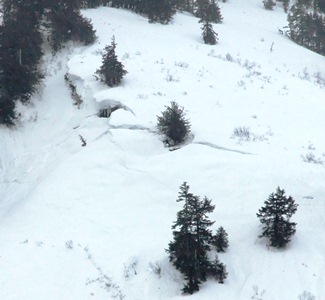
Fracture on Showboat trail outside Eaglecrest boundary. Photo by Rosemarie Alexander.


“Even if we had had a large scale event last week, the boots on the ground that are going to be out saving lives, they already know what’s going on,” Mattice said.

Each community adapted the scenario to fit what it needed to test. In Juneau, for example, Mattice brought together emergency operations center staff, who would be commanding the boots on the ground and coordinating with emergency managers statewide.

According to Alaska Emergency Management Director John Madden, some problems occurred, particularly in communications, and the point was to quickly correct them.

“We’re trying to build up our ability to perform the mission wherever it happens when the real event happens,” Madden said.

“Seems as though we’ve had real events all winter,” I noted.

“I started out with this overarching scenario about a year and a half ago, and I think I predicted far too accurately,” Madden said. “We had the Prince William Sound storms, the adventure with the Coast Guard ice breaker going up to Nome, and all the extreme cold we had throughout most of the state. I may stop predicting!”

The scenario was so real that Cordova and Valdez decided not to participate in Alaska Shield 2012. They’re still dealing with the impact of hundreds of inches of snow in early January.

Madden says Alaska Shield was preparing emergency responders for the right things.

“Oddly enough, we did a tsunami workshop and evacuation just a few months before the Japanese tragedy. We had something set up for December simulating a widespread Bering Sea storm, which hit in November,” Madden said.

If such bad weather were to strike, suddenly there would be need for statewide warnings, emergency management, shelters for large numbers of people, medical care, and utility repairs. And in each community, the University of Alaska has a presence. Rick Forkel is UA Emergency Management Director.

“Those of us at the campus would be dealing with the issue of student housing units and people and sheltering them temporarily anyway and having the ability to assess what the impacts going of all of our buildings being without power for who knows how long,” Forkel said.

He said UA also needed to test the campus incident management teams on each campus as well as statewide communications.

The Alaska Shield exercises bring everyone together under the state’s emergency operations center. The 2012 drill is leading up to Alaska Shield 2014. That’s the 50th anniversary of Alaska’s great earthquake and tsunami, when there were catastrophic failures in multiple communities that required statewide response.

Fierce winds hit Juneau

Winds were fierce throughout Southeast Alaska this morning. The National Weather Service says Sitka, Juneau and Yakutat had the highest gusts.

In downtown Juneau this morning, gusts reached 73 miles per hour atop the federal building, and 44 mph at the airport. Alaska Airlines cancelled morning flights.

National Weather Service forecaster Rick Fritsch says winds in Hoonah reached 56 miles an hour, Elfin Cove, 53 mph, and Sitka winds were clocked at 86 miles per hour.

“But the winner, which occurred this morning between 6 and about 8, was the Eaglecrest Ski Area, here in Juneau: 133 mile-an-hour gusts this morning,” Fritsch says. “And those sustained winds were really quite healthy as well, 80 knots which equates to 92 miles per hour. No doubt the chair lifts were swinging something fierce,”.

Eaglecrest General Manager Matt Lillard says he heard this morning about the extreme winds from groomers.

“The cat drivers said it was shaking the cats as they were grooming up on the upper mountain,” Lillard says.

He says there was no damage, but signs, bamboo poles and rope lines were down. The lower mountain lifts operated this morning and by 11 a.m. winds subsided enough that the Ptarmigan chair lift to the upper mountain started running.

Despite high wind gusts at sea level, Alaska Electrical Light and Power reports no major outages.

About 4:45 a.m., though, the wind took down a large tree in the 17-mile area of Glacier Highway, hitting a power line. AEL&P says the tree hit a power line, suspending it between two other trees and causing electrical failures in three homes. Capital City Fire responded to the home of KTOO General Manager Bill Legere, where crews found smoke and what Deputy fire Marshal Sven Pearson calls a “red glowing electrical junction box that supplied power to the furnace.”

“Investigation team reported light smoke conditions inside the home that traced a circuit from the electrical panel that appeared to have been heavily charred,” Pearson says. “The homeowners stated that having working smoke detectors had aided in alerting them of the fire and to be able to safely evacuate the structure.”

Legere would go further:

“We’ve been very careful about having smoke alarms that work and fire extinguishers and a household emergency plan, and that smoke alarm undoubtedly saved our lives,” he says.

Pearson says there were multiple reports of electrical issues from nearby home owners after the tree hit the power line.

Urban avalanche season is here

Heavy wet snow slithered down the gullies above Thane Road Tuesday as a Department of Transportation crew conducted avalanche control.

It was the second time this winter that DOT brought down snow before it could slide.

The road was closed for about two hours. Southeast Maintenance and Operations Manager Greg Patz says the snow stopped just short of Thane Road and no cleanup was necessary.

Urban avalanche danger in Juneau has been high since the rain started to fall on Monday. That has created an upside down snowpack — with high density and wind-driven snow over the looser, lighter stuff that fell over the weekend.

Patz says Tuesday’s controlled slides show more stability than avalanche forecasters expected.

“With all the snow that we’ve gotten, and then with this heavier wetter snow on top of light snow, you’d would expect anything triggering it to cause some big slides and maybe as they come down to pull out more of the deeper snow. And that didn’t happen, so it kind of seems to indicate that maybe there’s a little more stability,” he says. “That’s not to in any way underplay the avalanche danger out there, but we didn’t cause a big movement and big slab avalanches.”

The avalanche crew fires the mortars from a gun mount on a platform at Treadwell on Douglas Island, across Gastineau Channel. Patz says the avalanche crew shot 21 rounds into the main avalanche paths about the road.

“We view it as three main chutes, and there are points that we like to shoot around each main avalanche gully or chute,” he says.

DOT does avalanche control along Thane Road two to three times a year, according to Patz.

Meanwhile, avalanche danger today (Wednesday) in Juneau is moderate to considerable, according to CBJ Emergency Programs Manager Tom Mattice.

In his daily report at juneau.org/avalanche, Mattice says it will be considerable overnight tonight. He expects it to be high again from Thursday through mid-day on Friday. Mattice updates the avalanche warning every day at 7 a.m. and as conditions change.

Update: Weather cancels hundreds of flights

Courtesy Alaska Airlines
Alaska Airlines had canceled six flights into and out of the capital city by 3 p.m. today (Friday), due to the wind.

The airline is still backed up due to Thursday’s snow and freezing rain in Seattle. But company spokesman Paul McElroy says schedules should be back to normal by tomorrow. By the end of the weekend, everybody who was booked on a flight that was canceled should be where they had planned to go.

Thursday’s weather forced the cancellation of 387 Alaska Airlines and Horizon Air flights in and out of Seattle, affecting 32,500 passengers.

“For the most part we operated a normal schedule as long as you weren’t touching Seattle,” he says.

Alaska operates about 120 flights a day out of Seattle Tacoma International Airport, 30 percent of its schedule.

McElroy says only 30 flights departed Seattle yesterday, but there were some arrivals.

“Once the airport was really open and we could have arrivals again, those airplanes were warm and we could more easily de-ice them and get them back out again,” he says.

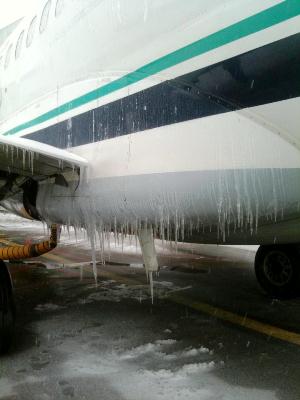
De-icing was one of the biggest problems. McElroy says it took about an hour to de-ice each jet, four times longer than usual. It also required quadruple the amount of deicing fluid.

“Oh my gosh, all those icicles dripping off the sides of our aircraft,” he says. “For a while yesterday we were even legally prohibited from flying just because the icing was so bad.

All airlines were prohibited from flying into and out of Seattle until 10 a.m. Thursday, due to the freezing rain.

If you’re one of the thousands of passengers trying to get on a flight, the airlines will rebook or refund the cost of the ticket. McElroy says change fees are also being waived until Wednesday.

Meanwhile, Juneau’s high wind warning remains in effect until tomorrow morning.

National Weather Service meteorologist Joel Curtis says winds reached 77 mph early this morning at the Douglas Boat Harbor.

“Eldred Rock has just been screaming as usual. Skagway has gusts to 60 miles per hours and it’s just windy wherever you can pick up a channel facing the north,” Curtis says.

Tonight’s Juneau-Douglas hockey games have been postponed until Saturday and Sunday, due to a flight cancellation.

The JDHS varsity will play West Valley at 5:30 p.m. Saturday, with the junior varsity game at 7 p.m. The varsity teams play again Sunday at 7:30 a.m. at Treadwell Ice Arena.

Tonight’s University of Alaska Southeast presentation on whale songs has also been cancelled. Backed up flights out of Seattle prevented whale researcher Jim Darling from flying to Juneau.

Site notifications
Update notification options
Subscribe to notifications