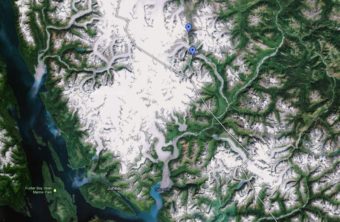
The state ferry LeConte ran into high winds and rough seas north of Juneau this morning (Friday) that forced it to turn around and head back to the Auke Bay ferry terminal.
Today’s sailings to Haines and Skagway were cancelled.
State marine highway chief, Captain Mike Neussl, says the LeConte was in a narrow channel when the decision was made to head back. So instead of turning around in the channel, the master decided to do it in Berners Bay.
“After they made the decision, hey we’re going back, they did intentionally have to steam further north in order to get to a wider part of the channel to make the turn around to come back south,” Neussl says. “They didn’t want to do that in a narrow channel.”
The LeConte was back in Juneau by 12:30 this afternoon.
Neussl says the captain reported 75 knot winds and 12 foot seas. The National Weather Service had issued a high wind warning for Juneau and Lynn Canal through 5 o’ clock tomorrow morning (Saturday). Neussl says it’s up to individual ferry captains to decide when to brave rough seas.
“Really it’s the master’s discretion. I know we have limits on our fast vehicle ferries, because they’re a little more weather sensitive than the larger steel-hulled displacement ships, which are little bit more tolerant of the weather,” he says. “But as usual, safety dictates first and if the master determines it’s not safe to continue, he has my full backing to turn around and come back.”
Neussl says all passengers on today’s northbound trip will be rebooked for Sunday, which is the next scheduled departure for Haines and Skagway.
Hold onto your hats and break out the thermal underwear, Southeast Alaska is in for a cold snap that could see temperatures dip into the single digits, bringing Taku winds along for the ride.
Edward Liske with the National Weather Service in Juneau says an Arctic air mass from the Canadian Interior is set to move into the region this weekend.
“That’s going to be spilling over the mountains starting this weekend and into next week, bringing us the northerly winds and really cold temperatures,” says Liske.
Temperatures should start to fall into the 20s and lower 30s over the course of today (Friday). This weekend, high temperatures are expected to range from the single digits in the north, to the mid-twenties in the southern panhandle. Lows will range from below zero to the low teens.
Juneau will see northeast winds 15 to 30 miles per hour, with gusts around 45 miles per hour over the weekend and into next week.
Liske says it’s not unusual for Southeast to experience a handful of cold snaps during an average winter. The last one was in November.
“It wasn’t quite as strong as this one is going to be. But it did get our temperatures down into the teens at one point, and that’s what started all of the snow in the latter part of November,” he says.
There won’t be any precipitation associated with this front, and Liske says it may be awhile before snow lovers get another dump of the white stuff.
“The first system that comes up from the southwest again, it’ll probably have so much cold air still lingering in the panhandle that it’ll mostly be snow. But when and how much, it’s still hard to tell. It’s way out there. It’s way in the long-range,” says Liske.
He says the cold, clear conditions should last more than a week.
This machine melts the snow and the water is dumped down storm drains. Photo courtesy Nick Barshay. Click to enlarge.
The snowed-clogged town of Cordova had rain Wednesday, adding pounds to the snow, increasing avalanche danger, and complicating the cleanup. The forecast calls for more snow over the next two days, then some sun.
The town needs the sun, says former Cordova Mayor Tim Joyce. He’s the new information officer for the small Prince William Sound community. The job didn’t exist until the world found out about Cordova’s 15-plus feet of snow.
Joyce volunteered to answer all those media phone calls coming into city hall.
He says the warmer temperatures and rain have helped somewhat, but it’s also made all that snow a lot heavier. Residents were evacuated from one apartment building earlier this week when the roof started to sag, jamming doors and windows. It’s one of the many roofs yet to be shoveled by residents and others who’ve come to the town to help.
Joyce says the Copper River Highway to the airport also has been closed due to high avalanche danger.
“During daylight hours, people are being escorted through by police, a little like a convoy kind of thing around the avalanche zones,” he says.
Large, scoop-type shovels – capable of moving a cubic foot of snow at a time — are expected in town by Friday. Joyce also describes a wonderful piece of equipment that came in from Anchorage.
“Basically, it’s a snow melter and it’s here!” he says. “We’ve been working on some of the snow that we’re pulling off the roads and got no place to put. We have like three backhoes feeding this thing as fast as they can. And it melts the snow and turns it into water. The only thing you have to do is make sure the drains are open so it has some place to go,” he says.
Sixty Alaska National Guard members have been helping state transportation crews, city workers and residents dig out those drains, shovel the roofs, and a myriad of other chores. Joyce sends a shout out to the guardsmen’s home towns.
“They all had jobs and their employers let them go to be able to come down and do this. And we really want to thank those employers wherever they might be in Alaska to let these guys come down here to help us,” he says.
Twenty-two crew members from the Coast Guard Cutter Sycamore have been working in the harbor, including shoveling floats, some of which had started to sink.
“They’ve also been really good because they had six mechanics assigned to us to help maintain some our heavy equipment, you know loaders and graders and stuff,” he says. “That’s been real useful.”
Too much snow to ski
Cordova is on Orca Inlet at the base of Mount Eyak. Two weeks ago, Joyce says, the Mount Eyak Ski Area had some of the best skiing Cordova has ever had.
“You know with two feet of powder, it was phenomenal skiing,” he says. “After our storm we have no skiing because the chairlifts are buried.”
Jan. 9, 2012. More snow has fallen since. Courtesy Mt. Eyak Ski Area. Click to enlarge.
The Mount Eyak Ski Area, elevation 1,230 feet, is operated by the Sheridan Alpine Association. Dave Branshaw is general manager.
“We had 15 feet at the snow stake, but that was a week and a half ago,” he says. “It’s snowed quite a bit since then, and it’s still snowing up there.”
Branshaw says even the 30-foot O tower close to the top of the mountain is nearly buried.
Here’s the message he put on the Mount Eyak Ski Area hotline earlier this week:
“After this storm blows through we’re going to start and it’s going to take us probably about a week to dig it out, depending on how much help we get.”
Mount Eyak’s historical chairlift dates back to Sun Valley, Idaho’s Mount Baldy, where it was first installed in 1936. It was moved to Cordova in 1974, and is one of only two single chair lifts still in operation in the U.S. The other, by the way is in Mad River Glen, Waitsfield, Vermont, which remains closed for lack of snow.
Branshaw says a crew started shoveling a path to Mount Eyak’s base buildings and shop on Wednesday. They still have to uncover the rope tow, the base of the chair lift, and midway station. Then they’ll tackle the top.
But first there’s the town to dig out. Branshaw says it’s like a job:
“Every day we’re starting with a shovel plan and we get our gear together and head out there and keep scoopin’,” he says. “We usually put in a solid eight hours every day.”
Valdez also breaks snow records
Another Prince William Sound community is struggling with more snow than it can handle.
Valdez normally has about 150 inches by this time of the year, but the National Weather Service says snowfall is up to 318 inches, or 168 inches more than usual.
Even so, the city is holding off on declaring a state of emergency.
The Valdez City School District earlier this week closed Hermon Hutchens Elementary School, because the roof had exceeded its snow load capacity. Then the high school roof exceeded its capacity, so the Valdez district has shut down schools for the rest of the week.
Hooter lift at Eaglecrest base.Photo by Rosemarie Alexander.
Not only does Eaglecrest have record amounts of snow for this time of year, it also did record business over the two-week Christmas and New Year’s holidays.
Now that the accounting is done, General Manager Matt Lillard says sales were up in all departments, from the number of day tickets sold to equipment rentals, ski and snowboard lessons, and the cafeteria.
“Percentage-wise we’re looking at over a 42 percent increase over the highest two-week period that I can track. We also had our busiest day on Saturday, December 31st, with approximately 15-hundred skiers (and snowboarders) up at the mountain,” he says.
He says the city-owned ski area also has had record season-pass sales in terms of revenue.
“Season pass sales to date are 778-thousand dollars, surpassing the record that was set in 2009 and 2010,” Lillard says. “Between the online sales and what actually takes place here (Eaglecrest office) it’s going to be probably around the 21-hundred, 22-hundred mark (individual season passes).”
Most ski areas make more money from daily ticket sales, while Eaglecrest has historically brought in most of its ticket revenue through season passes.
Eaglecrest opened the day after Thanksgiving for weekends only, then on December 16th it began operating every day through Monday, January 2nd. The holiday period is important to all ski areas, which stand to make 10 to 20 percent or more of season revenue. But across the U.S., many ski resorts had little or no snow last month.
According to skicentral.com, a database of North American ski resorts, 347 or 471 U.S. and Canadian areas are now open. Eaglecrest still has more snow than any other ski area in North America.
Eaglecrest is back on its normal operating schedule, open Thursday through Monday; closed Tuesday and Wednesday.
For the sixth time in seven years, the Alaska Department of Fish and Game is projecting a directed commercial fishery for Taku River King salmon in 2012.
The department says the number of Taku Chinook should be up from last season. The forecast calls for a summer run of about 48,000 Kings, with an allowable catch of about 6,700 for commercial fishermen in Alaska.
But fishery manager Kevin Monagle says projections don’t always turn into reality.
“In some cases we have had a number similar to this or maybe a little lower to go after, and we have decided to wait until we had in-season information and to make our management decisions based on that information alone, not the forecast,” says Monagle.
Case in point, in 2011 the forecast called for a run of about 41,000 Kings, with an allowable catch of about 1,500. But a directed fishery was not allowed once managers were able to collect in-season data.
Monagle says it can be a difficult fishery to forecast, because the Alaska catch is set according to a treaty with Canada, which shares the Taku with the United States. And Canada gets first crack at the fish.
“The first 5,000 fish surplus, Canada gets that and we get none of it,” says Monagle. “So, in recent years when you have very small surpluses to go after, if the forecast changes even a little bit – 2 to 4 percent – then that U.S. allowable catch goes away.”
Monagle says Canadian managers also regulate the Taku King fishery according to in-season data, and that biologists on both sides of the border are in regular communication before and after fishing starts.
May 1st is the first day a fishery is allowed to open in Alaska. Monagle says the department will release more information closer to that date.
The snow just keeps coming at Eaglecrest. Juneau’s city-owned ski area boasts more snow than any other ski area in North America, a distinction it has held since November.
The snow stake Tuesday morning read 140 inches at the top of the Ptarmigan lift and 63 inches at the lodge. Alyeska Ski Resort in Girdwood is also doing fine, with 38 inches at the base and 105 on top.
By comparison, Aspen Mountain, Colorado, had a base of 16 inches of snow; Sun Valley, Idaho had 20. Magic Mountain in Southern Vermont has 10 inches and two of 40 trails open. That’s where Eaglecrest’s general manager Matt Lillard recently worked.
Many ski areas across the continent are hurting for snow during this holiday season when they stand to make up to 20 percent, sometimes more, of their winter revenue.
A database of ski areas indicates 366 areas have opened, out of 469 in the U.S. and Canada. Many are running partial operations.
On those days when it’s raining at sea level, it’s probably snowing at Eaglecrest. According to the Juneau Forecast Office of the National Weather Service, temperatures decrease about three degrees for every one-thousand feet this time of year.
Close
Update notification options
Subscribe to notifications
Subscribe
Get notifications about news related to the topics you care about. You can unsubscribe anytime.