35-year-old Rob Liberman of Telluride, Colorado, was guiding a group of five skiers for Chilkat Valley company Alaska Heli-Ski when the avalanche occurred. It buried him and 26-year old Nickolai Dodov of Trukee, California.
Liberman is confirmed dead and Dodov was on life support at the Haines clinic Tuesday afternoon, awaiting transport to Harborview hospital in Seattle.
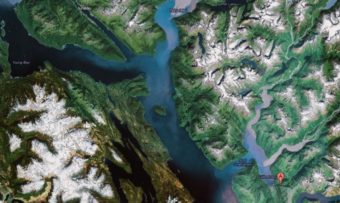
The avalanche occurred on Takhin Ridge, about 20 air miles northwest of Haines, and near a helipad used by skiers at mile 33 on the Haines Highway. One of the two men, who were buried about seven feet under the fallen snow, was skiing as a client with one of the area’s heliski companies. The other, was skiing as a guide.
“They were able to get them out of the snow and one was transported back to 33 mile, the other was transported to the Haines Clinic, and we have one confirmed fatality,” Alaska State Trooper Josh Bentz says.
The remaining ski party located the two missing men using avalanche beacon equipment. Other organizations, including the heli-ski company, skiers in the area, local fire departments, Troopers, and State Parks, helped transport the two men.
The surviving victim is being transported to Seattle. No other injuries were reported in the accident and all skiers are accounted for.
According to the Alaska Avalanche Information Center, Alaska has had the second highest number of avalanche fatalities since 1950, behind Colorado.
Fisheries Board member John Jensen, of Petersburg, and chairman Karl Johnstone, of Anchoage, review documents during their meeting in Ketchikan. Photo by Ed Schoenfeld.
Sport fishermen and chum trollers have reached a compromise in a salmon allocation battle in northern Southeast.
Chum salmon trolling is relatively new in Southeast.
“It’s only in the last 20 years, but particularly in the last four or five, the trollers have really been able to target hatchery chums,” said Eric Jordan, who represented the Chum Trollers Association at the Ketchikan Board of Fisheries meeting.
He said the Icy Strait and North Chatham Strait fisheries were worth $1 million to trollers last year.
They wanted the fishery to grow. So they put a pair of proposals, numbers 325 and 326, before the Fisheries Board.
One expanded spring harvest areas in Icy and Chatham straits. The other added a summer troll area in upper Stephens Passage, which is much closer to Juneau.
That didn’t go over well with capital city anglers. Larry Edfelt of Juneau-based Territorial Sportsmen says the plans encroached on popular fishing areas.
“We wanted to protect the king and coho access. And we were afraid that if you put 150 trollers into the north end of the Juneau area that a lot of juvenile kings and feeder kings and cohos would be caught in addition to a lot of chums,” Edfelt said.
Rather than butt heads before the board, they decided to work together on a compromise. The commercial group gave up much of what it wanted, while the sportsmen dropped objections to the remaining fishing grounds.
Jordan said it was a good deal for chum trollers.
“We ended up with less area and less time than we wanted in the new area on the Admiralty shore. But we figure we’ll have an even higher percentage of hatchery fish,” Jordan said.
He said the compromise allows trollers to target hatchery chums and hatchery kings, switching from one to the other as caps are reached.
Edfelt said the sportsmen are satisfied, because they were able to keep trollers out of popular fishing areas off the northern part of Juneau.
“They agreed to not only a reduced area but (also) a four-day fishery that did not include Friday, Saturday and Sunday,” Edfelt said.
The measure has a sunset clause, so the expansion will come back before the Fisheries Board in three years. And there’s more to the agreement.
“The chum trollers have agreed to not try to expand that fishery without gaining the consensus of the Juneau sport fishermen and charter fishermen, as well as the gillnetters,” he said.
The compromise is one of a number that developed during – or leading up to – the Fisheries Board meeting.
Jordan said that’s becoming more common. He says it’s good for Alaska’s fisheries.
“If the interest groups will get together and solve their own problems, as much as they have to compromise, they usually end up with a better deal than if the seven dark angels of the Board of Fisheries have to swoop in and decide it for you,” he said.
He credits the board, particularly Chairman Karl Johnstone, for encouraging negotiations.
Johnstone said he puts the proposals with the most impact before the whole board, rather than running them through a committee. He said that seems to quell some of the controversy.
“And the wind kind of goes out behttp://ktoo.sandbox.5mts.com/wp-admin/post.php?post=15264&action=edit&message=10cause everybody has pretty much decided one way or the other what’s happened. And the rest of the proposals are available and people seem to be more conciliatory,” the retired judge said.
Gillnetters, Fish and Game Department staff and a charter group joined the chum trollers and the sportsmen in drafting this particular compromise.
Their measure passed the board on a unanimous vote.
The braided channels of the lower Taku River, east of Juneau. Photo courtesy AK Department of Fish and Game.
Sport anglers will not get to fish for king salmon in the Taku River. And personal-use fishermen won’t be able to use dipnets or have a longer sockeye season.
The state Board of Fisheries rejected several requests to change Taku River fishing during its meeting in Ketchikan. The salmon-rich waterway, east of Juneau, runs from British Columbia to Taku Inlet.
The sport Chinook fishery was proposed by the Taku Users Group, representing riverbank cabin-owners. Fish and Game Department staff warned it could violate an international agreement governing fisheries from Oregon to Alaska.
Juneau board member Bill Brown spoke in opposition.
“It flies in the face of the history we have about fresh water salmon fishing,” Brown said. “Also, we have a problem with treaty fish. That’s an ugly nightmare we don’t want to open yet again.”
Some of the same objections came up with other proposals from the Taku Users Group.
One would have extended the personal-use fishery from mid-June through August to coincide with a gillnet opening. Another would have increased the household bag limit based on the number of family members.
Yet another would have allowed personal-use dip nets in the river, which Juneau residents access by boat.
Talkeetna board member Tom Kluberton said it would be popular.
“I think we would unleash a tremendous dip net fishery from boats down that way. That would offer much more opportunity to go and try for this harvest,” Kluberton said.
But other concerns, including salmon treaty implications, led the board to vote the proposal down.
It also rejected an Alaska Trollers Association plan to increase access to Taku River kings. Trollers proposed lengthening openings and changing how they are determined. Now, they’re tied to the gillnet fishery, which has a larger harvest.
Kodiak Board member Sue Jeffrey said she understands trollers want an equitable share. But she said the plan would create more conflicts.
“This is an area where we should just back off for now and let the rebuilding continue. So I’m leaning away from supporting this,” Jeffrey said.
Like other Taku River proposals, it failed on a unanimous vote.
Eaglecrest racer. Photo by Randy Bates. Kids are training and ski racing every weekend at Eaglecrest Ski Area. But when was the last time their parents ran the gates? They’ll get a chance on Saturday at the Town Downhill.
Skiers and snowboarders of just about any age can race in the Giant Slalom, says Juneau Ski Club head coach Dan Ord.
“If you are up there and out of control, if you really can’t ski, we’re going to reserve the right to say this might not be for you,” he says, laughing. “But as far as a 10-year-old kid wanting to challenge his mom or his dad to a race, it’s not going to be a downhill, it’s going to be a GS set on a course, coming down upper Hilary’s, rockin’ through the throat and all the way down lower Hilary’s.”
It’s been years since public races were held at the city-owned ski area. Ed Squibb recalls the three-race Rainier Challenge in the mid-1980s:
“We combined the times of all three races. We started in the West Bowl and went straight down Raven and Log Jam. It was incredibly fast. And we’d usually go down Cheechako and start right under Steep Chutes,” he says. “And then toward the end of the year in the spring we started in the East Bowl, right about were the rope line is. We came through there and under Steep Chutes and down Cheechako. That was a fast one, too.”
The winner of the Challenge got a pair of K2 skis topped with the Rainier beer logo. That’s not the case this year, but there will be prizes (and T-shirts).
Contest categories are ages 10 to 12, 13 to 16, and 17 and over.
Squibb will be setting the course. He says it won’t be a conventional GS; instead, turns will be more open to accommodate snowboarders. He also plans to race.
That means he’ll be competing in the category of 17 and up at age 60-something.
“You can’t get rid of the (race) bug, I guess,” he says.
The race includes two runs – one in the morning and one in the afternoon — with free BBQ in the middle.
Squibb and Ord say they’ve been planning the Town Downhill since early fall and hope it’s the first of an annual public race program at Eaglecrest.
Fish descenders, or safe-release devices, are displayed at the Board of Fisheries meeting in Ketchikan. Photo by Ed Schoenfeld.
Guided fishermen will have to return deep-water rockfish to a safe depth under a plan approved this week by Alaska’s Board of Fisheries. The proposal is an unusual compromise between longliners and charter-boat operators.
Yelloweye live a couple hundred feet below the ocean’s surface. So the rockfish usually die when they’re reeled in – because of the difference in pressure.
That occurs when fishermen are over their limit and throw them back.
“It does happen relatively frequently, particularly with declining halibut stocks, there’s increased pressure on DSR resources,” says Heath Hilyard, executive director of the Southeast Alaska Guides Organization.
The group, called SEAGO, represents about 40 regional charter-boat operators.
DSR is short for demersal shelf rockfish, a group of near-shore bottom-dwellers. Yelloweye are the most sought. They’re sometimes called Pacific red snapper or red rock cod.
Yelloweye rockfish. ADF&G photo.
A variety of devices can be used to return the rockfish safely. The most basic are weighted milk crates.
“Essentially, they are put in the crates upside down, dropped and then they pull the line back up and the fish can swim away at depth, increasing survivability,” he says. “There’s reverse hooks and a variety of different mechanisms that can be used. Ultimately, you bring the fish back down to a reasonable depth to where they can survive and then pull back the line.”
He says up to 90 percent of caught rockfish survive when quickly returned to deep waters. Only about 10 percent make it when released on the surface.
The Board of Fisheries considered several yelloweye proposals at its Ketchikan meeting.
One, from the charter group, would have increased the sport allocation at the expense of the commercial sector. It was unanimously voted down.
A closeup of EcoLeeser, one brand of fish-release device.
Two others, one from the guides group and the other from Sitka’s board advisory committee, required safe, deep rockfish release.
The approved measure was a compromise among charter and commercial interests.
The conflict came before the fish board about half-a-dozen years ago.
“And at that time the board told both of us to figure out a way to live within your allocation,” says Linda Behnken, executive director of the Alaska Longline Fishermen’s Association, known as ALFA.
She says commercial fishermen put together a conservation network. It began mapping the seafloor, identifying where the accidental yelloweye harvests are high.
“Fishermen are moving their gear out of the high bycatch areas. We saw a 20 percent reduction in the bycatch rate of the fishermen participating in this network. The commercial fleet has not been over its allocation in the last six years,” she says.
She says her group was unhappy charter operators wanted to increase their take after several years of exceeded allocations.
Despite many battles over halibut, longliners and charter groups worked together on the compromise that was passed.
Behnken says the plan originally included individual sport fishermen. But that changed on the advice of Department of Fish and Game staff.
“They suggested we make it charter-only because of the implications of educating every sport angler about having to have one of these devices and release at depth. Then we both signed on,” she says.
Longliners mostly target halibut, not yelloweye, so their harvest is bycatch they’re allowed to keep, within limits.
But the guide organization’s Hilyard says more charters are chasing the rockfish.
“It’s not a species that a lot of our guys go out of their way to target. But it’s a natural bycatch for halibut. And with halibut declining, there’s increased pressure because it’s an additional species that clients can catch,” he says.
The safe-release requirement goes into effect next year. Hillyard calls it a key conservation measure.
Fisheries Board members Mike Smith of Fairbanks, Tom Kluberton of Talkeetna and Vince Webster of King Salmon discuss proposals during a break. Photo by Ed Schoenfeld.
The state Board of Fisheries today (Tuesday) decided to continue allowing sport anglers to use electric reels. The panel voted down a proposal prohibiting power-assisted reels, except for disabled sport fishermen.
Supporters say it’s just one more piece of gear in an ever-expanding toolbox. Opponents say it’s too easy, and gives too much access to commercial black cod stocks.
Current rules limit the size and weight of powered gear, but not who can use it. The proposal would have limited use in Southeast Alaska to people with disabilities.
Author Steve Merritt, president of the Alaska Trollers Association, testified power-assisted reels are taking the sport out of sport fishing.
“I mean it also on the principal of fair chase. We have rules for no night scopes, spotlighting deer, all involving electricity. That’s not really considered fair chase,” he said.
Some sport fishermen use electric reels to target black cod, which are also called sablefish. The deep-water dwellers can be hard to catch without power assistance.
A Penn 50 Motor Drive electric reel, one of many targeting the sport-fishing market. Photo courtesy Dolphin Electreel.
“Outlawing electric reels would close the black cod fishery in Juneau and the northern Chatham area. We fish in 1,500 to 2,000 feet of water there. It takes 10 minutes just to get the bait down,” Edfelt said.
Guided fishermen also use the devices. Richard Yamada of the Alaska Charter Association testified the plan is the wrong way to approach the issue.
“I think this proposal was a go-around to just restrict, to try to control harvest of sablefish. And I think the appropriate way is bag limits,” Yamada said.
Board of Fisheries members voted 6-1 against the proposal. Petersburg’s John Jensen was the only one in support.
Member Sue Jeffrey of Kodiak said it’s a social issue.
“I liken this to a debate in Kodiak about whether we should allow people to hike up a mountain on 4 wheeler versus on foot. The outdoors is for all users and for some people, just getting out in a boat on the water is sporting enough,” Jeffrey said.
Representatives of local Board of Fisheries advisory committees voiced support for the proposal.
Department of Fish and Game staff said the best way to reduce power-reel use would be to ban it all together. They said existing rules could allow disabled people to use the devices.
The proposal was among 145 before the board. Deliberations continue through Sunday.