Alaska Native Government & Policy

Tribal members call for transparency after Tlingit and Haida ends review of allegations against president

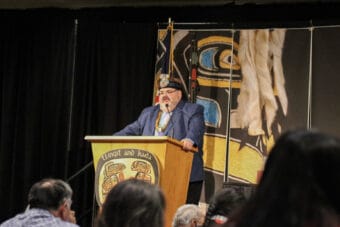
Chalyee Éesh Richard Peterson, president of the Central Council of the Tlingit and Haida Indian Tribes of Alaska, speaks at the 90th annual Tribal Assembly in Juneau on Wednesday, April 18, 2025. (Photo by Clarise Larson/KTOO)

The Central Council of the Tlingit and Haida Indian Tribes of Alaska’s executive council says it has concluded its review of abuse allegations against its president, Chalyee Éesh Richard Peterson.

He returned from a brief personal leave last week. His time away from his role coincided with the wide circulation of sexual abuse accusations made by his former fiancée on social media.

On Friday morning, the tribe’s executive council — which includes the president — hosted its regular monthly meeting.

The tribe’s first Vice President, Ku.seen Jacqueline Pata, briefly acknowledged the allegations. Pata did not directly identify Peterson in her remarks.

“Tlingit and Haida has been reviewing an employment matter with the assistance of outside counsel following a social media post concerning the private personal lives of current and former employees,” she said. 

Tlingit and Haida is Alaska’s largest tribal government. Peterson has been its president for more than a decade. He attended the meeting on Friday and did not speak to the allegations during his presidential report. 

Pata originally informed Tlingit and Haida staff in an email earlier this month that the tribe’s executive council was aware of the online accusations. She wrote that the council was taking the matter “very seriously” and initiated a review. Pata served as acting president in Peterson’s absence. 

Pata said the review focused on whether inappropriate conduct occurred in the workplace and whether the tribe has effective measures to uphold workplace respect and accountability. She said the council also conducted a broader review of the tribe’s policies, procedures and reporting mechanisms. She said that review led to the council adding a third-party reporting system and additional training to its policies and accountability systems. 

“With the review of this matter now concluded, we are confident in moving forward with strengthened policies and supports in place,” she said. “Tlingit and Haida remains committed to providing a respectful and welcoming workplace that honors our traditions and culture and reflects tribal values.”

She did not disclose the results of the reviews and the tribe has not responded to questions regarding the allegations. In 2019, Pata stepped down as the executive director of the National Congress of American Indians after nearly two decades. Her resignation came after she was placed on administrative leave following allegations regarding her handling of sexual and workplace harassment reports.

The meeting was open for public comment. Multiple tribal members testified, asking for transparency regarding the allegations and what the tribe’s executive council is doing to address them. Stláay Cloud-Morrison testified that she is a survivor of sexual assault, and said the allegations made her think about what the tribe owes its citizens.

“It’s deeply troubling when serious complaints are not handled with [the] honesty and respect they deserve,” she said. “Only through genuine transparency can our tribe demonstrate respect for survivors and a real commitment to healing.”

Following the accusations earlier this month, local Alaska Native artist and activist Chloey Cavanaugh gathered more than 350 signatures demanding Tlingit and Haida hire an independent, trauma-informed investigator to review policy and leadership behavior. She testified at the meeting on Friday — and said the issue raised broader questions about accountability in tribal government. 

“I realized through this process that there’s really no way for us tribal citizens to contact our delegates and talk to those that represent our communities to be able to voice our complaints or things that we’re seeing that we don’t like,” she said. 

The tribe’s executive council is required to adhere to a code of conduct adopted by the tribe. 

The code states that members must not engage in “any form of sexual harassment, coercion, or misconduct” and that members are required to self-disclose if they believe their actions fall short of council standards and may negatively impact the perception of the tribe. The code states that violations may result in disciplinary action, up to and including removal from office.

No criminal charges have been filed against Peterson as of Friday. 

Tlingit and Haida tight-lipped following abuse allegations against president

Chalyee Éesh Richard Peterson, president of the Central Council of the Tlingit and Haida Indian Tribes of Alaska, speaks at the 90th annual Tribal Assembly in Juneau on Wednesday, April 18, 2025. (Photo by Clarise Larson/KTOO)

The president of the Central Council of the Tlingit and Haida Indian Tribes of Alaska, Chalyee Éesh Richard Peterson, has returned from personal leave following accusations of misconduct that circulated widely online earlier this month.

Tlingit and Haida is Alaska’s largest tribal government. Peterson has been its president since 2014. His personal leave last week coincided with abuse accusations made by his former fiancée that spread broadly on social media.

The tribe’s first Vice President, Ku.seen Jacqueline Pata, informed Tlingit and Haida staff in an email shared with KTOO that the tribe’s executive council was aware of the online accusations. She wrote that the council was taking the matter “very seriously” and initiated a review. Pata served as acting president in Peterson’s absence. 

“This process is being handled with care, respect and a strong commitment to fairness for everyone involved,” she wrote. “Our priority is to ensure that all employees are supported and protected in matters relating to their employment and that our policies reflect those protections.”

Last week, tribal spokesperson Dixie Hutchinson said in a written statement that the council “initiated an internal review and confirmed our workplace policies and practices remain sound.” 

“In addition, we have engaged independent human resources and employment law experts to assess the Tribe’s existing policies and ensure they reflect best practices, grounded in our tribal values,” she wrote.

Hutchinson did not respond to a question asking whether the review was of Peterson’s alleged conduct or of the tribe’s policies and did not answer any other questions. She did not say whether the tribe’s policies and practices address informal allegations.

As of Tuesday, no official charges have been filed against Peterson, and the tribe has not confirmed whether a formal complaint was made against him. 

The tribe’s executive council, which includes the president, is required to adhere to a code of conduct adopted by the tribe. 

The code states that members must not engage in “any form of sexual harassment, coercion, or misconduct” and that members are required to self-disclose if they believe their actions fall short of council standards and may negatively impact the perception of the tribe.

The code states that violations may result in disciplinary action, up to and including removal from office.

Following the accusations, some tribal members have asked for more transparency from the tribe. A petition started by local Alaska Native artist and activist Chloey Cavanaugh has gathered nearly 300 signatures. It calls on Tlingit and Haida to hire an independent, trauma-informed investigator to review policy and leadership behavior in light of the accusations. 

The executive council’s next regular meeting is on Friday and will be open for public comment.

Tlingit and Haida reviews president following abuse accusations

Chalyee Éesh Richard Peterson, president of Central Council of the Tlingit and Haida Indian Tribes of Alaska, speaks at the 90th annual Tribal Assembly in Juneau on Wednesday, April 18, 2025. (Photo by Clarise Larson/KTOO)

The executive council of the Central Council of the Tlingit and Haida Indian Tribes of Alaska is reviewing misconduct accusations made against its president, Chalyee Éesh Richard Peterson. 

That’s according to the tribe’s first Vice President, Ku.seen Jacqueline Pata, in an email sent to staff earlier this week. 

The review comes after a former fiancée of Peterson made accusations of abuse on social media in late July. The posts circulated widely online this week. Pata confirmed in a staff email that the tribe’s executive council was aware of the accusations and taking the matter “very seriously.”

“This process is being handled with care, respect and a strong commitment to fairness for everyone involved,” she wrote. “Our priority is to ensure that all employees are supported and protected in matters relating to their employment and that our policies reflect those protections.”

The tribe’s spokesperson, Dixie Hutchinson, said Peterson is on personal leave and is anticipated to return sometime next week. Pata is serving as acting president in his absence. 

As of Friday afternoon, no official charges have been filed against Peterson. He has been president of the tribe since 2014. Tlingit and Haida is Alaska’s largest federally-recognized tribal government.

Judge throws out case against Eklutna Tribe’s casino

Dan Amadon is one of the first patrons to visit the casino during a private opening in January.
Dan Amadon was one of the first patrons to visit the casino during a private opening in January. (Photo courtesy of Chin’an Gaming Hall)

The Eklutna Tribe has operated its new casino outside Anchorage under the shadow of two separate lawsuits. A federal judge has dismissed one of those, filed by a group of property owners near the tribe’s casino in Birchwood.

With approval from the U.S. Interior Department, the tribe opened its Chin’an Gaming Hall on a Native allotment in February.

The property owners argued that the casino harmed the rural character of their neighborhood and claimed it would increase traffic, noise and raise the risk for water pollution. Their attorney, Don Mitchell, also challenged the Native Village of Eklutna’s status as a federally recognized tribe.

“Congress has never allowed a middle-ranking employee of the Interior Department to just wave a magic wand and create 200 Indian tribes, either in Alaska or any other place,” Mitchell said.

Mitchell is referring to Ada Deer, who served as Assistant Secretary of Interior during the Clinton administration. In 1993, she included Eklutna in a list of Alaska tribes to eliminate any doubt that they have the same status as tribes in the Lower 48. Numerous court cases have tried and failed to invalidate this decision. In a ruling on Friday, June 27, U.S. District Judge James Robart said the Eklutna lawsuit should be dismissed in “equity and good conscience.”

In a statement, Aaron Leggett, the president of the Native Village of Eklutna called the ruling a significant step forward, because it affirmed an important principle to the tribe — that its rights are firmly rooted in the land.

Tribal legal experts like Michelle Demmert says even one challenge to an Alaska tribe’s legitimacy threatens them all. They also consume time, energy and precious dollars, she says.

“Time and time again, the law is clear in these areas that continue to be challenged,” said Demmert, an attorney in the Tribal Governance Program at the University of Alaska Fairbanks. “If the argument was that the Eklutna tribe is not a tribe, there’s legal precedent. There’s federal law that says, ‘They are.'”

Mitchell disagrees that the federal law and courts have been clear on tribal jurisdiction in Alaska.

Depending on what the neighboring property owners decide, Mitchell says an appeal could be the next step, because the judge delivered a second blow to his case on Monday. Mitchell had asked the judge to reconsider his ruling, a motion he quickly rejected.

The tribe also faces another federal lawsuit, this one brought on by the Alaska Attorney general. It also aims to shut down the casino and contests the tribe’s authority over the land the gaming hall was built on land that was conveyed to the Ondola family under the Alaska Native Allotment Act of 1906.

The Chin’an Gaming Hall sits on about eight acres near the Birchwood Airport, which the tribe has leased from the heirs of the Ondola family. During the Biden administration, the Interior Department reversed course on an earlier decision that said Native allotments in Alaska could not be considered “Indian Country.” This step cleared the way for the casino’s approval.

Since the gaming establishment opened, it’s seen brisk business, sometimes with long lines waiting to enter. Chin’an means thank you in the Dena’ina language. For now, it’s a small gambling operation in a temporary building limited to electronic gaming. The Native Village of Eklutna hopes to build a permanent facility, so it can add restaurants and expand its operations. The tribe hopes to use the money to create jobs for its members and fund social and economic development programs.

Huna Totem Corporation opens enrollment to descendants

Huna Totem Corporation’s CEO Russell Dick at the corporation’s 2025 annual meeting on June 21, 2025. (Courtesy of Huna Totem Corporation)

Huna Totem Corporation shareholders adopted open enrollment last week at the village corporation’s annual meeting. That means that lineal descendants of original shareholders can now enroll and receive their own shares in the corporation. 

The vote wasn’t close — 71% of voters approved opening enrollment to descendants.

“It’s a recognition that we’ve got a future generation of leaders that are ready to come in and put their fingerprints on the future of not only the company, but of our culture and our heritage,” said Huna Totem CEO Russell Dick. 

He said the board discussed opening enrollment for decades. 

“They just said, ‘Look, this is time to get this done.’ It’s been 50 years of ANCSA, and it’s time for us to recognize the future generation.”

The Alaska Native Claims Settlement Act, or ANCSA, passed in 1971, creating the Alaska Native corporation system. It limited shareholders to those born before it became law — for Huna Totem, that was roughly 1,650 people. 

Until now, those original shareholders could gift shares to their family members or leave them to their descendants in their will. But often, their shares would be divided among multiple children, leaving younger generations with unequal shares to their parents and grandparents, Dick said.

“And for us to be able to come out and say, ‘you are a regular shareholder of this company, here’s what that means: you are the next generation of leaders for Huna Totem Corporation, the community of Hoonah,’ I think it’s a huge, huge thing,” he said.

Each descendant who enrolls will receive 100 shares, the same number as the original shareholders. Huna Totem did a study to see how many people qualify, and it estimated that 1,540 descendants of original Huna Totem shareholders are eligible.

Sealaska  — Southeast Alaska’s regional Alaska Native corporation — opened enrollment to descendants in 2007, and removed its blood quantum requirement that limited the enrollment of people with mixed heritage in 2022. Huna Totem may be the first village corporation in Southeast Alaska to open enrollment. 

Several corporations throughout Alaska have made similar moves in recent years. 

Pilot program for tribally-run schools on hold as Alaska lawmakers set aside bill

Deena Bishop wears a red sweater vest and sits on a blue chair in front of legislators.
Deena Bishop testifying before the House Education Committee on May 7, 2025. (Photo by Jamie Diep/KTOO)

Lawmakers are setting aside until next year a bill that would kick off a pilot program for tribally-run public schools. 

Rep. Andi Story, a Juneau Democrat, is a co-chair of the House Education committee. She said there isn’t enough time to move the House Bill 59 through the legislature this year. But she’s supportive of what tribally compacted schools can accomplish.

“Our education system was responsible for removing the language and culture, and so I think we have a responsibility to bring it back and have education opportunities through this tribal compacting,” Story said. “I think the details are just really important.”

The bill would fund and open five tribally-run schools through a state and tribal education compact, or STEC. 

Superintendents in affected areas testified in support of the bill at the most recent hearing for the bill. However, Nome Public Schools Superintendent Jamie Burgess said she wants to see case studies that show how opening a compacted school affects local school districts. 

“We are happy to support the development of a STEC school if that does move forward,” Burgess said. “However, I believe that there are still a great deal of questions for some schools. How it impacts each community is going to be unique.”

Story said stakeholders and tribal representatives will spend the time in the interim before next legislative session to get more feedback on the bill.

The Central Council of the Tlingit and Haida Indian Tribes of Alaska is one of the tribes that is involved in the program. Tribal representatives told KTOO earlier this month they plan to continue developing a new education campus if the bill doesn’t pass this year.

The current session ends May 21 and will reconvene next January.

Site notifications
Update notification options
Subscribe to notifications