Alaska Native Government & Policy

Judge denies Southeast Alaska tribes’ effort to dismiss Metlakatla fishing rights case

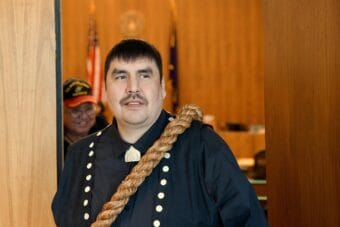
Metlakatla Mayor Albert Smith exits the courtroom at the Robert Boochever U.S. Courthouse in Juneau, Alaska following oral arguments in a fishing rights case on Feb. 15, 2024.
Metlakatla Mayor Albert Smith exits the courtroom at the Robert Boochever U.S. Courthouse in Juneau, Alaska following oral arguments in a fishing rights case on Feb. 15, 2024. (Eric Stone/Alaska Public Media)

A lawsuit from Alaska’s only Native reservation will proceed over the objections of other Southeast Alaska tribes. A federal judge last week declined a request from a coalition of tribes, including the largest in Southeast, to throw out Metlakatla Indian Community’s lawsuit challenging the state’s authority to regulate its fishermen.

Metlakatla Indian Community asserts in its five-year-old lawsuit that the state has no right to regulate the tribe’s fishermen. Its attorneys say that’s because when Congress created Metlakatla’s reservation in 1891, Congress implicitly included a federally guaranteed right to fish in nearby waters.

The state disagreed, saying Metlakatla members should be subject to the same rules governing the rest of Alaska’s fishermen. A panel of the Ninth Circuit Court of Appeals, though, sided with Metlakatla and sent the case back to U.S. District Court to determine where exactly Metlakatla’s members have the right to fish.

The case was headed for trial when a coalition of tribes, including the Central Council of Tlingit and Haida Indian Tribes of Alaska, weighed in, arguing it should be dismissed outright.

“They felt this was something that should be resolved between the tribes and not by a federal judge,” attorney Richard Monkman said in an interview.

The tribes argued granting Metlakatla’s members the right to fish in waters near Ketchikan and Prince of Wales Island would violate their rights to their cultural property.

“We would analogize this to other cultural rights, like dances, stories, carvings, other types of rights that all sort of fall under the general category of at.oow, in the Lingít language, or cultural rights, which belong to the clans and belong to the houses within clans,” Monkman said.

Metlakatla’s attorneys, however, argued that the right to fish in those areas wasn’t legally protected — in part because of the Alaska Native Claims Settlement Act. Chris Lundberg is an attorney representing Metlakatla.

“With the exception of Metlakatla, all Alaska Natives participated in that act,” Lundberg said. “In exchange for releasing all claims to aboriginal rights-type claims and claims to land and fishing areas, the tribes received compensation.”

There’s still a long way to go, and it’s unclear when it might go to trial — for one thing, the state has filed a motion to end the case without a trial — but Lundberg said the decision from Judge Sharon Gleason puts the case back on track.

Metlakatla Indian Community Mayor Albert Smith said in an interview he was pleased with the decision and is optimistic about the road ahead.

“Now we are excited about getting back to the main issue: restoring the community’s reserved fishing rights,” he said.

Haines and Skagway collect donations for people displaced by Typhoon Halong

The tops of several canning jars, labeled with stickers showing a formline illustration of a fish and the words "Saak Eix̲í"
The Chilkoot Indian Association will ship donations to Anchorage, including these jars of saak eix̲í, or hooligan oil. (Avery Ellfeldt/KHNS)

Haines and Skagway have joined communities across Alaska that are doing what they can to support the more than one thousand people displaced by ex-Typhoon Halong last month.

Skagway’s donation drive is focused on clothing and gear, as opposed to food. Residents have until the end of the day on Wednesday to drop items from a long list at the Dahl Memorial Clinic, the local health care facility. Donations will be handled by nonprofits in Anchorage.

“The items that they’re looking for are clothes of any sort, preferably new, sleeping bags and pillows and hygiene items like toothbrushes and things of that nature,” said Albert Wall, the clinic’s executive director.

Wall emphasized that people should bring items that are either new or gently used – and clean. Other acceptable donations include air mattresses, duffle bags, cell phone chargers and crafting supplies.

“We’ve had a pretty good response so far,” Wall said.

In Haines, meanwhile, the Chilkoot Indian Association initially asked the community to drop off traditional, harvested foods. But council President James Hart says they will accept any food donations, as long as they’re shelf stable and not expired.

“The preference would be something that you harvested,” he said. “But we shouldn’t be pushing anything away.”

On Monday, at the tribe’s downtown office, there were several boxes of canned goods, including sockeye salmon, homemade applesauce, highbush cranberry juice and hooligan oil.

Soon, there will also be three cases of canned seal meat. Hart, along with locals Zack James and Nels Lynch, harvested the seal in late October to contribute to the effort.

Hart said he knows first-hand how important it is to help when communities are struck by disaster, referring to the 2020 atmospheric river event in Haines that triggered widespread destruction and a fatal landslide.

“I know how much we pulled together as a community, and how much outside help we received, so having the opportunity to give back in that way is special,” he said.

“My heart goes out to all those folks and the challenges they’re going to be going through,” Hart added. “They just went through a whole harvest season, and I’d assume all of that has been lost. That’s so hard to hear and think about and even fathom.”

Cut off from their jobs at home, Alaska typhoon evacuees have alternative income options

Regina Qussauyaq Therchik, manager of workforce and shareholder development at Calista Corporation, shows information on a laptop on Oct. 29, 2025, to Stephanie and Carl Anaver of Kipnuk. Therchik was among the Calista representatives participating in a workshop at the William A. Egan Center in Anchorage that connected evacuated Yukon-Kuskokwim residents with temporary employment and job-training opportunities. The Anavers have been staying in Wasilla with a relative since being evacuated from their home region. The Egan Center has been serving as a temporary shelter and assistance hub for the hundreds of Yukon-Kuskokwim residents flown to Anchorage after their villages were devasted by the remants of Typhoon Halong. (Photo by Yereth Rosen/Alaska Beacon)

For wage-earning Alaskans who were displaced by the remnants of Typhoon Halong, a powerful storm that lashed the western coast of the state earlier this month, qualifying for one special type of federal assistance could be a cinch.

The U.S. Department of Labor’s Disaster Unemployment Assistance program provides financial benefits to people who cannot perform their normal jobs because of disaster interference. One qualification for the benefits — $153 to $370 per week for up to 27 weeks, according to the Alaska Department of Labor and Workforce Development — is an inability to reach normal worksites.

Among the hundreds of Yukon-Kuskokwim region residents who were evacuated by military flights to Anchorage, nearly 500 miles to the east of their home villages, those that held wage-earning jobs in their home villages easily meet that requirement.

Beyond that weekly benefit, many evacuees will need to earn income over what might be a prolonged period away from home. To meet that need, companies and government agencies are seeking to place evacuees in temporary jobs and training programs.

At the forefront of those efforts is Calista Corporation, the Alaska Native corporation for the Yukon-Kuskokwim region. It has a series of programs underway to help displaced residents find work and training.

Cleanup and recovery work is a logical opportunity for people from storm-damaged villages, said Thom Leonard, Calista’s vice president for corporate affairs. But there are some obstacles to starting those recovery jobs.

“One of the challenges is: When are they going to go, and where are they going to stay if they are able to go back to the villages?” he said. Villages that lack power, water and other basic services might not yet be able to house the people who would do the cleanup and recovery work to make those villages habitable again, he said. “It’s kind of a chicken-and-egg situation,” he said.

Bradley Cupluaraq Lake, a workforoceo and shareholder development specialist with Calista Corporation, holds up a brochure on Oct. 29, 2025, with information about the program. Calista is the regional Native corporation based in the Yukon-Kuskokwim region. Lake was one of the Calista representatives at the William A. Egan Center in Anchorage helping shareholders who have been evacuated to Anchorage from villages ravaged by the remnants of Typhoon Halong. Calista and other organizations are coordinating efforts to place evacuees in temporary employment or job-training programs. (Photo by Yereth Rosen/Alaska Beacon)

Calista’s construction and environmental services subsidiary, Calista Brice, has been enlisted in the disaster response and is hiring people from affected villages, Leonard said.

More generally, Calista and other partners held a career workshop on Wednesday for evacuees at the William A. Egan Civic and Convention Center in Anchorage, and more such events are planned. Through those events, Calista’s workforce and shareholder team, which operates a year-round program, is connecting displaced residents with job-training opportunities.

Calista has also offered temporary office space to tribal governments from Kipnuk and Kwigillingok, the coastal villages most heavily hit by the storm. The Kipnuk tribal government has taken Calista up on that offer, Leonard said.

Among the individuals getting help from Calista at the Egan Center on Tuesday were Carl and Stephanie Anaver of Kipnuk.

Stephanie inquired about the possibility of working as a home health care aide for her aged sister, and Carl was seeking a building maintenance job similar to the work he was doing at the Kipnuk Clinic. Regina Therachik, manager of Calista’s workforce shareholder development program, counseled them in Yup’ik.

Anchorage was not their first choice for a relocation spot, Stephanie Anaver said. “I wanted to stay in Bethel. But since Bethel was full, they brought us here,” she said in a brief interview.

Rather than staying in Anchorage, the couple has made a temporary home in Wasilla with a family member, she said.

The time in Southcentral Alaska is shaping up to be a period of limbo for the couple. Exactly when the couple will return to Kipnuk, or even if that is possible, is unknown, Stephanie said.

“If they relocate Kipunk to higher ground, yeah, I’ll go back to Kipnuk,” she said.

Tlingit and Haida’s plans for casino-like gambling hall in limbo after federal reversal

A “No Trespassing” sign hangs on a tree at the border of a Native allotment on Douglas Island on Friday, Sept. 26, 2025. (Photo by Clarise Larson/KTOO)

The Central Council of the Tlingit and Haida Indian Tribes of Alaska’s plan to open a casino-like gambling hall on Douglas Island may be in jeopardy. 

That’s after the U.S. Department of the Interior withdrew a legal opinion that gave Tlingit and Haida — and other tribes in Alaska — legal jurisdiction over Alaska Native allotments.

On Thursday, the U.S. Department of the Interior withdrew a Biden Administration decision that allowed tribes in Alaska to hold jurisdiction over Native allotments in the state. 

The National Indian Gaming Commission approved Tlingit and Haida’s proposal for a gaming hall on Douglas Island in January — just days before President Donald Trump began his second term in office. 

The land is a small parcel on Fish Creek Road, just a short drive from Eaglecrest Ski Area. It’s owned by tribal members who lease it to Tlingit and Haida. Rumors of the tribe developing something on that property have circulated for years.

Last month, Tlingit and Haida confirmed its plans to open the gambling hall. Construction is already underway. The tribe says the facility would be a step toward economic self-sufficiency and sovereignty. 

Construction is underway at a Native allotment on Douglas Island on Friday, Sept. 26, 2025. (Photo by Clarise Larson/KTOO)

Very few tribes in Alaska have authority over land, so they haven’t had a way to open reservation-style casinos like tribes in the Lower 48. Many, like Tlingit and Haida, have sought to assert authority over Native allotments owned by individual tribal members.

But following Thursday’s withdrawal, it’s unclear if the tribe will be able to open the gambling hall after all. 

The withdrawal is a return to decades of precedent. Federal and state officials in Alaska have long said that land allotments given to individual tribal members in Alaska were not considered “Indian country.” Therefore, they are not under tribal jurisdiction and cannot be home to federally regulated gaming halls.

But that opinion was briefly reversed during the Biden Administration when the Interior Department Solicitor released a legal opinion that expanded tribal jurisdiction in Alaska. That opinion is what provided an avenue for tribes like Tlingit and Haida to move forward with gambling halls.

In a statement on Monday, Tlingit and Haida spokesperson Dixie Hutchinson said the tribe anticipated the action and remains “committed to exercising our Tribal sovereignty to preserve sovereignty, enhance economic and cultural resources and promote self-sufficiency and self-governance for Tribal citizens.” 

Other tribes in Alaska, like the Native Village of Eklutna, had also begun to take advantage of the Biden-era ruling. In February, Eklutna opened a gaming hall on a Native allotment near Anchorage. But the State of Alaska filed a lawsuit to shut it down just days after it opened, arguing that the state still maintains primary jurisdiction over Native allotments. 

In a statement on Friday, Alaska’s new Attorney General Stephen Cox applauded the federal action. He said it “restores the jurisdictional balance Congress intended and courts have repeatedly affirmed.” 

According to the withdrawal memo, Tlingit and Haida’s approval for gaming from the National Indian Gaming Commission in January needs to be reevaluated in accordance with the revocation.

Alaska Native leaders say the USDA’s reorganization plan could threaten tribal food security

Tyonek Garden in 2024.
Tyonek Garden in 2024. Some Alaska Native leaders said the USDA reorganization could harm tribal agriculture.
(Photo from Tyonek Tribal Conservation District)

U.S. Secretary of Agriculture Brooke Rollins announced in July a plan to reorganize the Department of Agriculture, citing the need to decrease spending and bureaucracy. That plan is not final, but the current proposal includes consolidating tribal relations programs and personnel, according to the memorandum of the decision.

Leaders of the First Alaskans Institute, one of the state’s largest Native advocacy organizations, said the reorganization could diminish tribal voices and harm regional agriculture and food security.

Last month, the statewide nonprofit submitted a comment to USDA about the plan asking the agency to consult with tribes.

“We’re calling on the USDA to honor its trust responsibility by engaging in formal government-to-government consultation with Alaska’s 229 federally recognized tribes, before finalizing its organizational plan,” the president of the First Alaskans Institute, Apagruk Roy Agloinga, said in an interview.

“Food security for Native communities, it’s not just a policy issue,” Agloinga added. “It’s really a matter of survival, cultural continuity and self-determination.”

Another major statewide organization, the Alaska Federation of Natives, also urged the USDA to hold a tribal consultation on its plans, stating that the public comment period does not meet the requirements for consultation with tribal governments.

The USDA Office of Tribal Relations was created in 2010, after tribal farmers argued in court that the department discriminated against them.

Tikaan Silas Galbreath, the chief operating officer of First Alaskans Institute, said that the USDA’s reorganization plan might move the Office of Tribal Relations down from the higher-up secretarial level of the department. He said the change could diminish tribal access to USDA programs.

“It needs to be at that secretarial level to really have the influence that is required to really provide the services to the tribes,” Galbreath said.

Another USDA change that the First Alaskans Institute is concerned about is the consolidation of the Natural Resource Conservation Service program, which includes relocating its offices out of Alaska. Galbreath said the program has been helping Alaska tribes manage land and water resources and access traditional foods.

Galbreath said that access to USDA programs, whether to advance tribal agriculture or reindeer herding, is especially important in light of the changing environment.

“The change in the migratory patterns and the decline for many of the species has raised the question for a lot of our communities of, ‘How do we continue to provide protein security for our tribal members?'” he said. “The USDA and the programs available through the USDA are some of the solutions that are being looked at by the tribes.”

USDA did not respond to the comment the First Alaskans Institute submitted last month. However, the department did respond to a request for comment from KNBA, calling the proposed plan a first step to “right-size USDA’s footprint.” It added that the agency’s critical functions would not be affected.

The department has extended the public comment period on reorganization to the end of September and encouraged sharing feedback by emailing reorganization@usda.gov.

Sealaska announces first woman to lead the corporation as new president

Sarah Dybdahl sports an “Aunties Vote” sticker during the Nov. 8, 2022 election. (Photo by Paige Sparks/KTOO)

Southeast Alaska’s regional Native corporation has announced its new president. Aanshawatk’i Sarah Dybdahl will be the first woman to hold the position since Sealaska’s founding in 1972. 

The corporation’s board of directors voted to appoint Dybdahl, according to a press release. She currently directs the Office of the President at the Central Council of the Tlingit and Haida Indian Tribes of Alaska, and previously led the Huna Heritage Foundation. 

In her new role, she will manage Sealaska’s local operations, like their workforce development program.

Board Chair Richard Rinehart said the search for a president took longer than he imagined. But he said Dybdahl’s background in Alaska Native leadership made her a strong candidate.

“We wanted somebody that was going to have a new, fresh perspective, but still be very knowledgeable of where we’re at and what we’re trying to achieve,” Rinehart said. “And I think she has all of that.”

Sealaska changed its leadership structure amid the 2023 departure of Anthony Mallott, who served as both president and CEO. Now, the roles are separate. Terry Downes, the current Sealaska CEO, leads Sealaska’s business investments. Joe Nelson has served as interim president since last year and will continue to serve on Sealaska’s board.

Dybdahl was unavailable for comment Tuesday. 

“It is an honor to serve Sealaska and our shareholders,” Dybdahl said in the release. “Growing up in Klawock, I was shaped by the strength of our people and our culture, and I look forward to building on that foundation to create opportunities that uplift our communities for generations to come.”

Dybdahl’s salary is undecided, but Rinehart said it will be “competitive.” She starts next month.

Site notifications
Update notification options
Subscribe to notifications