Alaska Native Government & Policy

Tlingit and Haida president calls for unity amid federal uncertainty at tribal assembly in Juneau

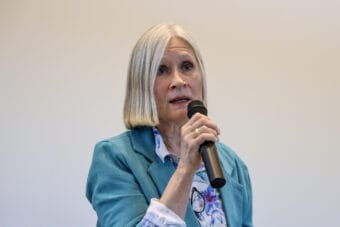
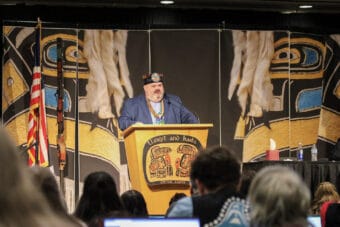
Chalyee Éesh Richard Peterson, president of Central Council of the Tlingit and Haida Indian Tribes of Alaska, speaks at the 90th annual Tribal Assembly in Juneau on Wednesday, April 18, 2025. (Photo by Clarise Larson/KTOO)

The president of Southeast Alaska’s largest tribal organization called for unity as proposed federal funding cuts could drastically impact the future of the tribe. 

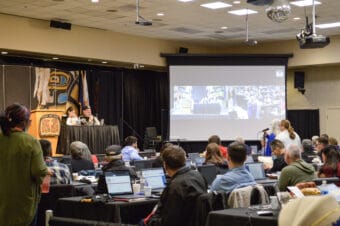
On Wednesday, more than 120 delegates of the Central Council of the Tlingit and Haida Indian Tribes of Alaska met for the first day of its 90th annual tribal assembly in Juneau. 

Its president, Chalyee Éesh Richard Peterson, told delegates during his State of the Tribe address to remember the values and strengths of their ancestors and fight for the tribe’s future.

“Today, we face new challenges, political division, environmental threats and the continued impacts of colonial systems,” he said. “But our power is in our connections to each other, to our land, to our ancestors and to the generations still coming.”

Peterson expressed concern to tribal leaders during an executive council meeting earlier this week about proposed federal cuts that he said have the potential to slash a third of the tribe’s funding from the government. 

During his speech to delegates, he specifically referenced a traditional food distribution program that was ended by the Trump administration. He said the cut is a setback in a much longer fight.

“Federal policies took our lands, restricted our harvest and undermined our food sovereignty,” he said. “This program was helping us rebuild that connection to our food, to our health and to who we are.”

The tribe also works closely with federal agencies like the U.S. Forest Service and the Bureau of Indian Affairs, which were both hit by the Trump administration’s sweeping federal workforce and spending cuts

The theme of the three-day assembly is “Honor the Past, Empowering the Future.” This year’s assembly is also a constitutional convention, meaning the tribe will consider proposed changes to its constitution. 

Delegates traveled to Juneau from different villages in Southeast Alaska, Washington and California. The tribal assembly will consider amendments to its constitution Friday morning before adjournment that evening. 

State seeks preliminary injunction against Eklutna Tribe casino

Aaron Leggett, president of the Native Village of Eklutna, and Ryan Walker, manager of the tribe’s gaming hall. (Rhonda McBride/KNBA)

The Chin’an Gaming Hall is in a doublewide trailer off the Birchwood exit on the outskirts of Anchorage, a far cry from a Las Vegas style casino, but there are often long lines of people waiting to get inside. Since it opened in January, its 85 electronic bingo machines stay busy.

This picture could change if the state is successful in its bid to shut down the gambling operation. Last Wednesday, the Alaska Attorney General asked a federal court in Washington, D.C. to issue a preliminary injunction against it.

This latest motion follows a lawsuit the state filed in February, after the federal government approved the project in the final days of the Biden administration.

The outgoing assistant secretary of Interior, Bryan Newland, gave the Eklutna Tribe final approval for the gambling operation on Jan. 16, one of his last acts before the Trump administration took the reins of power.

The tribe immediately went to work. In four-and-a-half days, it bolted together several modular buildings and opened its doors to limited gambling operations. The building, it said, was temporary and would eventually be replaced by a permanent gaming hall with about 700 machines and restaurants.

A security guard watches over rapid construction of the Chin’an Gaming Hall on Jan. 20, 2025. (Rhonda McBride/KNBA)

The project had been on the fast track since February 2024, when the U.S. Interior Department’s solicitor, Bob Anderson, issued a new opinion on the legal status of Native allotments in Alaska.

Anderson’s opinion upended previous court decisions on Native allotments in Alaska. He said under certain conditions Alaska tribes could operate gambling establishments, just as tribes do on Lower 48 Indian reservations.

After the new legal interpretation, the National Indian Gaming Commission and the Bureau of Indian Affairs green-lighted the Eklutna tribe’s proposed gaming hall. Anchorage Mayor Suzanne LaFrance also endorsed the project in her comments in a federal environmental review, despite a lawsuit filed by a group of neighboring property owners to block the gaming hall.

The neighbors claim it will change the rural character of their community and force them to pick up the costs of the new development, such as increased public safety services and road upgrades, because Native allotments are not subject to state and local taxes.

The tribe has promoted its gaming hall has a boon to the region, that could eventually bring 400 jobs and 70 million dollars in economic activity on an annual basis.

In a statement, Aaron Leggett, president of the Native Village of Eklutna, called this latest court filing against his tribe disheartening, a sign that Governor Mike Dunleavy is escalating his attack on tribal sovereignty.

“If Governor Dunleavy and Attorney General Treg Taylor are successful in their quest to preempt the Native Village of Eklutna’s tribal sovereignty and self-determination, it could mean an end to the Chin’an Gaming Hall and the permanent facility that the Tribe intends to develop,” Leggett said. “It will undoubtedly discourage other Tribes across our state in our communities.”

The Chin’an Gaming Hall sits on about eight acres of Native allotment land near the Birchwood Airport. Although it’s a tiny sliver of the 1.5. million acres of Native allotments in Alaska, it has become a huge test case for the state.

In a statement, Deputy Attorney General Cori Mills said the state’s jurisdiction over these lands is at stake.

“We are asking a court to reaffirm what it has already said—the State maintains primary jurisdiction over Alaska Native allotments. A solicitor’s opinion cannot convert them into Indian reservations,” Mills said. “We are asking for the court to make sure the issues can be resolved before further development occurs—we believe keeping the status quo best protects all parties involved. Once the litigation is completed, then everyone will know where their lane is.”

For now, the Native Village of Eklutna is staying in its lane and will continue to operate the gaming hall. The profits will be used to fund tribal health programs and create jobs for its members. Leggett said the tribe has struggled in the past to help its members but calls its gambling establishment an “incredible success.”

Excitement and raindrops as cruisers arrive in Juneau

The first cruise ship of the 2025 tourism season in Juneau, the Norwegian Bliss, arrives downtown on Monday, April 14, 2025. (Photo by Clarise Larson/KTOO)

The Norwegian Bliss and its more than 4,000 passengers arrived in Juneau this afternoon to kick off the 2025 cruise ship season. 

City officials say tourism this year is uncertain, but visitors and vendors started the season with  optimism. 

The familiar sounds of tourists chatting on the seawalk, shuttle buses in the street and chicken sizzling at Bernadette’s barbecue filled the air. 

Cruise ship visitors book tours on the seawalk in downtown Juneau on Monday, April 14, 2025. (Photo by Clarise Larson/KTOO)

Tourists meandered down the seawalk, into downtown stores and to the Mendenhall Glacier. Patricia Cespedes was headed to the Goldbelt Tram with her sister. She’s from Peru but currently lives in Los Angeles.

“It was always my wish that I really wanted to come and see Alaska. It always looks so beautiful,” Cespedes said. “It was on my bucket list.” 

Another visitor, Debbie Ohl of Pennsylvania, was on her way to catch a bus to the Mendenhall Glacier. She said she booked a trip early in the season on purpose. 

“I took the cruise because I want to see glaciers, and I want to see wildlife, and I want to see mountains with snow and anything they have to offer, because I love winter,” Ohl said. “Winter is my favorite.”

The blustery spring day might have felt like winter for some visitors coming from down south, as cold rain drizzled down on the docks. 

Cruise ship visitors walk the docks in downtown Juneau on Monday, April 14, 2025. (Photo by Clarise Larson/KTOO)

Tyrone Payne with Juneau Tours said sales were great and there hadn’t been any hiccups.

“We sold out of our whale watches immediately, in less than an hour, and all of our times for the shuttle have been sold out already,” he said. “We only have one time left for the day. So sales have been going really well.”

City officials have warned of economic uncertainty this season. That’s amid the Trump Administration’s tariffs and recent federal firings that could impact the operation of the Mendenhall Glacier Visitor Center, which is Juneau’s most popular tourist attraction.

A young tourist takes a photo of the Mendenhall Glacier on the first day of the 2025 cruise season on April 14, 2025. (Photo by Yvonne Krumrey/KTOO).

Out at the glacier, staff greeted the tourists who trickled in. It was Saaní Liana Wallace’s first day greeting the public as a cultural ambassador, and she said she was excited to talk to the visitors.

“It’s my very first minute, how do you like that?” she said.

The ambassadors were hired by the Central Council of Tlingit and Haida Indian Tribes of Alaska to share Indigenous language, history and culture with tourists. This year they may serve a larger role at the glacier, after the Trump administration’s federal firings left the Forest Service’s presence at there in flux. 

“You know, we’re going to do the best we can with what we got, and I’m feeling very optimistic about it,” said Cultural Ambassador Supervisor Aankadax̱steen Jeremy Timothy.

Timothy said he was eager to see how the first day of cruises goes, so the ambassadors can prepare for the rest of the season.

“I mean, we’ve gone through quite a bit of hardships and things back and forth, but, you know, I’m hoping that things kind of turn out in a positive aspect for us,” he said.

There won’t be any staff at the glacier on Saturdays, however, and Timothy said he doesn’t know what that means for visitors. 

But on Monday, the people coming off the buses were enchanted by the glacier, like Basilia Quintero from Mexico. She was a little overcome by the view — and the cold weather — but she said not even her imagination prepared her for the glacier.  

“The things that I’m seeing today—Sorry, I have the mouth frozen,” she said. “Not even in my dreams.”

Juneau is expected to see around 1.65 million passengers come off ships between now and late October when the season ends. The next ship, the Carnival Spirit, will arrive on Friday. 

Transfer to Alaska? Offer to health leaders called ‘insult’ to Indian Health Service

The exterior of a health clinic
The Cheyenne River Sioux Tribe Wellness Center is an Indian Health Service facility in Eagle Butte, South Dakota. This picture was taken in 2021 when the area was hard hit by the pandemic. (Dawnee Lebeau/Bloomberg via Getty Images)

The emails started arriving late on a Monday night.

“The Department of Health and Human Services (HHS) proposes to reassign you as part of a broader effort to strengthen the department and more effectively promote the health of American people,” the email read. “One critical area of need is in the American Indian and Alaskan Native communities.”

Amid the Trump administration’s massive layoffs at HHS, these reassignment emails accelerated an apparent purge of leadership at federal health agencies. Top officials in different parts of HHS were put on administrative leave with the option of relocating to a new job in Alaska, Montana, New Mexico or other postings within the Indian Health Service (IHS).

“I did not see this coming at all,” a senior executive at the Department of Health and Human Services told NPR. The executive asked not to be identified for fear of retribution from the administration.

William “Chief Bill” Smith chairs an organization that advocates for the IHS on behalf of tribes, the National Indian Health Board. “Any major leadership changes within IHS should be made in full consultation with Tribal Nations, as required by law,” Smith wrote in a statement to NPR. “Tribal Consultation is not just a procedural step—it is a fundamental responsibility of the federal government.”

“Utmost disrespect”

The number of health leaders who got the emails and the reasons for who was picked remain unclear. The email doesn’t specify what will happen to those placed on administrative leave if they don’t accept the offer.

HHS did not respond to NPR’s questions about the scope of the reassignment offers. NPR has confirmed nine leaders got the reassignment email; there may be more.

“The move displays the utmost disrespect for public service. It is clearly designed to force talented scientists and health experts to leave government,” says Richard Besser, CEO of the Robert Wood Johnson Foundation, a nonprofit philanthropy focused on health. “It is also an insult to those health care professionals in the Indian Health Service who dedicate their lives to providing health care services on tribal lands.”

It is unclear if anyone took the offer or plans to take it.

“I’m a career public servant. I’ve worked for Republicans and Democrats,” the HHS executive told NPR. “Public service is noble work and the ability to serve our country and impact entire populations just by coming to work is a gift. So there’s a sadness that comes with this.”

Connections to Fauci

At the National Institutes of Health (NIH), some sources who spoke to NPR suspect the targets were picked as retribution dating back to the pandemic.

Dr. Jeanne Marrazzo, who took over as the director of the National Institute of Allergy and Infectious Diseases after Dr. Anthony Fauci departed, got the offer, according to an email obtained by NPR.

So did Fauci’s wife, Christine Grady, the top bioethicist at NIH, along with two others close to Fauci, according to a source who was not authorized to speak about the situation.

Fauci, who left the NIH in 2022, became a hero to many during the pandemic, but has also been vilified by critics of the government’s response. Dr. Francis Collins, who also worked closely with Fauci as NIH director, was recently forced out of the agency.

The offer appears to be “an opportunity to try and say they’re not being let go, they’re being offered a new opportunity,” said Susan Polan, associate executive director of the American Public Health Association. But that “does not seem to be the ultimate goal. The goal really does seem to be to undermine the leadership in these agencies.”

IHS used as “a pawn”

Polan spoke during a briefing last week by public health advocates and officials decrying cuts of about 10,000 workers at the Centers for Disease Control and Prevention, the Food and Drug Administration, the NIH and other agencies.

“IHS needs are not being met and it is being used as a pawn in the game of forcing HHS staff to resign instead of being fired,” Polan added later in an email to NPR.

“It’s a way to try to get people to quit,” added Dr. Phillip Huang, director of Dallas County Health and Human Services, at the briefing.

The Indian Health Service provides crucial services and deserves to be adequately staffed with the most qualified workers, Huang and others at the briefing said.

The officials, who got the offer on Monday, March 31 or Tuesday, April 1 had until 5 p.m. on Wednesday, April 2, to respond to the offer, according to the email obtained by NPR.

The email reads: “This underserved community deserves the highest quality of services, and HHS needs individuals like you to deliver that service.” It is from Thomas J. Nagy Jr., deputy assistant secretary for human resources at HHS.

Reassignment locations

Nagy’s email gives the officials the options of working in a variety of places that are a mix of states, cities and reservations. They appear to correspond to IHS areas, an official designation, with some exceptions. This is the list from the email:

  • Alaska
  • Albuquerque [New Mexico]
  • Bemidji [Minnesota]
  • Billings [Montana]
  • Great Plains [South Dakota, North Dakota, Nebraska, Iowa]
  • Navajo [Arizona, New Mexico, Utah]
  • Oklahoma

“We would like to understand your preference across these potential reassignment opportunities,” the email says.

“Specifically, we would like to know which regions you would accept a voluntary reassignment and the order of your preference, if any, across the regions,” it states.

Health leaders offered transfer

According to sources who shared information with NPR on the condition of anonymity because they are not authorized to speak to the press, officials in addition to Marrazzo and Grady who received the IHS reassignment offer include:

– Dr. H. Clifford Lane, deputy director for clinical research at the National Institute of Allergy and Infectious Diseases, who had long worked with Fauci.

– Dr. Emily Erbelding, director of the division of microbiology and infectious diseases at the National Institutes of Allergy and Infectious Diseases.

– Renate Myles, director of communications for NIH;

– Dr. Eliseo J. Pérez-Stable, director of the National Institute on Minority Health and Health Disparities;

– Dr. Shannon Zenk, director of the National Institute of Nursing Research;

– Dr. Diana Bianchi, the director of the Eunice Kennedy Shriver National Institute of Child Health and Human Development.

– Brian King, director of the Food and Drug Administration’s Center for Tobacco Products.

IHS is a priority for RFK Jr.

The Indian Health Service was an early target of Elon Musk’s DOGE cuts, when 950 employees were fired in February. But HHS Secretary Robert F. Kennedy Jr. quickly intervened and said all of those staff should be rehired. “The Indian Health Service has always been treated as the redheaded stepchild at HHS,” Kennedy said at the time in a written statement to ICT, a nonprofit news organization that covers Indigenous people.

People i high-vis vests and masks speak to people waiting in cars.
A COVID-19 vaccination event organized by the Navajo area Indian Health Service in Gallup, New Mexico in March 2021. (Cate Dingley/Bloomberg via Getty Images)

Kennedy announced he would be visiting the Navajo Nation in a western trip Monday through Wednesday. Kennedy dubbed it a “MAHA tour” — referring to his Make America Healthy Again slogan. He will also go to Arizona and Utah and meet with tribal leaders, though HHS did not share a precise itinerary in a press release on the trip.

Indian Health Service and all HHS divisions have been ordered to cut contract spending by 35%, HHS spokesman Andrew Nixon confirmed to NPR.

Georges Benjamin, executive director of the American Public Health Association, says broader cuts to federal health programs affect tribal communities, too. “When they cut grants or close down CDC programs they also directly and indirectly cut IHS programs,” he says.

Benjamin says he doesn’t think the intent of the NIH reassignment offers was to “hurt or demean” IHS, but to “take a person trained in clinical skills that has not been practicing clinically is usually not helpful if the job is a clinical one or even a clinical manager job.” He added: “The most cynical view is this is a way to get senior people to quit.”

Smith, who is from Valdez in Alaska and who chairs the National Indian Health Board, says tribal leaders need the chance to weigh in on any changes.

“We urge the Department of Health and Human Services (HHS) to uphold this obligation and engage in meaningful Tribal Consultation before moving forward with any reassignments,” Smith wrote in the statement.

Other top federal health officials who have been recently forced out include Dr. Peter Marks, who was the top vaccine regulator at the FDA.

Cultural ambassadors prepare for tourists at Mendenhall Glacier amid staffing uncertainty

Lee Miller is a Cultural ambassador at Mendenhall Glacier Visitor Center on April 2, 2025. The Central Council of the Tlingit & Haida Indian Tribes of Alaska program started in 2024 to teach tourists about Lingít stewardship of the land. (Photo by Yvonne Krumrey/KTOO)

At Mendenhall Glacier Visitor Center earlier this week, cultural ambassadors were learning how to best represent Lingít stewardship and connection to the glacier to the roughly one million tourists slated to visit this summer. 

Saaní Liana Wallace set off down the walkway toward Steep Creek. For this training, her supervisor sent her and her fellow ambassadors out to study the plants along nearby trails and take photos of the ones they don’t know. 

“Join the crowd,” she said. “We’re talking about plants, so Lee [Miller], who’s been here a while, is going to show me a plant that he wants us to work on.” 

While U.S. Forest Service staffing at Mendenhall Glacier Visitor Center remains uncertain, there will be eight people working at the glacier in a different role – as cultural ambassadors. They’re employed by the local tribe and they teach visitors about Lingít history, culture, and its connections to the land.  

The Central Council of the Tlingit & Haida Indian Tribes of Alaska program started last year, as part of a co-stewardship agreement the tribe formed with the Forest Service. 

It will allow people like Shaaḵ’indax̱ Jonah Johnson to teach visitors about things like Devil’s Club – or as it’s called in Lingít, s’axt. He likes it because there’s more to it than meets the eye.

“It looks like it’s just a harmful plant, but it’s really our medicine plant,” Johnson said.

In February, a wave of federal firings left one remaining Forest Service staff member at the visitor center. In a typical summer, there are about a dozen on site. 

Some of the fired staff have been rehired, but there are rumors they may lose their jobs again, or accept a deferred leave offer. Forest Service officials say they aren’t able to share any plans for staffing for the summer.

But while that’s up in the air, the cultural ambassadors are moving forward with their plan to staff Mendenhall Glacier Recreation Area.

Góos’k’ Ralph Wolfe directs Indigenous stewardship programs for the tribe.

“We’re still out there, we’re still going to be there,” he said. “And we’re just trying to figure out where we can help the Forest Service kind of fill in.”

He said he’s been thinking of how the ambassadors may be stepping in to do work the Forest Service rangers would be doing – like managing visitor safety. 

But he said the program’s mission is still focused on highlighting Indigenous stewardship. 

“We’re trying to be flexible while also making sure our mission is to make sure that the culture is passed on,” Wolfe said. 

Cultural ambassador Saaní Liana Wallace takes a photo of a plant to identify on April 2, 2025. (Photo by Yvonne Krumrey/KTOO)

Cultural Ambassador Lee Miller is returning for his second season. He said he thinks all of the staff at the glacier will be spread thin this year. 

“But it’s exciting,” he said. “I mean, every day is different, every person is different.”

Miller said he loves representing the Áak’w Ḵwaan, and bringing the joy of the natural world to visitors. 

“You can pass it on to them. You’re, you know, you’re coming in and you say, ‘Okay, I just saw a porcupine out on the meadow there,’ or an eagle or a heron, and, you know, just point it out to them, and they’ll ask you questions,” he said.

Miller’s family has been here for thousands of years, but he’ll be greeting people who are seeing the glacier for the first time. 

“Just interacting with them and watching them,” he said. “You know it just — that made the whole season.”

And the 2025 season begins April 14, when the first cruise ship arrives in Juneau.

How Alaska Native youth are protecting the land for their future ancestors

Clockwise from top center: Malia Towne, Mackenzie Englishoe, Sophie Swope and Jazmyn Lee Vent. (Mer Young/High Country News)

Alaska Native youth are living through a pivotal time, bearing witness to the dramatic impacts of climate change that have occurred during their lifetimes: rapidly melting permafrost, warming oceans and declining salmon runs. Subsistence living, which is critical to Alaska Native culture and rural food security, has suffered in turn, whether it involves Iñupiaq whale hunts, Gwich’in caribou harvest or Tlingit salmon fishing. The threat to a shared way of life is uniting many Indigenous people across the state, calling them to protect Alaska Native homelands and cultural continuity.

In light of this, many Alaska Native youth are dedicating their careers to protecting the environment and bringing Indigenous knowledge into mainstream spaces, including environmental science, policy work, increased tribal co-management and conservation initiatives. High Country News talked to four young Alaska Native women from different parts of the state who are working in climate advocacy, from community organizing to fishery sciences.

JAZMYN LEE VENT

Siqiniq Jazmyn Lee Vent (Koyukon Athabascan and Iñupiaq) has attended Ambler Road meetings for half her life. Vent, who is 24, went to her first meeting at 12 years old. At that time, the Ambler Road project — which would build a 211-mile-long highway to a mining project through sensitive habitat — was in the beginning stages, and different road maps were still being considered.

“I remember that, in our hall, a bunch of our elders (were) sitting in the meeting, and even though they might have not known exactly what was going on in those early stages of the proposed development, they knew that it was really important to show up and speak out against it,” Vent said. “So I really try to carry that with me.”

Vent co-founded No Ambler Road in 2023 to amplify the voices that oppose the proposed road, which could harm caribou migration patterns and habitat along with salmon spawning streams. For Vent and many others working on No Ambler Road, the project is much too risky, given that caribou populations are declining in Alaska and across the Arctic, and people can’t fish in the Yukon River.


I really envision a future where Alaska Native people have title to our land and are able to engage in these decision-making processes that directly impact our livelihoods.

– Jazmyn Lee Vent


Projects like these are often at the whims of the current administration. Last year, the Biden administration rejected the Ambler Road project, citing the harmful impacts it could have on the environment. But the U.S. Army Corps of Engineers never fully revoked the project’s permit, and Alaska’s congressional delegation and Gov. Michael Dunleavy support building the road, while President Donald Trump has long been enthusiastic about resource extraction in Alaska.

Vent wants the federal government to uphold the Alaska National Interest Lands Conservation Act (ANILCA) and its obligation to sustain subsistence hunting and fishing. Most of all, though, Vent wants Alaska Native people to be centered in these decisions and for companies, politicians and governments to leave their homeland alone.

“People might think this is crazy,” Vent said, “but I really envision a future where Alaska Native people have title to our land and are able to engage in these decision-making processes that directly impact our livelihoods.”

SOPHIE SWOPE

Anaan’arar Sophie Swope (Yup’ik) founded the Mother Kuskokwim nonprofit three years ago at 24 in her hometown of Bethel, Alaska.

Previously, she was the self-governance director for Orutsararmiut Traditional Native Council, which was in consultation with federal agencies about the Donlin Gold Mine project. If built, it would be one of the largest open-pit gold mines in the world — and it would be located dangerously close to salmon spawning tributaries in the Yukon-Kuskokwim Delta (Y-K Delta).

“I noticed the energy was low,” Swope said. “I kind of stood up and was like, ‘Hey guys, this stuff is really important, and we have to really fight to take care of all of our natural resources. Because it’s all that we have, and it creates who we are.’”

It was a key experience that inspired her to found Mother Kuskokwim. Swope now works full-time on fighting the Donlin Gold Mine, a project that is supported by her own Native corporation, Calista Corporation, despite its potential impact on salmon populations.

She helped organize a lawsuit against the U.S. Army Corps of Engineers, arguing that its environmental impact statement was insufficient — a lawsuit the group recently won.


This stuff is really important, and we have to really fight to take care of all of our natural resources. Because it’s all that we have, and it creates who we are.

– Sophie Swope


If chemicals from the mine get into rivers and food, it would be devastating for people in the Y-K Delta, who already suffer from extremely low salmon runs. And Swope doesn’t want future generations to have to worry about toxicity in their food or having a large tailings dam nearby.

“One day, I will have children, and hopefully I’ll have grandchildren, too,” Swope said. “I want them to have the same access to these resources that our DNA was literally created to thrive off of.”

Her elders taught her how to find her own voice. Now she wants younger generations to realize that they can and should use their voices when their way of life is threatened — and that they, too, have an obligation to take care of this place for future generations.

“Our time here on this Earth is very short,” Swope said. “We were gifted all of the things that we have by our ancestors, and we’re only borrowing this space on earth from the future generations.”

MALIA TOWNE

Malia Towne, who is Haida and Tlingit, grew up subsistence fishing every summer on her family’s traditional lands near Ketchikan, Alaska. As the years went by, they watched as the salmon population that their community had relied on for centuries began to fluctuate and decline. “It made me realize that something needed to be done,” said Towne.

Towne’s Tlingit values drove her to work in fishing sustainability.

“Everything is circular within traditional values,” she said. “What I do today affects tomorrow. It’s the whole reason I got into this work, because I want to be able to continue practicing what my ancestors practiced and want future generations to be able to do the same.”

Now a senior at Northern Arizona University, Towne, who is 20, studies environmental science, hoping to help ensure healthy fishing populations within Alaska. Last summer, she worked at the Alaska Longline Fishermen’s Association, a nonprofit that promotes sustainable fishing practices and flourishing coastal communities. Her goal is to protect subsistence salmon harvesting and create more access for subsistence fishers, many of whom are Alaska Native.


Everything is circular within traditional values. What I do today affects tomorrow.

– Malia Towne


“My mom says it’s genetic,” joked Towne. Her grandfather worked in fishing sustainability, and her sister does as well. “It’s in our blood.”

Towne aims to create policies that prevent environmental damage from happening in the first place, as opposed to laws that merely slap Band-Aids on serious injuries that have already occurred. These policies would incorporate an Indigenous approach to conservation, protecting the environment while still allowing for sustainable harvesting and resource use.

Towne cited the recent movement to list the king salmon as endangered. “It’s something that needs to be protected, but you shouldn’t cut off all access, because that hurts more people,” she said. “It’s incredibly detrimental to subsistence fishers.”

After graduating, Towne plans to return to Alaska and continue working on fishing sustainability, ideally in tribal co-management. She hopes that the policies she works on today will help salmon populations thrive for generations to come.

“What we do now is important, whether or not it’s recognized or appreciated today,” she said. “It will be appreciated eventually. Eventually, we’ll be thankful for it.”

MACKENZIE ENGLISHOE

Mackenzie Englishoe’s great-grandparents taught her to live off the land, using Gwichya Gwich’in knowledge that had been passed down for centuries. Englishoe’s great-grandparents, who experienced the dramatic changes caused by colonization, dedicated their lives to ensuring that her generation would be able to continue living the Gwich’in way of life.

“Our relationship to the land, it’s physical, mental, emotional and spiritual,” said Englishoe, who was raised between the remote Chandalar Lake in the Brooks Range, and Gwichyaa Zhee (Fort Yukon), a village of roughly 500 people on the Yukon River. “When I think about the future, I cannot — I will not — live in a future that does not have that, or where I’m not able to provide that for my family.”

Englishoe, 21, is living during another time of change. Using the traditional knowledge her great-grandparents taught her, she works on climate crisis issues that impact villages in Interior Alaska: fostering healthy caribou and moose populations, protecting Indigenous land rights and water and improving wildfire management. She’s been particularly involved in efforts to combat king salmon’s decline in the Yukon River, advocating for closing salmon fishing in Area M near the Aleutian Islands and ending bottom trawling.


When I think about the future, I cannot — I will not — live in a future that does not have that, or where I’m not able to provide that for my family.

– Mackenzie Englishoe


“Seeing the king salmon decline over time has really broken me,” she said. “And then seeing people who do not have this connection to the salmon, people who are not from these lands, making decisions about it, and a lack of action from them. … It’s just broken me.”

Last March, Englishoe was elected the emerging leaders chair for the Tanana Chiefs Conference, representing 42 Alaska Native communities in the Interior Region through her role as youth advisor. She wants young Alaska Natives to know that they’re capable of making change and that they deserve to have a seat at the table.

“Indigenous people, we do this work out of a place of love. For our community, for future generations, but also for people who are not Native,” she said. Everything is connected, she explained, from the salmon to the bears to entire food systems beyond Alaska. “So we’re trying to protect everybody, out of love.”

How Alaska Native youth are protecting the land for their future ancestors was originally published on April 1, 2025, at High Country News

Site notifications
Update notification options
Subscribe to notifications