Alaska Native Government & Policy

Tanana Chiefs Conference to rejoin Alaska Federation of Natives

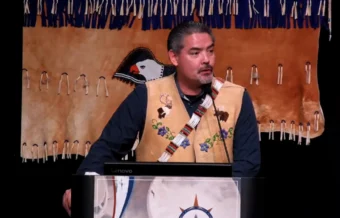
Tanana Chiefs Conference Chief/Chairman Brian Ridley speaks at TCC’s full board of directors meeting March 13, 2025, in Fairbanks, Alaska. (Courtesy of Tanana Chiefs Conference)

Interior Alaska’s major tribal consortium will be rejoining the Alaska Federation of Natives, two years after it withdrew.

During their annual four-day meeting in Fairbanks, the full board of directors for the Tanana Chiefs Conference voted Thursday in favor of a resolution to restore membership with AFN.

Tanana Chiefs Conference is a nonprofit tribal organization that aims to advance the health and social service needs of its 42 members, 37 of which are federally-recognized tribes. In April 2023, TCC voted to bow out of AFN, which is the largest statewide Native organization in Alaska.

Denakkanaaga brought forward Thursday’s measure. First Chief of Huslia Jack Wholecheese is on the Denakkanaaga board of directors, and he said unity will be key as looming federal cuts threaten to impact the budgets of tribes and tribal organizations in the region.

“We feel that it is important that we all collaborate and work together with other Native people to have a stronger voice during the critical time we are facing with the federal government and other entities,” Wholecheese said.

The move comes as Congress is considering major reductions in federal spending, including cuts that budget experts say will shrink Medicaid coverage.

On Wednesday, TCC Chief and Chairman Brian Ridley said Medicaid contributes about $68 million in annual revenue that the organization uses to provide health services to its members.

And while he acknowledged that TCC isn’t likely to lose all those funds, Ridley said his organization may have to pull from budget reserves to continue their level of service if Medicaid funding is significantly reduced.

“There’s no way to sugar coat it. Cuts are coming, and so we just have to be as prepared as we can be,” he said.

And it’s that kind of financial uncertainty that’s making a united front more appealing, according to Elder Peter Demoski of Nulato.

“I’m having second thoughts about my opposition to AFN all these years,” he said Thursday. “We are going to be in a financial crisis in the next few years. And I believe we’ll need the support of AFN to help us get through those difficult times.”

The decision to rejoin AFN goes beyond strength in numbers.

The resolution directs TCC staff to renew membership ahead of the annual AFN convention in October, with the goal of advancing tribal sovereignty and protecting subsistence rights.

Those goals touch on one of the reasons Tanana Chiefs Conference broke from AFN two years ago. A TCC statement from 2023 said the statewide organization hadn’t taken adequate action in response to calls to support subsistence salmon populations and traditional ways of life.

“Since then, they’ve made a huge effort to try to push subsistence on social media and other things,” Ridley said Thursday. “I want to give credit where credit is due. They have tried to make a lot of the improvements that we asked for.”

Leaders from Alaska’s St. Lawrence Island take contamination claims to U.N.

Sandra Gologergen from Savoonga has lost many members of her immediate family to cancer. She believes military contamination on St. Lawrence Island is a cause. (Liz Ruskin/Alaska Public Media)

The tribal governments of Alaska’s St. Lawrence Island in the Bering Sea say they’re living with the toxic legacy of Cold War military installations on their land, and this week they took their complaint to the United Nations special rapporteur on toxics and human rights.

About 4,000 miles from home, at a press conference Wednesday in Washington, D.C., tribal leaders spoke about troubling health problems on the island.

Vi Waghiyi works with the Alaska Community Action on Toxics. She said her family lived at the most contaminated location on St. Lawrence, the Northeast Cape, for five years when she was growing up.

“I’m a cancer survivor. I’ve had three miscarriages. I’m 66,” she said. “My mother had a … stillborn child after me. Heart disease, strokes, diabetes and cancer. Her name was Della Waghiyi. I want to say their name.”

Sandra Gologergen from Savoonga said her father and his brother salvaged materials from the military buildings at the Northeast Cape, and, unaware of any contamination risk, built a cabin.

“We stayed there every summer, not knowing,” she said. “My father and his brother always worked and camped together. And then they both died of cancer, three months apart.”

The Yup’ik people of St. Lawrence Island have PCB levels in their blood 4.5 to 9 times higher than the average in Lower 48 communities, according to the Alaska Community Action on Toxics. ACAT recognizes that much of that is not attributed to the military but notes research showing that those who lived near the Northeast Cape have higher PCB levels than residents of other parts of the island.

The U.S. Army Corps of Engineers spent more than $130 million to clean up the island and considered the work largely done a decade ago. The Army Corps says it continues to monitor and review the site and expects to do so indefinitely. A federal public health agency concluded in 2017 that the number and type of cancer cases on the island are similar to those in other Alaska Native communities in the region.

St. Lawrence leaders call the cleanup superficial.

Their 42-page complaint is now in the hands of the U.N. special rapporteur, an independent expert. He can’t order a cleanup, but his work could add pressure to the federal agencies.

It might seem like the Trump administration isn’t sensitive to that kind of pressure. News broke Wednesday that the administration intends to close all offices of environmental justice in the Environmental Protection Agency.

Attorney Claudia Polsky, who helped write the St. Lawrence complaint, said no matter what policies the administration rescinds or which offices it defunds, the law still applies.

“Whether we call it environmental justice, whether we call it hazardous waste cleanup, whether we call it something else, there is still a law domestically that is being violated and that is enforceable,” she said, “and this is the time to make it happen.”

Alaska Native Corp. subsidiary running Guantanamo Bay detention facility

Migrants detained in the Trump administration’s immigration crackdown are led to a plane bound for Guantanamo Bay, Cuba. (U.S. Department of Homeland Security)

As the Trump administration’s immigration crackdown has ramped up, officials are sending some migrants to a detention facility in Guantanamo Bay, Cuba that’s run by the subsidiary of an Alaska Native corporation.

Much of what happens at Guantanamo is shrouded in secrecy. The U.S. naval base there is infamous for the government’s alleged abuse of enemy combatants rounded up in the War on Terror.

And now there are questions about how Akima Infrastructure Protection — a subsidiary of Akima, itself a subsidiary of NANA Regional Corporation — is treating migrants detained at a separate facility there.

Investigative journalist José Olivares wrote about Akima recently for the Guardian. Olivares says the questions about Akima follow accusations of civil rights abuses and health and safety issues at the company’s other detention facilities.

Below is the transcript of an interview with Olivares on Alaska News Nightly. It has been lightly edited for length and clarity.

José Olivares: And the Inspector General essentially found that at the Florida facility that is run by Akima, there were instances where guards used an inappropriate use of force on immigrant detainees who were held there. There’s one example that is listed that is cited in the Inspector General’s report in which guards opened the slot to a solitary confinement door and pepper sprayed a man who was detained in there, even though, and this is from the words of the Inspector General, even though this person did not pose a threat to himself or to anybody else. That facility, since Trump stepped into office, has had two deaths, two separate migrants who were detained at this facility have died since Trump stepped into office.

And if we look at the other facilities, too, around the country, the Port Isabel detention center in Texas, which is run by Akima, that facility has been criticized for just the horrendous conditions inside the solitary confinement units. The conditions were so bad that the Inspector General actually recommended that the entire building be condemned and torn down and built again, because of the ceiling that was caving in, the conditions, the mold, everything that was just so, so terrible within this building.

So there’s been a lot of complaints about these different facilities that Akima runs throughout the U.S. as part of the Immigration and Customs Enforcement, ICE, network.

Casey Grove: And in terms of how big Akima itself is, how much money do they get from the federal government in a year?

JO: Akima is massive. And I think the exact numbers are hard to find out, because Akima is a subsidiary of the NANA Regional Corporation. And so, because these Alaska Native corporations are owned by, you know, indigenous Native Alaskan shareholders, we don’t really know about what goes on behind the scenes, right? The shares cannot be traded and cannot be sold. So there’s very little regulation from the federal government, including the Securities and Exchange Commission.

So NANA itself, it’s really, really difficult to understand and grasp the sheer size and how much money that NANA and Akima are making now. Last year, Akima did announce, they did publicly announce, that the company is worth $2 billion, and they have, you know, over 40 subsidiaries within the broader Akima company, and all of those subsidiaries are getting multi-million dollar contracts with the federal government.

CG: Is there a higher proportion of Alaska Native corporations in this line of work, or is it just that Alaska Native corporations are into government contracting, and that’s what the contracts are for?

JO: I think it’s difficult to say what the proportion is between just general security contractors and other federal government contractors, and how it compares to Alaska Native corporations. But I think it’s easier for a lot of these federal government (contracts) to go to Alaska Native corporations, and there are dozens and dozens of subsidiaries, right?

So, because there are so many subsidiaries, and because they are owned by Native Alaskan shareholders, they technically are classified and qualify to be determined to be small businesses, right, and small minority-owned businesses. And so they’re able to very quickly get government, federal government, contracts for this type of work that essentially just kind of doesn’t necessarily force the government or these corporations to go through extensive contracting bids and negotiations that maybe other companies might.

But yes, I mean, Akima is not the only Alaska Native corporation that does these types of federal government contracting work. I’ve done a story, for example, the Bering Straits Corporation, they run, or they used to run, at least, a detention center in El Paso, an immigration detention center in El Paso. But a lot of the other immigration jails, the majority of them are run by private corporations, including CoreCivic or GEO Group or other large private prison companies. So, no, Akima is not the only one that’s doing this type of work, but it is significant to note how they’re able to very quickly get these types of government contracts, and it is significant to note that they received the federal government contract to run the ICE facility at the Guantanamo Bay Naval Base last year under the Biden administration.

CG: Yeah. So, José, tell me if I’m oversimplifying this, but it seems like at at one end of this you’ve got a lucrative government contract and migrants that are being detained in Guantanamo and elsewhere, and at the other end of this are Alaska Native shareholders that, in some way, are benefiting from that, right?

JO: I think so. I think it’s OK to simplify that, and I think it kind of speaks to just the broader questions about the system, right? I mean, I think because Akima has so many subsidiaries, I think the question that needs to be posed is, “Do the shareholders, do the Native Alaskan people who truly do own the NANA Regional Corporation, are they fully aware of the type of contracting work that the companies that they partly own are doing?” I mean, are they? Are they aware of the rights abuses that these companies have been accused of? Do they have any certain oversight?

And I think it’s really important to not necessarily blame the shareholders, the Alaska Native shareholders, for this, but the broader system of this immigration detention center and this private contracting system that opens a door for these types of actions to take place.

Olivares got no response after multiple requests for comment from Immigration and Customs Enforcement, the Department of Homeland Security, Akima, and multiple attorneys representing Akima in a lawsuit and in contract disputes.

Tribal education compact bill takes next step into bringing tribal sovereignty into public education

Central Council of the Tlingit and Haida Tribes of Alaska Education Liaison Mischa Jackson testifies in front of the Alaska House Tribal Affairs Committee on Feb. 6, 2025. (Photo by Jamie Diep/KTOO)

The Central Council of the Tlingit and Haida Tribes of Alaska has been working on expanding its education programs for years. One of the tribe’s next steps is building an educational campus in Juneau focused on culturally relevant, place-based learning.

This is one of many efforts Alaska Native tribes around the state are working on to improve educational outcomes for Native students. The state is joining in by working with tribes to develop an education compacting program.

An education compact is an agreement between tribal and state governments that allows tribes to run their own public schools. Alaska’s Department of Education and Early Development is working with tribes to kick start a compacting program and give tribes sovereignty over education.

Gov. Mike Dunleavy’s administration is moving things along with a bill proposal that would approve a pilot program for tribally compacted public schools. The House Rules Committee introduced it as House Bill 59 last month. 

Mischa Jackson is an education liaison with Tlingit and Haida – one of five tribes that would be part of a pilot program to see if the compact works.  

“Compacting is the mechanism to provide tribes an opportunity to play a role in the operation of schools,” Jackson said. 

Jackson presented to lawmakers in a state House Tribal Affairs Committee meeting last Thursday. She talked about what education compacts could look like in the state.

Tlingit and Haida — along with the King Island Native Community and the Village of Solomon, Inupiat Community of the Arctic Slope, Ketchikan Indian Community and Knik Tribe — negotiated with the Department of Education and Early Development, or DEED, to create a report on how compacting could work. According to the report, the program came out of a list of education priorities the state Board of Education is following. It aims to close the achievement gap between Native and non-Native students in the state. 

State testing results in recent years show a gap in Alaska Native students and other students of colors achieving proficiency in math and language arts when compared to all students.

Results from the Alaska System of Academic Readiness exam shows fewer Alaska Native and other students of color consistently reach advanced or proficient levels in math and language arts when compared to all students. The same goes for students experiencing homelessness and students in foster care.

Jackson said she’s really excited to implement the program.

“This has long term gains we’re really excited about, and I would say we have a pretty strong team and a lot of Indigenous educators throughout Southeast Alaska that are really excited to help contribute to this project,” she said.

Jackson said many Alaska Native tribes aren’t structured in a way that allows them to receive federal funding for education. Compacting would allow them to do that. She said the program would give tribes more say over education they don’t have under current state law, even if they operate as a charter school within a school district.

“For the vision that a lot of tribes have for education, we’ve never had the true opportunities to be able to work as an education system with the level of authority and autonomy,” Jackson said.

Joel Isaak is a consultant with DEED for tribal compacting. In an interview, he said the program would give tribes the ability to oversee many aspects of running their own schools.

“The tribes are the ones carrying out the education in the classroom, and the state is the one that’s providing the fiscal backing, and then ensuring safety and adequacy,” Isaak said.

This means tribes would be able to hire teachers, design curriculum and create a governing body like a school board to run the schools, as long as it follows state requirements. Isaak said tribes can also create training requirements for teachers. 

While some tribes may want to require their teachers to simply get a teaching degree at a university, he said others may want teachers to be trained in place-based or cultural learning.

“It allows the tribe to really direct how they weave together the culture, language with those regulated skill sets around, for example, reading or math or science,” he said.

Tribally compacted public schools would also receive state funding. To determine how much funding they receive from the current formulas in place, they would be treated as Regional Educational Attendance Areas. These are educational districts in places without a taxing authority like a borough.

This bill also includes start-up funds for carrying out the program. A fiscal note for the bill estimates it could cost close to $17.5 million for the next fiscal year. This includes both foundational funding and start-up funds for all five pilot schools.

Isaak said compacting is a way to improve the state’s education system.

“It does not fix every single thing in education, but it brings in another person to help carry the weight and to help think about how you get there more efficiently, or how you get there with everybody,” he said. “And that’s why it’s a systems transformation, that’s really powerful.”

Washington is the only state that uses education compacts since approving it in 2013. The New Mexico Legislature is also considering a bill to allow the state to enter tribal education compacts.

Jackson, with Tlingit and Haida, said the tribe is already working on building an education campus in Juneau behind Fred Meyer. 

If the bill doesn’t pass, Jackson said the tribe is ready to find other sources of funding for the campus.

“Our movement towards the education campus is going to happen whether this bill passes or not,” she said. “This will just be another vehicle towards supporting the infrastructure, and what will go inside of the buildings. The education in itself is going to move forward.”

If the bill passes, Isaak said DEED will negotiate compacts with the tribes to get the schools running.

The House Tribal Affairs Committee will hold a hearing on the bill on Thursday at 8 a.m.

The last skipper in Ouzinkie: How Gulf of Alaska villages lost their Native fishing fleets

Nick Katelnikoff learned to fish from his father, and he says his first paycheck as a fisherman came when he turned 8 years old. Now 76, pictured aboard his boat, the MZ L, he’s the last skipper running a commercial fishing vessel from his home village of Ouzinkie, on an island just north of Kodiak. (Photo by Nathaniel Herz/Northern Journal)

This story was produced as part of the Pulitzer Center’s StoryReach U.S. Fellowship. It was reported and edited by Northern Journal and APM Reports, with support from Alaska Public Media.

KODIAK — On an early, foggy summer morning, Nick Katelnikoff steered his boat through the treacherous waters off Kodiak Island’s Spruce Cape and chuckled.

“Trust a blind guy through the rock pile?” he asked.

Katelnikoff, 76, is a veteran fisherman — the kind of guy who, friends say, can call his catch into his boat.

He’s made a career chasing the bounty of the North Pacific, building up a storehouse of knowledge about his maritime backyard that allows him, even with failing eyesight, to confidently steer his 38-foot craft away from rocks that have sunk other vessels.

The MZ L motors past Kodiak Island’s Spruce Cape in July. (Photo by Nathaniel Herz/Northern Journal)

Katelnikoff describes his heritage as Aleut; he’s one of the Indigenous people who have been pulling fish out of these waters for millenia. Their catches helped sustain trading networks long before white people arrived on Kodiak and began setting up fish traps and canneries — businesses that were supplied, in part, by the harvests of Katelnikoff’s more recent ancestors.

When Katelnikoff was still beginning his career in the 1970s, he was one of a dozen or so skippers in Ouzinkie — a small Indigenous village on an island just off Kodiak’s coast.

But today, that tradition is all but dead: Katelnikoff is the last skipper running a commercial fishing boat from Ouzinkie’s harbor.

A similar story has played out in villages up and down the Gulf of Alaska coast. Angoon, Nondalton, Old Harbor — each of those small Native communities is home to a fraction of the commercial salmon fishermen who were once the lifeblood of their economies.

Over the last 50 years, hundreds of Alaska’s most valuable salmon permits have drained out of its Indigenous coastal villages. Now, the profits flow increasingly to those who live in Alaska’s population centers or in other states.

“We used to be people who fished,” an anonymous respondent wrote in a recent survey of thousands of Indigenous people with ties to the Gulf of Alaska. “Now, we don’t have access to our resources located in our backyard.”

Salmon dry on racks in Old Harbor in 1889. (U.S. Fish Commission photo via National Archives)

The outflow was set in motion in the early 1970s. At the time, new fishermen were flooding into the industry as salmon harvests had plummeted from historic highs, making it more difficult for each boat to turn a profit.

In response, Alaska’s government made a monumental change in the way it regulated those fisheries.

No longer could just any commercial fisherman set out in a boat and cast their net — even Alaska Natives whose ancestors had fished for generations. The new system, approved by voters in 1972 and put into effect three years later, placed caps on the number of permits available in each fishery.

The policy was known as “limited entry” because it restricted who could enter the industry, and it created permits that have since been valued collectively at more than $1 billion.

Scholars diverge on how effective the policy has been at preserving the salmon population, with critics arguing that limiting the number of fishermen on the water doesn’t necessarily prevent overfishing.

But one result is clear: The policy has dragged down the economies of many Indigenous villages along the Gulf of Alaska. Places that once called themselves “fishing towns” have been hollowed out, with little-used harbors and even dilapidated boats grounded on shore.


Rural local ownership in Alaska salmon purse fisheries

Alaska salmon permit values

Estimated earnings

Data source: Commercial Fisheries Entry Commission   Zac Bentz for Northern Journal

The people who live in those Gulf communities, which are disconnected from the road system and reachable only by plane or boat, are overwhelmingly Alaska Native.

They face high prices for groceries, fuel and other supplies, which have to be flown or barged in from afar. Jobs outside of fishing are scarce, and fishing jobs are increasingly sparse, too. Residents who can’t afford permits have to leave their homes, families and cultures to find full-time jobs.

“If you’ve got young people who live in the fishing communities where the fisheries occur and they don’t see that as an opportunity, that’s bad public policy,” said Rachel Donkersloot, a researcher who grew up in the Bristol Bay region and has spent more than a decade studying obstacles to fisheries access. “Being able to provide for yourself from that fishery should be a birthright.”

When limited entry started in 1975, many Alaska Natives in coastal villages received permits without having to buy them, based on their long histories working in the industry.

With some exceptions, the permits were permanent — entitling holders to fish until they died or retired, then pass the permit on to an heir. But a controversial provision known as “free transferability” also meant that they could sell them to the highest bidder at any time.


Where did Nondalton’s permits go?
A total of 15 Bristol Bay salmon drift gillnet permits were issued in the Native village of Nondalton in the early years of limited entry. Today, none remain. Here’s where they went.

Data source: Commercial Fisheries Entry Commission   Zac Bentz for Northern Journal

The limited supply turned those permits into valuable assets. At their peak in the 1980s and early ’90s, prices for some permits hit more than $500,000 in inflation-adjusted dollars, before the advent of farm-raised salmon began depressing their value. Still, just three years ago, some Bristol Bay permits were selling for $250,000.

Those eye-popping sums created a powerful incentive for rural fishermen to cash out. And those who sold at the top of the market likely came out ahead.

But the one-time windfalls severed an Indigenous tradition of commerce tied to Alaska’s ocean harvests — a trade that could now require a permit to access. And the high prices put them out of reach for many rural Alaskans who lacked a credit history or who didn’t have collateral for a loan.

“We should never have been allowed to sell them,” said Freddie Christiansen, a tribal member and longtime fisherman from the Kodiak Island village of Old Harbor. “We’re Indigenous people. We’re from here. We take care of it. Everyone else comes and goes.”

Freddie Christiansen flies in a bush plane between the city of Kodiak and the village of Old Harbor. Christiansen, an outspoken critic of the limited entry system, grew up commercial fishing in Old Harbor, where, at the time, “everybody fished,” he said. Today, the village has a fraction of the salmon permits once held there. (Photo by Nathaniel Herz/Northern Journal)

Some of the exodus can be explained by rural fishermen relocating to urban areas, bringing their permits with them. But many permits were simply bought up by city dwellers who had better access to capital — and far more experience working with western institutions like banks and government-sponsored loan programs.

At the time, many of Alaska’s Indigenous communities were just beginning to encounter those systems. And in some cases, sophisticated urban operators took advantage of that inexperience to buy their permits at low prices, according to people who witnessed the transactions.

The state has dozens of fisheries and types of fishing gear, and the losses vary across different regions and classes of permits. But they’ve tended to be more acute in fisheries where more money is at stake.

Each permit’s sale effectively marked the loss of a small business from the rural villages. Those businesses produced cash for captains and crew to feed families and heat homes over the winter, along with extra fish to eat and share during the off-season.

Old boats sit onshore in Angoon. The Tlingit village, 50 miles south of Juneau on Admiralty Island, used to have a fleet of small salmon fishing vessels, but many have fallen into disrepair and few permits remain in the village. (Photo by Johnny Hunter for Northern Journal)

“It’s just terminated this ability to be self-sufficient and self-determined,” said Jonathan Kreiss-Tomkins, a former state legislator from Sitka who tried and failed to reverse the permit losses before he left office in 2023. He described spending time in struggling rural villages in his district that were once “thriving, bustling communities 40 years ago that ran on commercial fishing.”

“That contrast was stark and depressing,” he said.

Kreiss-Tomkins described limited entry as “the opposite of a panacea”: Instead of a cure-all, it turned out to be the root of countless ills.

“It was an alien construct that got dropped onto all these communities. And even if they’re as good or better fishermen, or as good or harder workers, it didn’t really matter,” he said. “The structure was so foreign. And once in motion, it just got worse.”

Scholars have been raising alarm about the problem since the 1980s. But Alaska’s elected leaders, most of whom live in regional or urban hub communities, have largely ignored it. And many people who currently own permits are leery of change, which they fear could reduce the value of their investments.

Some larger Alaska communities like Kodiak, pictured here, and Homer have seen an increase in permits since the limited entry system was created. (Photo by Nathaniel Herz/Northern Journal)

After decades of inaction, state lawmakers are reconsidering parts of the limited entry system amid a broader effort to aid the fishing industry. Alaska’s seafood businesses and fishermen have faced major upheaval in the past two years, stemming from reduced demand and low-priced competition from Russian harvesters.

In a draft report released in January, a legislative task force noted the “large loss of permits held in rural and Alaska Native fishing communities.” And the new speaker of the state House, Bryce Edgmon, believes there’s growing interest from legislators in addressing the issue.

But he said it also faces competition from other policy problems like school funding and a shortage of the natural gas used to heat urban Alaska homes.

Most lawmakers still do not see stemming permit losses in villages “as a public policy change that’s urgently needed at this point,” said Edgmon, an independent from Dillingham, a fishing town of 2,100 in Bristol Bay.

‘It was what would work’

Terry Gardiner still remembers fishing outside Ketchikan in the 1960s and seeing all the other boats.

There were hundreds of them, nets stretching almost continuously a couple of miles out into the ocean from shore.“It was just, like, a wall,” he said.

Bristol Bay fishing boats sit at a dock, likely in the 1960s. (Amos Burg, Alaska Department of Fish and Game Historical Photograph Collection, 1950-1991, Alaska Resources Library and Information Services, on behalf of Alaska Department of Fish and Game)

Scores of new fishermen had entered the industry in the 1950s and 1960s amid Alaska’s postwar boom. Many were newcomers to the state, and fishing wasn’t their main occupation. Often they were teachers or out-of-staters with office jobs who could afford to take summers off to fish.

Gardiner wasn’t a full-time fisherman, either. He was still in high school, just looking for a fun way to earn a few bucks. He and a buddy made perhaps a “couple grand” in profit each summer, he said.

So, at the end of one season, Gardiner was surprised when a seafood processing company told him that his boat was one of the highest earners in the fleet.

“It was like, ‘Holy smokes, we’re a top boat? This is a joke,’” he said. “How would a family make a living?”

A poster advertising Terry Gardiner’s campaign for the Legislature, featuring his 36-foot fishing boat. (Photo courtesy Terry Gardiner)

Gardiner’s experience was a symptom of what he describes, more than a half-century later, as a “sickness” that was afflicting Alaska’s fishing industry.

Salmon populations had crashed in the 1950s and were starting to rebound in the 1960s just as the number of fishermen exploded.

In 1972, Gardiner ran for the state House at age 22. His campaign slogan, he said, was “too many fishermen, fishing for too few fish, at too low a price.” At the Capitol, he became one of the most vocal advocates for limiting the number of fishing boats on the water.

It was an approach supported by influential natural resource economists, who argued against what they called open access to the ocean. Fisheries in the United States at the time were “marked by obsolescence, waste, and poverty,” James Crutchfield and Giulio Pontecorvo wrote in a 1969 book about the economics of Pacific salmon harvests.

When fisheries are “common property,” they said, there are no ways to prevent “declining yields and the disappearance of net revenues to the industry.”

The economists said that far fewer boats and nets could catch the same amount of fish, allowing the industry to return to profitability.

Fishing boats are tied up at a dock in Juneau in a historical photo. (Alaska Department of Fish and Game Historical Photograph Collection, 1950-1991, Alaska Resources Library and Information Services, on behalf of Alaska Department of Fish and Game)

The limited entry program was not Alaska’s first attempt to restrict the number of fishermen. Legislators had initially approved policies aimed at making it harder for people from other states to access its waters.

The courts, however, struck down those efforts, saying, in one case, that they violated the U.S. Constitution’s Equal Protection Clause.

So the final limited entry legislation prioritized permits for the fishermen who were most financially dependent on the industry for their livelihoods.

That meant that when the permits first rolled out, nearly half of them went to Alaska Native people, who at the time represented some 18% of the state’s population.

Ouzinkie’s harbor in the 1950s. The village had as many as 17 salmon seine permits in the 1970s, but just three remain, with only one commercial fishing boat operating out of the harbor. (Arnold Granville/Alaska and Polar Regions Collections, University of Alaska Fairbanks)

But after that, there was nothing to stop permits from leaving rural, Indigenous communities.

Gardiner said that “nobody was really a big fan” of the transferable permits.

“But it was what would work, what would be constitutional,” he said. “And everybody was tired of passing a law, getting everyone excited, spending all this effort and then boom, it fails after a year or two.”

Alaska voters approved a constitutional amendment paving the way for the limited entry system in 1972, and state lawmakers passed a bill to implement the policy the following year.

Lawsuits and a statewide referendum campaign both challenged the new system. But the program held up.

And in rural Alaska, the invisible hand of the market went to work.

‘They all went one way’

Jerry Liboff grew up in Southern California, and in his early 20s he signed up with Volunteers in Service to America, a program that has since become part of AmeriCorps. In 1969 the program dispatched Liboff to Koliganek, a Yup’ik village of 140 in the Bristol Bay region.

Liboff didn’t know it, but he had arrived just in time to witness an immense change to the economic and cultural fabric of his new home.

At the time of Liboff’s arrival, Koliganek, like many other Native villages, was barely connected to urban Alaska.

Bush planes, the only way to reach the road system, arrived in the village just once or twice a week, Liboff said. Many Koliganek residents spoke no English, only their Indigenous Yup’ik language. Most finished school after eighth grade; there were just a handful of full-time jobs.

Subsistence harvests of fish and game were essential to survival. There was, however, one strong link connecting Koliganek to the cash economy.

Each spring, about half the village’s 30 families would push their fishing boats into the water, run the 120 miles down the Nushagak River into Bristol Bay and spend the summer catching salmon that they would sell to local canneries.

Their harvests would pay for the fuel and food they needed to get through the winter. Fish canning businesses in Bristol Bay, like others across the Gulf of Alaska, formed close ties with the Native skippers and would often float them with supplies on credit if they had a bad year.

“You didn’t need a full-time job to survive,” Liboff said. “People got by. I don’t remember anybody being hungry.”

Liboff’s fluency in English and in navigating bureaucracy made him useful in the village, and he decided to stay, developing a passing facility with the Yup’ik language. He also drummed up a tax preparation business — working with residents of Koliganek and, eventually, more than a dozen surrounding villages.

Jerry Liboff works in his home office in the Bristol Bay hub town of Dillingham in January. (Photo by Margaret Sutherland for Northern Journal)

Many of his clients were fishermen, giving him a unique chance to observe the effects of the new permit system in the years after its approval.

In Koliganek, Liboff said, residents hadn’t been informed or consulted about the limited entry program beforehand, though at first, it seemed to work. All the village’s boat owners initially got permits, and “nobody really thought much about it,” he said. But after a few years, troubling signs began popping up.

A man with a drinking problem in a neighboring village went on a weeks-long bender after selling his permit for $1,500 in cash and a rickety snowmachine that the buyer claimed was worth $2,500, Liboff recalled.

Two brothers who had fished in an equal partnership realized that only one could pass their single permit on to their children.

Liboff said he witnessed teachers and pilots — non-Natives who lived in and traveled through the villages — acting like speculators. They found local fishermen in Bristol Bay who needed money and bought their permits on the cheap, then flipped them for a profit, Liboff said.

“In villages, we had a bum season, they couldn’t meet their family needs, they sold their permits,” said Robin Samuelsen, a Native leader from Bristol Bay. “It reoccurred, reoccurred, reoccurred, reoccurred. Anything of any value, like a permit, you sold — you had to feed the family. You had to buy stove oil.”

Robin Samuelsen poses for a photo at an office in Dillingham, the Bristol Bay salmon fishing hub town, in October. His father harvested Bristol Bay salmon from a sailboat — powered boats were banned in the area until 1951. Samuelsen says he initially supported limited entry as a way to limit the number of outsiders in the fishery. “But the problem with limited entry permits is, you could sell them,” he said. (Photo by Nathaniel Herz/Northern Journal)

In another village, Liboff knew a Native woman who didn’t speak English and had what he said was a common misunderstanding about the permit system. She thought that if her children needed to generate some cash by selling the permits they initially qualified for, they could simply earn new ones later.

“That was her very incorrect version of how the law worked: If you fished enough years, you’d get another permit,” Liboff said. Today, he added, “there’s one permit left in the family, out of eight.”

Liboff spent his career as a tax preparer trying to find ways to stop the outflow of permits from the villages — as did other advocates, researchers and local and regional groups.

But they were fighting the pervasive power of the market.

“There are a whole ton of different reasons why permits went. But the bottom line is they all went one way,” Liboff said. “Whether a guy lost it because his taxes were bad. Whether a guy lost it because he bought a boat he couldn’t afford. Whether a guy lost it because he didn’t want to give it to one of his kids and have the rest of his kids pissed at him.”

Limited entry is one of multiple ways in which 1970s-era policymakers imposed Western systems of private ownership on Alaska’s natural resources and lands — systems that fundamentally changed Native people’s relationships to their ancestral territory.

Congress also passed legislation in 1971 that terminated Indigenous land claims in Alaska. In exchange, the Alaska Native Claims Settlement Act transferred some 10% of the state to Indigenous people — but it did so through newly created, for-profit corporations. Native leaders and advocacy groups, in recent years, have increasingly questioned how well that for-profit model serves their interests and aligns with their culture.

“This Westernized model, one-size-fits-all, does not work,” said Christiansen, the tribal member and fisherman from Old Harbor, on Kodiak Island. “We’ve proven it over and over and over again.”

Years of warnings, little action

Rural Alaska residents weren’t the only ones to notice permits trickling out of the villages.

Within a decade of limited entry’s passage, scholars and government agencies had begun to document the phenomenon.

1980 paper by Anchorage anthropologist Steve Langdon described a “clear and escalating trend” of diminishing rural permit ownership.

“The outflow of permits that has occurred and that potentially can occur must be regarded as (a) significant threat to the rural Alaskan economic base and the well-being of rural Alaskans,” Langdon wrote.

Four years later, the state agency that oversees commercial fishing permits said that Indigenous ownership of Bristol Bay salmon permits had fallen 21% since the new system went into effect — a dynamic that called for “serious attention,” according to the agency’s commissioners.

One driving force that appeared to be behind the trend, according to Langdon: The permits were worth more money to fishermen who could catch bigger hauls with them.

Urban and out-of-state fishermen were more likely to own cutting-edge boats and gear that allowed them to catch more fish and reap bigger profits. As a result, they were willing to pay more for a permit than fishermen without those advantages.

Courtney Carothers speaks at a community meeting in Ouzinkie in July. (Photo by Nathaniel Herz/Northern Journal)

“The economic rationale of why you want to privatize the rights to fish is all about efficiency. It’s eliminating inefficient users,” said Courtney Carothers, a University of Alaska Fairbanks anthropologist whose scholarship has focused on Native fishing communities on Kodiak Island. “The ideology is that those who don’t fish efficiently could better serve society by getting other jobs.”

Carothers said that logic may make sense in an urban environment where there are lots of employment opportunities. But, she added, it breaks down in intensely isolated rural areas like the coastal villages. “Their lives are from the sea, and if you’ve displaced people from sea-based livelihoods, there’s not a whole lot to pick up.”

A view of Old Harbor from the mountainside that looms behind the village. (Photo by Nathaniel Herz/Northern Journal)

There were a few efforts in the early years of limited entry to keep more permits in Alaska Native hands — one, started in 1980, was a short-lived loan program targeted at residents of rural communities.

But it was shut down a few years later, after a state agency said it had the unintended effect of driving up the cost of permits. Langdon’s research concluded that an earlier state loan program had actually contributed to the losses from rural areas, because it was used mainly by urban residents.

Langdon has suggested that the state allow tribes to own permits, so they can stay in Indigenous hands. But those and other ideas got little traction. Most legislators, Langdon said in an interview, live in more urban areas where their constituents are buying up permits — not selling them.

“They’re the ones benefiting,” he said.


Where did the Kodiak village permits go?
There were 73 Kodiak salmon purse seine permits initially issued in the island’s six Native villages. Ten remain, along with roughly a dozen more that have come into the villages from other communities. Here’s where the rest of the initial-issue permits are now.

Data source: Commercial Fisheries Entry Commission   Zac Bentz for Northern Journal

Kreiss-Tomkins, the former Sitka legislator, is the only lawmaker who’s made a major push to tackle the problem in recent years.

He said he and his aides put thousands of hours into developing and pushing legislation that would have allowed local trusts or regional organizations to buy and own permits, then lease them to new fishermen.

But the bill never got to the House floor for a vote. Kreiss-Tomkins said he thought the proposal “bewildered” some of the legislators from urban communities who weren’t familiar with the limited entry system. There was also a wariness from fishing industry stakeholders who represented existing permit holders, he said.

“I think, to some extent, the idea was written off at the outset because of political cues from opponents in the commercial fishing world,” he said. “There was never a rich, policy-based conversation or understanding.”

Gardiner, the legislator who promoted the limited entry bill in the 1970s, put it more bluntly: “There’s not a whole lot of votes in all those small, coastal communities.”

The sale of permits isn’t the only factor driving the losses in rural Alaska. Migration — when a rural resident moves with their permit to urban Alaska or out of the state — has also been responsible for the loss of hundreds of rural permits statewide. Experts say the closure of many remote processing plants in coastal villages also makes it harder for rural fishermen to turn a profit.

Empty slips in the harbor in Angoon. (Photo by Johnny Hunter for Northern Journal)

But residents across coastal Alaska say that permit costs remain a significant barrier for people seeking to enter the industry. In the Kodiak island villages, there are “a bunch of young guys” who would love to be a skipper and the owner of a boat, Christiansen said. But the cost of a modern vessel, combined with a seine permit and gear, is out of reach, he added.

“They love fishing. But they don’t have the opportunity,” Christiansen said. “How are you going to be able to come up with half a million dollars to get in?”

Christiansen is one of many Alaska Native people and groups — including Kodiak’s and Southeast Alaska’s regional Native corporations — that are increasingly agitating for reforms to the limited entry system.

Those two Native corporations, working with nonprofit organizations and scholars, released the January survey of Indigenous people with ties to the Gulf of Alaska. Some 80% agreed that villages are in “crisis” because of loss of access to fisheries.

“We’re ready to go to work” on policy reforms, said Joe Nelson, interim president of Sealaska, the Southeast Alaska Native corporation. “We’re working all together.”

In the meantime, communities like Ouzinkie — the home of Katelnikoff, the aging skipper with the failing eyesight — face existential questions.

At a community meeting last summer, as Katelnikoff was finishing up a trip, residents described how the village is steadily shrinking. A few decades ago, there were more than 200 people there, with dozens working in commercial fishing. The population is now down to just 100.

Jimmy Skonberg is retired from commercial fishing in Ouzinkie, but he still owns a salmon seine permit there. He’s skeptical that the commercial fishing culture can be revived in the village. “It’s gone forever,” he said. “Limited entry, I have to blame that.” (Photo by Nathaniel Herz/Northern Journal)

The community, through a federal program, has purchased rights to a small halibut harvest that it wants to make available to residents to fish. But many of the young people that old-timers hope would get into fishing have moved out of Ouzinkie, making them ineligible to participate.

“Our younger generation can’t afford to buy a skiff, or the equipment, or the permits,” said Sandra Muller, who once fished commercially with her husband and young children. “It is a big crisis for our young people. I feel for them.”

The village’s sole remaining commercial fishing boat, meanwhile, motors on.

Katelnikoff has renewed his state permits for 2025. More than six decades after he began fishing, he says he’s still “too young” to retire. But when he does, he’ll likely pass his operation on to a daughter, who was onboard for his summer trips.

Nikolai Katelnikoff’s boat, the MZ L. (Photo by Nathaniel Herz/Northern Journal)

Other Ouzinkie old-timers say it’s too late to resurrect the village’s commercial fishing culture, that the loss of collective knowledge and experience is too great to overcome.

But Katelnikoff isn’t so sure. He pointed out that permit prices have fallen in recent years — making it, he said, a good time for aspiring fishermen to buy in.

“Things could happen where it could come back,” he said.

Brian Venua contributed reporting, and Zoë Scott contributed research and reporting.

Do you have a story about the loss of a permit from your family or village, or do you have feedback on this piece? Take Northern Journal’s brief survey that will inform future reporting on fisheries access in Alaska.

Nathaniel Herz welcomes tips at natherz@gmail.com or (907) 793-0312. This article was originally published in Northern Journal, a newsletter from Herz. Subscribe at this link.

U.S. House passes two bills from Alaska Rep. Nick Begich

Republican U.S. House candidate Nick Begich helps wave campaign signs with supporters in Anchorage on Monday, Nov. 4, 2024. (Matt Faubion/Alaska Public Media)

The U.S. House of Representatives on Tuesday passed bills that unlock additional land for Alaska Native village corporations and make it easier for disabled Alaska Natives to qualify for federal aid programs.

The bills were the first from Rep. Nick Begich III, R-Alaska, to pass the House this year. Both ideas were inherited from Rep. Mary Peltola, D-Alaska, and Begich reintroduced them on the first day after Congress convened in January. Both passed the House almost unanimously, with bipartisan support.

“We’re the first freshman office to get a bill passed. So that was really exciting,” Begich said by phone.

“They’re commonsense bills, bipartisan bills; they do important things in Alaska, but they shouldn’t be Democrat or Republican,” he said.

If signed into law, HR43 would eliminate the requirement that Alaska Native village corporations hold some land in federal trust, unused, in case a new village corporation is created. That hasn’t happened in more than three decades, and the Alaska Legislature requested last year that Congress repeal the law requiring the trust.

HR42, the other bill, states that certain income shouldn’t count against the federal benefit eligibility limit for Alaska Natives who are “aged, blind, or disabled individual(s).”

Two other Begich bills have yet to advance. One would provide federal land to Southeast Alaska Native village corporations that have no land base, and the other would extend the time that Alaska Native Vietnam War veterans have to select land parcels from the federal government.

As of Monday, Begich has been in Congress for one month. Is he happy with how things have gone in that first month?

“Things are moving at a high velocity, I’d say, but I’m encouraged to see the camaraderie on the Republican side of the aisle as it relates to moving Alaskan priorities forward,” Begich said.

He said he sees a “unique window of opportunity” to open resource development — a term frequently used for mining, drilling, logging and fishing — in Alaska in a way that can’t be reversed by a future presidential administration, ending “the yo-yo effect,” he said.

“The idea that we are working on is to instantiate that right in congressional code, such that the next executive who steps in, who may have a different perspective on Alaska, no longer has the authority to close our state to development,” Begich said.

On Friday, the Alaska Senate is scheduled to vote on a resolution that asks Congress and President Donald Trump to keep the name Denali for North America’s tallest mountain. What does Begich think of that idea?

“I’ve always called the mountain Denali, and I know many Alaskans will,” he said.

By phone, Begich implied that while he hasn’t agreed with everything that’s happened in the first month of his term, he’s generally satisfied.

“We have to look at the glass. Sometimes the glass is 10% full. Sometimes it’s 95% full. Right now, it’s 95% full. And I’m very excited about all the good things that are happening for our state, and I’m looking forward to being a part of that conversation to make sure that Alaska remains part of the national discussion on energy security, mineral security and national security, and that’s my focus,” he said.

Site notifications
Update notification options
Subscribe to notifications