Alaska Native Government & Policy

City and Borough of Juneau apologizes for 1962 burning of Douglas Indian Village

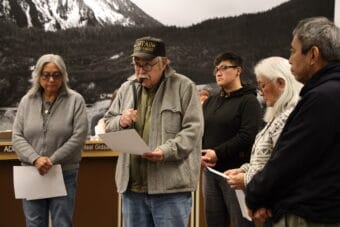
Butch Laiti responds to the City and Bureau of Juneauʼs formal apology for the 1962 burning of the Douglas Indian Village. Monday, Oct. 21, 2024. (Photo by Clarise Larson/KTOO).

The City and Borough of Juneau formally apologized for the 1962 burning of the Douglas Indian Village at a Juneau Assembly meeting on Monday. 

The apology was sudden, and not widely advertised, but it’s been on the mind of one Assembly member for years. 

Andrea Cadiente-Laiti is the Tribal Administrator for the Douglas Indian Association. She stood to receive the apology alongside other tribal members at the Juneau Assembly meeting. 

She said the burning of the village – where Savikko Park and the Douglas Harbor are now – happened more recently than many realize.

“People were shocked to find out we weren’t talking about 1862. We were talking about 1962,” she said.

That’s a little more than 60 years ago, recently enough that people who used to live in the village are still alive now. 

In 2018, the Douglas Indian Association raised a kootéeyaa – or totem pole – honoring the Yanyeidí Taku people who lost their homes. 

 “A kootéeyaa itself won’t heal the pain,” Cadiente-Laiti said. “The proclamation alone won’t but it’s a start, and it’s a wonderful start.”

The Yanyeidì Gooch (wolf) totem pole is raised in Savikko Park on June 6, 2018. (Photo by Adelyn Baxter/KTOO)
The Yanyeidí Gooch (wolf) totem pole is raised in Savikko Park on June 6, 2018. (Photo by Adelyn Baxter/KTOO)

DIA President Butch Laiti was also at the meeting to accept the apology. He said he wants more public awareness of the history of the site. 

“When I heard about this, I wrestled with this apology,” he said. “The problem I guess I have is the whole story is not out there, and I believe that to make this right, we have to tell the whole history of our relationship between Douglas, City of Douglas, Juneau, and the Lingít people.”

He said this history wasn’t taught when he was growing up, He had to learn about it through his own research.

Douglas Indian Association didn’t get much advance notice about the apology. Tribal administrator Cadiente-Laiti only heard about it days before. She said news of the apology was sudden, but welcome.

Mayor Beth Weldon said the reason for the timing of the apology is to honor the wish of departing Assembly Member ‘Wáahlaal Gidaag Barbara Blake. 

“‘Wáahlaal Gidaag said we never quite got to the apology for the burning of the village on Douglas Island,” Weldon said. “And so with that, we looked into it, and it took us a little long — longer than we thought — to get it going and everything so, but we wanted her to share in the formal apology to the Douglas Indian Association for the burning of that village.”

Blake later said this apology was fulfilling a campaign promise she made in 2021. It’s not nearly enough though. 

“It’s not okay,” she said. “We will do what we can to make it right, but this is at least the first step in that process.”

Blake chose not to run for reelection this fall, but said she plans to keep the pressure on the city to take this apology further and do more to commemorate what happened. 

“Just because I’m stepping off the assembly doesn’t mean I’m stepping away. I still live in Juneau,” she said. “I’m still going to be around and holding folks accountable. So I will be poking people if, if I don’t see some kind of movement.”

Blake said the other entities involved in the burning – like the Bureau of Indian Affairs – should also be apologizing. 

This weekend, a U.S. Navy Admiral will offer the Lingít people another long-overdue apology, for the 1882 bombardment of the village of Angoon. Sealaska Heritage Institute plans to livestream the event on their Youtube channel

Clarise Larson contributed to this story.

Advocates seize AFN convention as opportunity to rally the Native vote

United Tribes of Bristol Bay was among the organizations that promoted voting at the 2024 AFN convention. (Liz Ruskin/Alaska Public Media)

A person could barely move a few yards at the Alaska Federation of Natives convention in Anchorage last week without bumping into a message to vote.

Daniella Tebib was working the ground at the artisans’ market on the first floor.

“Hello! Do you guys have a plan to vote this November?” she asked of passers-by

“In November?” a man responded, a little tentative. “Everybody’s going to vote, right?”

“I hope so. That’s the goal,” Tebib said, thrusting a brochure at him. “Would you like some more information?”

Tebib, a volunteer for Congresswoman Mary Peltola’s re-election campaign, sweetened her pitch with invitations to spin the prize wheel at the Peltola booth for t-shirts, hats and other campaign swag.

The AFN convention is in October, and in election years, there’s always some emphasis on voting. But this year, AFN co-chair Joe Nelson said the convention is especially focused on encouraging a strong Native vote.

“Yes, because we know there are forces in play that are trying to marginalize our communities,” he said.

Shannon Mason staffs a popular prize wheel at Rep. Mary Peltola’s campaign booth at the 2024 AFN convention. (Liz Ruskin/Alaska Public Media)

For Nelson and other AFN leaders, an effort to suppress Native votes came into clear view this month, when a pair of Republican legislators were guests on a conservative talk radio show. State House Speaker Cathy Tilton, R-Wasilla, told host Michael Dukes that she and fellow Republicans killed a bill that would have eliminated the witness signature requirement on mail-in ballots, which she acknowledged is a barrier for rural voters.

“The changes in that bill definitely would’ve leaned the election towards, you know, towards Mary Peltola, to be quite honest,” Tilton said during the broadcast.

Tilton did not respond to an interview request for this story.

Nelson said Alaska Native voters need to show up in huge numbers to overcome barriers like the signature requirement. He’s passionate about re-electing Peltola, the first Alaska Native person elected to Congress — and, incidentally, Nelson’s ex-wife. He’s also plugging a “no” vote on Ballot Measure 2. That’s the measure that would repeal Alaska’s open primary and ranked choice voting. Nelson said Alaska’s current voting method helps eliminate partisan gridlock and serves most Alaska Native voters, who he describes as common-sense moderates.

“We’re, you know, 17-ish percent of the population, 120,000-plus Alaska Natives,” he said. “If we actually aligned on all of our things and showed up and voted, there would be no denying that our vote actually matters.”

The No on 2 campaign was one of the convention sponsors this year, so that message was on banners, pencils, buttons and brochures.

(The Yes on 2 campaign wasn’t present at the convention, but supporters of repeal say that ranked chance voting is confusing and that the open primary is unfair to conservatives.)

Some of the voting stickers available at a Sealaska table at the 2024 AFN convention. (Liz Ruskin/Alaska Public Media)

Some of the get-out-the vote effort was generic, not promoting any particular candidate.

Shelley Cotton, chief strategy director of United Tribes of Bristol Bay, was reeling in shoppers at the AFN artisans market with a non-partisan approach. She invited voters to sign a pledge to vote, with check boxes to indicate they’d welcome reminder messages or translation services.

“Getting out the vote is really important for us, because we want Native people to decide who’s best for our people and for those people to be in position so we can work with them as well doing our advocacy work,” she said.

Cotton said United Tribes of Bristol Bay has 11 interns spread out in their region, to engage communities and make sure everyone knows when and where to vote.

Upstairs, Michelle Sparck beamed as she handed out indigenous-specific “I vote” buttons.

“Here we go,” Sparck said, sizing up one young family. “That’s for your baby: ‘future Alaska Native voter.’ YayI”

Sparck leads the non-partisan Get out the Native Vote. She has labored largely alone in past years. Not this time. Several Alaska Native organizations pitched in so that she could hire 30 workers for the election season, to spread the word. And, Sparck said, they’re determined not to see a repeat of what happened in the primary, where voting stations didn’t open in some rural villages, for lack of poll workers.

“We’re actually ready to fly out our volunteers to any vulnerable precinct that does not have an election worker signed up, lined up, or will fall out before Election Day on Nov. 5,” she said.

A few yards away, convention participants thronged to a Sealaska table with Native-themed voting stickers and signs. “Aunties vote” was particularly popular.

“We’re not endorsing any candidates here, but we’re just making sure that Alaska Natives have a plan to get to the polls and cast their vote,” Christian Ḵaat’aawu Gomez of Juneau said, “because we know that our voices need to be heard and that we have a huge impact.”

Near him a poster summed up the aspiration: “Voting is our way of life.”

Alaska Federation of Natives endorses Peltola, opposes ranked choice repeal

Attendees at the 2024 AFN convention, listening to an address by U.S. Sen. Lisa Murkowski, R-Alaska, on Oct. 19, 2024, hold signs with Mary Peltola’s face on Oct. 19, 2024. (Photo by Yereth Rosen/Alaska Beacon)

The Alaska Federation of Natives voted Saturday to endorse the reelection of Democratic U.S. Rep. Mary Peltola and to oppose the ballot measure to repeal the state’s open primaries and ranked choice voting.

The votes came on the last day of its annual three-day convention, which had the theme this year of “Our Children, Our Future Ancestors.” The delegates from tribes, nonprofit tribal organizations and regional and village Native corporations passed 18 resolutions on issues ranging from a call for Congress to amend federal law to explicitly recognize Native rights to subsistence hunting, fishing and gathering to support for the state prioritizing public education funding.

Peltola, who is Yup’ik, from Bethel and the first Alaska Native member of Congress, drew broad support from the delegates, though some groups abstained from the vote.

The resolution endorsing Peltola was introduced by Sealaska, the regional Native corporation for Southeast Alaska.

“Representative Peltola has been a strong advocate for Alaska’s fisheries and subsistence users by introducing and working with her colleagues, regardless of party affiliation, for legislation to strengthen US seafood competitiveness in international markets, taking actions to enhance research to improve federal programs that support domestic seafood production and working tirelessly to reduce bycatch and protect fisheries habitat,” the resolution said.

Peltola’s top opponent is Republican Nick Begich. AFN did not host a candidate forum this year, after having hosted forums at previous conventions.

The resolution opposing Ballot Measure 2 — which would repeal the voting system — passed without opposition. But a resolution in support of Ballot Measure 1 never made it to a vote.

Ballot Measure 1 would raise the state’s minimum wage to $15 per hour by 2027, require employers to pay sick leave, and bar employers from requiring workers to attend political or religious meetings.

A motion to table the resolution supporting Ballot Measure 1 was introduced by Curtiss Chamberlain, assistant general counsel for Calista Corp., the regional Native corporation for the Yukon-Kuskokwim Delta region.

Chamberlain noted that many village corporations face declining revenue because of the projected decline in revenue being shared by the Red Dog mine. The potential added costs from the ballot measure trouble village corporations in Calista’s region, he said.

“A few brought their concerns to our attention,” he said. “And with that, and based on those discussions and concerns, I respectfully ask that this be tabled.”

Debra Call, a member of the Cook Inlet Tribal Council, unsuccessfully spoke in favor of the resolution and against the motion to table it.

“You really need to raise the standard of living of many of our people, and this is the start to do that,” Call said of the minimum wage increase.

She later added: “I would request that we support this resolution for the betterment of all of Alaska, particularly those who are in jobs that don’t pay what they can live on, so it’s about a living wage.”

The delegates tabled the resolution by a voice vote.

The AFN passed all of the other resolutions. A full list of the resolutions in their draft form — before they were amended on the convention floor — can be found at this link.

New rule adds three Alaska tribal representatives to federal board managing subsistence

Salmon dry on a rack in Quinhagak, a Yup’ik village in Western Alaska, in July 2023. Salmon is a staple of the traditional Indigenous diet in Alaska and one of the main foods harvested through subsistence practices. A new rule made final by the Department of the Interior is aimed at boosting tribal participation in subsistence management. (Photo by Alice Bailey/University of Alaska Fairbanks)

The federal government board that manages subsistence will be expanded with three representatives of Alaska Native tribes, under a new rule the Biden administration made final on Wednesday.

The new Federal Subsistence Board  members are to be nominated by federally recognized tribes. They need not be tribal members or Native themselves, but they must have “personal knowledge of and direct experience with subsistence uses in rural Alaska, including Alaska Native subsistence uses,” according to the rule.

The term “subsistence” refers to harvests of fish, game and plants for personal or family consumption or material to be used in artwork, clothing or toolmaking. For Alaska Natives, subsistence is connected to cultural traditions.

The board manages those harvests that are conducted on federal lands within Alaska.

It currently has eight members. Five are the Alaska directors of the U.S. Fish and Wildlife Service, National Park Service, U.S. Forest Service, Bureau of Indian Affairs and Bureau of Land Management. There are three public representatives on the board, including its chairman.

The new rule expanding the board rule stems from consultations in 2022 with tribal organizations, according to a Federal Register notice to be published by the U.S. Department of the Interior and U.S. Department of Agriculture.

Raina Thiele, senior Alaska adviser to Interior Secretary Deb Haaland, speaks on Wednesday at the 7th annaual Alaska Tribal Unity Gathering in Anchorage. Thiele summarized a new agreement to boost tribal involvement in the Department of the Interior’s Gravel to Gravel Keystone Iniative to protect and restore salmon runs in Alaska river systems. With her on the state are other participants in the agreement. (Photo by Yereth Rosen/Alaska Beacon)

“Rural Alaskan communities depend on sound and equitable subsistence decisions to sustain their ways of life. Foundational to this effort must be a balanced and diverse Federal Subsistence Board that recognizes the unique perspectives of Alaska Native people, for whom subsistence practices have been integral to their social, economic, spiritual and cultural needs since time immemorial,” Interior Secretary Deb Haaland said in a statement.

Agriculture Secretary Tom Vilsack also described reasons for the added board members in the statement.

“Ensuring that Alaska Native Tribes and rural communities have a strong voice in managing the natural resources vital to their livelihoods is essential, and this effort aligns with our commitment to reshape our programs to incorporate Tribal and Indigenous perspectives,” he said.

The Biden administration took other action earlier this year that was intended to elevate the role of tribes in the federal subsistence program. In June, Haaland issued an order in June that moved the Office of Subsistence Management from the Fish and Wildlife Service to a position directly in the Office of the Secretary.

In addition to finalizing the rule expanding the Federal Subsistence Board, the Department of the Interior made other tribal outreach announcements. The announcements were made at tribal and subsistence meetings held just before Thursday’s start to the annual Alaska Federation of Natives convention in Anchorage.

Federal officials and tribal organizations in the Yukon River, Kuskokwim River and Norton Sound regions signed an agreement that is intended to bring more Indigenous knowledge and management to the Fish and Wildlife Service’s Gravel to Gravel Keystone Initiative. The program of research and restoration was launched in response to salmon crashes on those river systems. The new Gravel to Gravel agreement was signed at a tribal meeting held in downtown Anchorage.

A second agreement signed Tuesday was with the Tanana Chiefs Conference, a coalition of Interior Alaska tribes The agreement authorizes TCC to administer education and outreach programs on behalf of the Fish and Wildlife Service and the Bureau of Land Management, and it placed new emphasis on Indigenous knowledge that TCC can incorporate into management plans and decisions.

A third agreement signed Wednesday is with Ahtna Inc., the regional Native corporation for the eastern Interior region. It is aimed at improving access to public lands and waters through easements that are located on Ahtna-owned lands.

Thousands of Alaska Natives to gather in Anchorage this week

Audience watches a dance group perform at the Alaska Federation of Natives convention in October 2018 at the Dena’ina Convention Center in Anchorage, Alaska. (Photo from video by Joaqlin Estus/ICT)

Coming up in Anchorage next week is the First Alaskans Institute’s Elders and Youth conference Oct. 13 to 16, followed by the larger Alaska Federation of Natives (AFN) convention Oct. 17 to 19.

The second and larger of the two gatherings, the Alaska Federation of Natives Convention, brings together delegates from tribes, village and regional for-profit corporations, and regional nonprofit entities. It’s a public event that draws from 4,000 to 6,000 people. AFN’s 2024 convention theme is “Our Children – Our Future Ancestors.” AFN’s website describes it as, “the principal forum and voice for the Alaska Native community in addressing critical issues of public policy and government.”

AFN’s keynote speaker will be outgoing president Julie Kitka, who is Chugach. She announced her resignation from AFN in February. She’s been with the statewide advocacy organization for 40 years, after getting her start there in 1984 as a special assistant for human resources. She went on to serve as AFN’s Washington, D.C., lobbyist and vice president before the board elected her as president in 1990. She recently was inducted into the National Native American Hall of Fame.

At the convention, delegates hear speeches, reports from political leaders, and presentations by panels of experts. On its website, AFN said participants “share stories of resilience, experiences, strengths, knowledge, and hope for the future. The resolutions passed by the voting delegates set the priorities for the year and guide AFN’s efforts. The Convention is the largest representative annual gathering in the United States of Native peoples.”

The 2024 convention will host panels on strengthening subsistence rights, Alaska’s brain drain, and a report by the Alyce Spotted Bear & Walter Soboleff Commission on Native Children. Another session will cover barriers that Alaska Natives face in education, access to public services, and the right to vote, as well as legislative and judicial efforts to remove those barriers.

Tickets for the evening traditional dance performances, called Quyana Alaska, regularly sell out. The Alaska Native Customary Art market, where hundreds of artisans sell items such as jewelry, clothing, sculptures, paintings, and regalia, is likewise popular.

The first of the two gatherings, the Elders and Youth conference, is hosted by the policy and advocacy nonprofit First Alaskans Institute. Its website described the conference as, “a unique space for our communities to come together and learn about a variety of topics such as traditional and subsistence practices, arts, advocacy and more.” The 2024 conference theme is: “Dinjii Zhuh K’yàa Zhit Gwarandaii,” a Gwich’in Athabascan phrase that translates to “Our Land Our Food – We are Living Our Indigenous Ways of Life.”

The institute’s president and CEO Roy Agloinga, who is Yup’ik and Iñupiaq, said a special feature this year is the presence of several traditional healers to help people. Agloinga said even some sessions that are not meant to be heavy can “bring up deep issues around colonization or really reclaiming our language, our culture, and our food.” For example, some may “involve people talking about and acknowledging the loss that they’ve had around language and the memories of their parents or their grandparents being able to speak,” Agloinga said.

There will also be more lighthearted sessions such as a talent show and a teen dance, and hands-on sessions such as one on how to cut fish. “They’re really about affirming our culture, our language, and our practices. We (also) have a session that’s going to be about stewarding the land, which is a strong session where we’re really talking about our tradition of taking care of this place that we are from and our deep connection to the land that we have,” Agloinga said.

The Elder keynote address will be by Rosita Worl, a longtime advocate for subsistence and the president and CEO of Sealaska Heritage Institute. The Youth keynote speaker will be Sam Hiratsuka, who is Aleut, Yu’pik, Winnemem Wintu, and Navajo. He’s a legislative assistant for U.S. Rep. Mary Peltola.

The First Alaskans Institute on its website said the conference typically attracts more than a thousand people.

Both gatherings will be at the Dena’ina Convention Center, at 600 W. 7th Ave., in downtown Anchorage.

The week also features a half-day tribal workshop on Oct. 16 on subsistence, various receptions, entertainment and meetings of other organizations.

ICT originally published this article. ICT is an an independent, nonprofit, multimedia news enterprise. ICT covers Indigenous peoples.

KTOO 360TV will broadcast the Elders & Youth and AFN conventions. Tune in online or on television. 

Alaska tribes get nearly $14 million in federal grants to address domestic violence, sexual assault

The tundra in the Yukon-Kuskokwim Delta is seen in the evening sun on Oct. 11, 2023. (Photo by Claire Stremple/Alaska Beacon)

The U.S. Justice Department has announced more than $86 million in grants for American Indian and Alaska Native communities to ​​support survivors of domestic violence, dating violence, sexual assault, stalking and sex trafficking.

Nearly $14 million of those dollars were awarded to Alaska tribes and tribal organizations.

The news comes after Alaska lawmakers increased state funding to the state’s Council on Domestic Violence and Sexual Assault to make up for a decrease in one if its federal funding sources and as advocates have stressed the need for even more financial support.

The grants come through the federal Violence Against Women Act, a law that funds the investigation and prosecution of violent crimes against women, which had its 30th anniversary this month. The law established the federal Office of Violence Against Women within the Justice Department; its Tribal Affairs Division will administer the grants.

Fourteen different tribes or tribal organizations in Alaska have been awarded grants so far and several of them received more than $1 million. The Organized Village of Kake was awarded $1.5 million to support Tribal jurisdiction over crimes committeed in the community, including domestic violence, dating violence, sexual assault, and sex trafficking.

Bristol Bay Native Association Inc., Aleutian Pribilof Island Association Inc. and the Yakutat Tlingit Tribe each received roughly $1.2 million to support the response to such crimes in the communities they serve.

The Yup’ik Women’s Coalition and the Healing Native Hearts Coalition each received more than $400,000 in grants to continue their work in the Yukon-Kuskokwim and Interior regions.

U.S. Attorney General Merrick Garland weighed in on the awards.

“Tribal communities, and particularly American Indian and Alaska Native women and girls, have experienced disproportionately high levels of violence for too long,” he said in a news release. “This $86 million dollar investment represents the Justice Department’s commitment to working in partnership with Tribal nations to address and prevent gender-based violence and provide safety and justice for survivors.”

The Office of Violence Against Women will have made all its grants by Sept. 30, a spokesperson said.

Site notifications
Update notification options
Subscribe to notifications