Alaska Native Government & Policy

Alaska enacts law to reduce high rates of missing and murdered Indigenous persons

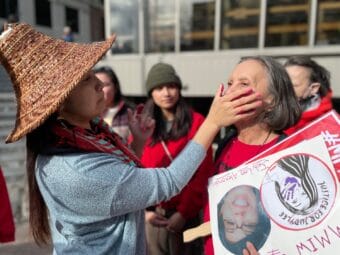
Candace Frank gets a red handprint pressed onto her face at the Missing and Murdered Indigenous People Rally in Juneau on May 5, 2022. (Lisa Phu/Alaska Beacon)

ANCHORAGE, Alaska — Despite Alaska’s small population, a 2018 report by the Urban Indian Health Institute identified it as the state with the fourth-highest number of missing and murdered Indigenous women and girls, and Anchorage as the city with the third-highest number of such cases in the nation.

A new law aims to address some of the reasons for those high rates.

Experts say the causes are complex but clearly the lack of any law enforcement in a third of rural Alaska villages is an issue. Then, where there is law enforcement, there are various layers, including: Alaska police departments, village public safety officers, Alaska state troopers, and sometimes the Federal Bureau of Investigation.

In a 2021 report, the nonprofit Data for Indigenous Justice said when jurisdictions overlap, the result is not dual coverage, but an “unwillingness by either system to assume responsibility for the safety of Indigenous people.”

“One sentiment that illustrates the issue is that law enforcement and criminal prosecution often mobilize to address hunting violations more quickly than they do for cases of homicide against Indigenous people,” the report stated.

In an effort to change course, Alaska has a new law addressing missing and murdered Indigenous persons (MMIP).

Kendra Kloster, who is Tlingit, is co-director of law and policy with the Alaska Native Women’s Resource Center. The center is part of the Missing and Murdered Indigenous Women, Girls, and Two-Spirit Relatives (MMIWG2S) Working Group. The other group members are the Alaska Native Justice Center, Alaska Native Heritage Center, Data for Indigenous Justice and Native Movement.

Kloster said the bill addresses issues identified through working with and listening to Indigenous peoples. “So these ideas and these things that have come up are things that we’ve talked with our tribes about, we’ve talked about with our communities. And these were kind of some of the things that rose to the top that we really needed to do to really look into cases to develop our resources, to really understand what else we can do better.”

She continued, “we collaborate with a lot of other organizations across the state that are doing really great work on this as well, and talking with families who we really appreciate them sharing stories and their information. It’s really hard to do that. But without them, we wouldn’t be able to identify all the different things that really need to be addressed and kind of the loopholes. And so it really takes our whole communities coming together to make this change.”

Kloster said much more is needed — for example, 911 services that are available and responsive, better and more accessible data, and wellness and trauma services—but this new law is the result of efforts beginning in 2018.

Gov. Mike Dunleavy signed Senate Bill 151 into law on Sept. 3. In a prepared statement he said, “this legislation is a continuation of Alaska’s mission to recognize and solve missing and murdered Indigenous persons cases. My administration will continue to support law enforcement, victim advocacy groups, Alaska Native Tribes and other entities working together to solve these cases and bring closure to victims’ families.”

“Senate Bill 151 represents a pivotal moment in our fight to end the crisis of Missing and Murdered Indigenous Peoples,” bill sponsor Sen. Donny Olson (D-Golovin) said in the prepared statement. “By bringing diverse voices together and enhancing our investigative efforts, we are making a clear statement: every life matters, and we will not rest until justice is served for all our missing and murdered loved ones. This legislation is a critical step in the state’s dedication towards healing our communities and ensuring that no family is left without answers.”

“The Alaska Department of Public Safety has led the local, state, and federal government efforts in Alaska of reducing instances of missing and murdered indigenous persons and will continue to invest resources into all of our MMIP initiatives,” Alaska Department of Public Safety Commissioner James Cockrell said in the statement. “With Senate Bill 151 becoming law today many of the initiatives that we started within DPS will now be codified into Alaska Statute and carried on into the future. Your Alaska State Troopers are committed to continuing to aggressively investigate cold case homicides and suspicious missing persons cases that involve Alaska Native victims.”

The prepared statement states the new law:

  • Creates a nine-member MMIP Review Commission to review unsolved cases and submit a report to the Legislature every three years with its recommendations and findings;
  • Requires indigenous cultural training for new police officers;
  • Requires the Alaska Department of Public Safety to conduct a one-time assessment of its protective and investigative resources for identifying and reporting MMIP cases; and
  • Requires the Department of Public Safety to file a missing persons report to the National Missing and Unidentified Persons System database within 60 days after the first report is filed with state and local law enforcement.

The legislation takes effect Jan. 1.

ICT originally published this article. ICT is an an independent, nonprofit, multimedia news enterprise. ICT covers Indigenous peoples.

$15 million EPA grant for Southeast composting projects latest in local expansion efforts

Greens for compost
In a commercial operation like Juneau Composts in Lemon Creek, items are sorted out before they are mixed into a compost pile. (Photo by Matt Miller/KTOO)

The Central Council of the Tlingit and Haida Indian Tribes of Alaska has received $15 million in funding via the U.S. Environmental Protection Agency’s Climate Pollution Reduction grant program.

The Tribe will use the money to expand composting in Juneau and tribal communities across Southeast Alaska. It’s part of a larger trend of funding for composting in the region.

Tlingit & Haida Environmental specialist Cer Scott said the Tribe was surprised to receive the grant. They’re still developing more specific plans for how to use it, but they hope it will go towards strengthening existing composting operations in the region. 

“We’re not looking to reinvent the wheel,” Scott said. “We’re more so looking to serve as a resource to help these composters expand and reach new heights, whether that be with their local composting groups or the local municipalities, forming together partnerships across the region.”

The Tribe’s environmental department said they’re interested in working Tribal communities like Wrangell, Hoonah, Petersburg and Yakutat, which already have local composting programs. They’re in preliminary talks with leaders in those places, but the Tribe says they’re open to working with other communities too. 

Brandi Tolsma is also an environmental specialist for Tlingit and Haida. She said they’re relatively new to the world of composting, but they’re eager to invest in it. According to the U.S. Department of Agriculture, annual CO2 emissions from food waste and food loss are comparable to that of 42 coal-fired power plants.

And food waste is the single most common kind of waste in U.S. landfills. In Juneau, a recent draft waste characterization study estimated that 32% of the material in our landfill could be composted instead. 

“There’s still a lot of potential for expanding composting and really trying to divert as much as we can from these landfills,” Tolsma said. “Whether it be the Juneau landfill, to help expand that lifespan of the landfill, or also in these tribal communities, trying to divert waste. Also the other communities that are shipping their waste down south to help alleviate that economic burden.”

This is at least the third round of federal funding that Tlingit and Haida has received for composting and recycling in recent years. There was a $1.5 million earmark from the Bipartisan Infrastructure Law to develop a regional composting hub last year.

And $300,000 via the U.S. Department of Agriculture for composting at the Tribe’s Taay Hít greenhouse in Juneau. Those projects are not yet up and running. 

The City and Borough of Juneau is also looking to invest in composting, with early plans to develop a municipal facility, also supported with $2.5 million in federal funding from the Bipartisan Infrastructure Act. Tlingit and Haida said they plan to collaborate with the city, but they have yet to figure out what that partnership might look like.

Juneau already has one private composting business, run by Lisa Daugherty since 2017. Juneau Composts collects and processes food waste from 40 local businesses and at least 500 households. 

“I know that the people and the businesses of our community really support the work that we’ve done for the past seven years,” Daugherty said. “I hope that community leaders who are going to be shaping the compost future can recognize that and ensure that composting is going to be wonderful for everyone.”

In the past, Daugherty has publicly expressed concerns that the influx of federal money for composting in Juneau could put her out of business. She said she hasn’t seen any of Tlingit and Haida’s plans yet.

While she’s eager to grow composting in Juneau and the rest of Southeast Alaska, she said she hopes the process is collaborative, with room for public-private partnerships.

Southeast Alaska tribe continues hands-on response to glacial flooding

A flooded house is pictured in Juneau, Alaska. (Photo courtesy of National Weather Service)

A Southeast Alaska tribe is continuing to respond to a glacial outburst that flooded some 290 homes in Juneau.

Early estimates show around 14.6 billion gallons of water were released from an ice dam on the Mendenhall Glacier. That’s according to Aaron Jacobs, a senior service hydrologist at the National Weather Service office in Juneau. The Mendenhall River gauge crested at 15.99 feet at 3:15 a.m. on Aug 6.

The National Weather Service had issued alerts two days before about the likelihood of major flooding from a glacial dam outburst. It had happened before. In 2023, two homes were demolished when erosion undermined their foundations, and flooding to a lesser degree also occurred in other years. So, many homeowners took precautions. They piled up sandbags and lifted things off their basement floors.

However, the flooding was deeper and more widespread than expected. As many as 500 tribal citizens live in the flood zone, but a door-to-door check showed not all were impacted, said Chalyee Éesh Richard Peterson, who is Tlingit and Haida, and heads the Central Council of Tlingit and Haida Indian Tribes of Alaska.

“It’s devastating to see what people are going through and then to hear people had minutes to respond in some cases, depending on where they were located. Hearing the story of just, ‘I was just trying to get my kids out.’ That’s all they thought. And then they lost their family dog and their other animals and it’s devastating, but they got their kids out,” he said in a Facebook video posted by the council.

Water fills the streets and floods houses in the Mendenhall Valley early the morning of Tuesday, July 6, 2024. (Photo courtesy of Rich Ross)

Robbert Holland, age 9, said in the video, “I was nervous, but I just went for it to save my life.”

Peterson said the council and the Tlingit-Haida Regional Housing Authority set up an emergency operations center within hours of the flood’s peak.

Sabrina Grubitz, Tlingit, is incident commander for the tribe. “The first phase is dewatering and getting the debris out of the homes in order to dewater the homes. We were not able to move into a second phase with standing water in those houses,” she said in an Instagram post.

Next comes removal of hazardous materials such as refrigerators, dishwashers, washers, and dryers that are no longer working, and then removal of drywall and insulation.

“By removing those, we’re ensuring that mold will not be growing in those homes in the next few days. And then our phase three is moving into sanitization, so we wanted to ensure that we were able to put together sanitization kits consisting of Simple Green, Clorox, gloves, masks, anything that someone who’s done a self demolition of removing drywall and installation in their home would need to spray on afterwards and use so that they can ensure that the mold’s not going to grow back and have later health concerns,” Grubitz said.

The tribe has 65 staff in the field working closely with 20 National Guard assigned to them to assist. It has issued an emergency declaration, which will help it access resources. Next steps include the tribe helping tribal citizens connect with other services to rebuild as needed.

Jacobs said scientists need to continue to improve their understanding of complex glacial systems, especially as the climate continues to change and warm throughout Alaska.

ICT originally published this article. ICT is an an independent, nonprofit, multimedia news enterprise. ICT covers Indigenous peoples.

Aniak’s tribe sues state, feds over ancestral remains taken from airport site

An aerial view of Aniak’s airport (From Alaska DCRA)

Aniak’s tribal government is suing state and federal agencies for allegedly taking human remains from a burial site discovered beneath the local airport — and not returning them.

The Aniak Traditional Council, the federally recognized tribe for the Kuskokwim River community about 90 miles northeast of Bethel, says the actions of the federal and state agencies are a violation of federal law. Its suit, filed in U.S. District Court, claims they have barred the tribe from practicing its cultural and religious traditions, and have endangered other ancestral remains of Aniak’s tribe that could still be at the community’s airport.

The suit names five defendants: the Alaska Department of Transportation and Public Facilities and DOTPF Commissioner Ryan Anderson; the Federal Aviation Administration and FAA Administrator Michael Whitaker; and the University of Alaska system.

The Traditional Council is represented by Anchorage-based law firm Fortier & Mikko, P.C.

The tribe wants the excavated remains to be returned. It also seeks permission to continue exploring the site to recover and preserve other remains or cultural artifacts.

According to the complaint, filed Tuesday, the suit stems from a project to relocate Aniak’s airport runway to comply with federal aviation standards.

In 2020, a contractor digging trenches for the project found human remains. Almost a year later, the Traditional Council brought in an archaeologist to examine the site. The suit says the archaeologist discovered that the airport project cut a trench through a “previously intact prehistoric burial site.”

The recovered remains and related artifacts were sent to the University of Alaska for examination.

Since then, the Traditional Council says that the University of Alaska has kept the remains. It also claims that the FAA has refused to assist in repatriating them, a violation of the federal Native American Graves Protection and Repatriation Act.

The Traditional Council also claims that the FAA and DOTPF have barred the tribe from conducting further excavation. Aniak’s tribal government is concerned that airport maintenance could further disturb the site.

An FAA spokesperson said Wednesday that the agency does not comment on litigation.

A federal judge ruled that Alaska tribes may put land into trust. Now what?

The piece of land that was attempted to be put into trust is a less than 800-square-foot lot near the corner of Capitol Avenue and Village Street in Juneau. (Clarise Larson/KTOO)

Last week, a federal judge in Anchorage ruled that tribes in Alaska may put land into trust, essentially allowing tribes to create “Indian Country” in the state. That’s something that had nearly been done away with since the Alaska Native Claims Settlement Act took effect 53 years ago. 

Alaska Beacon reporter James Brooks sat down with KTOO’s Clarise Larson to talk about what the ruling really means, and why it matters.

Listen:

This transcript has been edited lightly for clarity. 

James Brooks: This matters a lot because it allows Alaska Native tribes within the state to put land in the federal trust, protecting it from sale, from give away from anything that they don’t want — effectively. It’s a form of long-term protection that places this land under tribal law, rather than state or local law. The main idea is that putting land into trust is something that Alaska tribes haven’t been able to do since the Alaska Native Claims Settlement Act in the 1970s.

Clarise Larson: What is the Alaska Native Claims Settlement Act, and why is it influencing what is happening today?

James Brooks:  We know that Alaska Natives have lived in Alaska for 10s of 1000s of years, since time immemorial, as the phrase goes. The Alaska Native Claims Settlement Act back in the 1970s was designed to settle what’s known as Aboriginal land claims, the idea that folks have been living here for so long, they should have title or right to the land around them — the land that they have used. 

The Settlement Act was designed to settle those Aboriginal claims to land. But what it did was it didn’t give land to tribes, instead, it created corporations to hold that land. And those corporations have rights, but they’re not sovereign governments. And in the decades since then, there have been plenty of people who are unhappy with that result. Even though corporations received millions of acres of land and millions of dollars. It didn’t answer all of the problems that Alaska Natives have had with the current system. And so by putting land into trust, you can put land under the authority of the sovereign tribal governments allowing them to exert tribal law on that land.  

Clarise Larson: In Alaska, who is going to be impacted the most by this?

James Brooks: It has the potential to impact virtually everyone in the state. There are almost 230 federally recognized tribes in the state. And until now, most of those tribes have had very small land bases. Now, tribes can take a greater influence in how land is administered here. And say, for example, Tlingit and Haida’s situation here in Juneau, they’re seeking to put a fairly notable part of downtown Juneau into trust. And that has the potential to impact all of the people who live around that plot of land.

Clarise Larson: But, the ruling wasn’t exactly cut and dry, right? Explain to me some of the intricacies of this particular ruling. 

James Brooks: The ruling this week matters because it says that tribes can do this, but it wasn’t a complete win for the federal government or for Tlingit and Haida. Judge [Sharon] Gleason, who gave the ruling said that the process used in the particular case that was before her court was flawed and needs to be started over. 

That while tribes and the federal government can do this process, the process that was used in the case under question wasn’t correct. So Tlingit and Haida is going to have to go back to the federal government, they’re going to have to restart this process. And it might take a little bit for that to happen. But in the end, the most important thing is that Tlingit and Haida, and other tribes will be able to do this process. 

Clarise Larson: Why did the State of Alaska sue in the first place?

James Brooks: The state of Alaska through various governors, and various legislatures, has always been somewhat skeptical of tribal sovereignty of tribal land claims. And, in challenging tribes’ ability to put land into trust, this latest lawsuit was following in the state’s historical pattern. Because the state government, state governors feel they have a responsibility for all their state residents. And they worry that allowing tribes to put land into trust could create lots of patches of varying jurisdictions that might deprive different residents of their rights.

Clarise Larson: So, what’s next?

James Brooks: This decision could end up getting appealed to the Ninth Circuit Court of Appeals, it could end up reaching the US Supreme Court. And we could see changes if there’s a new presidential administration as well.

Policies on Native land claims and in putting landed the trust have varied from presidential administration to presidential administration. And so we could see that change as well. While this is an important step, it’s not the last word by any means.

Federal judge says Alaska tribes may put land into trust, a step toward ‘Indian country’ here

Tlingit tribal members march down Front Street in downtown Juneau on June 8, 2024, during Celebration 2024. (Photo by James Brooks/Alaska Beacon)

A federal judge in Anchorage has ruled that the Department of the Interior may take land into trust on behalf of Alaska Native tribes, a decision that could allow tribes to create “Indian country,” which had been mostly eliminated here by the 53-year-old Alaska Native Claims Settlement Act.

In a 39-page summary judgment order, Judge Sharon Gleason ruled mostly but not entirely against the state of Alaska, which sued the Interior Department in 2023 to challenge a legal memo stating that the department believes it has the power to take land into trust on behalf of the state’s 228 federally recognized tribes.

At issue in Wednesday’s case was the Biden Interior Department’s decision to accept a trust application from the Central Council of the Tlingit and Haida Indian Tribes of Alaska, which sought to protect a 787-square-foot parcel of land in downtown Juneau.

Gleason said that while the Interior Department does have the power to place land into trust, the process used for the Tlingit and Haida request was flawed and should be redone.

Putting land into trust would put it under Tribal law and shield it from sale or taxation by city and state officials, effectively locking its authority in place. Tlingit and Haida has worked for decades to place portions of Juneau’s historic “Indian Village” into trust.

The U.S. District Court for Washington, D.C., previously ruled in favor of Alaska tribes’ right to put land into trust, but that ruling was later vacated by an appeals court, and Interior Department rules have fluctuated based on the party controlling the White House.

The Democratic Obama and Biden administrations have supported Alaska tribes’ efforts to put land under tribal control, while the Republican Bush and Trump administrations opposed them.

“I think the main takeaway for the Tribe is that for the second time now, a federal judge has held that the (Interior) Secretary retains authority to take land into trust in Alaska. The state has now fought that multiple times and lost,” said Whitney Leonard, an attorney who represented Tlingit and Haida in court.

Attorneys representing the Interior Department declined to comment on the decision.

Most Alaska Native land in Alaska is owned by Native corporations, which fall under state and federal law. Alaska Native tribes, which are sovereign governments and can exert authority over Indian country, have relatively little land under their control.

“From the Tribe’s perspective,” Leonard said, “being able to take control of its land and control how those lands are going to be designated and used in perpetuity is really important to the Tribe. That’s why the Tribe has made a concerted effort over decades to walk through this process and have land taken into trust.”

Attorneys representing the state of Alaska had argued that while the 1971 Alaska Native Claims Settlement Act did not explicitly forbid the Department of the Interior from putting land into trust on behalf of tribes, Congress’ actions implied that it intended to do so.

In legal arguments, the state has expressed its worry that allowing land into trust could balkanize Alaska into a variety of disparate jurisdictions.

“We filed this litigation because of the patchwork it would create with enclaves of reservations scattered through the state,” said Alaska Attorney General Treg Taylor in an emailed statement Wednesday. “The judge’s decision today ensures that for the time being, that is not happening. The agency’s decision was vacated, and the agency will have to address some pretty major hurdles in order to grant an application in the future. What the decision did not do was provide the clarity and finality that the State was ultimately seeking.”

Attorneys representing the federal government and Tlingit and Haida argued that the actual language of federal law — which does not forbid taking land into trust — should carry the day.

To support its argument, state attorneys suggested that the issue is a “major question,” a designation under federal case law that says Congress must explicitly grant an agency a power if it involves a decision of extreme economic and political significance.

Gleason ruled against that idea, saying in part that the issue will not “affect millions of Americans or implicate billions of dollars.”

She went on to say that while the state suggested “the court should still find that (land into trust) was impliedly repealed, the court declines to do so.”

In oral argument this spring, Gleason expressed skepticism about the rules used by the federal government to decide who may put land into trust here.

The state of Alaska had argued that the federal government’s determination in the Tlingit and Haida case would allow “any person of indigenous descent in Alaska, no matter the percentage of ‘Indian blood,’” to put land into trust. In the Lower 48, someone must be “one-half or more” Native in order to put land into trust.

Gleason agreed with the state’s argument, saying that the Department of the Interior must declare that a tribe meets one of three definitions under federal law before placing land into trust.

She also “finds problematic” the Interior Department’s statement that it was putting Tlingit and Haida land into trust as part of the “restoration of Indian lands.”

The Alaska Native Claims Settlement Act specifically ended aboriginal title in Alaska, Gleason said. While the Department of Interior may put tribal land into trust, she said, it cannot justify that decision by saying that it is restoring land to a tribe.

That determination is somewhat academic. It doesn’t prevent the department from putting historic tribal land into trust; the federal government simply can’t use that historic use as justification for doing so.

It isn’t yet clear whether Wednesday’s decision will be appealed. All sides said they are still processing Gleason’s order.

“On the one hand, the Court definitely struggled with the language in ANCSA that eliminated the reservation-system and seemed to indicate that reservations are not permitted in Alaska. On the other hand, the Court still held that lands can be taken in trust. Because this decision ultimately seems to raise more questions than answers, we will need some time to thoroughly evaluate it before determining next steps,” Taylor said by email.

This story originally appeared in the Alaska Beacon and is republished here with permission.

Site notifications
Update notification options
Subscribe to notifications