Alaska Native Government & Policy

‘Not in the business of just giving away our entire collections:’ Denver Art Museum denies Lingít claims for repatriation

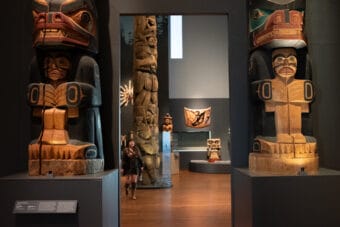
Works on display from the Denver Art Museum’s Northwest Coast and Alaska Native arts collection on April 16, 2024. (Ian Dickson/KTOO)

Earlier this month, the Denver Post reported that Lingít tribal members have been requesting cultural items back from the Denver Art Museum in Colorado for years — to no avail

The museum holds many Lingít items that may qualify to be returned under federal law. 

Investigative reporter Sam Tabachnik says delegates from the Central Council of the Tlingit and Haida Indian Tribes of Alaska sought the return of five items, including a 170-year-old clan house partition featuring the Naanya.aayí clan crest. 

One Tlingit and Haida cultural resource officer told Tabachnik that the Denver Art Museum was “probably the worst museum” they had dealt with. And Tabachnik says the museum has a history of denying repatriation requests.

Listen:

This transcript has been edited lightly for clarity. 

Sam Tabachnik: With the passage of NAGPRA, the Native American Graves Repatriation Act in 1990, American museums were required to compile inventories of all their Native American objects that may be subject to the act. This includes ancestral human remains. It includes associated funerary objects, objects of cultural patrimony, and a few other categories. And so these museums had to go through their collections and try and figure out what might be subject to the law.

The Lingít tribe had sort-of, off-and-on conversations with the Denver Art Museum over the years. They submitted three formal claims for various objects in the early 2000s. But it was really this meeting in 2017 that kind of, I think, really put the relationship between the tribe and the museum into, kind of, stark focus. 

It was a three-day set of meetings here in Denver. There were about a dozen tribal members who came from Alaska to talk with the museum. 

It was on this third day, you know, from talking to people who were in this meeting, that the tone really started to shift. Now, the museum says this shift occurred when museum officials were talking about the necessary process that the tribe would have to go to, in order to comply with NAGPRA, in order to file an official claim that might be accepted by the museum. 

Tribal members told me that they viewed this meeting in particular, as incredibly, uh — Denver officials were incredibly condescending, insensitive, and seemingly intransigent. Unwilling to really budge.  

Yvonne Krumrey: And what has taken place in the last seven years since it’s happened?

Sam Tabachnik: You know, it’s unclear. There has not been a lot of movement here. The museum says the tribe has not submitted formal claims for a couple of the pieces I talked about in the article. And so the museum says, “Hey, you know, we’re just waiting on a formal claim.” 

The tribe says, “Well, the museum has been quite clear in their discussions that even if we submitted a formal claim, that they would not return these objects.” So I think the tribe has sort of taken the impression that this is just not gonna happen.

Yvonne Krumrey: And from your reporting, and speaking with tribal members and the museum officials, what are some of the barriers to the process of submitting these formal claims? Is it fairly straightforward? Or are there, kind of, hoops to jump through to do it?

Sam Tabachnik: There are a number of different qualifications or categories that tribes are supposed to fill out, or they’re supposed to show evidence to check off certain boxes. 

ProPublica published a really impressive project about NAGPRA in the last year called the Repatriation Project, and it essentially showed how museums — 33 years after the lawʼs passage in 1990 — still half of these funerary objects and human remains are still in some of America’s most prestigious universities and museums. 

It is that museums really hold the cards here. They have control of these objects, and they can make it as easy or difficult as they want.

Yvonne Krumrey: And you said that there are still a couple items that there hasn’t been a formal request process for. What has happened with the ones that have been formally requested?

Sam Tabachnik: Yeah, so the museum told me there were three formal claims from the Lingít tribe. Two were rejected for not having enough information — for not checking all the boxes of, you have to prove that a single individual could not give up the rights to an object, that it had to be collective ownership. There are several other categories you have to hit. And the museum said the tribe wasn’t able to prove certain things. And so they rejected them. The third one, they said they didn’t get even enough information from the tribe in the claim. They were unable to initiate a formal evaluation process. So in all essence, they rejected three claims from the tribes.

Yvonne Krumrey: How do Denver Art Museum’s actions compare to other museums that have had this experience or have gone through this process?

Sam Tabachnik: Yeah, so Colorado has generally been viewed as a national leader in complying with NAGPRA, the Denver Museum of Nature and Science has been incredibly proactive. History Colorado has been also cited by some national folks as really leaders in the field. They kind of went above and beyond. A lot of museum folks talk about the difference between complying with the letter of the law and complying with the spirit of the law. And several of these Colorado institutions really wanted to comply with the spirit of the law. And people have spoken about how the Denver Art Museum has not been a part of that. They have not been as proactive as other museums.

Yvonne Krumrey: You’ve reported on Denver art museums ownership of contested items before. Can you tell me a bit about that reporting?

Sam Tabachnik: Sure, I’ve been writing about the Denver Art Museum and repatriation requests or claims for about three years. I spent a long time — wrote a long series about a former now deceased museum consultant and board member named Emma Bunker, who was tied in with the antiquities trafficking and organization essentially. And she helped the museum acquire a host of Southeast Asian antiquities that the Southeast Asian countries — Cambodia, Thailand, Vietnam — said were looted from their ancient temples.

Yvonne Krumrey: In your understanding of this landscape with the Denver Art Museum, how does the story fit into a broader pattern of them holding items that are contested or maybe weren’t acquired in honest means?

Sam Tabachnik: Yeah, what the Lingít tribe reported to me jives with what other countries have told me about the reluctance of the museum to give up objects in their collection. I thought it was telling — the curator of Native American arts who I interviewed I sat down with as part of this latest story said, “We’re not in the business of just giving away our entire collections.” And I thought that quote was an interesting quote and spoke volumes.

New Department of Interior opinion promises to recognize expanded tribal jurisdiction in Alaska

Tongass National Forest (Photo by U.S. Forest Service)

A new legal opinion by the top attorney at the U.S. Department of the Interior has extended the jurisdiction of Alaska tribes over a broad swath of the state, upending decades of precedent and offering new opportunities for the state’s 228 federally recognized tribal governments.

The opinion, issued Feb. 1 by Interior Department Solicitor Robert Anderson, says tribal authority applies on land allotments given to individual Alaska Natives, unless those parcels of land are owned by a nontribal member or are “geographically removed from the tribal community.”

“That is a very big change,” said Joel Jackson, president of the Native Village of Kake in Southeast Alaska.

“We’re always looking for land back,” he said. “That’s important to us. We’re going to do that.”

The opinion — which reverses decades of prior interpretation — doesn’t change who owns the land, but it does change the laws that apply to the land. Tribal law, not just state, local or federal law, will now apply.

Since the passage of the Alaska Native Claims Settlement Act, Alaska’s tribal governments have had authority over minimal territory because that law assigned Native corporations — which are legally distinct and not governments — most Native land.

Almost 17,500 allotments have been awarded to individual Alaska Natives since 1906 or are in the process of being awarded, according to figures published by the U.S. Department of the Interior. Each parcel can be as big as 160 acres.

That means the opinion has the potential to change the legal framework around many thousands of acres in Alaska.

“All in all, it will be a positive step forward for the state of Alaska,” said Rhonda Pitka, first chief of the Native Village of Beaver. “Having Native lands in Native jurisdiction makes a lot of sense for everybody, I think.”

Attorneys for the state of Alaska disagree.

In a court filing last month, they expressed alarm, calling the new opinion a “sea change” for the state.

In response to emailed questions, the Alaska Department of Law provided a written FAQ that said, “In two strokes of its Solicitor’s pen, Interior has changed how Alaska has operated for more than 50 years. The state has gone from minimal amounts of tribal territorial jurisdiction to millions of acres.”

“The federal government already owns more than 60% of the lands in Alaska, but with these recent changes that percentage could significantly increase,” the FAQ said.

The change has implications for things as varied as game management, local zoning and police coverage.

In the past 10 years, the Native Village of Eklutna and the Central Council of the Tlingit and Haida Indian Tribes of Alaska each sought to open federally regulated gaming halls on Native allotments in their traditional territory.

A federal judge and the National Indian Gaming Commission, respectively, rejected the plans, concluding that the allotments were not under tribal jurisdiction.

“The tribe is reviewing the solicitor’s opinion with interest and considering what it might mean for us,” said Brenda Hewitt, tribal administrator for the Native Village of Eklutna.

A message to the Tlingit and Haida Central Council was not returned.

Legal experts expressed mixed opinions about the state’s analysis, which was offered in a legal filing known as a surreply.

“The state’s vibe in its surreply is a bit like that ‘It’ll be anarchy!!!!’ line in the ‘Breakfast Club.’  Will it though? My short answer is that I don’t think it will be anarchy or affect folks much day to day,” said Erin Dougherty Lynch, senior staff attorney for the Native American Rights Fund, by email.

“And if the state is worried about confusion, it could proactively work with Tribes to address any issues, as other states have done for years,” she said.

Dougherty Lynch said Palm Springs, California, is an example. There, the Agua Caliente Reservation is arranged in a checkerboard over the city, with Native land next to municipal and private land.

Multiple people familiar with the new legal opinion said each of the state’s tribes will use the new authority differently and gradually, based on local needs and goals.

“There is no one, tribal way of doing things,” Pitka said.

“It’s really a local decision, and it’s up to (the tribes) how they wish to enforce it,” she said.

Pitka said she believes the change will help public safety in her region. The holders of Native allotments nearby are being plagued by trespassers, she said, but state and federal law enforcement has been slow to address the problem.

“We’ve called them on this several times, and the troopers won’t enforce it. They asked us to put up more signs on our lands. So we do that, and they still don’t come out and enforce the trespass,” Pitka said.

In one case, she said, someone appeared to steal large amounts of gravel from an allotment.

Having tribal jurisdiction over that allotment might allow the tribe or the owner of the allotment to bring claims in tribal court against trespassers and thieves.

“That would be the remedy,” Pitka said. “That would be kind of exciting to do. That would be kind of exciting to test.”

Dougherty Lynch also suggested that the state’s concerns should be viewed in context.

The state of Alaska, federal government and Native tribes are deep in litigation over the extent to which the federal government has the ability to take land into trust on behalf of tribes. Trust lands are held by the United States for the benefit of tribes or individuals.

Tribes in the Lower 48 and Hawaii have long had that ability, but the state has argued that federal law applies differently in Alaska, something the Department of the Interior and several tribes contest.

The state filed suit against the federal government in 2023, after Tlingit and Haida put a 787-square-foot parcel of land into federal trust, becoming the first tribe to take that action since 2017.

Oral arguments in that case are scheduled for March 28, and the state has argued that the matter should fall under the “major questions doctrine,” which says that judges should give federal agencies less deference when there are conflicts over the meaning of the law.

The arrival of the new solicitor’s opinion adds evidence to the idea that the issue is a major question, state attorneys say. Opposing attorneys disagree, and the issue is among those that the judge will decide.

Most Native allotments have been in the hands of individuals or families for decades.

From 1906 through the enactment of the Alaska Native Claims Settlement Act in 1971, individual Alaska Natives could request up to 160 acres of land from the federal government, akin to a homestead.

Natives lost the ability to select allotments under ANCSA, but in 2019, Alaska’s congressional delegation inserted a provision, allowing Alaska Native veterans of the Vietnam War, or their survivors, to select new allotments.

Already, the Bureau of Land Management has received 358 applications, with more expected. Both Gov. Mike Dunleavy and Alaska’s members of Congress have urged the federal government to speed up the transfer process, an act that might result in more land being placed under tribal jurisdiction.

To date, the federal government has restricted the locations of new allotments, and most are in Interior, northern, or western Alaska. Jackson, of Kake, said Vietnam veterans in his area have been reluctant to seek allotments under the new law because they’re far from home.

Dougherty Lynch said that it’s too early to tell how much new tribal jurisdiction will be created by the new legal opinion, which requires the allotment to be owned by a tribal member and be geographically close to the relevant tribe.

“So given those requirements there are some allotments (who knows how many) that would not meet that criteria,” she said by email.

In Southeast Alaska, Jackson and the Kake Tribe have a long-running culture camp on one Native allotment, and the tribe has been seeking to acquire the land around the camp in order to protect it. The order could offer additional protection, he said.

But he also has his eyes in a different direction, he said. The Tribe has been fighting development projects in the Tongass National Forest for more than two decades and has frequently taken a lead role in lawsuits over the region’s Roadless Rule.

He said he sees the new order as a chance to protect some of the remaining stands of old-growth forest in the region.

“We want to protect it,” he said. “That’s our main concern.”

He’s now in his 60s, and as a younger man worked on a road-building crew, logging in the region. He later came to realize what was being lost as the forest was cut.

“When I take a breath and look back — and I tell you the truth — I was out on my boat, and I looked up at the land, and a tear rolled down my cheek,” he said.

“I still go out — I can hardly walk very far anymore. But I’ll walk into an area and find a log to sit on and just sit there and absorb everything that’s going on around me: the smells, the sounds,” Jackson said. “And, you know, it’s just amazing how much peace it brings me. It centers me in my life. And it’s way more valuable to me to leave something for future generations to experience that, to be able to walk into an old growth forest.”

Tlingit and Haida is hiring ambassadors to share Lingít culture at the Mendenhall Glacier

Mendenhall Glacier Visitor Center in July, 2023. (Clarise Larson for the Juneau Empire)

This summer, there will be a new type of guide at the Mendenhall Glacier,  one whose job it is to educate visitors about how Lingít history is intertwined with the glacierʼs. 

The role is part of the new co-management strategy between the U.S. Forest Service and the Central Council of the Tlingit and Haida Indian Tribes of Alaska.

Tlingit and Haida President Chalyee Éesh Richard Peterson says that, in the past, staff at the glacier wouldnʼt know what to say when visitors asked them about the Indigenous history of the area.

“The feds at the time out there at Mendenhall said ʼWell, they didnʼt have anything to do with glaciers.ʼ And that was kind of dumbfounding to us,” he said. “Iʼm Kaagwaantaan, we have migration stories about the glacier. I think everyone does. We have songs and stories about the glacier.” 

Now, Peterson said, this position will allow for the hundreds of thousands of annual visitors to the glacier to understand the history and original language of the area more deeply. 

“I think if you want them to have an authentic experience — a more inclusive experience — then the voice of our people need to be out there in that representation, and so weʼre moving towards more opportunities for co-stewardship and make sure that our voices are represented out there.” 

Itʼs not just for the benefit of tourists, he said. Roles like these reinforce the Lingít communityʼs place on the land and in its caretaking. 

“That weʼre still here and that our language should be valued and our placenames should be valued, and as all people, we should be valued,” Peterson said. 

The Tribe plans to hire up to four people for the job. It’s a seasonal position, from March to September, with a training period before the cruise ships start arriving. Ambassadors will be paid $20 an hour. 

Julie Kitka to step down as longtime head of the Alaska Federation of Natives

Alaska Federation of Natives President Julie Kitka is hopeful the state can create a seat at the federal table. (Photo courtesy Alaska Federation of Natives)

A major transition is ahead for the Alaska Federation of Natives. AFN leaders have announced plans for Julie Kitka to step aside as president before this fall’s convention.

Next month, AFN will open up the application process, the first step in choosing the next person to lead state’s largest Native organization.

In an announcement, AFN leaders said it was Kitka’s choice to leave this role.

Kitka was elected president in 1990, but her service to AFN goes back four decades. From healthcare to fulfilling the goals of the Alaska Native Claims Settlement Act, Kitka has had a hand in almost every one of AFN’s major achievements.

Paul Ongtooguk, an Alaska Native Historian, says Kitka’s long tenure has enabled her to shepherd AFN through historic issues, which have had a huge impact on Alaska Native peoples. The downside, he says, is that it’s always tough for a legacy leader to decide when it’s the best time to leave.

“No one lands on that squarely that I’ve ever seen,” Ongooguk said. “There’s an enormous amount of appreciation that needs to be given for all the time and enormous effort that she’s put in, year after year.”

Ongootuk says presided during a time of great change, and AFN has benefited greatly from her thoughtful leadership.

Kitka first joined AFN in 1984 as a special assistant for human resources. She has also served as AFN’s Washington D.C. lobbyist and vice-president.

AFN’s board of directors has created a succession committee and hired The Foraker Group to help with the search and transition. Foraker is an organization that helps non-profits grow and adapt to change.

AFN is also asking its members to fill out a questionnaire to help choose a new president.

Ongtooguk says the survey is a good idea and that it’s especially important for the younger generation to weigh in. But more important, he says, is for today’s AFN leaders to listen carefully to what they say — that young people may offer ideas they aren’t capable of even imagining.

Ongtooguk says the new leader of AFN must deal with a changing demographic, in which AFN membership will be dominated by urban natives, as rural Natives opt for city life and become less connected to subsistence and the Native way of life.

He says the new president will face different challenges than Kitka, as well as different opportunities.

“The way people think about that role and what it could be and should be for the future. It really does need to take a fresh bend in the river,” Ongtooguk said.

The plan is to have the new president in place by October to lead the 2024 AFN Convention, the largest gathering of its kind in the state.

Kitka says she has no comment at this time but will not leave the picture completely. She says she plans to take up a new role at AFN, to be announced sometime in the near future.

AFN’s Co-Chair, Joe Nelson said in a statement that it’s difficult to imagine an AFN without Julie Kitka at the helm, but AFN leaders are committed to a healthy transition.

Juneau Tlingit and Haida Community Council donates $150,000 to local school programs

Parents, teachers, students and district staff attend a Juneau School Board meeting on Feb. 13, 2024. (Clarise Larson/KTOO)

The Juneau Tlingit and Haida Community Council has donated $150,000 to the Juneau School District. The funding will support school activities, a snack program and Indian Studies programs.

Rhonda Butler is the president of the community council, an elected group that represents Juneau’s Tlingit and Haida citizens. The council’s weekly bingo games fund their annual donation program, and Butler said they’ve donated to the school district in the past.

“This year it was a little bit higher, especially when we were getting notice from different tribal members that the need for food was on a rise,” she said.

The council donated $55,000 to help pay for snacks at the district’s schools.

They also donated $45,000 to support student activities, including the high school basketball teams, Thunder Mountain’s wrestling team, Yadaa.at Kalé Juneau-Douglas High School’s cheer team, the district’s Native Youth Olympics programs and the Tlingit Culture, Language and Literacy program’s robotics team.

The council also donated $50,000 for the district’s Indian Studies programs, which help address academic and cultural needs of Alaska Native students.

Butler said partnerships like this will be key to supporting all of Juneau’s students through the district’s budget crisis. The district is facing an $8 million deficit for the current school year and is considering closing schools.

“I think with collaboration and partnership a lot of these deficits or financial cuts might be lesser in the future,” she said.

The Juneau School Board accepted the donation at its meeting Tuesday night.

Alaska Native Tribes pressure Canada for rights in Unuk River mining project

A petroglyph at the mouth of the Unuk River. (Photo by Lee Wagner/SEITC)

Tribes near Ketchikan submitted evidence Jan. 30 to the Canadian and British Columbia governments that they hope will give them a voice in transboundary mining discussions.

The tribes say the evidence proves they’ve had a historical presence along the Unuk River, which runs through the border.

Southeast Alaska tribes have long demanded a seat at the table in how Canada manages mining projects that affect lands and waters across its border.

On January 30, a coalition of the Lingít, Haida and Tsimshian Tribal governments submitted testimonial evidence to protect the Unuk River, one of their river watersheds. The tribal group fears the watershed could be damaged by a proposed open-pit gold mine on the other side of the border.

The coalition is called the Southeast Alaska Indigenous Transboundary Commission (SEITC) and represents 15 tribes and tribal groups in Alaska and Canada.

“The border that transects these transboundary rivers is a completely false construct. Nothing in nature respects that line on the map – the water, the salmon, the people, the wildlife, nothing respects that. What happens in the upper reaches of these trans boundary rivers will impact our tribes, our communities, and our tribal citizens,” said Guy Archibald, SEITC’s executive director.

The evidence submitted by the commission, which includes personal testimony from tribal members of Metlakatla and other communities along the border, is meant to demonstrate the Lingit people’s historic presence along the Unuk River. The river, northeast of Ketchikan, is an established wild salmon habitat and holds cultural significance to Alaska Natives. And the tribal governments say it is under threat from Eskay Creek Mine, a silver and gold mining project proposed upriver in British Columbia,.

Essentially, the tribes are alleging that unregulated mining across the border in Canada is conflicting with the tribe’s obligation to protect traditional lands for future generations.

Tazia W’ally Sthaathi Ta Wagner, a member of the Wolf Clan in Metlakatla, testified that she grew up harvesting hooligan, moose and king salmon on the Unuk and plans to protect that cultural right.

“I would love to see us do another community harvest on the Unuk River again and see those bright smiles on everyone’s faces one more time. And to bring hooligan again to our elders, that is what I would really love to happen in the future, for generations to come,” she said.

Skeena Resources, Ltd., the Vancouver-based mining company in charge of the mining proposal, did not respond to repeated requests for comment.

Earthjustice, the organization representing the tribal commission, has also brought a case against the Canadian government alleging that their refusal to consult with Alaska Native Tribes on large-scale mining development is an international human rights violation. The claim was recently recognized by the Inter-American Commission on Human Rights.

“This isn’t a new right. I mean, these are rights that go back millennia,” said Earthjustice attorney Ramin Pejan. “The ownership of the Unuk River and the territory and the use of that river is integral to their culture, to their subsistence. It goes back thousands of years before these borders were in place.”

Pejan said the goal is to capitalize on recent Canadian legal precedent to get the country to consult with Alaska tribes properly – the way they would for tribes protected under the Constitution in Canada. Something that Guy Archibald said felt hopeless a few years ago – even from the state of Alaska.

“Alaska signed a [Memorandum of Understanding] with British Columbia to have a trans-boundary working group,” Archibald alleged. “They did that without any consent or consideration of the tribes. It’s bilateral. It’s between Alaska and BC. The tribes are not involved. And the state doesn’t share any of that information with us.”

Then, a door opened back in 2021. That door was the Desautel case – an Indigenous American citizen tried in Canada’s courts for killing an elk in British Columbia without a hunting license. The defendant lived on a reservation in Washington and argued that he was exercising his aboriginal right to hunt in the traditional territory of his ancestors. Archibald explained that the case forced the Canadian Supreme Court to ask a central question.

As Archibald put it, “Do Indigenous, non-resident people of Canada – people who live outside of Canada but have ties to traditional lands within Canada – have any rights to those lands? And the Supreme Court said ‘yes.’”

Pejan said that the Eskay Creek Mine case is the first case through that door opened by Desautel but it is by no means the biggest. It is dwarfed by the KSM Mine, a proposed project that would be one of the largest open-pit mines on the planet.

If the coalition succeeds, it would be the first time in history that a US-based tribe is granted “Participating Indigenous Nation” status in Canada. The country has never legally recognized US-based Indigenous peoples as stakeholders in the country’s policy decisions.

“You know, we keep hearing that these resources are so abundant. They’re just infinite. Like the buffalo?” Archibald, an environmental chemist by trade, complained, citing his past as a miner and what he calls “the standard mining company line.” “And on and on. And then we keep making the same mistake over and over and over again.”

For Archibald, the chances to make mistakes are running out.

“Alaska is the last stand,” he said. “These transboundary rivers are the last undeveloped salmon spawning rivers left in North America. If we don’t get it right here, then we’ve run the table. There is no place further to go. So this is the place to make the stand.”

Site notifications
Update notification options
Subscribe to notifications