Alaska Native Government & Policy

Tlingit and Haida opens Washington state office

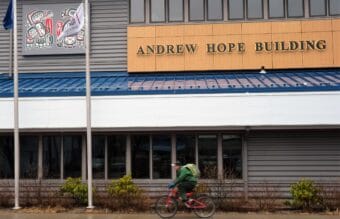
The Andrew Hope Building in downtown Juneau is home to the courtroom of the Central Council of Tlingit and Haida Indian Tribes of Alaska. (Photo by Ed Schoenfeld/CoastAlaska News)
The Andrew Hope Building in downtown Juneau is the headquarters of the Central Council of Tlingit and Haida Indian Tribes of Alaska. (Photo by Ed Schoenfeld/CoastAlaska)

Alaska’s largest federally recognized tribe is opening a new office in Lynnwood, Washington.

More than 8,200 tribal citizens live in the Washington area, according to the Central Council of the Tlingit and Haida Indian Tribes of Alaska. President Chalyee Éesh Richard Peterson said it’s the tribe’s latest step in establishing a presence in all of its communities.

“I’ve always said we’re going to meet our citizens where they’re at, so it’s kind of that promise kept,” he said.

The office’s 20 staff will provide tribal court services, enrollment, case management in child welfare cases and other services. The new office also has a large classroom where Tlingit and Haida’s education staff can host language, arts and cultural programs.

Lynnwood is just north of Seattle, and the regional transit system plans to open a light rail station there next year. Peterson said having a centralized space will help build community among tribal citizens who live in Washington.

“In an area like Seattle, you could go about your daily life and never look across and see somebody who looks like you, who has your background,” he said. “You’re going to be able to go in and feel like you’re home.”

Tlingit and Haida recognizes 21 communities in and outside of Alaska as community council chapters. Delegates from those chapters make up the governing body during annual Tribal Assembly meetings

Last month, the tribe announced new relief programs for its citizens in Anchorage and Washington using American Rescue Plan Act funds.

The tribe has been pursuing other revenue sources, too. They bought the Alaska Seafood Company in June and the Driftwood Lodge in March.

“We’re working for our own economic sovereignty,” Peterson said. “We’ve started enterprises so that we can build our own unrestricted revenue and serve our people how we want – not dictated by anybody else – which I think is true sovereignty.”

Tlingit and Haida staff based in Washington had already worked for the tribe remotely. Peterson said the pandemic showed remote work was possible, both in and outside of Juneau. 

“It’s really opened up the hiring pool for us,” he said. “For the first time ever, we’re hiring tribal citizens and creating opportunities for people who live outside of the service area.”

In February 2022, Anchorage became the site of the tribe’s first office outside of Southeast Alaska. A second Anchorage office opened earlier this year. Peterson said he’s seen the difference having a presence there can make.

“Just driving in downtown Anchorage, and you see a Tlingit and Haida sign, your head kind of spins around. We’ve had people walk in right off the street and they’re saying, ‘Hey, I’m Tlingit. Hey, I’m Haida. What’s this?’” he said. “I’ve had people literally tear up, they’re so excited about having those connections and opportunities.”

Peterson said the Washington office is a success worth celebrating. 

“I just think this is a really important time in our history for Tlingit and Haida,” he said. “We’re kind of changing what people think of as the rules or how we do things.”

Staff moved into the new Lynnwood office this week, and the tribe is planning a grand opening on Nov. 8.

Douglas Indian Association seeks permit for cultural education center

The Douglas Indian Association is requesting a conditional use permit for up to 4,000 square feet for the building and up to 1,000 square feet of covered outdoor space. The lot is about 13,500 square feet. (Katie Anastas/KTOO)

The Douglas Indian Association hopes to build a new learning center in South Douglas. The Juneau Planning Commission will consider permitting the project later this month.

According to information submitted by NorthWind Architects, the proposed facility is a single story building with a basement. It would include a classroom and a teaching kitchen. The Douglas Indian Association owns the proposed building site at the end of St. Ann’s Avenue near the Treadwell Mine Trail.

Kamal Lindoff, the Douglas Indian Association’s property management and transportation director, said classes would focus on Lingít language learning and food sovereignty. 

“It’s going to be on a small scale – probably no more than 20 students,” he said.

Right now, the Douglas Indian Association teaches tribal members about processing traditional foods like salmon and crab at Tlingit and Haida Community Council’s bingo hall.

The location is also culturally significant, he said. It overlooks Sandy Beach, the site of the former Douglas Indian Village, and Mayflower Island, a traditional subsistence site.

“It’s a pretty historical and important site for the Douglas Indian Association,” Lindhoff said.

The lot is about 13,500 square feet. Its zoning allows for an educational facility with a conditional use permit. The Douglas Indian Association is requesting a permit for up to 4,000 square feet for the building and up to 1,000 square feet of covered outdoor space. The planning commission will review the request on Nov. 14.

A drawing by NorthWind Architects shows a possible design with a small parking lot in front of the building. (Drawing by NorthWind Architects submitted to Juneau’s planning commission)

One major question is how to provide parking for the new facility. Because of the proposed size of the building, the architects are likely required to put in at least six parking spaces.

One option is to put angled parking spots along the front of the lot. Drivers would back out of those spots directly onto St. Ann’s Avenue. That design would allow for nine spaces.

“The DIA would consider posting some of these spaces as shared for public use, thereby expanding public access capacity at the trailhead at no cost to the City,” the architects wrote.

Another option is to put a small parking lot on site. “Due to challenges in site development and subsequent cost,” the architects wrote, the Douglas Indian Association is requesting a waiver to reduce the required parking from six spots to five.

Lindoff said he’s heard concerns about increased traffic or difficulty parking in the area. But he emphasized that the building wouldn’t be big enough to host large events.

“I can understand people’s concern, but I don’t think we’re going to be pushing that limit to where it’s going to be a problem,” he said. 

The site where the Douglas Indian Association hopes to build the learning center is near an entrance to the Treadwell Mine Trail. The city has a small parking lot there. (Katie Anastas/KTOO)

If the planning commission approves the conditional use permit for the overall project, their next step is to approve or reject the angled parking spot proposal. If they reject it, they’d consider the five-spot parking waiver instead. If both parking plans are denied, the planning process ends unless the Douglas Indian Association appeals.

Lindoff said he expects construction would take two to three years.

AFN delegates pass 28 resolutions, including plea to Congress for subsistence action

Jonathan Samuelson, chair of the Kuskokwim River Inter-Tribal Fish Commission, speaks Friday at the Alaska Convention of Natives convention about the effects of salmon crashes in his region. (Photo by Yereth Rosen/Alaska Beacon)

Members of this year’s Alaska Federation of Natives conference in Anchorage voted Saturday to ask Congress and the federal government to protect and increase subsistence hunting and fishing rights for Alaska Native people in rural Alaska.

The request puts the state’s largest Alaska Native organization at odds with the state government, whose constitution forbids laws that give rural residents a greater subsistence right than urban residents and likely forbids giving Native people a preference over others.

AFN has already sided with the federal government in a subsistence-fishing lawsuit against the state of Alaska, and Saturday’s resolution suggests the disagreement may grow into hunting and trapping and outlast the court case.

Conference attendees approved 28 of the 29 resolutions on the agenda, including one calling for the preservation of Alaska’s new ranked choice voting system. Opponents of the system were active outside the convention, gathering signatures for a proposed ballot measure that seeks its reversal.

Another resolution, supported by the Alaska chapter of the American Civil Liberties Union, advocates an independent federal investigation into Alaska Native deaths within Alaska state prisons and jails.

Alaska Native people make up 22% of the state’s population but more than 41% of Alaska’s prison population. Last year, 18 people died in state prisons and jails; half of those were Alaska Native.

The lone resolution to not pass a final vote was one asking the Environmental Protection Agency to not grant further extensions of water treatment waivers for urban municipalities. That proposal was withdrawn to a committee for further work.

Past AFN conventions have seen delegates divided by resolutions. Since 2019, three regional Alaska Native corporations and two large tribal groups have quit AFN.

Last year, extensive debates over salmon shortages put some Native groups at odds.

This year’s resolution debates were much more sedate and finished an hour ahead of the schedule set on the official agenda.

Subsistence issues — those covering the traditional harvest of fish and game for personal, noncommercial use — garnered the most attention during the three-day convention.

Before Saturday’s votes, delegates spent hours on Friday afternoon discussing the need to preserve traditional subsistence fishing amid a drastic decline in salmon returns to mainland Alaska rivers.

Under the 1980 Alaska National Interest Lands Conservation Act, the federal government guarantees subsistence preferences for rural Alaskans, but not Alaska Native people specifically. AFN delegates contend that Alaska Native people should be granted special permission, something the state rejects.

“A Native-only preference is a non-starter for the state and questionable under both the state and federal constitutions,” said Patty Sullivan, communications director for the Alaska Department of Law.

The state and federal government are also currently fighting in court over who should have management authority over fisheries in rivers that flow within federal parks and preserves.

As part of its defense, the state has argued that a federal judge should reexamine a series of cases known collectively as Katie John, after an Ahtna elder who waged a lengthy legal battle.

The Katie John decisions underpin current subsistence management, and AFN has joined the federal government in arguing that they should continue to stand.

For its part, the state says that it is being forced into revisiting Katie John because of federal actions, not because it wants to overturn precedent.

The ongoing disputes remain unresolved in federal district court in Anchorage. If the judge rules in favor of the federal government and AFN, current precedent will remain.

That isn’t good enough, some Alaska Native people said at the convention, which is why they’re pushing for congressional action that would grant more rights for rural Alaska Native people.

This story originally appeared in the Alaska Beacon and is republished here with permission.

AFN attendees urge unity at convention as underlying tensions simmer

Attendees at the Alaska Federation of Natives convention on Friday, Oct. 20, 2023. (Matt Faubion/Alaska Public Media)

During this year’s annual Alaska Federation of Natives convention, there was one clear message coming from members who remain: unity and cooperation.

But behind that message, relations are strained between AFN and some tribal entities and corporations in Alaska.

“At this point in time, there is some uncomfortable tension between AFN and some tribes and some corporations,” said Beverly Hoffman who is on the Bethel Native Corp.’s board of directors. “But at this day and time, it’s really important to unify on common ground and we talk about fish, we talk about the land, and protecting the annual convention, our ways of life, that’s what we fight for.”

That uncomfortable tension Hoffman is talking about wasn’t immediately obvious at this year’s convention. That’s because some of the organizations that have disagreements with AFN have withdrawn their memberships, and their leadership wasn’t present at this year’s convention.

Among those tribal organizations are the Central Council of Tlingit & Haida Tribes of Alaska, which withdrew its membership from AFN earlier this year.

President and CEO Chalyee Éesh Richard Peterson questioned the need for membership in AFN.

“You know we’ve been told that if we’re not there at the table, we’re not there in the room or whatever. My executive council asked, ‘Well, what room do we need to be in?’ because we’ve met with the Secretary of the Treasury, we’ve met with Commerce, we’ve met with Transportation.”

Peterson was in Anchorage for meetings with Department of Interior officials, including Secretary Deb Haaland, but he didn’t attend AFN’s convention. He said Tlingit & Haida has outgrown it.

“I think we are stronger together and certainly that’s the criticism I have heard of us pulling out, but the reality is we don’t have to be members of anything to stand with other tribes,” he said. “So, we’ve been building our capacity for years and continuing to do that and we have a great legal team now, we have a strong governance department now and we’re really good at advocating and doing our own work, quite honestly.”

Since 2019, nearly half a dozen tribal organizations have left AFN for various reasons.

Tanana Chiefs Conference Chief & Chairman Brian Ridley said the tribes he represents voted to withdraw – primarily over salmon.

“We feel like the conservation of the salmon has been entirely on the backs of our subsistence people in the villages along the rivers, because we haven’t fished for years and all we were trying to do is trying to get others to share in the conservation so that the salmon will come back,” Ridley said.

TCC is the largest tribal organization in Alaska’s Interior region. Last year, Ridley spoke in support of two AFN resolutions that called for efforts to reduce salmon bycatch to allow more fish to return to the Yukon and Kuskokwim rivers. Those passed during the convention, but debate was contentious and divided regions, including the Interior and the Aleutians and Pribilof Islands.

Since then, Ridley said his organization has been front and center at state board of fish and federal management meetings, but AFN has not been there to back them up.

“A step in the right direction would be them showing up and showing that subsistence, our fish, our game is important to our people, to AFN to see them at those same meetings fighting shoulder to shoulder with us,” he said.

The Alaska Federation of Natives first convened in 1966, when only 17 Native organizations came together. Today, AFN co-chair Ana Hoffman said the convention draws hundreds of member organizations and each one has specific and unique wants and needs.

“There are times where there’s disagreement and we are not insensitive to that,” she said. “In fact we try to be very sensitive to that. And we are trying continually to improve our systems internally at the organization to be responsive to that and to improve ourselves for future engagement.”

One of AFN’s first co-chairs, Willie Hensley, said this kind of tension between members is nothing new.

“There’s always been disagreement…” he said. “Once in a while we have had regions pull out in the past…In fact at one point, we almost split into two statewide groups at one point in the ’70s. But I think usually reason prevails, because if we get fractured, and vulcanized, that diminishes our ability to represent Alaska and Alaska Natives.”

Alaska’s Indigenous population is regionally and culturally diverse, he said, with an array of concerns that transcend AFN.

“We have many different groups, small regions, big regions, some really modernized, some very traditional,” Hensley said. “AFN can’t solve all the problems.”

And Hensley said it would be a mistake to look only at divisive issues in place of challenges Alaska Natives share collectively.

Even so, strategic planning is underway at AFN. As part of that, the organization is circulating membership surveys this year. Questions include what members most value about the organization, what weaknesses the organization faces and ask for suggestions on goals for the AFN’s next five years.

AFN keynote speakers highlight the importance of perseverance and protecting ‘our ways of life’

Sophie Minich, outgoing CEO and president of CIRI, speaks at the Alaska Federation of Natives convention on Thursday, Oct. 19, 2023. (Matt Faubion/Alaska Public Media)

The annual Alaska Federation of Natives convention kicked off in Anchorage on Thursday. The group is the largest organization of Indigenous people in the country, bringing in delegates from all corners of the state. The theme of this year’s convention is “Our Ways of Life.”

This year, delegates had the rare opportunity to hear from two keynote speakers: the outgoing president of an Alaska Native corporation and an Iditarod champion.

AFN Board co-chair Ana Hoffman introduced both keynote addresses, highlighting how each relates to the theme of the convention.

“Our traditional ways of life as Alaska Native people are centered around land, and subsistence,” Hoffman said. “And that sustains us as Alaska Native people for thousands of years, and we continue to practice that way throughout the state.”

The first keynote address came from Sophie Minich, the outgoing president and CEO of CIRI. Minich said she has attended AFN’s convention for 25 years, and the only constant has been change, and how Alaska Native people react to it.

“As Alaska Native people, we seek to not only survive, but to thrive,” Minich said. “It is no exaggeration to say that our future depends on our ability to work together in unity.”

Minich highlighted several issues facing Alaska Native communities, including climate change, impacts to subsistence, substance misuse and missing and murdered Indigenous women, girls and two-spirit people.

“Overcoming the collective challenges that face us requires clearly defined priorities, consensus, and coalition building, cooperation, respectful dialogue and courage,” Minich said.

Keeping on the topic of change, Minich spoke about her mother, a Gwich’in Athabascan woman who grew up in Fort Yukon. Minich’s mother was forced to go to boarding schools in Nenana and Eklutna at age 13 when her own mother died of tuberculosis.

“Like so many experienced, her way of life was erased,” Minich said. “Pride in her Athabascan heritage was stripped away. Stories that she learned from her elders and experiences in the village were pushed deep inside.”

Despite her mother not celebrating her heritage as she grew up, Minich said her mother enrolled her and her siblings as tribal members after the passage of the Alaska Native Claims Settlement Act. Minich ended up thriving in a leadership program for Alaska Native students and worked for CIRI for 30 years, serving as president and CEO for the last decade.

She ended her keynote speech talking about the future, and the ways that Alaska Native people would need to use new technologies and ingenuity to protect and preserve their ways of life.

“We put in the work today, so that we can build a future for the next seven generations,” Minich said. “Preserving our ways of life depends on our collective ability to innovate.”

Minich was followed by the second AFN keynote speaker, Ryan Redington, the 2023 champion of the Iditarod Sled Dog Race. This year’s race was noteworthy for three Alaska Native mushers finishing in the top three, with Redington followed by Pete Kaiser of Bethel and Richie Diehl of Aniak.

Ryan Redington, 2023 Iditarod champion, shares stories from his childhood at the Alaska Federation of Natives convention. (Matt Faubion/Alaska Public Media)

Redington comes from a long line of dog mushing royalty. His grandfather Joe Redington Sr. was commonly known as the “Father of the Iditarod.” At 10 years old, Ryan Redington and a friend even tried to follow his grandfather on the trail, three hours behind him with no extra gear or dog food.

“We borrowed some dogs without asking and we shouldn’t have,” Redington said. “And it was a lot of fun. We didn’t catch up to grandpa.”

Redington said the race was calling his name from a young age, and it was a dream of his to bring home the bronze trophy adorned with his grandfather’s likeness.

“To have the result of my dream come true after 16 attempts spread out over 22 years, I mushed across the finish line in Nome after eight days, 21 hours, 12 minutes and 58 seconds on the trail,” Redington said. “I finally brought home my grandpa’s trophy.”

Redington said he learned two things after he won the 1,000 mile race in March.

“Number one, the trophy actually weighs 101 pounds, not 90 pounds,” Redington said to laughs from the crowd. “And number two, I learned that it’s okay to struggle, to scratch, to learn from your mistakes, to regroup, and then to keep moving forward.”

Redington thanked the people he’d met over the years visiting various communities on the Iditarod trail and the mushing mentors he looked up to growing up.

“In the words of one of my mushing heroes, George Attla, ‘Anybody that can get on top of their problems and drive their thoughts in the right direction is a winner,’” Redington said.

Ryan Redington receives a gift after his keynote speech. (Matt Faubion/Alaska Public Media)

The AFN convention will continue through Saturday, with Alaska’s two U.S. senators and Interior Secretary Deb Haaland set to deliver remarks on Friday. U.S. Rep. Mary Peltola will speak at the conference on Saturday.

Alaska Federation of Natives joins feds’ suit against state over rural subsistence priority

A podium with the letters AFN on its front stands on a stage.
A podium at the 2022 Alaska Federation of Natives convention in Anchorage. (Elyssa Loughlin/Alaska Public Media)

Alaska’s federal and state governments have never comfortably co-existed on the Kuskokwim River. Each shares management of the river, and each has its own priorities. Now that the federal government has filed a lawsuit against the state, it’s come to a head.

The Alaska Federation of Natives is the latest party to side with the federal government. A federal judge last week granted AFN’s request to intervene in the case.

The Kuskokwim has historically provided a wealth of salmon to the communities that hug its shores. Decades ago, the river’s silty waters produced one of the largest king salmon fisheries in the state — enough to have both subsistence and commercial fisheries, as well as an abundance of chum salmon, sockeyes and silvers.

In recent years, king salmon numbers crashed to a crisis point that restricted and sometimes even closed subsistence harvests.

At that point, the U.S. Fish and Wildlife Service stepped in to enforce a federal rural subsistence priority in the lower stretches of the Kuskokwim, which flows through a federal wildlife refuge.

The state continued to manage the fisheries upriver, outside the refuge.

In 2021, the state opened up the whole river to subsistence fishing for all Alaska residents, because its managers felt there was a surplus of fish that season. But the federal government filed suit. It argued the state had not only overstepped its bounds but also failed to manage for a rural subsistence priority, breaking federal law.

AFN says it sought to join the federal lawsuit — because it believes the state’s actions threaten subsistence protections under the Alaska National Interest Lands Conservation Act, or ANILCA.

AFN legal counsel Nicole Borromeo says the landmark Katie John court case, which affirmed a rural priority for subsistence fishing, is also jeopardized by the state.

“It does more than challenge Katie John,” Borromeo said. “The state is arguing in no uncertain terms that Katie John is no longer good law.”

Katie John was a Mentasta elder who successfully sued the state to open the Copper River to subsistence fishing in a place where her family had fished for generations. It turned out to be a legal fight that went on for decades.

“We fought the battle. We’ve won the battle,” Borromeo said. “But apparently the state has yet decided to mount up again for another legal attack on the rural priority.”

State Fish and Game Commissioner Doug Vincent-Lang says it’s the federal government that’s picking this fight, not the state, which is simply following its constitutional duty to provide equal access to fish and game and protect its authority over navigable waters.

“Well, if we didn’t respond to this, we would have accepted the fact that the federal government could replace state management with federal management on any of Alaska that touches the federal reserve,” Vincent-Lang said, “and that becomes untenable.”

In times where the runs are strong enough to support subsistence fishing, the state has taken over management of subsistence fisheries in the Lower Kuskokwim, which Vincent-Lang says affects the overall management of the river.

“They’re basically managing within the refuge for subsistence priority,” Vincent-Lang said. “But that’s impacting our ability to meet escapements in the upper river.”

There is one thing the state and AFN agree upon, that this legal fight has far-reaching implications. Borromeo says this case may eventually have to go all the way to the U.S. Supreme Court to be resolved.

Otherwise, she says, the state will continue to make management decisions that undermine rural priority.

“The state’s been very clear that it will only stop if the U.S. Supreme Court tells them to,” Borromeo said, “So we need a ruling from the U.S. Supreme Court.”

Vincent-Lang also believes it may come to this.

“I think it needs to be settled,” he said.

It’s an old battle that stems from a problem that’s hard to fix — conflicts in the Alaska constitution with federal law that can only be resolved through a state constitutional amendment, which remains politically out of reach.

Site notifications
Update notification options
Subscribe to notifications