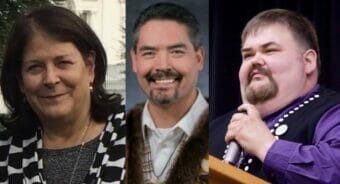
Alaska Federation of Natives President Julie Kitka, Tanana Chiefs Conference board Chairman Brian Ridley and Central Council of the Tlingit and Haida Indian Tribes of Alaska President Richard Peterson all hailed the Supreme Court’s ruling upholding the Indian Child Welfare Act. (File/KNBA)
Tribes throughout the nation and all across Alaska are celebrating the U.S. Supreme Court’s decision to uphold the Indian Child Welfare Act. In a 7-2 vote, the court rejected claims that ICWA is racist and unconstitutional.
And with the court’s decision to back the right of tribes to oversee child custody cases came a collective sigh of relief among Alaska Native leaders.
“This is something we care deeply about,” said Julie Kitka, president of the Alaska Federation of Natives.
Kitka says AFN has been involved in this fight for many years, because a lot more was a stake beyond protecting Native children.
“A lot of threads of Federal Indian law, the authority for the Congress to deal with Alaska Natives, Native Americans, derives from that,” she said.
Had efforts to overturn ICWA succeeded, Kitka says tribal sovereignty could have seen widespread erosion. It also could have undermined AFN’s progress in working with the state to build a better partnership with tribes in child custody matters.
ICWA, a law that was passed in 1975, puts tribes in the driver’s seat in child custody cases. It requires that American Indian and Alaska Native children be placed within their extended family, tribe or other Native people, whenever possible, so they can maintain cultural ties.
“Today’s decision represents a huge win for tribes throughout the nation and reaffirms tribal sovereignty,” said Brian Ridley, chairman of the Tanana Chiefs Conference executive board.
Ridley says TCC’s programs to support tribal adoptions and foster care placements have been a huge success story.
Ridley said it’s taken many years of work to reach a point where the tribe has been able to fully realize the mission of ICWA — protect Native kids and keep them in Native families.
The Association of Village Council Presidents (AVCP), which represents tribes in Southwest Alaska, concurred – and in a statement said ICWA has been the gold standard of child welfare.
But during a Supreme Court hearing last year, Matthew McGill, an attorney representing the Brackeens, a white family fighting to adopt a Native child, argued that ICWA had discriminated against them – and put the interests of the tribe over the needs of the child.
“That means each year hundreds, if not thousands of Indian children are placed in non-Indian foster homes. And sometimes there, they bond with those families,” McGill said in his oral arguments, which he talked about the harm to the child when the tribe intervenes to enforce ICWA.
Along with the Brackeens, several states and white families seeking to adopt Native children also joined the fight to overturn ICWA. They claimed ICWA was unconstitutional and racist, because it gave tribes preference.
Tribes have argued that they have a longstanding political relationship with the government, and are not a racial classification, which the court affirmed. Had ICWA been overturned, the status of this relationship might have changed and potentially weakened tribal sovereignty in other areas.
Justice Amy Coney Barrett wrote the majority opinion, which leaves the federal law intact. She cited more than a century of precedent and the plaintiff’s lack of standing on the issues.
In his dissenting opinion, Justice Clarence Thomas wrote that the court had allowed the federal government to overstep its powers by displacing state authority, to regulate child custody proceedings.
The State of Alaska stayed neutral on ICWA and did not support the lawsuit, nor the tribes. Attorney General Treg Taylor said it was a difficult decision not to join tribes – but says the state believed other entities would give the court all the information it needed to make a decision.
In a statement, Taylor said, “It does not appear that anything has been changed, and the decision underscores our commitment to partnering with Tribes to improve outcomes for tribal children and families.”
\
Chalyee Éesh Richard Peterson is president of the Central Council of the Tlingit and Haida Indian Tribes of Alaska, which represents Southeast Alaska and is the largest tribal group in the state. He says he’s still disappointed that the state did not join more than 500 tribes to fight for ICWA.
“I applaud that statement. I agree with that statement, but their actions really don’t back that up,” Peterson said in response to the Taylor’s statement. “If that’s how they felt, they would have signed on and supported tribes in this ICWA battle.”
Despite the state’s lack of support, Peterson says the tribes prevailed.
“Our sovereignty continues on and on again in these court cases, to be reaffirmed in court,” Peterson said. “It’s always scary when you go to court, but we keep winning, because we’re on the right side.”
Peterson said the timing of the decision couldn’t be better. It came as a group of Polynesian seafarers prepared to depart Juneau on a global voyage. He says both Polynesian and Alaska Native cultures have struggled to maintain their sovereignty.
“I’m just full of excitement and love. This couldn’t have happened on a better day,” Peterson said.
Peterson says the Polynesian voyagers are on a mission to spread the word about the strength and beauty of Indigenous cultures, which ICWA was created to protect.
One of 30 totem poles along Juneau’s Totem Pole Trail, or Kootéeyaa Deiyí, is seen on June 15, 2023, in Juneau. (Photo by James Brooks/Alaska Beacon)
On Thursday morning, the U.S. Supreme Court upheld the constitutionality of the Indian Child Welfare Act in a 7-2 decision. The ruling preserves a 35-year-old law intended to address the harm caused by the federal government’s boarding school program by prioritizing the placement of Alaska Native and American Indian children into tribal homes.
Alaska Native leaders and the state of Alaska hailed the verdict, with praise coming in from all corners of the state.
“Like most Alaska Native and American Indian tribes from across the country, we have been anxiously awaiting this decision,” said Julie Kitka, president of the Alaska Federation of Natives, in a prepared statement. “The wait is over, and the victory is ours. Our ways of life will continue through our children.”
ICWA, as the welfare act is commonly known, guides many — if not most — of the adoption and child custody cases that work their way through state courts in Alaska. The case also tested the legal principle that tribes are sovereign governments, with the same standing as the state or federal government.
Dozens of Alaska’s federally recognized tribes joined a friend-of-the-court brief last year that urged the Supreme Court to uphold the law.
“Today the Supreme Court upheld ICWA and today they upheld tribal sovereignty,” said President Richard Chalyee Éesh Peterson of the Tlingit and Haida Indian Tribes of Alaska, one of the tribes that signed the brief. “Our sovereignty was tested, and it was ICWA that won the day and was our truest expression of our sovereignty. Our staff are on the frontline, their work preserves our families, and that is indeed our responsibility to protect and defend our citizens.”
Alex Cleghorn, chief operating officer of the Alaska Native Justice Center, said in a prepared statement, “This decision rightly recognizes tribal sovereignty and self-determination. It is a major victory for Alaska tribes, Alaska Native children, families, and the future of Alaska Native culture.”
In 2021, the state of Alaska joined other states in a friend-of-the-court brief that urged the justices to uphold the federal law. That saw Alaska make uncommon allies with California, Massachusetts, New York and other predominantly Democratic states.
“Our commitment to partnership, communication and collaboration with tribes in Alaska is steadfast,” said Attorney General Treg Taylor in a prepared statement.
“We understand and appreciate the value tribes bring to child welfare in Alaska. Together, the state of Alaska and tribes have established the Tribal State Collaboration Group and Alaska Tribal Child Welfare Compact to work together to better serve Alaska Native and American Indian families. In terms of daily practice and application of the ICWA in Alaska, it does not appear that anything has been changed, and the decision underscores our commitment to partnering with tribes to improve outcomes for tribal children and families,” he said.
Rep. Mary Peltola, D-Alaska, and Sen. Lisa Murkowski, R-Alaska, praised the verdict as well, with Murkowski calling it “a victory for Native people.”
Peltola, who is Alaska Native, said she is “overjoyed” with the Supreme Court’s decision.
“This decision provides certainty and security for children and families all across this country, and respects the basic principles of self-governance for Native American tribes,” she said in a prepared written statement. “This is an important step in continuing the process of intergenerational healing from long histories of separation and loss, and a victory for tribal advocates everywhere. I look forward to strengthening ICWA and making sure that children everywhere are able to stay with their families and loved ones.”
The U.S. Supreme Court heard oral arguments Wednesday, Nov. 9, 2022, in Brackeen v. Haaland, a case that will decide if the Indian Child Welfare Act is constitutional. Outside the Supreme Court Building, ICWA supporters were on site in numbers. (Photo by Jourdan Bennett-Begaye, ICT)
The Supreme Court handed down a major decision Thursday in the Haaland v. Brackeen case, affirming the constitutionality of the Indian Child Welfare Act by a 7-2 vote.
Justices Clarence Thomas and Samuel Alito were the lone justices to dissent.
The decision represents a major victory for federal Indian law and tribes across the nation.
In the opinion, authored by Justice Amy Coney Barrett, said the court “declines to disturb the Fifth Circuit’s conclusion that ICWA is consistent with” Congress’s authority under the Constitution in Article I.
“The United States, joined by several Indian Tribes, defends the law,” read the opinion. “But the bottom line is that we reject all of petitioners’ challenges to the statute, some on the merits and others for lack of standing.” Challengers cited that ICWA was against “federal authority, infringes state sovereignty, and discriminates on the basis of race.”
Justice Neal Gorsuch, the justice with extensive federal Indian law knowledge and experience of all the justices, wrote in support:
“Often, Native American Tribes have come to this Court seeking justice only to leave with bowed heads and empty hands. But that is not because this Court has no justice to offer them. Our Constitution reserves for the Tribes a place—an enduring place—in the structure of American life. It promises them sovereignty for as long as they wish to keep it. And it secures that promise by divesting States of authority over Indian affairs and by giving the federal government certain significant (but limited and enumerated) powers aimed at building a lasting peace.
“In adopting the Indian Child Welfare Act, Congress exercised that lawful authority to secure the right of Indian parents to raise their families as they please; the right of Indian children to grow in their culture; and the right of Indian communities to resist fading into the twilight of history. All of that is in keeping with the Constitution’s original design.”
Haaland v. Brackeen wasn’t the only Supreme Court case affecting Native people directly. The court also released a decision regarding Lac Du Flambeau Band of Lake Superior Chippewa Indians et. al. v. Coughlin. ICT will have more on this case soon.
The third federal Indian law case this term, Arizona v. Navajo Nation, has yet to be decided by the end of the month along with 22 other cases.
“For purposes of comparison, between June 13, 2022, and the last opinion day of the 2021-22 term (June 30, 2022), the court issued 29 decisions,” wrote former editor and reporter of SCOTUSblog Amy L. Howe.
President Joe Biden also weighed in shortly after the Haaland v. Brackeen ruling was released. He said ICWA is a vital law he is proud to support and stands with tribes.
The ruling keeps in place a vital law that protects tribal sovereignty and Native children, Biden said in a statement.
“Our Nation’s painful history looms large over today’s decision. In the not-so-distant past, Native children were stolen from the arms of the people who loved them. They were sent to boarding schools or to be raised by non-Indian families—all with the aim of erasing who they are as Native people and tribal citizens,” the statement reads. “These were acts of unspeakable cruelty that affected generations of Native children and threatened the very survival of Tribal Nations. The Indian Child Welfare Act was our Nation’s promise: never again.”
Interior Secretary Deb Haaland, Laguna Pueblo, called the decision “a welcome affirmation across Indian Country of what presidents and congressional majorities on both sides of the aisle have recognized for the past four decades.”
“For nearly two centuries, federal policies promoted the forced removal of Indian children from their families and communities through boarding schools, foster care, and adoption. Those policies were a targeted attack on the existence of Tribes, and they inflicted trauma on children, families and communities that people continue to feel today.”
Angelique EagleWoman, Sisseton Wahpeton Oyate (Dakota), described the decision as a “full circle moment” for Haaland. EagleWoman is a professor of law as well as the director of Native American Law & Sovereignty Institute at Mitchell Hamline School of Law.
“How wonderful it is to see Secretary of Interior Deb Haaland, Laguna Pueblo, have her name on a case, 7 to 2, that upholds the Indian Child Welfare Act,” she said. “I’m sure she breathed a huge sigh of relief to have her name in history in this manner.”
EagleWoman added that Gorsuch heavily relied on the investigation Haaland started through the Bureau of Indian Affairs into boarding schools to give historical context in his concurring opinion.
“We have a full circle moment here. We have cultural affirmation, we have true justice,” EagleWoman said. “So there’s a lot of good here.”
Tribes, Native organizations, advocates and allies cheered for the decision reposting sentiments like “tribal sovereignty wins” or “ICWA stands!”
Mary Kathryn Nagle, Cherokee, is a Native rights attorney and Counsel to the National Indigenous Women’s Resource Center for which she filed an amicus brief on behalf of in the case.
She emphasized what the day means to Indian Country, “we just could not have gotten better news. This is an incredible, incredible victory.”
“It’s definitely a day for Indian Country to celebrate,” Nagle told ICT.
Like many, she was still reading through the 133 page opinion as the news broke Thursday morning. She noted that there will be a number of Native attorneys and federal Indian law lawyers who will comb through the court’s opinion.
The first thing she said that jumped out at her was the overwhelming win for tribes.
“Just the fact that we won on every single issue and Gibson Dunn (the law firm representing the petitioners’) is not taking home anything,” Nagle said. “They’re not winning on a 10th amendment issue. They’re not winning on Indian as a race-based classification. They’re not winning on anything is huge.”
The Indian Child Welfare Act was enacted in 1978 and its purpose is “…to protect the best interest of Indian Children and to promote the stability and security of Indian tribes and families by the establishment of minimum Federal standards for the removal of Indian children and placement of such children in homes which will reflect the unique values of Indian culture…,” the Bureau of Indian Affairs website states.
For years, ICWA has been long seen as the “gold standard” for child welfare policy.
The Protect ICWA campaign, which includes the National Indian Child Welfare Association, the National Congress of American Indians, Native American Rights Fund and the Association of American Indian Affairs, said they are all “overcome with joy” that ICWA has been upheld.
“One thing is certain: ICWA is crucial for the safety and well-being of Native children and families and the future of Native peoples and Tribal Nations,” the campaign said in a statement. “The positive impact of today’s decision will be felt across generations.”
The campaign said they will give a deeper analysis Thursday afternoon after a legal review.
The ruling is an affirmation of rule of law and the constitutional principles of the relationship between Congress and tribes, Cherokee Nation Principal Chief Chuck Hoskin, Jr., Morongo Band of Mission Indians Chairman Charles Martin, Oneida Nation Chairman Tehassi Hill and Quinault Indian Nation President Guy Capoeman said in a statement.
They hope that this decision will slow the “political attacks” aimed at diminishing tribal sovereignty.
“By ruling on the side of children’s health and safety, the U.S. constitution, and centuries of precedent, the justices have landed on the right side of history. With these latest political attacks on ICWA now behind us, we hope we can move forward on focusing on what is best for our children,” the statement says.
Native members of Congress, Tom Cole, Chickasaw, and Sharice Davids, Ho-Chunk, shared a joint statement as co-chairs of the Congressional Native American Caucus. Echoing many, they said ICWA has protected vulnerable Native children since it was enacted and applauded the Supreme Court.
“This landmark decision rightly upholds protections for Native children and reaffirms the sovereign rights of tribal governments,” their statement reads. “We applaud the Supreme Court in rejecting these challenges and standing with Native American children and their right to remain in their own cultures.”
Indigenous peoples woke up to the news as early as 6:07 a.m. in Alaska. Social media reactions range from ICWA supporters saying they’re “really emotional” or “grateful for today.”
Charitie Ropati, Yup’ik and Samoan, wrote on Twitter, “Celebrate today, celebrate indigenous youth joy.”
Medical student and Forbes contributor Victor Lopez-Carmen, Hunkpati Dakota and Yaqui, gave kudos to the lawyers involved. “Just wanna throw a big party for all the Native lawyers who bodied this. Wow. Y’all really are incredible,” Lopez-Carmen wrote on social media.
In an April 2021 decision, the U.S. Court of Appeals for the Fifth Circuit upheld certain sections of ICWA and flagged constitutional concerns about others, prompting appeals on both sides. The U.S. Supreme Court granted petitions to review the Fifth Circuit’s decision and heard the case last November. Congressional members, 87 in total, filed a bipartisan, bicameral amicus brief defending ICWA’s constitutionality in Haaland v. Brackeen.
Oral arguments on the landmark case took place in November. Indigenous people from around the country traveled to Washington, D.C., for the hearing.
Kimberly Jump-CrazyBear, Osage and Oglala Lakota, was one of many who showed up to show support for the Indian Child Welfare Act.
“I’m just here on behalf of all of you who can’t be here today. To help lend my voice,” she told ICT before the oral arguments for Haaland v. Brackeen began. “Without our children, we don’t have a people anymore.”
While it is a day for celebration, Nagle said it is also important for tribes to stay vigilant and to support and heal one another after enduring the trauma of this long legal fight.
“They’re gonna probably try to find a different way to attack us. And so we have to celebrate, then we also have to kind of come back together and understand where the next attack is going to come from. And that’s unfortunate, but I think that’s just what it means to be Indigenous in the United States. So, but I think the first thing to do is to really celebrate because this is, I think, next to McGirt, the most incredible decision, victory we’ve gotten in the Supreme Court ever.”
A sign saying tribal IDs aren’t accepted for tobacco purchases at Fred Meyers in Juneau in 2020. (Photo courtesy of Jamiann S’eitlin Hasselquist)
The Alaska State Commission for Human Rights has scheduled a public hearing for a complaint regarding the use of tribal IDs at a Juneau grocery store.
The issue relates to a 2020 incident when a sign posted at Juneau’s Fred Meyer stated that tribal IDs would not be accepted for tobacco sales. Another sign allegedly posted around the same time said customers would be required to show “valid identification when purchasing alcohol or tobacco.”
Jamiann S’eiltin Hasselquist filed the complaint after an elder called her and told her about the signs.
“He was really shook up and said that it reminded him of those days when signs were posted,” Hasselquist said.
She said the elder was referring to the period before Alaska passed the Anti-Discrimination Act of 1945, when Juneau businesses would post signs that said “No Natives allowed,” “No Dogs, No Natives” and “We cater to white trade only.”
City and Borough of Juneau Assemby member ‘Wáahlaal Gíidaak Barbara Blake said that tribal IDs should be valid for any purpose that any other government-issued identification can be used for.
“People don’t understand that the tribes are a sovereign entity, that they actually have governing authority,” Blake said. “Their inherent authority predates the United States of America, predates the state of Alaska, or any Constitution for the state or for the United States of America.”
Fred Meyer staff eventually took the signs down.
A sign saying only “valid” IDs are accepted at Fred Meyer. This sign was allegedly posted around the same time as another sign that said tribal IDs weren’t accepted for tobacco purchases at Fred Meyer in Juneau in 2020. (Photo courtesy of Jamiann S’eiltin Hasselquist)
But Hasselquist said the store’s action caused harm to the community, so she submitted a complaint to the Alaska State Commission for Human Rights. She says she wants to make sure that Fred Meyer will offer education and training to make sure this won’t happen again.
“They have to integrate civil rights and anti-discrimination into their policy to teach their employees that it is not okay to hang signs like that,” she said. “That it’s discrimination.”
She wants that education to include Elizabeth Peratrovich and the history of Alaska’s own anti-discrimination movements.
The Central Council of Tlingit and Haida issues IDs for tribal members. Their website lays out what the cards can be used for and gives advice for what people should do if their ID is rejected.
The state Office of Administrative Hearings has scheduled the hearing for Oct. 9. Neither Fred Meyer nor its parent company, Kroger, responded to requests for comment.
Audience watches a dance group perform at the Alaska Federation of Natives convention at the Dena’ina Convention Center in Anchorage, Alaska. Oct. 2018 (Photo from video by Joaqlin Estus, ICT)
“The foundation of the Alaska Federation of Natives is our people,” said the statewide organization’s President and CEO Julie Kitka, Chugach Eskimo, after a quarterly meeting of the organization’s board held on May 15. Her comment focused on the theme of this fall’s annual AFN convention: Our Ways of Life.
It’s also perhaps a response to the predicament the organization finds itself in: a diminishing membership. AFN represents and advocates to influence policy for 158 federally recognized tribes, 141 village corporations, nine regional corporations, and 10 regional nonprofit and tribal consortiums that contract and compact to run federal and state programs. .
The National Congress of American Indians, a national tribal policy organization based in the nation’s capital, is similar to AFN in terms of trying to represent hundreds of tribes with a wide range of interests and backgrounds while maintaining membership.
What drives members to resign? What keeps them united?
Julie Kitka, Chugach Eskimo, is president and CEO of the statewide Alaska Federation of Natives. (File: photo by Joaqlin Estus, Indian Country Today)
Two large regional tribal entities resigned from AFN earlier this month: southeast Alaska’s tribal consortium Central Council of Tlingit and Haida Indian Tribes of Alaska, and the Interior region’s nonprofit Tanana Chiefs Conference. That comes after three for-profit Alaska Native regional corporations dropped out in the past few years.
Tanana Chiefs stated, “Over the past few years, over 40 resolutions were passed by the full board at AFN that support a subsistence way of life, but no significant action has been taken on those directives.” Tlingit and Haida said it’s in its best interests to directly advocate for its people and communities, and it has strategically built capacity to do so.
The Arctic Slope Regional Corp. withdrew its membership after delegates of AFN member organizations at the 2019 AFN convention voted to declare a “climate emergency,” overriding the Arctic corporation’s opposition. Doyon, Limited, the regional corporation for Interior Alaska, had been urging improvements to AFN’s process for addressing conflict before it resigned in 2022. The Aleut Corp. resigned last year over fisheries.
The fisheries issue came up at AFN’s 2022 convention in October. Tanana Chiefs and delegates from the southwest Aleutian Islands region got into a battle over management of an area in North Pacific waters. Tanana Chiefs believes if fishing in Area M (a management designation) were cut back, more salmon would reach the Yukon and Kuskokwim rivers for subsistence users. The Aleutian delegates said closing Area M would only hurt them without benefiting other fisheries.
For both sides the argument was about putting food on the table.
When the convention voted in favor of AFN recommending to authorities that Area M fisheries be reduced, the Aleutian delegates stood up and turned their backs to the convention chair and audience.
Now two parties to that disagreement, The Aleut Corporation and Tanana Chiefs Conference, have resigned from AFN.
Emil Notti, at his 90th birthday party at the Alaska Native Heritage Center in Anchorage, AK on March 10, 2023 (Photo by Joaqlin Estus, ICT)
AFN’s first president, Emil Notti, who is Koyukon Athabascan, said AFN shouldn’t have been in that argument. The way to handle it, “would be to call the parties together, call a statewide meeting or a conference and talk about what can be done but arrive at a common solution.”
“Both sides are mad now. (Resigning) is just short sightedness on the side of these organizations,” he said.
Notti said the members who left AFN will feel, and regret, a loss of influence. He described a meeting organized by AFN and held in Washington, D.C., a few months ago. “They had five or six generals there. I think they had four Cabinet members there. They had John Podesta (White House deputy chief of staff), who has the ear of the president. They had the White House budget director. They had other influential people at this conference.”
“(The Alaska Federation of Natives) pulled it off,” Notti said, something he said smaller organizations couldn’t do. “Tlingit and Haida by itself couldn’t do it. Tanana Chiefs couldn’t do it. None of the regional corporations can get that kind of power to organize something like that. So I think that illustrates why they need to stay unified — in order to influence policy.”
“Our ancestors understood the need for a united front. AFN is a gift from your ancestors. Keep it strong,” Notti said in a statement. AFN was founded in 1966 to fight for land claims for tribes. The claims movement led to the enactment of the Alaska Native Claims Settlement Act of 1971, which transferred nearly $1 billion and title to 44 million acres of land to for-profit corporations created under the new law.
Tribal leader and long-time tribal advocate Mike Williams, who is Yup’ik, supports the tribal withdrawals. He said for decades AFN hasn’t given strong support to the priorities of tribes, especially tribal subsistence and sovereignty. Williams is chief of the Akiak Native Community and NCAI regional vice president for Alaska.
For instance, Williams has advocated that AFN support the transfer of Alaska Native corporate lands to trust status, which would provide protection from takings and strengthen self governance. “These are our lands, these are resources that we’re living with, and we’re suffering because of inaction,” Williams said.
Mike Williams, Yup’ik, Chief of Akiak Tribe, Alaska region representative to NCAI, speaking at the Alaska Federation of Natives 2022 convention, Oct. 22, 2022. (Photo by Joaqlin Estus, ICT)
Notti said AFN works to promote tribal interests on both subsistence and sovereignty but is limited in what it can get federal and state agencies, the state legislature, and Congress to do on those as well as many other issues.
The National Congress of American Indians was founded in 1944 to influence policy and otherwise advocate for its tribal members.
Like AFN, NCAI relies on membership dues for some of its operating costs. NCAI is the oldest, largest and most representative American Indian and Alaska Native organization in the country. Of the nation’s 574 federally recognized tribes, 40 percent are Alaska Native.
W. Ron Allen, S’Klallam Tribe, is chairman and CEO of the Jamestown S’Klallam Tribe located in western Washington state. He was NCAI president from 1995-1999. He also served on the board as first vice president, secretary, and treasurer, for 26 years in total. He said NCAI’s membership is down to about 150 from a norm of 200 to 300 but it fluctuates for a variety of reasons.
He said NCAI’s bylaws forbid the organization from taking sides in intertribal disputes. In the case of a tribe’s withdrawal over NCAI actions, the board would send a delegation to meet with the tribe, Allen said.
“We just encourage and we recognize and respect their position. If a tribe’s got one position, whatever it is, that is so important to them that they feel that they, in good conscience, can’t remain a member of an organization that is intended for unity, we’re disappointed, but we’re not discouraged,” Allen said.
He reminds tribes that “a singular voice is like the single twig that can break easily. But if we bond together, like a bunch of twigs together, then we can’t be broken.”
In his view, single tribes can’t win alone. “The political system that surrounds you, no matter where you are, whether you’re in Alaska or anywhere else in Indian country, the system is too big. It’s too overwhelming. It’s too complicated,” Allen said.
“It’s a multi-layered chess game, and it’s complicated because now the tribes, the tribal leadership is involved at the local level, at the state level, at the regional level, at the federal level, even at the international level. And so it’s hard for leaders now to grasp the magnitude of the game that they’re within and not realizing that they need to work together,” he said.
“No matter how good you are, no matter how much energy you have, there’s too many bases to cover and you need to cover them together.” Allen concluded, “you have to make a few mistakes before you realize this (going it alone) doesn’t work.”
For its part, AFN said it “will continue to advance and enhance the political, cultural, social, and economic voice of Alaska Natives. The board of directors remains hopeful for full membership again in the future.”
AFN said its annual convention will be held October 19-21, 2023 in Anchorage, Alaska. NCAI’s mid-year conference is June 4-8, 2023 in Prior Lake, Minnesota
The Alaska Federation of Natives did not respond to a request for comments to add to their prepared statement. The National Congress of American Indians had no comments for this story.
Tiffany Stephens, left, works at the Seagrove Kelp farm in Doyle Bay near Craig on April 14, 2021. (Photo by Jordan A. Hollarsmith/NOAA Fisheries, Alaska Fisheries Science Center)
Two Alaska Native organizations are creating lending institutions dedicated to funding clean energy and environmental infrastructure projects. The Valdez Native Tribe launched Alaska Green Capital, the state’s first green bank, earlier this year, and Spruce Root is joining a coalition to form a national green bank.
Joe Arvidson is on the operations team at Alaska Green Capital. He said the bank can access newly available funding through the federal government and from private foundations, and then distribute the money to local businesses and individuals through low-interest loans.
“There’s a lot of people with really cool ideas, and they have difficulty getting funding,” he said. “This funding can go to people who might not traditionally have been able to get a loan. We have the ability to lose a little bit of money, so we’re not going to be as conservative as a traditional bank. So it could definitely help stimulate the economy.”
Projects could range from carbon-absorbing kelp and oyster farms to hydroelectric plants.
Separately, Spruce Root last month announced a partnership with the Coalition for Green Capital, a national green bank, which is better positioned to leverage federal funding for its several regional stakeholders.
Spruce Root is a nonprofit founded by Sealaska Corporation that supports entrepreneurs in Southeast Alaska, especially rural and Native-owned businesses. Executive Director Alana Peterson said the new money will target renewable energy initiatives to alleviate the high costs of diesel power and transporting goods.
“If we can start to address energy challenges with solutions, then as a region, we can become more resilient,” Peterson said. “And so a Green Bank allows us to set up a financing mechanism to help create those solutions.”
She pointed out that this will also allow the interest from loans to go back into the community.
“If we’re taking out loans within the region, millions of dollars, it would be better if that money was actually being lent out from a local, regional organization, so that the interest earned could actually go back into the region itself, rather than leaving the region altogether,” Peterson said.
Meanwhile, Gov. Mike Dunleavy introduced legislation last month to set up a state green bank, called the Energy Independence Fund, but it failed to pass in the regular session.
Close
Update notification options
Subscribe to notifications
Subscribe
Get notifications about news related to the topics you care about. You can unsubscribe anytime.