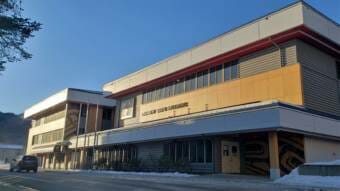
Tlingit tribal members moved from Auke Bay to the area known as the Juneau Indian Village in the late 1800s. (Photo by Katie Anastas/KTOO)
The Central Council of the Tlingit and Haida Tribes of Alaska is one of five tribal organizations to receive a state-tribal education compacting grant.
Education compact agreements allow tribes to develop their own K-12 curriculum and schedule. Unlike charter schools, they’d be independent of existing public school districts. Supporters say tribal schools could help improve educational outcomes for Alaska Native students by providing culturally relevant, place-based lessons.
Last year, Gov. Mike Dunleavy signed a bill to kick off the multi-year process of creating state-tribal compact schools.
To start, the five selected tribes will work with the state Board of Education to develop their own schools and work on legislation that could make them more widespread. The grant to Tlingit and Haida will fund someone to serve as a liaison to the state board.
Tlingit and Haida President Chalyee Éesh Richard Peterson spoke in support of the bill to the Senate Education Committee last year.
“The state of Alaska supports local control in many ways, including in education,” he said. “Tribal compacting is the epitome of local control.”
Peterson said the Tribe, which has more than 33,000 enrolled members, has a strong track record of administering programs throughout Southeast Alaska. Tlingit and Haida runs Head Start for kids aged 3 to 5 and offers cultural learning opportunities for public school students of all ages.
The other grant recipients include the Ketchikan Indian Community, King Island Native Community, Knik Tribe and Inupiat Community of the Arctic Slope.
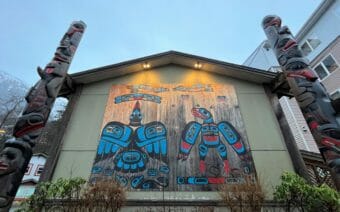
Totem poles stand outside Ketchikan Indian Community’s clinic and office building at 2960 Tongass Avenue. (KRBD file photo)
Alaska’s state education department has selected five tribes for a pilot program that will allow tribes to open new independent schools.
The state tribal education compacting program was established under Senate Bill 34, which passed the Legislature and was signed into law by Gov. Dunleavy last year. The five selected tribes each receive grant funding to start their school over the next handful of years through a compact agreement with the state’s Department of Education and Early Development.
The tribes can set their own curriculum and schedule. They’ll receive guidance from the Alaska Federation of Natives as the program moves forward.
Supporters say the program will improve education for Alaska Native students. It’s part of a larger push to bring more culturally relevant lessons into the classroom to support Indigenous students.
Sealaska Heritage Institute holds a conference each year that brings together educators to train them on how to bring Alaska Native culture into their lessons. The University of Alaska Fairbanks also offers standards for culturally responsive teaching set out by several Alaska Native organizations and tribes.
According to the state education department, the schools would be open to all students from kindergarten through high school.
“These State Tribal Education Compact Schools (STECs) would be public schools open to all students and would offer a unique, culturally rich combination of Western and millennia-old tribal educational models,” reads information on the Alaska Department of Education and Early Development.”
The tribes selected for the pilot program include Ketchikan Indian Community, the Central Council of Tlingit and Haida Indian Tribes of Alaska, King Island Native Community, Knik Tribe and Inupiat Community of the Arctic Slope.
Raegan Miller is a Report for America corps member for KRBD. Your donation to match our RFA grant helps keep her writing stories like this one. Please consider making a tax-deductible contribution at KRBD.org/donate.
“Our ancestors fought tirelessly for the passage of the Anti-Discrimination Act and it is our responsibility to continue that advocacy,” the statement says. It goes on to say that LGBTQ+ people, including youth, deserve protection and support.
Alaska’s first out, queer lawmakers introduced the bill earlier this month. It would change the current definition of “sex” as a protected class to include LGBTQ+ identities. The bill is currently in the Labor and Commerce Committee.
Tribal President Chalyee Éesh Richard Peterson said on Thursday it’s important to show support for LGBTQ+ tribal members.
“As their tribal president, I want them to know that they are loved and valued for who they are,” he said. “Every year we see it bubble up, and it’s getting worse and worse, and human rights are under attack.”
The statement comes amid what advocates feel are escalating attacks on LGBTQ+ rights from Gov. Mike Dunleavy’s administration.
A recent Anchorage Daily News investigation revealed that last year, the Alaska State Commission for Human Rights quietly reversed a 2021 decision that expanded LGBTQ+ protections in the state. And on March 7, Dunleavy announced a bill that would restrict Alaska students’ ability to live in accordance with their gender identities in school.
A preliminary design for the proposed “10-mile project” that would include a substance abuse treatment center. (Photo courtesy of Camille Booth).
Ketchikan Indian Community owns a swath of land about 10 miles north of downtown, in the Mud Bight area. It’s been set aside for years, and the tribe’s new business arm is working to turn it into something big: what it calls a “healing center” for community members — Native or not — with substance abuse issues.
Ketchikan — and Southeast Alaska as a whole — has seen a steep rise in opioid-related deaths in the last few years. State health officials tallied 23 opioid-related deaths in Southeast in 2021 — the last year that data is available — and eight were in Ketchikan, with two in nearby communities.
Advocates have long rallied for more treatment options for the island. Ketchikan Indian Community President Norman Skan says that’s the problem the tribe hopes to address.
“About two years ago, we just saw the trend of opioid use just getting out of control — in not only in our community, but outlying communities,” Skan said. “And we felt like we needed to do our part to help the individuals out.”
It’ll be the first major project for the Ketchikan Tribal Business Corporation, essentially the business arm of the tribe. The corporation is a so-called IRA Section 17 Corporation, named for the section of the Indian Reorganization Act that sets out the rules governing it. It’s wholly owned by the tribe but operates separately. An online statement says that the corporation’s mission is “to develop Ketchikan Tribal Business Corporation into a stronger, healthier, and more prosperous organization that continues to reach higher levels of economic competitiveness.”
Camille Booth is the corporation’s operations manager.
“It gives us the benefits of being tribal with also being able to build revenue in other streams and other areas,” she explained. “So it’s very much our economic development arm.”
Booth said the corporation is “somewhat comparable” to regional and village corporations set up by the Alaska Native Claims Settlement Act. But instead of distributing profits to shareholders, dividends could potentially go to Ketchikan Indian Community members.
“Just like with any corporation, then,once the company is profitable, … dividends are likely, but the company has to be profitable before dividends are offered,” she said.
The corporation has three divisions — commercial, real estate, and government contracting.
Booth said the real estate division will focus on leveraging the tribe’s existing properties. The government contracting division could provide a variety of services.
“That could be an IT areas, it can be environmental services, it can be in procurement, there’s all sorts of areas of government contracting,” she said. “There’s all sorts of contracting that fit our type of effort.”
The healing center is part of a larger initiative dubbed “the 10-mile project,” from the corporation’s commercial division. The corporation hopes to develop the property with alternative housing for people in recovery, single-family homes, trails, and even tourist attractions and art installations.
“It’s very much the big vision. … In phases, of course,” Booth explained. “So the first phase would be the healing center and actually the substance use disorder center with housing for that sort of a transitional type housing, and then the next then it would build into the business area and then into additional housing out there because it is a very large property, too.”
John Brown is the corporation’s vice chair.
He said work is still in the beginning stages and the 16-bed inpatient treatment center — let alone everything else sketched out for the property — won’t open its doors for at least three years.
“They purchased the property and came up with, you know, and again, this was a long standing thing that he wanted to try to accomplish,” Brown said. “And so we are, we are part of that process. And so we’re in the process of, again, we’re putting ourselves in place, so we can do stuff. And then the next phase is ‘OK, how much funding do we need, who do we need to contact’ — those types of things.”
Details are a bit hazy in this early phase of the project, but Booth said she hopes the project will support community members in every stage of their recovery.
A photo of the Duncan Memorial Church fire in 1949. (Photo courtesy of the Annette Island Reserve Historical Archive)
Alaska’s only reservation is fighting to reclaim how its story is told. Metlakatla residents hope that by filling the new Annette Island Reserve Historical Archive with pictures, videos and sounds, future generations will know where they came from — and the current generation will remember the past.
Right now, when someone writes about Metlakatla, they don’t always get to hear the story from the people who live there. Tribal Councilmember Keolani Booth said that’s because there’s not a central archive to store the tribe’s stories and memories.
“You know, when anyone writes about Metlakatla, or does anything … we’ve got one narrative — that’s from our narrative, and, and I think the fact that we don’t have that right now, it’s left up to interpretation by anyone who would want to write about Metlakatla,” Booth said.
Reggie Atkinson is a former Metlakatla mayor. He told KRBD there have been efforts to build archives in Metlakatla before, but they haven’t been digitized, and they aren’t organized.
“We do have a building right next to our council chambers and it’s (an) archive building,” he explained. “There’s archive boxes stacked in there, and actually, I don’t even know what’s in there. I went in there once.”
Atkinson said he’s heard that there are historical images of Metlakatla inside Duncan Church, and that relatives might have even more.
“There are people saying they have photos,” he said. “I know for a fact that a relative has eight millimeter movies from his father. His father was in the territorial guard unit here then.
The Metlakatla Indian Community contracted Caitlin Steinberg, a researcher from Wisconsin, to come to the island and help develop the Annette Island Reserve Historical Archive. When it’s finished, Steinberg said the archive will hold pictures, videos, and interviews with local elders and families.
“It’s been brewing for decades, it seems, in Metlakatla,” she said.
The effort will involve the whole community, largely led by youth: students will interview their parents, aunts, uncles and neighbors, learning more about their family’s history, as well as the history of Annette Island.
“So there was already this hunger for this place for anyone to just go find their stories of their family in the community,” she said. “And it was born from talking about all these different ideas and all these, you know, hopes and wishes for how organizing Metlakatla’s history could benefit the people.”
Once the interviews are completed, Steinberg says they’ll be filed away along with a questionnaire, created by residents.
Steinberg says there will be a little of everything in the archive — from stories about the founding of Metlakatla to the history of residential schools and what life was like in World War II.
“And it’s also going to be fishing, hunting, gathering, you know, it’s going to be things about stories about the old cannery and you know, when there would be coffee meet ups at the old cannery as well as the fishing culture down at the docks,” she said.
The archive will be contained in a room at Metlakatla High School, and anyone will be able to record an interview for the collection.
The work has already started taking shape. On a recent Friday afternoon, community elders gathered at Metlakatla High School for “coffee with elders.”
The recording is a little hard to hear, but resident Henry G. Smith spoke about the value of the archive in this clip from the event sent to KRBD.
In the clip, Smith said, “It’s a good thing for the kids to learn … the history of where thier parents, their grandparents, their great-grandparents came from, how Metlakatla came about. It’s good for them to know this stuff, to know the history of their ancestors.”
And Booth, the councilmember, hopes that knowledge will be preserved for future generations in Metlakatla.
As a councilmember, Booth said if he wanted to look back at something a past member had done, in most cases, he’s out of luck. He doesn’t want that to happen to future generations.
“And there are things that I’d love to speak to Henry Littlefield about, or Solomon Guthrie,” he said. “And they were councilmen, many, many years ago. And, you know, if they didn’t write it down, we don’t know. So I think it’s really going to help a lot in the continuity of serving the community, passing information, and, and preserving our culture.”
“You’ve got to know what you’ve done to move forward,” he added.
He hopes the archive will help preserve knowledge of times both good and bad, as well as traditional language.
“It’s things that we need to know, and we feel we have the right to know about our people,” he said.
Booth says that Steinberg, the contracted archivist, plans to train a member of Metlakatla’s tribe to take over as lead historian, once the project is fully on its feet.
The 32-foot gillnetter F/V Deja Vu sails on Aug. 3, 2020 near Metlakatla. (Courtesy of Johon Atkinson)
A federal appeals court has affirmed Metlakatla tribal members’ right to fish in their traditional waters without state permits. But a new opinion issued Tuesday by the Ninth Circuit Court of Appeals leaves open the question of where exactly those traditional fishing grounds are.
Metlakatla Mayor Albert Smith welcomed the news.
“This is something that we’ve been fighting for a long time, so we are extremely pleased to know that the Ninth Circuit so strongly supported our fishing rights,” Smith said in a phone interview from Juneau.
Metlakatla’s tribal government sued Gov. Mike Dunleavy and other state officials in 2020. The tribe asserted that the 1891 federal law that created the Annette Islands Reserve, the only reservation in Alaska, guaranteed the tribe fishing rights throughout much of the southern panhandle. Congress passed the 19th-century law after members of the tribe relocated from their previous home in Metlakatla, British Columbia at the invitation of President Grover Cleveland.
Senior U.S. District Court Judge John Sedwick rejected the tribe’s claim and dismissed the case the following year.
Metlakatla appealed to the Ninth Circuit Court of Appeals, which ruled in favor of the tribe last year. The court said Congress guaranteed Metlakatla’s tribal members the right to fish in their traditional waters despite the state’s limited entry program, which limits the number of vessels targeting particular species of fish.
“Alaska’s limited entry program, as currently administered, is incompatible with the Metlakatlans’ off-reservation fishing rights. Fishing had always been, and continues to be, the heartbeat of the Community. Congress’ intent in the 1891 Act was that the Metlakatlans would have off-reservation fishing rights that would ‘satisfy the future as well as the present needs’ of the Community,” wrote Senior Ninth Circuit Judge William Fletcher.
The Ninth Circuit’s three-judge panel initially ruled that Metlakatla tribal members had the right to fish in the state Department of Fish and Game’s Districts 1 and 2. Those encompass areas around Ketchikan’s Revillagigedo Island and the southeastern coast of Prince of Wales Island.
Smith says the tribe has records of its members bringing fish from as far as the Aleutian Chain. But he acknowledges that the tribe’s fishermen largely harvested from waters within a day’s travel of the reserve at the southeastern tip of the state.
“Since time immemorial, we’ve been fishing all of those districts — 1 and 2, all the way down to the border,” Smith said.
But the new opinion notes that the state of Alaska disputes the extent of the tribe’s historical fishing grounds. It’ll be up to the lower court to determine just how far the tribe’s fishermen should be allowed to go.
In its new order, the court also denied a request from the state of Alaska to reconsider its decision or put it before a larger Ninth Circuit panel.
Alaska Department of Law spokesperson Patty Sullivan said in a statement that the Ninth Circuit panel “continues to fundamentally misunderstand the history and legal framework in this case.”
“Even if the Ninth Circuit panel disagreed that the case should be dismissed, it should have merely remanded the case back down to the district court so it could properly vet the factual background,” Sullivan wrote. She said the state is reviewing the opinion and considering its next steps.
Smith says Metlakatla is eager to continue with the case.
“We are ready for the next phase in this case and look forward to finally and permanently restoring our community’s fishing rights. … Wayi Wah!” he said, using a Sm’álgyax phrase that translates to “Let’s go!”
The court’s decision would allow tribal members to fish “for personal consumption and ceremonial purposes, as well as for commercial purposes.” But details of how the decision might be implemented once the case concludes remain unclear.
Close
Update notification options
Subscribe to notifications
Subscribe
Get notifications about news related to the topics you care about. You can unsubscribe anytime.