Alaska Native Government & Policy

Tribes advance self-governance initiative with tax bill

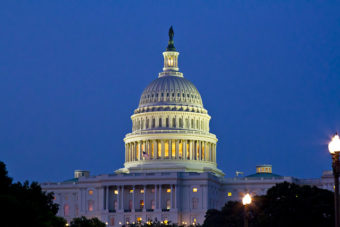
Capitol Hill, Washington DC. (Creative Commons photo by KP Tripathi)

A bill that will exempt tribes from taxation on social welfare programs has made its way through Congress and is awaiting the president’s signature. The bill was introduced in response to the Internal Revenue Service’s increased auditing of tribes over the last few years and is part of a national initiative to give tribes the same tax status as local and state governments.

John Dossett, an attorney for the National Congress of American Indians, says this whole thing started in 2005 when the IRS Tax Exempt and Government Entities Division went to the National Indian Gaming Commission and got a list of its tribal members.

“They started at the top with the most wealthy tribes and they started auditing them around 2005,” Dossett says. “And then they started working their way down the list.”

While some of the larger tribes complained about the audits, it wasn’t until smaller, less wealthy tribes started getting audited that NCAI looked into the issue. Dossett notes one of the most egregious examples was when the IRS went after the Oglala Sioux tribe. The IRS expected families to claim charity – such as $200 vouchers to buy their children new school clothes – as income on their individual tax forms.

“It’s ridiculous. It’s absolutely off-the-Richter-scale ridiculous,” Dossett says. “And then when they started doing that kind of stuff, that’s when it just lit the tribes up. “

To be clear, the IRS was targeting tribal general funds. So if a tribe was operating a social welfare program with its own money, the IRS wanted those benefits to be taxed. If a tribe was operating a program funded by the federal government, that was OK.

In Alaska, Native interests in oil, timber or other business investments are most often held by the corporations. In turn, most tribes have little if any general funds and instead operate most of their services with federal funding.

Still, Dossett brought a warning to last year’s Alaska Federation of Natives convention in Fairbanks. He told delegates that the same IRS division that had been under fire for targeting Tea Party and conservative groups was also targeting tribes. While the IRS does not disclose who it audits, there haven’t been any publicized reports of Alaska tribes subjected to the targeted audits.

Despite that, tribes like the Central Council of Tlingit and Haida Indian Tribes have become involved in the NCAI’s Inter-Tribal Organization Tax Initiative, which seeks to put Alaska Native and American Indian tribes on a level playing field with local and state governments.

“We need to, one, be on par with state and local government,” says Will Micklin, a vice president with Tlingit and Haida. “And, two, we need access to capital to monetize tax credits that would allow us to operate those economic ventures that would generate those general funds or enterprise funds that we could use for our own purposes to supplement the decreasing federal funding.”

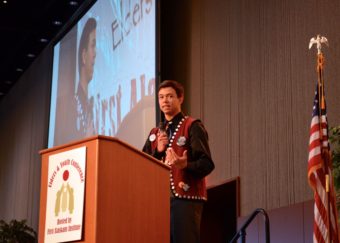
Central Council of Tlingit and Haida Indian Tribes 1st Vice President Will Micklin. (Photo courtesy of Central Council of Tlingit and Haida Indian Tribes)

Micklin is also the CEO for the Ewiiaapaayp Band of Kumeyaay Indians in San Diego and the executive director of the California Association of Tribal Governments. He says numerous tribes in California were subjected to the IRS audits.

“It was burdensome. It was unproductive and resulted in hardship on the tribes and the tribal citizens,” Micklin says.

In June the IRS issued formal instructions on how to deal with tribal welfare programs. It essentially gave tribes the benefit of the General Welfare Doctrine, which allows federal, state and local governments to operate tax-exempt social programs. Despite the change in IRS regulation, the Tribal General Welfare Exclusion Act of 2013 passed both the House and Senate last week with strong bipartisan support and numerous cosponsors, including all of Alaska’s congressional delegation.

Dossett says key elements of the legislation include the temporary suspension of the targeted audits and a mandate for IRS field officers to receive training in federal Indian law, but he hopes that training includes tribal representatives.

“That’s one of the things we’re really advocating for: that it isn’t just a bunch of IRS agents going in a room talking to themselves, but that the tribes are involved and they bring in key people who know what’s going on and that there’s really more consultation with the IRS so they can better understand what the tribes are doing,” Dossett says.

The bill also establishes a Tribal Advisory Committee within the Treasury that will advise the Secretary on Indian tax policy and authorizes the Secretary to waive any penalties or interest imposed on tribal governments or members. The bill allows tribes to file claims for any taxes or fines imposed on its social programs in the last three years and directs the Secretary to resolve any ambiguities in the act in favor of tribal governments.

Another bill that NCAI advocated for through its initiative — the Tribal Tax and Investment Reform Act of 2013 — would have allowed tribes to issue tax-exempt bonds for community infrastructure. The bill is in a House committee and has no companion bill in the Senate. With Congress in recess until November, it’s unlikely to advance.

U.S. Patent Office Cancels Washington Redskins’ Trademark

Several of the Washington Redskins' trademark registrations have been cancelled, in a decision that is likely to be appealed. Nick Wass/AP
Several of the Washington Redskins’ trademark registrations have been cancelled, in a decision that is likely to be appealed. Nick Wass/AP

The U.S. Patent and Trademark Office has revoked the trademark of the NFL’s Washington Redskins, after ruling in a case brought by five Native Americans that the name disparages a minority. While the decision could have wide repercussions, it does not require the team to change its name.

In a statement about the decision, the patent office said the petitioners proved that “the term ‘Redskins’ was disparaging of Native Americans, when used in relation to professional football services, at the times the various registrations involved in the cancellation proceeding were issued.”

As a result, the agency said, “the federal registrations for the ‘Redskins’ trademarks involved in this proceeding must be cancelled.”

Explaining the decision’s immediate effects, the agency said its review board “determines only whether a mark can be registered with the federal government (and thus gain the additional legal benefits thereof), not whether it can be used.”

The trademarks in question date back to the 1960s and ’70s. The Washington, D.C., team lost a similar trademark case in the late 1990s, only to have its registration reinstated by a U.S. district court in 2003. It is almost certain the team will appeal the agency’s latest decision.

From The Washington Post:

“Federal trademark law does not permit registration of trademarks that ‘may disparage’ individuals or groups or ‘bring them into contempt or disrepute.’ The ruling pertains to six different trademarks associated with the team, each containing the word ‘Redskin.’ ”

The decision comes from the patent office’s Trademark Trial and Appeal Board, which said the trademark registrations will remain “on the federal register of marks” and wouldn’t be officially listed as canceled until “after any judicial review is completed.”

The football team has been under increasing pressure to change its name. You can follow our coverage here.

Copyright 2014 NPR. To see more, visit http://www.npr.org/.image
Read original article – Published June 18, 201410:43 AM ET
U.S. Patent Office Cancels Washington Redskins’ Trademark

AFN asks ANB to help voting-rights campaign

Tlingit-Haida Central Council President Ed Thomas and AFN President Julie Kitka speak after a Native Issues Forum address in Juneau. (Ed Schoenfeld/CoastAlaska)

Alaska’s largest Native organization is challenging a Southeast group to lead the regional campaign to regain federal voting-rights protections.

The Alaska Federation of Natives is already campaigning to restore voting protections struck down by the U.S. Supreme Court last year.

Speaking at a Native Issues Forum in Juneau, President Julie Kitka asked for regional help.

“You have the history in our Native community, helping leading us to getting us to the right to vote. We need the full weight of the Alaska Native Brotherhood and Sisterhood,” Kitka said.

The organizations have a hundred-year history of advocating for Alaska Native rights, including voting. The Brotherhood and Sisterhood have about 20 local chapters, called “camps,” mostly based in Southeast.

ANB Grand Camp (regional) President Bill Martin said the organizations are behind the effort.

“At our ANB convention in Yakutat in October we passed a resolution. And we’ll be there again this year, both the Alaska Native Brotherhood and Sisterhood, to voice our objections,” Martin said.

The federal Voting Rights Act used to require Alaska and some Southern states to get pre-approval for redistricting plans. That led officials to set some election district boundaries so they included significant Native populations.

The U.S. Supreme Court struck down that part of the act last year.

Bipartisan legislation proposed in January would restore some of those provisions.

AFN’s Kitka said a coalition of Latino, African-American, Asian-American and other civil-rights groups is backing the proposed amendment.

But she said it won’t do any good here — yet.

“At this time, we’re not included in that amendment. In fact, Native Americans get no protections under the formula that they use. And we calculate it would probably cost us $800,000 to file lawsuits enough … for us to be considered under that federal mechanism,” Kitka said.

That’s why her organization is seeking statewide support for changes to the act that would include Alaska Natives.

The Supreme Court ruling came as Alaska’s redistricting board shuffled election boundaries.

The plan used for the 2012 elections was a factor in the defeat of Southeast’s two incumbent Tlingit lawmakers. And that was before the high court’s ruling. It’s since undergone minor changes, but none expected to help either win back seats.

Kitka said restoring some of the voting rights act’s struck-down provisions would help more people cast ballots.

“Over the last few years we’ve seen increasing effort to try to really depress people voting as people try to angle for this campaign or that campaign. And so, from our vantage point, it’s critically important that we make sure we have that rock-solid foundation protection of our voting rights,” Kitka said.

The high court ruled redistricting pre-clearance was based on discrimination that no longer exists. Alaska’s Redistricting Board agreed, saying changes in Native voting power have more to do with population growth and rural-urban shifts than redrawing election boundaries.

Hear Kitka’s full address to the Native Issues Forum, covering voting rights, subsistence and other topics:

Kookesh remains hospitalized after heart attack

Then-Sen. Albert Kookesh addressed a 2011 Native Issues Forum audience in Juneau. He remains hospitalized in Anchorage after suffering a heart attack.

An Alaska Native leader and former lawmaker remained in the hospital Tuesday after suffering a heart attack Monday in Juneau.

Providence Alaska Medical Center in Anchorage listed Albert Kookesh in critical condition as of late Tuesday afternoon.

Kookesh co-chairs the Alaska Federation of Natives and chairs the Sealaska regional corporation’s board of directors.

His family could not be reached for immediate comment. But Sealaska posted an update on its website saying he is resting after undergoing surgery to correct a blockage.

The update says doctors plan to wake him up from sedation Wednesday.

It says his family asked that no flowers be sent because Kookesh is allergic.

The Angoon Democrat served eight years in the House and eight years in the Senate. He lost a re-election bid last year after redistricting separated him from many of the communities he represented.

Kookesh has also been involved in a number of regional and nationwide Alaska Native organizations. He has a law degree and has been a seiner and a store- and lodge-owner.

In a recent interview, he said he was contemplating rejoining the fishing fleet.

Site notifications
Update notification options
Subscribe to notifications