Alaska Native Government & Policy

AFN president publicly criticizes Parnell for appealing subsistence rights case

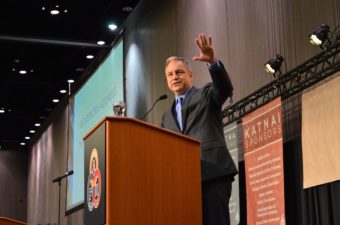
Gov. Sean Parnell gave opening remarks to delegates at the Alaska Federation of Natives Convention Thursday. (Photo by Jennifer Canfield/KTOO)

The head of Alaska’s largest Native organization publicly criticized Gov. Sean Parnell Thursday morning, the opening day of the Alaska Federation of Natives Convention in Anchorage.

Immediately after Parnell’s opening remarks, AFN President Julie Kitka called him out during her report to the convention.

“We began this year under attack. Gov. Sean Parnell and his administration decided to appeal the State of Alaska v. Sally Jewell, or the Katie John case, to the U.S. Supreme Court.” Kitka said. “The governor and his legal team were trying to overturn Native victories at the lower courts and shift the balance between the federal and state government over management of subsistence on federal and public lands.”

The case was an attempt by the state to assert management rights over navigable waters on state and adjacent federal land. At the heart of the issue was the difference between the state’s constitution and federal law. Alaska’s constitution mandates equal access to fish and game for all residents. Federal law gives subsistence hunting and fishing priority to rural Alaskans.

Parnell was not in the room at the time; he left the main room at the Dena’ina Center  to sign a bill in another room making Alaska’s Native languages official languages of the state.

The week after last year’s AFN convention where Parnell also gave opening remarks, the administration announced the state would appeal the Katie John case. AFN made a large effort during that convention to raise funds for their “subsistence war chest.”

Leaders in the organization vowed to fight the state over the matter. The U.S. Supreme Court rejected the state’s petition to appeal the case in March.

“Nineteen years of litigation. Nineteen years you’ve heard year after year at the convention about this. This is a victory that we have earned through a conscious and powerful defense as our rights as a people and we should all be proud,” Kitka said. “On a side note, I have a question for you. If political candidates are asking for your votes, does it matter what their position on subsistence is? If they continually sue Native people in court over our inherent and God-given rights, will we vote for them? (People in the audience said ‘no.’)  Just wanna know.”

The focus of Parnell’s remarks at last year’s convention was digital learning. This year he talked about the state’s efforts to work with tribal courts.

“We listened to what Alaskans said about the need for culturally accepted remedies,” Parnell said. “We said, ‘We must protect the constitutional rights of all.’ And you said, ‘There must be a way to increase tribal involvement.’ And we said, ‘We will find that way together.’ We will work with you and we will continue to do so for as long as it takes because justice is a journey and healing is the prize.”

The State of Alaska intervened in a case earlier this year, challenging a tribal court’s authority to extinguish the parental rights of a person who is not a member of their tribe. In the Simmonds v. Parks case, the Minto tribal court terminated the parental rights of Bessie Stearman, a Minto tribal member, and Edward Parks, a member of the Stevens Village Tribe. Just months before the termination, Parks had beaten Stearman badly enough that she suffered three broken ribs and a collapsed lung. The state asserted that it was trying to protect the Parks’ constitutional rights.

Tanana youth speak out against sexual assault, marijuana legalization

Tanana 4-H members on Tuesday asked Elders and Youth Conference participants to oppose marijuana legalization. (Photo by Jennifer Canfield/KTOO)

The Tanana 4-H club returned to the Elders and Youth Conference Tuesday, following up on their emotional presentation at last year’s conference. The group’s message is still the same: they don’t always feel safe or cared for and they want that to change, but now they’re also taking a stand against marijuana legalization.

During last year’s presentation, each 4-H member told the audience that they’d been molested, abused, or neglected and that they were tired of it. The youth shocked the unsuspecting audience.

An encore presentation during the Alaska Federation of Natives convention a few days later brought overwhelming support and praise for the group and thousands of dollars in donations.

Those donations brought the group back this year. This time, First Alaskans Institute, which hosts the conference, was more prepared for the intense feelings that the 4-H presentation might stir. A volunteer counselor in the audience was available to anyone who needed to talk.

One 4-H member, 17-year-old Ashley, identified herself as a victim of sexual abuse. She listed off statistics about Alaska’s high rate of sexual abuse and domestic violence and she chided adults for not doing more to protect children from it.

“If you experience sexual abuse you need to report it, but what difference does that make? They still send abusers back to villages to prey on us. They don’t change; they’re still a sick, twisted person,” Ashley said. “This is our time to come out and speak. I challenge every one of you to stop keeping this a secret and protect our children to save our future.”

The kids talked about how their families have been affected by things like rape, domestic violence and substance abuse. A few took the opportunity to speak out against ballot measure 2, which would legalize the use and sale of marijuana.

Big Marijuana Big Mistake spokeswoman Kristina Woolston talks to Tanana 4-H members after their presentation. (Photo by Jennifer Canfield/KTOO)

“Hi my name is Linda, I’m 15 and I’m against legalizing marijuana. I may be young but I’m already sick of the negative effects the marijuana has (had on) my community. It has destroyed my village, we have crime and outstanding teen usage.”

As the legalization initiative is written, if voters approve legal pot there is nothing stopping people from bringing it into villages. When it comes to alcohol, communities can choose to allow importation but ban sales or they can completely ban it altogether. With marijuana, only incorporated municipalities have local control over retail sales, villages have none. The law will allow for legal possession of up to one ounce of marijuana and up to six plants. The Alaska Federation of Natives will consider a resolution Saturday opposing ballot measure 2.

Group leader Cynthia Erickson said that a few months after the kids returned from last year’s conference, she asked them if they thought anything had changed in their village of Tanana. They said nothing had. A few months later in May, a Tanana man shot and killed State Troopers Sgt. Patrick Johnson and Gabe Rich. The kids looked up to the troopers and were devastated.

“But I said all of you are changing, don’t get discouraged,” Erickson said. “It took 50 years to get this dysfunctional. Seven kids can’t walk on stage and expect a change overnight. But you are changing. You won’t drink and do drugs with a baby in you. You won’t molest. You won’t rape. You are the change; we are the ones we have been waiting for. By one child changing it changes a whole village. One healthy child does make a difference.”

Tanana 4-H members wore Alaska State Trooper patches on their kuspuks in honor of two troopers who were killed by a Tanana man in May. (Photo by Jennifer Canfield/KTOO)

After the presentation Erickson said that the 4-H kids were starting to get a sense of how they impact others around the state. Some got to travel to Bethel and Ruby to meet and talk with peers going through the same struggles. Erickson wondered if kids outside of Tanana might also benefit from getting some weight off their chests.

“I asked the kids how many of you would sign up today to go and take the stage with us at AFN. We have seven of you that will come and blast your village’s ass out of the water, they stand up and clap, ‘where do we sign up?’ It’s really empowered the youths’ voices.”

The Tanana 4-H club will again take the stage this year at the AFN convention. The group is scheduled to present Thursday after the Elders and Youth Conference report is delivered.

Editor’s note: We’ve omitted Ashley’s last name because she’s a minor and did not use it on stage.

AFN president: Scheduling error canceled Sullivan-Mallott forum, not Sullivan

Alaska Federation of Natives President Julie Kitka listens during a panel discussion on taking tribal land into trust. (Photo by Jennifer Canfield/KTOO)

The president of the Alaska Federation of Natives says Republican lieutenant governor candidate Dan Sullivan is not skipping out on a convention election forum as a press release from the Alaska Democratic Party claims. Julie Kitka says the press release is false.

“He was not disrespectful to AFN and the Native community by not participating,” Kitka says.

“There was a glitch on the staff level, he did not get the formal invitation inviting him to participate. Sometimes this time of year with all the things flying left and right people get the wrong information.”

In the press release, Democratic Party Chair Mike Wenstrup accuses Mayor Sullivan of dodging the debate because “he can’t defend the Parnell Administration’s offensive record on Alaska Native issues.”

Kitka says the lieutenant governor candidates have been rescheduled to address the convention. Sullivan and his Democratic counterpart Byron Mallott will have 10 minutes each to address the convention. Mallott, who is a former AFN president, is scheduled to speak at 3:30 p.m. Friday. Sullivan is scheduled for 1:30 p.m. Saturday. The mayor is also scheduled to give opening remarks to the convention Thursday.

AFN released endorsement resolutions Tuesday calling for the delegation to support Mallott for lieutenant governor, independent candidate Bill Walker for governor and Sen. Mark Begich for re-election to the U.S. Senate.

AFN drafts resolutions supporting Begich and Walker, opposing marijuana legalization

The Alaska Federation of Natives Board of Directors met Tuesday to finalize resolutions that will be voted on by delegates Saturday. (Photo by Jennifer Canfield/KTOO)

Alaska’s largest Native organization will vote on candidate endorsements Saturday morning. The Alaska Federation of Natives Board of Directors has drafted two resolutions that will be heard on the final day of the AFN convention in Anchorage.

The resolutions call for the re-election of Sen. Mark Begich and the endorsement of Bill Walker for governor and Byron Mallott for lieutenant governor. Mallott is a former president of AFN.

Resolutions are typically decided with a voice vote. Roll call votes, however, are not unheard of. In that case, regional caucuses will discuss the resolution with their delegates and a caucus leader will then cast the vote on behalf of each group.

AFN’s co-chairs Tara Sweeney and Ana Hoffman are on opposite sides when it comes to the senate race. Sweeney is the co-chair for the Sullivan campaign. Hoffman has been actively involved in Begich’s campaign.

Sullivan made an unscheduled appearance during a Board of Directors executive session meeting Tuesday. He reportedly received a cool reception. Despite the preference for Begich, board members were urged by delegates to not make endorsements and instead draft resolutions for them to vote on.

The final list of resolutions includes several measures that, in some form or another, have been voted on at previous conventions. One resolution calls for stronger protection of tribal subsistence resources. Another asks for subsistence priority over commercial and sport fishing and hunting.

Delegates will also vote Saturday on resolutions to oppose marijuana legalization, reduce Chinook and chum salmon bycatch in the Bering Sea pollock fishery, and support juvenile justice reform during the 2015 legislative session.

Native languages a core issue at Elders and Youth Conference

Devlin Anderstrom gives the youth keynote speech on the first day of Elders and Youth Conference 2014. (Photo by Jennifer Canfield/KTOO)

The 30th annual Elders and Youth Conference began Monday in Anchorage. The gathering is hosted by the First Alaskans Institute each year during the same week as the Alaska Federation of Natives convention.

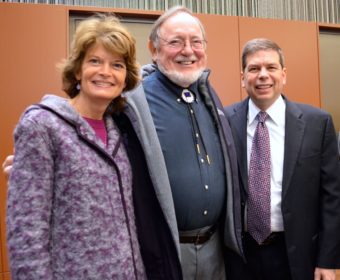
Sen. Lisa Murkowski, Rep. Don Young and Sen. Mark Begich pose for a picture at the 2014 Elders and Youth Conference. (Photo by Jennifer Canfield/KTOO)

The conference opened with Dena’ina dancers and a blessing from Eklutna Tribal Council President Lee Stephan. First Alaskans President and CEO Liz Medicine Crow from Kake and board chair Willie Hensley welcomed conference participants. Rep. Don Young and Sens. Lisa Murkowski and Mark Begich each took the stage to give opening remarks. Representing the White House, Associate Director of Intergovernmental Affairs Raina Thiele, originally from Pedro Bay, also addressed the conference.

When it came time for the keynote speeches, 17-year-old Devlin Anderstrom from Yakutat gave one to remember. Anderstrom introduced himself in his Tlingit language and then gave his entire nine minute speech in it, never once slipping into English until he gave the speech a second time.

People in the audience turned to each other and with wowed faces, they nodded and smiled. Anderstrom’s speech was no small feat.

There are only a few hundred Tlingit speakers left and most of them are more than 60 years old. Anderstrom, who is a senior at Yakutat High School, learned some of the language growing up. He left Alaska as a young boy and didn’t return until he was 12.

“I’ve lived in downtown Denver, the suburbs in northern California, even a small rural community in Nebraska. When I left home I knew the entire time that home was where I belonged and it was my place to be,” Anderstrom says.

Growing up, Anderstrom says he spent a lot of time around elders who spoke the language fluently. He began his study of Tlingit in earnest after he moved back home to Yakutat. Just this year, he started taking Lance Twitchell’s Tlingit language class through the University of Alaska Southeast.

Anderstrom says one of the reasons he has been so dedicated to learning Tlingit is because some cultural values and ideas can only be truly expressed in their original language.

“One of them would be haashagoon. So, haashagoon, it’s our ancestors and at the same time it’s the future generations, like, everything that we were and everything that we will be,”Anderstrom says. “It’s just kind of a hard concept to explain.”

And it’s not just the Tlingit language that Anderstrom feels compelled to learn. He’s also Iñupiaq, and Ahtna and Tanacross Athabaskan and he’s trying to learn those languages.

“Right now, Tlingit is the language I know best. It’s the only language I could have made a speech like that in. But I’ve also started to learn other languages as well, Eyak, Ahtna and Inupiaq,” Anderstrom says. “My goal is to learn as much as I can. I want to try to help preserve everybody’s language because I think everybody in the state deserves that, everybody that’s Alaska Native.”

True to the spirit of his role as a youth at the conference, Anderstrom brings optimism to the conversation. He doesn’t think that Alaska Native languages can ever be completely lost.

“I think language is a big part of culture, for me, and it’s really a hard hit for any culture to take to lose their language,” Anderstrom says. “But I don’t think it’s necessarily the end game, I don’t think it’s game over when a language is lost because like Eyak, a lot of language can be brought back at least partially through all the documented resources that we have. We just have to pull together and I think we can avoid language death all together.”

Anderstrom gave the youth keynote address after elder Fred John’s keynote address. The conference room at the Dena’ina center had 1,300 chairs set up and nearly all of them were full within an hour of starting the conference.

Elders and Youth conference begins today in Anchorage

The 30th annual Elders and Youth conference begins today in Anchorage. The conference is held each year during the same week as the Alaska Federation of Natives convention.

About 1,100 elders and youth from around the state attended last year’s conference. The gathering is an opportunity for youth to discuss an array of issues relevant to Alaska Natives with support from their elders. Some of the activities during the conference focus on leadership development, learning about voting, how to elect group representatives and consensus building.

The theme for this year’s conference is Get up! Stand up! Participants will focus on creating solutions to issues like subsistence, education and economic development.

Watch it live on 360 North and on 360 North’s website.

Site notifications
Update notification options
Subscribe to notifications