Alaska Native Government & Policy

New federal regulations to favor subsistence users, rural residents

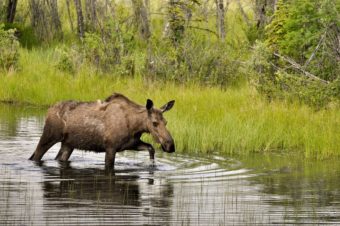
moose
(Photo by Heather Bryant/KTOO)

The Federal Subsistence Board’s rural determination process will change, according to an announcement made at the Alaska Federation of Natives Convention last month.

The changes should mean a more favorable process for villages and other rural communities that rely on hunting and fishing. Deputy Secretary of the Interior Michael Connor told AFN attendees that the new regulations will come soon.

“We’re moving out, beginning the discussions,” Connor said. “We’ve got to consult with the state, overall this is strongly supported throughout the leadership at the department of the Interior.”

Title VIII in the Alaska National Interest Lands Conservation Act, or ANILCA, mandates a subsistence preference for rural residents on public lands. Every ten years the Federal Subsistence Board determines whether a community meets certain guidelines to qualify for ANILCA’s subsistence preference. That rural determination process has been harshly criticized in recent years.

In 2007, several communities were told that they were no longer considered to be rural, including the Southeast community of Saxman. The board reasoned that the community’s proximity to non-rural Ketchikan put it in the same category. While the community is incorporated as a municipality, a majority of the population is Alaska Native and are members of the Organized Village of Saxman.

The tribe has fought against the board’s attempt to take away their rural status arguing that they have a history of traditional subsistence gathering in the area. The determination was put on hold in 2009 by then-Secretary of the Interior Ken Salazar pending a comprehensive review of federal subsistence policies. That hold was scheduled to expire this past July, which meant that the Organized Village of Saxman’s opportunity to litigate would also expire.

In April, the Federal Subsistence Board voted unanimously to submit new regulations in the rural determination process. The board does not have authority to implement new regulations, but it can propose them to the Department of the Interior and the Department of Agriculture. While Connor did not give details of the proposal, he did say that the board will defer more to communities and tribes in its decision-making process.

“Once implemented the new determination process will enable the board to use more flexible criteria that could lead to the kind of determinations sought by AFN and others in cases such as Saxman in Southeast Alaska,” Connor said.

Native American Rights Fund attorney Matthew Newman represents the Saxman tribe. He says the proposed rules give residents hope, but that the outcome is still in question. While the tribe favors an administrative fix, Newman says the lawsuit won’t be dropped until they’ve had a chance to review the new rules and are satisfied with them.

“I think everyone is relieved and optimistic that the rule is going to move forward,” Newman says. “This rule moving forward is not just a good thing for Saxman, it’s a good thing for all rural communities subject to ANILCA’s priority. This rural determination process has really been a bane for many communities and this idea that every 10 years your way of life is potentially subject to change causes a very, very uneasy feeling among rural residents in Alaska.”

Deputy Secretary Connor also announced changes in the board’s makeup. Two additional public members were added, Anthony Christianson of Hydaburg and Charles Brower of Barrow. Former AFN co-chair Tim Towarak from Unalakleet was named chair of the board. Towarak has served as a president of the Bering Straits Native Corp. and as rural affairs advisor to Gov. Tony Knowles.

Connor said the Department of the Interior is working on a new process that would make it easier for communities and subsistence users to participate in the board’s decision-making process.

DOJ may intervene in Alaska Supreme Court case

The U.S. Department of Justice may intervene in an Alaska Supreme Court case concerning a non-Native couple’s adoption of an Alaska Native child. In September, the Native Village of Tununak lost its appeal against the State of Alaska and the adoptive couple.

DOJ is trying to determine, does the U.S. Supreme Court’s decision in the Baby Veronica case apply to the Tununak case? Baby Veronica was about a private adoption. The Tununak case is concerned with a state-sanctioned adoption.

Matt Newman is an attorney for the Native American Rights Fund, which has been involved in the Tununak case as a friend of the court.

“I think what is definitely of note and definitely what was a bit surprising is the Tununak decision is now on the radar of the Department of Justice,” Newman says. “Through this extension they’re certainly not committing to anything. They’re not saying ‘we have a brief to file.’ But they’re at least showing that there’s an interest in the case at levels higher than just the bar here in Alaska.”

The fate of a 6-year-old the court calls “Dawn” is at stake in the case. Dawn was placed into foster care as an infant in Anchorage near her mother in the hope that they could be reunited.

That was a deviation from the Indian Child Welfare Act, which mandates a preference for Native family placement. But the tribe and the child’s grandmother Elise agreed–initially. After a year Dawn was placed with a new non-Native family, the Smiths, who are now trying to finalize their adoption of her.

Three years after Dawn first entered the State of Alaska’s custody, her mother’s parental rights were terminated. After the termination the tribe argued that keeping Dawn in Anchorage was no longer warranted and they stepped up their efforts to have Dawn placed with her grandmother in Tununak. According to the September decision, Elise had requested custody of Dawn since the beginning and had made efforts to bring her home into compliance for placement.

During the last appeal the state court had initially granted the tribe a stay of the adoption. Four days later the U.S. Supreme Court issued its opinion in Adoptive Couple vs. Baby Girl, otherwise known as the Baby Veronica case. In light of this, the state court requested supplemental arguments from the parties.  Because the grandmother did not formally file for adoption, the court reasoned that the Baby Veronica decision meant that there was no ICWA placement preference to apply.

A window to appeal the decision to federal court closed Friday, the same day that the DOJ requested its own extension. The DOJ wrote that the “United States has a strong interest in the interpretation of the Indian Child Welfare Act,” and that the department was not aware of the case until after the September decision.

The DOJ has until November 24 to decide if it will intervene in the case. The Village of Tununak’s tribe is represented by Alaska Legal Services Corp.

Young apologizes for suicide remarks; is warmly received at AFN

Sen. Lisa Murkowski, Rep. Don Young and Sen. Mark Begich pose for a picture at the 2014 Elders and Youth Conference. (Photo by Jennifer Canfield/KTOO)

Originally published October 24, 2014

Alaska Congressman Don Young angered many of his constituents this week with remarks about suicide at Wasilla High that he later acknowledged were insensitive. Today, Young made the apology the focus of his annual speech to AFN.

“Because I did say what I said, I am profoundly and genuinely sorry for the pain it may have caused people, genuinely sorry for the pain of the individual, as I have experienced it,” he said.

On Tuesday at a Wasilla school assembly, Young seemed to blame suicide on the lack of support of family and friends. Principal Amy Spargo said it offended her and some of the students, especially because Young had just been informed that a student at the school recently took his own life.

At the AFN convention, Young said he knows the tragedy of suicide.

“Because I have been touched by this issue,” he said from the podium of the convention hall. “It’s very personal to me. It may have caused me to mangle some of my statements and comments that’s caused this uproar, but I will tell you how many times I’ve asked myself, did I do enough? Did I take a (nephew) away from an abusive father? Did I love him enough? Did I do enough? And apparently I did not,” he said.

He says his record shows he understands that suicide stems from mental illness and said he voted for federal funds to train teachers and others to combat it. He also reiterated the importance of support. He said Kotzebue has not had a youth suicide in five years, which he attributed to good support.

“And that’s what we have to do around this state – a support group,” he said.

Young then reminded his audience what he’s done for Alaska Natives over the years, with land claims, business advantages for Native corporations, subsistence bills and fishing quotas. He told them he’s working to advance a co-management plan to give Native communities the ability to manage fish and wildlife on their own lands.

“Now I look out in this room and I would suggest respectfully I have been your congressman, and I want to continue to be that congressman,” he said.

His speech was repeatedly punctuated with applause and Young received a standing ovation. His Democratic opponent, Forrest Dunbar, listened from the back of the room. Dunbar noted that Young sounded less than sorry on Wednesday when asked about his Wasilla remarks, but Dunbar said he thought Young’s AFN apology was genuine.

“I think, given the huge importance of this speech I doubt he would rescind or further clarify any of it in a private setting. Hopefully he won’t because I do believe he was being sincere,” Dunbar said.

Young was warmly embraced when he stepped down from the stage. But not everyone in the room was impressed with him. Anchorage resident Gloria Poullard, originally from St. Mary’s, says she had a relative commit suicide this summer. Poullard thinks there’s nothing Young could say that would erase his hurtful statements from Tuesday.

“He’s a leader for Alaskans,” she said. “Why’d he even mention stuff like this?”

Joe Nelson, a Juneau resident from Yakutat, says he would have liked to see the congressman focus his speech more on subsistence.

“I guess he’s trying to make up for a little misstep that happened up in Wasilla in the school there, but I don’t know if he’s really connecting with the younger generations, and that’s where we really need to be connecting,” Nelson said.

Sen. Lisa Murkowski, who has endorsed Young, was among those on Thursday who called for Young to apologize. An online petition calling for her to withdraw her endorsement has attracted more than 300 signatures.

AFN endorses Begich after hearing from Senate candidates

Candidate for U.S. Senate Dan Sullivan and incumbent Mark Begich met on-stage at the Alaska Federation of Natives Convention in Anchorage Friday. AFN delegates voted Saturday to endorse Begich for re-election. An endorsement of Bill Walker for governor and Byron Mallot for lieutenant governor was also announced.

From the start, delegates were overwhelmingly in support of Begich. Many waved Begich campaign signs from the audience and clapped and cheered every time the senator answered a question. For Sullivan, things got off to a rocky start during the lightning round, which required yes or no answers.

“Do you support the development of the Pebble Mine project?”

Begich said no. Sullivan responded, “I support the process for all economic development.” Before he could finish the sentence a moderator repeated that the answer has to be yes or no and the audience booed him.

Sullivan criticized Begich for being a Democrat because in 2010 the Alaska Democratic Party sued to ban a list of write-in candidates from voting booths. Sen. Lisa Murkowski was a write-in that year, and there were concerns that Alaska Natives whose first language is not English would have a difficult time without the list.

In the end, the Alaska Supreme Court allowed the list. Dan Sullivan was the state attorney general at the time defending it on behalf of the Division of Elections. What he–and Begich–didn’t mention was that the Alaska Republican Party joined forces with Democrats on that issue. Still, Begich tried to distance himself from the leadership of the Democratic Party.

“There’s a process that they elect a chairman, I’m not the chair never have been, just to make that very clear to you Dan,” Begich said.

“I understand what that case was about. The question was very simple: When the list of the write-in candidates were put forward is that electioneering close to the ballot box? That’s what that was. I wasn’t party to that lawsuit, so let me make sure that’s clear.”

Both candidates agreed that Alaska’s subsistence management system was “broken.” Their solutions, however, differed. Begich supports more federal involvement.

“I get requests now from many different parts of the community of Alaska asking for more federal control in the sense of managing the subsistence rights because they believe the state is not listening,” Begich said. “An example of that was when the commercial fishing was closed and subsistence was closed and when they reopened, commercial got the opening first and subsistence did not. I wrote a strong letter to the governor about this, that subsistence rights are a fundamental right.”

Sullivan told the audience that he understands the importance of subsistence. He talked about spending summers at fish camp with his wife, Julie Fate Sullivan, who is the daughter of Mary Jane Fate, a once prominent figure in the Alaska Federation of Natives. He thinks that more state involvement is key to fixing subsistence, not less. At the end of his answer, he defended himself to delegates for his role in representing the State of Alaska in the Katie John case, a case that AFN was involved in for 19 years. AFN saw the state’s appeals of the case as an attack on subsistence rights.

“When I was attorney general I did participate in an element of the Katie John case,” Sullivan said.

“This has been a case going on for decades. It was no personal lawsuit against Katie John; I have the deepest respect for her like I do my mother-in-law. That case was about, when I was involved, the extent of state control over our rivers and as Alaska’s attorney general, I advocated for more state control, not control from the federal government and that’s the way most state officials have done that.”

After the forum, volunteers with signs reading “Follow me to Vote” appeared. The volunteers led people across the street to city hall, where ballots for all precincts across the state were available for early voting.

On Saturday, the final day of the convention, delegates voted in a new co-chair. Tara Sweeney, who was appointed to the position last year, lost to Jerry Isaac, a former president of the Tanana Chiefs Conference in Fairbanks.

Sweeney is a senior vice president for the Arctic Slope Regional Corporation and also the co-chair of the Sullivan for Senate campaign. Some delegates said that they didn’t think an AFN co-chair should be allowed to campaign for any candidate. AFN co-chair Ana Hoffman has been actively involved in the Begich campaign. Hoffman is the president and CEO of Bethel Native Corp. Her term as co-chair will be up next year.

Sealaska Corp. put in all their votes for Sweeney. All the other Southeast groups gave their votes to Isaac. The Southeast region has one of the largest percentages of votes in AFN; most of those votes are held by Sealaska.

Delegates met in an executive session Saturday afternoon to debate two candidate endorsement resolutions. The Walker/Mallott campaign endorsement took less than 30 minutes to be approved.

It took another hour before delegates decided to endorse Begich. Some groups reportedly refused to vote for or against the resolution endorsing Begich, saying that they didn’t want to get involved in the back-and-forth that has been a part of this year’s convention. AFN doesn’t always endorse candidates during an election and the conversations surrounding this year’s senate endorsement have at times been tense.

Once forbidden, Alaska’s Native languages now official state languages

Gov. Sean Parnell signs HB 216 at the 2014 Alaska Federation of Natives Convention. The bill makes Alaska's Native languages official state languages. Looking on as the governor signs is Tlingit language teacher Lance Twitchell, Rep. Bennie Nageak, Rep. Charisse Millett, Lt. Gov. Mead Treadwell, First Alaskans Institute President Liz Medicine Crow, Sen. Lesil McGuire, Rep. Chris Tuck, Rep. Jonathan Kreiss-Tomkins, Rep. Doug Isaacson, Rep. Les Gara and others.
Gov. Sean Parnell signs HB 216 at the 2014 Alaska Federation of Natives Convention. The bill makes Alaska’s Native languages official state languages. Looking on as the governor signs is Tlingit language teacher Lance Twitchell, Rep. Bennie Nageak, Rep. Charisse Millett, Lt. Gov. Mead Treadwell, First Alaskans Institute President Liz Medicine Crow, Sen. Lesil McGuire, Rep. Chris Tuck, Rep. Jonathan Kreiss-Tomkins, Rep. Doug Isaacson, Rep. Les Gara and others. (Photo by Jennifer Canfield/KTOO)

When American missionaries began arriving in Alaska in the 1880s, it was the beginning of a very dark era for Alaska Natives around the state. As Bureau of Indian Affairs and state-sponsored schools were established, things became even worse for Alaska Native languages and cultural practices. Today, elders’ stories about being beaten for speaking their Native language or for practicing traditional dances or rituals are common.

So, fast forward to Thursday when dozens of elder Native language speakers found themselves in a packed room at the Dena’ina Center in Anchorage. Lawmakers and others clapped and cried as speakers young and old declared in their native tongue that their language was now an official language of the State of Alaska.

Kaséix̱ Selina Everson, originally from Angoon, was given the honor to speak first after Gov. Sean Parnell signed the bill.

Tlingit elder Kaséix̱ Selina Everson speaks after Gov. Sean Parnell signed a bill making Alaska's Native languages official languages of the state of Alaska. Former Tlingit Haida Central Council President Ed Thomas and Lance Twitchell look on in the foreground. (Photo by Jennifer Canfield/KTOO)
Tlingit elder Kaséix̱ Selina Everson speaks after Gov. Sean Parnell signed a bill making Alaska’s Native languages official languages of the state of Alaska. Former Tlingit Haida Central Council President Ed Thomas and Lance Twitchell look on in the foreground. (Photo by Jennifer Canfield/KTOO)

“Gunalchéesh, governor, to all the people who are here for our beautiful languages to be recognized after all these years we were forbidden to speak it, and every time we’d remember how we were forbidden,” Everson said. “An elderly gentleman from Angoon, he was 87, every time he spoke about us being forbidden to speak our own language on our own land, he cried like a baby.”

Everson thanked the bill’s prime sponsors Reps. Jonathan Kreiss-Tomkins, Ben Nageak and Charisse Millett.

“For every Native person standing here, in my language I will say gunalchéesh to all of you, all the learners, to the children, gunalchéesh. You’ve made this day an honorable day to honor all the people of Alaska,” Everson said.

Tlingit language teacher Xh’unei Lance Twitchell was also at the bill signing. Twitchell worked with a group of other language learners from around the state to advocate for the bill’s passage, even staging a sit-in protest at the capitol building in the final days of the past legislative session.

After 15 hours of sitting in the capitol hallways and observing lawmakers on the Senate floor go in circles trying to reach consensus on other bills, the protestors were finally rewarded. The legislature passed the Alaska Native languages bill around 2 a.m. on Easter morning.

Xh'unei Lance Twitchell addresses the crowd that had gathered for the signing of HB 216, a bill making Alaska's Native languages official state languages. (Photo by Jennifer Canfield/KTOO)
Xh’unei Lance Twitchell addresses the crowd that had gathered for the signing of HB 216, a bill making Alaska’s Native languages official state languages. (Photo by Jennifer Canfield/KTOO)

Twitchell says not all of the lawmakers were supportive of the bill in the beginning.

“I had a chance to tell them, ‘People are going to remember you for this. Regardless of what side they are on, people are going to remember,'” Twitchell said. “There was a real fear that someday languages were going to be mandated and I don’t see that as a fear. I think a logical step for Alaska is that if you graduate from high school in Bethel you know some Iñupiaq. If you graduate from high school in Juneau you know some Tlingit.”

For the rest of the day at the convention, there was plenty of talk on-stage and amongst delegates about the “historic moment” that they’d all shared.

Alcohol advertising near AFN prompts complaints

The alcohol ad was in front of McGinley’s Pub and used the AFN logo without permission (Photo by Alexandra Gutierrez/APRN)

Fostering healthy communities has been a regular theme of the Alaska Federation of Natives annual convention. Health associations set up booths with literature on substance abuse, and all official AFN events are sober. If anyone shows up under the influence, that person is escorted out.

So a banner advertising drink specials alongside the AFN logo attracted attention on Thursday, when it was up at McGinley’s Pub in sight of the convention entrance.

“It’s literally across the street where everyone is going in and out of the door to come in here and conduct the business at hand,” say Liz Medicine Crow, who is attending the convention, and she takes issue with the sign beyond the unauthorized use of the AFN logo. The banner read “A Jack in the hand is worth two in the Busch” to advertise whiskey and the Busch brand of beer, while punning on the term “Bush Alaska.”

Medicine Crow says the advertising is in conflict with the spirit of the Alaska Federation of Natives convention.

“People are really disgusted,” says Medicine Crow. “I’ve heard that people are hurt. I’ve heard that people think that it’s 100 percent inappropriate. I also hear that people are not surprised, because the welcome from this place of Anchorage is just not as warm as it could be considering how much money comes into this town and how many people are utilizing the services here.”

The banner took on added significance because of McGinley’s affiliation with Anchorage Mayor Dan Sullivan. Sullivan includes his status as a founding partner of the bar in his official biography, and a 2012 financial disclosure — his most recent completed filing available on the Alaska Public Offices Commission website — lists income from the establishment. Sullivan delivered welcome remarks to AFN on Thursday morning, and is running as the Republican candidate for lieutenant governor. He did not return a message left on his cell phone asking about the banner.

But employees of McGinley’s Pub explained that the sign was actually the work of their beverage suppliers. Bar manager Denise Bostedt said that the sign was produced and installed by K&L Distributors, and that no one from McGinley’s was involved in its design.

“I can promise from the bottom of my heart that we never meant to insult anybody,” said Bostedt. “We love when AFN comes to town.”

A spokesperson for AFN confirmed that use of their logo was unauthorized, and that they received “many” complaints about the banner through the day. After representatives from AFN contacted McGinley’s about the sign, the pub covered up the logo with three sheets of white paper but left the sign up, with the rest visible. When approached by a reporter with questions about the sign on Thursday night, they took it down entirely.

Site notifications
Update notification options
Subscribe to notifications