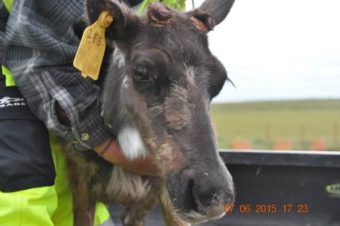
The first of 60 reindeer arrived in Port Heiden last week. The Native village is working to re-establish traditional reindeer herding in the community. (Photo courtesy of Village of Port Heiden)
The first of 60 reindeer began arriving in Port Heiden last week after a several month delay.
Adrianne Christiansen is the business development director for the Native Village of Port Heiden which has been working to reinstate a long-dormant tradition of reindeer herding. She said the reindeer began arriving Friday via charter plane from Stebbins/St. Michael’s.
“And we are really excited to re-establish reindeer herding in Port Heiden,” says Christiansen.
It’s going to be a big community learning experience, says Christiansen. For the next three months, an experienced herder will stay in Port Heiden to teach everyone about the reindeer.
“We have a pen built for them, and we have a traditional reindeer herder down to train our young people to learn how to herd reindeer … so they’ll be in the pen until we all learn how to herd the reindeer.”
Christiansen says about 100 community members, including 30 school-age children, will be trained.
Once the herd is well-established in the area, the community plans to harvest some for food. Christiansen says that may be four or five years down the road.
Several of the Washington Redskins’ trademark registrations have been cancelled, in a decision that is likely to be appealed. Nick Wass/AP
A federal judge has ordered the Patent and Trademark Office to cancel registration of the Washington Redskins’ trademark, ruling that the team name may be disparaging to Native Americans.
The ruling Wednesday by Judge Gerald Bruce Lee affirms an earlier finding by an administrative appeal board.
In his 70-page ruling, Lee emphasized that the organization is still free to use the name if it wishes — the team would just lose some legal protections that go along with federal registration of a trademark.
The team had sued to overturn a ruling against it by the Trademark Trial and Appeal Board. The team argued that cancellation of its trademark infringed on its free-speech rights because it required the government to judge whether the name is offensive.
The organization can appeal.
The Central Council Tlingit Haida Indian Tribes of Alaska announced a boycott of FedEx last month because of the business’s sponsorship of the team.
Pond on ANWR coastal plain. (Photo courtesy of the U.S. Fish and Wildlife Service)
Alaska Congressman Don Young has added an amendment to a bill that would block the federal government from spending any money on a plan that calls for more wilderness in the Arctic National Wildlife Refuge.
Young’s amendment to the Interior Department spending bill passed the House Tuesday by voice vote after a brief debate.
President Obama announced the update to the comprehensive plan for the Arctic refuge in January, with great fanfare. The planning document calls for designating more than half of the refuge wilderness – the highest level of protection in federal law. Including the areas that are already wilderness, there’d hardly be any part of the refuge that’s not under the designation.
Alaska’s congressional delegation and the governor hit the roof, and they’ve stayed mad. They, like a majority of Alaskans in many polls, want the coastal plain of the refuge opened to oil and gas exploration.
Young says the president’s actions are illegal, because only Congress can declare a wilderness area. He also referred to the “no more” clause in ANILCA, the Alaska National Interest Lands Conservation Act of 1980.
“This is an example of what I think of the whole Department of Interior. Between the EPA and Department of Interior, they’re trying to cripple this nation and cripple my state,” Young said.
The president’s defenders say he’s not breaking the law because he’s only asking Congress to declare the new wilderness areas. Congresswoman Betty McCollum, a Minnesota Democrat, stood to oppose Young’s amendment on the House floor.
“ I understand there’s differences of opinion how to manage this land, and that legislation designated in this area as wilderness — may not get very far in this Congress, but I want to commend the president for his leadership on this issue and I would hope that the legislative process could play out,” McCollum said.
The House is expected to vote on the full bill this week. The Fish and Wildlife Service says it’s concerned about Young’s amendment, but they haven’t done a thorough review. The service has repeatedly acknowledged it can’t fully carry out its new comprehensive plan anyway, unless Congress passes a bill declaring the new wilderness areas.
The planning document itself says it would take an act of Congress to implement. And the Arctic Refuge manager has said he’s still treating the areas in question as they’ve been treated since 1988, under a management regime called “minimal management.” The differences between that and actual wilderness management are administrative and subtle.
This picture was taken early June, after Ofi and some friends gathered for dinner around a first king salmon of the season. (Photo by Hannah Colton/KDLG)
Bristol Bay elder Hjalmar E. “Ofi” Olson passed away at an Anchorage hospital at the age of 75. Olson was a Bristol Bay fisherman, and was the longtime president, CEO and chairman of the board of the Bristol Bay Native Corporation. He also sat on a number of other boards, commissions, and panels throughout an active career as one of the region’s most prominent leaders.
Olson was battling kidney failure, and his health was deteriorating in recent months. He was medevaced to Anchorage Sunday, and according to a family friend, was taken off dialysis mid-week. He succumbed late Wednesday or early Thursday, surrounded by family.
“I think we all knew that he wasn’t in the best of health, and I just learned very early this morning that he had passed,” said Rep. Bryce Edgmon Thursday morning. “A big shock to everyone, even though we all knew his health was in decline. Very sorry to see him go.”
Edgmon spent Saturday evening with Ofi, driving around town, the harbor, boat yard and visiting subsistence sites all the way down Kananakak Beach.
“We watched a number of the set net boats being launched, and listened to the Fish and Game announcements, and really just had a very nice, quiet, reflective evening,” he said.
Olson remained in good spirits and his mind was sharp, even as his health grew worse and he spent more time at a hospital in Anchorage.
“We were down in the boat yard, and he was naming off all the boats that were still there, and why they weren’t going out, engine problems, whatever was the case. He was absolutely very sharp up until the very end,” said Edgmon.
Ofi and Anuska Olson (Photo by Clark James Mishler)
I think his legacy is so rich, and so profound, that it’s only going to grow over time. Ofi was the chairman of the BBNC board, I think, for the longest tenure of any chairman in the history of the state. As iconic figures are known, all you had to say was “Ofi” and people knew who you were talking about.”
As of Thursday morning, there was no information about funeral arrangements. A family friend did say there was consideration of delaying a funeral until after the commercial fishing season.
“I think as time goes on, and his service is held, we’re going to find that a lot of people throughout the state, a lot of Alaska Native leaders, a lot of people in the Native corporation world and elsewhere, are going to be coming to town and paying their respects to Ofi,” said Edgmon.
KDLG reporters Molly Dischner and Hannah Colton contributed to this story.
A severe case of ichthyophonus in a Yukon Chinook filet. (Photo courtesy of RapidResearch.com)
As Yukon salmon continue their summer runs, subsistence fishermen are expressing frustration about gear restrictions, closures, and now potentially infected fish.
When managers and fishermen met for their weekly teleconference Tuesday, they heard reports of discoloration and pus in chum salmon from callers in Pilot Station, Russian Mission and Fairbanks.
Stephanie Schmidt, summer season area management biologist for the Yukon for the Alaska Depart of Fish and Game, says the parasite ichthyophonus could be the culprit
“Folks here complaining about summer chums having white patches and pus sacs … A lot of these fish have pus in the meat, so that’s a bummer … Kind of little pockets of pus when you fillet the fish. That’ll be about the size of a pea or maybe a little smaller. And I know that in warm water, which is what we have right now, that ichthyophonus really grows rapidly if the fish is infected.”
Fish and Game says the pathogen is not harmful to humans, and Schmidt invites fishermen to submit samples for testing if they’re concerned.
The summer chum run is now estimated at 1.3 to 1.5 million fish, which is average but below Fish and Game’s preseason predictions. The first pulses are passing through Tanana, Koyukuk, and Kaltag, but many stragglers are still lingering in the lower river. Schmidt says that’s led to record numbers for commercial fishermen.
“There have been record catches of summer chum salmon with dipnets this year in district one and district two. To date, the dip net and beach seine commercial fishery in these lower districts have caught 185,700 summer chum salmon and they’ve released just over 8,000 Chinook salmon,” Schmidt says.
Meanwhile, subsistence fishing has been a mixed bag. Abundant chums on the lower Yukon have helped fishermen in Nunam Iqua to fill his racks. But fishermen upriver have struggled to meet their subsistence needs, citing plenty of activity but little production.
Fish and Game is continuing efforts to protect the kings through strategic closures, but Chinook numbers are still weak. More than 80,000 kings passed through Pilot Station by the end of June — about 20-thousand fish fewer than the historical average.
The possibility for incidental harvest of Chinook has been discussed and even allowed for short periods in areas with strong passages of chum. But the general call for immediate release, coupled with gear restrictions, hasn’t allowed for much.
Schmidt says it’s possible that king escapement goals will be reached this year, but conservative management strategies will continue to ensure that happens.
Wade Hampton was a Confederate general and senator from South Carolina. HIs son-in-law was a territorial judge in Western Alaska and named the census district for him. (Photo courtesy of the Library of Congress)
The Western Alaska census district named for a confederate slave owner and Civil War general has a new name. Gov. Bill Walker wrote Wednesday to the Census Bureau to begin the process of changing the name from the Wade Hampton Census District to Kusilvak Census District.
The city and tribe of the largest community in the area, Hooper Bay, passed a resolution in support of a change and came up with the new local name. A recent Alaska Dispatch News article brought the history to the forefront. Local and state politicians voiced their support for shedding the name of a Confederate general whose rise to political power was in tandem with terror campaign by a violent white power group, the Red Shirts.
“Everyone knows in the early times, that man was a slaver and never had stepped into Alaska. Why should our area be named after a man we don’t even know about,” says Edgar Hoelscher, the tribal chief for the Native Village of Hooper Bay.
Hoelscher says having a local Yup’ik name honors the region’s people.
“It shows that our elders and forefather were there, and we’re still living on the ground where they were,” Hoelscher says.
Wade Hampton’s son-in-law was a territorial judge and named a nearby mining district after the South Carolina politician. The name first showed up in census data in 1920 and it stuck.
Myron Naneng leads the Association of Village Council Presidents and Sea Lion Corporation of Hooper Bay. He’s been organizing behind the scenes to get a new name.
“Kusilvak means the high one. It’s the mountain located between Scammon Bay and Mountain Village. It’s highest mountain in the area and there’s a lot of history associated with it,” Naneng says.
The name is used for statistical record keeping. There’s no regional government with the name, but it shows up in countless publications for borough-level information. That will change going forward.
Close
Update notification options
Subscribe to notifications
Subscribe
Get notifications about news related to the topics you care about. You can unsubscribe anytime.