An education bill the U.S. Senate passed last week includes several provisions that boost the role of Alaska Native tribes. The bill, called “Every Child Achieves” rewrites the law known as “No Child Left Behind,” a key piece of the domestic legacy of President George W. Bush.
Sen. Lisa Murkowski, who sits on the Senate Health, Education, Labor and Pensions Committee, says she added a provision requiring states and school districts to consult with tribes and Native parents as they develop education plans.
“I think it’s time that our tribes and our Native organizations throughout the country will be part of designing the plans and shaping the programs used to improve schools that serve our Native students,” she said on the Senate floor.
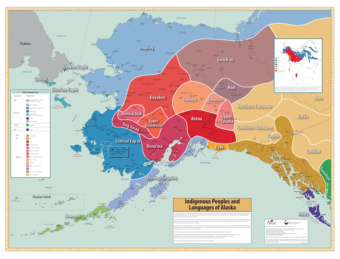
Indigenous Peoples and Languages of Alaska map by Michael Krauss. (courtesy of the Alaska Native Language Center)
The bill establishes a competitive grant program to support Native language immersion schools. The legislation doesn’t authorize a specific amount of money for the grants.
Murkowski also used the bill to revise the Alaska Native Educational Equity Program. The long-standing grant program last year gave some $30 million to Alaska school districts, the University of Alaska, tribal groups and nonprofits. Murkowski says if the bill becomes law, future grants will go directly to tribes and Native organizations that have expertise running education programs, or to tribes that partner with school districts.
“This will not only honor our constitutional relationship to Alaska Natives but ensure that they can take on more responsibility for helping their children succeed,” she said.
The bill passed the Senate by a wide margin. U.S. Education Secretary Arne Duncan praised it for easing the mandates of No Child Left Behind and reducing the amount of testing that eats up classroom time. But Duncan also says the bill doesn’t do enough for low-performing schools.
People attend the 45th annual Mille Lacs Band of Ojibwe powwow Saturday, Aug. 20, 2011, at the Iskigamizigan Powwow Grounds in Onamia, Minn. AP
When Tadd Johnson got a call in February that a Native American tribal elder in northern Minnesota had died and authorities were preparing to do an autopsy over his family’s objections, the message was simple.
“They’re going to do an autopsy on Mushkooub, and you need to stop it,” said Johnson, an attorney and chairman of the American Indian studies department at the University of Minnesota’s Duluth campus, a reference to deceased elder Mushkooub Aubid.
It had been years since Johnson, who also is a Native American, had practiced law. But he soon found himself poring over the state’s medical examiner guidelines and religious freedom statutes. He got in touch with Aubid’s family members, who were trailing the medical examiner’s car on its way to Duluth. That’s where the autopsy would be performed within a few hours unless they could stop it.
Johnson and the family obtained a judge’s emergency order halting the autopsy and then went to court to reclaim the body. There, they had to fight a medical examiner who has since been criticized as overzealous at best and insensitive at worst. (The examiner, who has since resigned, did not return calls for comment.) In time, they prevailed in preventing the autopsy and regaining control of Aubid’s body. Along the way, the state’s religious freedom laws were called into question.
Months later, activists and lawmakers in Minnesota say some good came of the episode: It’s being credited with pushing Minnesota to join only a handful of states enacting religious protections for families that object to autopsies, which are often required under state law.
“There really was a disconnect between our statute and a constitutional right,” said Democratic Sen. Tony Lourey, who sponsored the measure that Democratic Gov. Mark Dayton signed in May. “It’s a very emotional conversation. These families were quite upset, and we’re talking about a time when families are really stressed.”
Increasing Attention
Seven states have adopted strong religious protections against autopsies: California, Maryland, New Jersey, New York, Ohio, Rhode Island and, as of July 1, Minnesota.
Members of the medical community, lawmakers and religious rights advocates say the conflict between religious beliefs and a state’s interest in determining a cause of death will likely arise in an increasing number of states because of the diversifying religious makeup of America and a growing sensitivity to religious liberties. A number of groups, including Orthodox Jews, some Muslims and Native Americans, object to autopsies on religious grounds.
“We’re getting more diverse,” said Brian Rusche, executive director of Minnesota’s Joint Religious Legislative Coalition, which backed the autopsy bill there. “We can’t just assume everyone is OK with autopsies anymore.”
But if the trend toward greater discussion of the clash between religious liberties and state autopsy laws is clear, the details and politics remain murky. As illustrated in other states, religious freedom legislation can raise the ire of anyone from church-state separation watchdogs to advocates who fear broad legal protections could be a license to discriminate against lesbian, gay, bisexual and transgender people.
Details Matter
One of the more complicated tasks of handling objections to autopsies is sorting out the specifics of how any measure might work. Even supporters of exemptions acknowledge there must be limits, especially in cases when a death can raise a public health concern or foul play is suspected.
“If your wife is the one that’s deceased, and you have the opportunity to make a religious objection, and you know you had a hand in her death, you might raise a religious objection,” said Robert Small, a retired judge in Minnesota and head of the Minnesota County Attorneys Association, which worked to amend the autopsy bill before it was passed. “There were significant concerns about public safety.”
One of the best ways to deal with those disputes, lawmakers, advocates and medical experts say, is to have a medical examiner work with each family to address their concerns.
That’s how the process typically works in Maryland, said Dr. David Fowler, the state’s chief medical examiner and vice president of the National Association of Medical Examiners. State law explicitly says families have the right to object, and if they do, then officials will discuss the situation with relatives.
“These individuals are obviously at a time when they’ve just lost somebody near and dear to them,” Fowler said. “We will bend over backwards to try to work with the families.”
Fowler said Maryland hasn’t been taken to court over an autopsy objection since 1991. Other states haven’t been as fortunate. And, as the case in Minnesota illustrated, just one dispute between a family and a local medical examiner can shine a spotlight on the shortcomings of state laws.
The Minnesota law, for example, had a contradiction that lawmakers addressed this year. Medical examiners had sole authority to order an autopsy, despite a religious freedom provision in the state constitution. Other states handle the issue differently. In California, for example, people can make their wishes known to the state by submitting a religious objections form.
Yet, even states with existing protection laws aren’t immune from the growing debate.
In New Jersey, Assemblyman Gary S. Schaer, a Democrat and the first Orthodox Jew elected to the Legislature, is sponsoring a bill to amend state law on religious objections. It would require courts to make a determination within 24 hours in any dispute. The timing is especially important in the Orthodox faith, which dictates the dead are to be buried as quickly as possible, Schaer said.
“We don’t want anybody to deal with this at one of the most difficult times of their lives in terms of burying a loved one,” he said.
Schaer’s proposal would also clarify that when a compelling reason for an autopsy must be weighed against a religious objection, the least invasive procedure (such as a “virtual autopsy”) should be used. Any extra costs would be borne by the family.
The measure is awaiting action, and Schaer said he hopes it will move once lawmakers approve a new budget.
Messy Politics
The politics of autopsies can sometimes be messier than the medical or legal details. Georgia is a prime example: Republican lawmakers there failed to pass a broad religious freedom law this year.
The measure said, “Governments should not substantially burden religious exercise without compelling justification.” Supporters said it protected the free expression of religion, while opponents argued it was a thinly veiled attempt to legalize anti-LGBT discrimination.
Supporters invoked autopsy objections in pushing for the measure. They also sought the backing of the Jewish community.
The strategy was initially successful, said Robbie Medwed, assistant director of the advocacy group the Southern Jewish Resource Network for Gender and Sexual Diversity. Lawmakers claimed rabbinical support for the measure as it moved through the Legislature.
But Medwed said LGBT advocates viewed the Jewish community as being used to drum up support for a bill that went beyond autopsy objections.
Medwed and other advocates turned the tide and the Jewish community uniformly opposed the bill, which was then tabled. “They were mostly trying to use this as a trick to get the Jewish community to support this bill,” he said, in reference to the autopsy provision. The bill’s sponsors didn’t respond to requests for comment on the debate.
On the other hand, Minnesota’s autopsy legislation found bipartisan backing. The legislation’s sponsor in the Senate was a Democrat; the House sponsor was a Republican.
Gail Kulick Jackson, a former legislator and lobbyist in Minnesota who helped pass the legislation, said she found the political sweet spot.
“We had the Republicans, who love the idea of religious freedom and religious freedom trumping government action. And on the left, people who liked the fact that it was really respecting of the minority community and their cultures,” Kulick Jackson said. “It made for a very interesting agreement between two very split political parties in Minnesota.”
“I know that you may have moments in your lives when you’re filled with doubts, or you feel weighed down by history … But when you start to feel that way, I want you all to remember one simple but powerful truth -– that every single one of your lives is precious and sacred, and each of you was put on this earth for a reason,” Michelle Obama said addressing the gathering. Jacquelyn Martin/AP
First lady Michelle Obama spoke to Native youth at the White House last week, saying their customs, values, and discoveries “are at the heart of the American story.”
“Yet as we all know, America hasn’t always treated your people and your heritage with dignity and respect. Tragically, it’s been the opposite,” Obama continued.
Obama addressed the inaugural White House Tribal Youth Gathering, which brought together more than 1,000 youths from around the country. The conference featured sessions on safety, health and education, moderated by young people.
“Your traditions were systematically targeted for destruction,” she said, speaking about forced relocation, young people sent to boarding schools and other regulations that “literally made your cultures illegal.”
“While that kind of blatant discrimination is thankfully far behind us,” she said, “you all are still seeing the consequences of those actions every single day in your Nations. You see it in the families who are barely getting by. You see it in the classmates who never finish school, in communities struggling with violence and despair.”
Obama embraces Deandra Antonio, 17, of Whiteriver, Ariz., after her speech. Jacquelyn Martin/AP
Obama read the names of some of the 240 tribes represented.
The gathering coincided with an announcement from Department of the Interior Secretary Sally Jewell, who announced new funding and grants devoted to education in tribal nations. Education was a focus for many at the gathering as well, including a session with Chief Technology Officer Megan Smith, who spoke on the importance of science and technology.
Obama also touted Gen-I, the President’s initiative focused on empowering Native youth. To be invited to the conference, individuals ages 14-24 were required to enter the Gen-I Challenge.
The afternoon sessions ended with remarks from Cheyenne Brady, Miss Indian World and member of the Sac and Fox Nation in North Dakota. Brady emphasized the importance of education to the American Indian population. The day also included a performance from Canadian artist Inez Jasper, who encouraged the youth to join her on stage.
The first lady was introduced by 15-year-old Hamilton Seymour, a member of the Nooksack Indian Tribe in Bellingham, Wash., who wore traditional attire, as many attendees did.
“We have made a difference,” Seymour said. “This day signifies that our voice has been heard.”
Copyright 2015 NPR. To see more, visit http://www.npr.org/.
Calista is the regional Native corporation for much of Western Alaska. (Image courtesy of Calista Corp.)
Calista shareholders will decide this weekend whether to issue shares to thousands of so-called “afterborns” – those born after December 18, 1971, the year Alaska Native Corporations were formed. The final vote happens Saturday corporation’s annual regional meeting in Kasigluk.
Shareholders will be able to vote in-person at the meeting, but they’ve also been voting online and through the mail. Thom Leonard is communications manager for Calista. He says the corporation first offered online voting last year, however, less than 3 percent of the proxy votes were submitted online.
“The final numbers aren’t in for this year, but it’s looking to be many, many more times that. The number of shareholders participating in online voting has grown tremendously, which is very exciting,” Leonard said.
If shareholders approve opening up enrollment, descendants and those who could have but didn’t enroll in 1971 will be able to enroll. An estimated 25,000 new shareholders would triple the number of shares that make up the corporation. A three-fold increase in shares means per-share dividends would drop to a third of their previous value. This year’s annual dividend averaged about $380.
Leading up to the vote, the company met in person with shareholders in 15 communities and Anchorage. Leonard says they wanted to make sure shareholders know how including descendants would change the geographic makeup of shareholders.
“Right now about 61 percent of shareholders live in the Calista region. If this passes, we anticipate that that percentage will drop to about 55 percent,” Leonard said.
If more shareholders are added, holding annual meetings could also get more complicated.
“If the number of shareholders increases dramatically, that certainly could be a challenge to make sure the 50 percent plus quorum requirement is met,” Leonard said.
If enrollment is opened up, Calista would join other corporations such as the Arctic Slope Regional Corporation, Doyon and Sealaska — all regional corporations that issue shares to descendants. There are currently about 13,000 Calista shareholders.
First Lady Michelle Obama hugs a lunch guest as she and President Barack Obama have lunch with youth from the Standing Rock Sioux Tribe in Washington, D.C., Nov. 20, 2014. (Official White House Photo by Pete Souza)
About 30 Alaskans in their teens and 20s were in Washington, D.C. Thursday to participate in the first-ever White House Tribal Youth Gathering. The highlight for many was a passionate speech by First Lady Michelle Obama.
In a cavernous hotel ballroom near the White House, Obama told the crowd they, as individuals, matter.
“Each of you was put on this Earth for a reason,” she said. “Each of you has something that you’re destined to do. Whether that’s raising a beautiful family, or succeeding in a profession or leading your community into a better future. You all have a role to play. And we need you.”
Obama urged them to notice the investment placed in them. She also said despite how they may feel at low points, they are never alone.
“Everyone in this room has your back. Everyone speaking at this summit – all those cabinet secretaries and powerful people who’ve come here for you – they have your back,” she said. “And you definitely have a president and a first lady who have your back.”
Sierra Shanigan-Daugherty, 19, of Anchorage, and Miss Arctic Circle: Elizabeth Ferguson, 21, of Kotzebue in Washington, D.C. (Photo by A Liz Ruskin.)
The gathering is part of President Obama’s Gen-I – or Generation Indigenous –project, aimed at cultivating leadership in young people and helping them succeed. The participants, more than 1,000, had to apply for selection, so this is a high-achieving bunch. Many of them have already launched projects to improve their communities. In her speech, the first lady warned attendees that some of the big changes they’re seeking may not occur until their children or grandchildren are grown.
“Maybe decades from now, maybe those kids — your kids, your offspring — will look back at all of you and say you were the generation who started it all. Gen-I,” she said. “You were the generation that dug deep. You were the generation that drew strength from your history and wrote a new story of Indian Country, and of America.”
Among those seeking big changes is Meghan Topkok of Nome, who has roots in Ambler and Mary’s Igloo.
“My to-do list? It’s very long,” she said. “I’m really concerned about subsistence hunting, and shipping that’s increasing through the Bering Strait, as well as the erosion of the land.”
She’s a law student at the University of Oregon and, at 24, one of the older attendees at the gathering. She spoke after a session on environment and climate change.
“I think what’s really inspiring is our youth (is) engaging in these issues, because I think so often, especially out in the village, like where I’m from, there’s kind of a lack of awareness, or a passivity about it,” Topkok said. “These kids are really inspiring because they’re doing things in their communities and bringing ideas here with them and sharing them. So we’re all learning from each other and we take those ideas back and it’s like a ripple effect.”
Some of the Alaskans wore fur vests and calico kuspuks that made them easy to identify. Elizabeth Ferguson, 21, really stood out. She wore a tall crown made of jade and ivory. It’s her tiara for winning Miss Arctic Circle, a regional culture pageant. She wore a sash across her torso, with “Miss Arctic Circle” spelled out in sealskin. She’s also the youngest member of the Native Village of Kotzebue’s tribal council.
Ferguson says she drew inspiration from other leaders at the conference, but she says the First Lady’s speech really hit the mark.
“Not only did she just speak to us and encourage us and empower us, she didn’t speak down on us, you know, like she’s superior,” Ferguson said. “She spoke at us. She met us at our level, and she lifted us up.”
In conjunction with the conference, the White House also announced a raft of grants and programs to improve Indian education, justice and economic opportunity.
Chum salmon numbers are well below average. (Photo by Shane Iverson / KYUK)
The Kuskokwim River is experiencing a poor chum salmon run, according to state managers, and with it, a restrictive fishing schedule.
The Department of Fish and Game plans to eventually move to a 24/7, 6-inch mesh gillnet fishing schedule, but they’re still moving with caution and have not yet set a date. Gillnet restrictions on the lower river last year were relaxed June 30th.
On Wednesday at a meeting of the Kuskokwim River Salmon Management Working Group — an advisory body for fish management — fishermen supported a cautious approach.
“I talked to several fishermen over here; they were concerned about the very low numbers of chums showing up. Some said they hardly caught any. The majority catch is always chums and a few small chinook,” said John Andrew from Kwethluk. “We could recommend they be cautious for the next two weeks until the silvers pick up.”
Biweekly subsistence fishing periods are underway now. State officials are not considering a chum salmon commercial fishing period.
The working group wanted state officials to allow other opportunities to put away fish. They passed a motion recommending state managers lift the ban on 4-inch mesh set nets. Mike Williams of Akiak said he and other dog mushers rely on whitefish during the summer to feed their teams. The nets can still catch salmon species.
They also asked for longer fishing periods upriver, noting that there are far fewer fish and fishermen in the river. They passed a motion asking that the next fishing above the Holitna be at least 24 hours. The state then announced after the meeting that 50 fathom gillnet fishing above the Holitna opens Wednesday night until further notice.
Members noted that more people downriver are done fishing compared to the middle and upper river, where many are just starting. Red salmon will be the mainstay of the middle and upper river and many are also planning on taking advantage of the silver salmon run as the summer progresses.
Close
Update notification options
Subscribe to notifications
Subscribe
Get notifications about news related to the topics you care about. You can unsubscribe anytime.