Alaska Native Government & Policy

Yupiit Nation presses for tribal governance progress

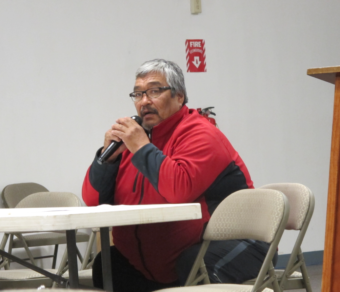
Mike Williams addresses the Yupiit Nation forum. (Photo by Ben Matheson / KYUK)

Yupiit Nation tribal members at an event Friday made a last second push for advancing sovereignty in Alaska. A few dozen members signed on to a letter to Gov. Bill Walker asking him to stop the state’s fight against putting lands into trust.

A brief is due in court Monday.

“We are urging, imploring, that the Governor drop the appeal on this litigation,” said Mike Williams Sr. of Akiak, the Yupiit Nation chief.

Williams calls Yupiit Nation a consortium of federally recognized tribes. Formed in 1978 with 19 tribes, there were people from eight tribes signed in Friday at the ONC meeting hall. The core of the group is centered in a section of the lower Kuskokwim River and includes Akiak, Akiachak, Tuluksak, and Kwethluk.

While tribes could see clarity on trust lands, the next steps for tribal governance are elusive after the Calista-led process lost steam and ran out of money. Calista leaders say that the matter is now in the hands of tribes. Their attorney, however, participated Friday. Williams wants to keep momentum.

“We’re making progress toward fixing our lives and savings our lands and ourselves. Nobody is going to save us. The state of Alaska isn’t going to save us. Federal government is going to save us. We are the ones that are going to save us,” said Williams.

At the Calista-led March convention that never reached a quorum, leaders asked tribes to consider resolutions supporting a new regional tribal government or strengthening the Association of Village Council Presidents. Long past the deadline, Calista has heard from just nine tribes, including three that oppose any new changes. With some overlap, six wanted a new tribal government and two wanted to change AVCP. Opponents worry that a new government undermines existing tribes.

Ivan M. Ivan of Akiak urged reaching out and bringing more people up to speed.

“Any questions they have could be answered in this process. However slow it is? Just keep moving forward,” said Ivan.

After a long discussion Yupiit Nation members wanted to maintain efforts to advance a tribal government structure and to push the issue at this fall’s AVCP convention.


British Columbia mine chief’s visit includes tribes, critics

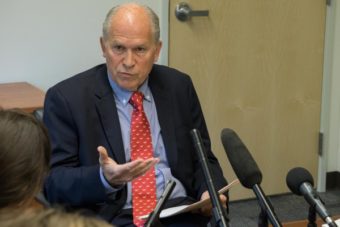
Alaska Lt. Gov. Byron Mallott, center, holds a press conference in May with B.C. Mines Minister Bill Bennett and Environment Minister Mary Polak. Bennett and other officials visit Southeast Alaska Aug. 24-27.(Photo courtesy B.C. government)

British Columbia officials travel to Southeast Alaska Aug. 24-27 to discuss concerns about transboundary mines.

B.C. Minister of Mines Bill Bennett and Deputy Minister of the Environment Wes Shoemaker will lead the seven-person delegation. They’ll spend four days in Juneau and Ketchikan.

Meetings with state officials are being led by Lt. Gov. Byron Mallott, who chairs the state’s transboundary mine working group. B.C. officials will also meet with tribal, industry, legislative and conservation leaders.

Mine critics are gearing up for the chance to confront Bennett and others about regulations and permits they consider lax.

Heather Hardcastle of Salmon Beyond Borders says the mines could pollute rivers that flow into Alaska and threaten valuable fisheries.

“I do think this issue of upstream development means that we’re taking on the risks and receiving no benefits. It’s uniting all of us on this side to come up with a better relationship with Canada,” she says.

British Columbia officials will also meet with the Southeast Conference, a regional development group, and the Alaska Miners Association.

Association Executive Director Deantha Crockett says she understands critics’ concerns. But she says B.C. mines could be good for Alaskans.

“There’s a lot of contracting that happens with a mining project, a lot of associated trickle-down jobs that happen with the mining projects that we could very well have a part in,” she says.

The itinerary also includes the Greens Creek Mine, near Juneau, which stores waste rock dry, rather than under water behind a dam. Some officials will also travel up the transboundary Taku River to B.C. and Alaska fisheries field camps.

Environmentalists also plan a rally on the Capitol steps at noon Wednesday to share concerns from around the region. The group Inside Passage Waterkeeper collected hundreds of rubber boots to present to the governor as part of its campaign.

Governor meets with tribes in advance of land trust deadline

Governor Walker visited five rural Alaska communities, including Akiachak. (Photo by Ben Matheson/KYUK)

Governor Bill Walker faces an August deadline for determining the future of the state’s appeal against a court case that could clear a path for Alaska tribes to put land into trust.

He’s facing pressure from tribes to drop the lawsuit. Trust status would reshape tribal sovereignty on certain lands. Walker said Monday that the purpose of his recent five-village trip was to listen and build relationships with tribes.

“I wasn’t trying to sell a deal or make a deal, or get anyone to do anything different. I just wanted to understand and hear from them about some of their issues in their village and tribal associations,” said Walker.

Walker inherited a 2013 lawsuit fighting an earlier decision about land into trust, from the Parnell administration. He’s delayed action for seven months. A brief is due on the 24th indicating the state’s plans. His tour last week brought him to five places: Akiachak, Tuluksak, Chalkyitsik in the interior, Barrow, and finally to Haines.

He brought boxes of vegetables and strawberries from Palmer-area farms to far corners of the state, as he spoke with plaintiffs who originally sued the federal government in 2006 for the ability to put lands in trust. Walker says a common thread was that tribes wanted to make sure the land is available for future generations.

“The theme I would take from across the state is they were looking at it more from a preservation standpoint. They’re trying to hold on to what they had, recognizing that they had a whole lot more previously,” said Walker.

Trust status, however, has major implications for jurisdiction and could give tribes wider control over laws and management of lands, while restricting the power of the state. It also has tax implications. Walker says land status is one of an array of issues related to tribal sovereignty that his administration is considering.

“We’re looking at some of those already, as far as for how we can transfer jurisdiction for certain matters over to tribes. I think I would look, our vision is much broader than land into trust,” said Walker.

His administration is also wrestling with how to implement tribal courts. Walker is not detailing his plans for the lawsuit yet. He says he and his legal team are still reviewing the case.

Governor meets with Kuskokwim tribes on ‘land into trust’

Gov. Bill Walker on April 18. 2015. (Photo by Jeremy Hsieh/KTOO)

Gov. Bill Walker was in Akiachak and Tuluksak Tuesday to discuss a lawsuit involving tribal lands into trust, according to officials in Akiachak. Walker’s office tried to keep a low profile on his first post-election visit to Southwest Alaska amid high interest in a case that could reshape jurisdiction on Alaska Native lands.

Walker arrived in Akiachak around 10 a.m. and spent a couple of hours meeting with tribal officials and community members before flying to Tuluksak.

Phillip Peter is chairman of the Akiakchak Indian Reorganization Act (IRA) council, which opposes any further delays.

“Akiachak already won the case. I said to them we’re not going to drop this issue, it’s already been approved by the court,” said Peter.

The Walker was traveling Wednesday on the North Slope where he was talking with other tribes about trust lands and was unavailable for comment. Spokeswoman Katie Marquette says Walker is reaching out to tribes like those in Southwest Alaska.

“… To talk to them about lands into trust issues, he has additional meetings across with other tribes in villages across the state to continue to talk about land into trust issues,” said Marquette.

The Department of the Interior announced new rules last year to allow Alaska tribes to put land into trust. Alaska Native leaders say the change, after years of litigation, brings them one step closer to self-determination.

Trust status for tribal land protects it from taxation and alienation – the taking or sale of land — and gives tribes greater jurisdiction. Under the new rules, tribes could put lands they own into trust, including land they’d purchased, received through an inheritance, or lands transferred to tribes by Native Corporations.

The state has fought the issue over the years. Walker inherited the 2013 lawsuit from the Parnell administration. Most recently, Walker asked earlier this year, for a six-month delay in the case. The state is not talking about its plans now, but Akiachak officials say Walker wants another six months.

Cori Mills, an assistant attorney general with the Department of Law, says the first six-month extension ended in July, the state then received a 30-day extension and now faces a deadline of Aug. 24.

“That’s the deadline in place now. Whether the state makes a different decision or wants to withdraw the appeal, that’s yet to be seen and will be determined by Aug. 24 in whatever is filed by that time,” said Mills.

The state can also ask for more time.

After the meeting, described as a first for the community, Akiachak’s Phillip Peter is hopeful that Walker seems willing to work with them.

“The governor is willing to work with the tribes about the land into trust issues. I was saying to the governor that we’re going to go forward and work with the state of Alaska on this land into trust issue,” said Peter.

Akiachak and Tuluksak were plaintiffs in earlier litigation to allow trust lands.

Tribes to get voice in state transboundary mine work

Lt. Gov. Byron Mallott speaks at a Wednesday tribal meeting on transboundary mines in Juneau. United Tribal Transboundary Mining Work Group Co-Chair Rob Sanderson Jr., center, and Fish and Game Commissioner Sam Cotten listen. (Photo by Ed Schoenfeld/CoastAlaska News)
Lt. Gov. Byron Mallott speaks at a Wednesday tribal meeting in Juneau on transboundary mines. United Tribal Transboundary Mining Work Group Co-Chair Rob Sanderson Jr., center, and Fish and Game Commissioner Sam Cotten, right,  listen. (Photo by Ed Schoenfeld/CoastAlaska News)

State government will formally involve tribal groups in its transboundary mining work.

Alaska Lt. Gov. Byron Mallott made that commitment Wednesday while meeting in Juneau with Southeast Native leaders.

“We agreed the transboundary state working group will have a place for a tribal voice in our work that allows them timely, transparent involvement so their voice is heard,” he says.

That will come through the United Tribal Transboundary Mining Work Group, formed last year by 13 Tlingit, Haida and Tsimshian governments.

Several Native leaders asked for a tribal seat on the state’s task force. Mallott says he’s not sure that can be done, but a formal arrangement will be set.

Tribes and state officials worry new British Columbia mines on rivers flowing into Alaska will damage fisheries, wildlife and those that harvest them.

Rob Sanderson Jr., who co-chairs the tribal transboundary group, says a now-closed mine upriver of Ketchikan already wiped out the area’s run of hooligan, a high-fat fish, also called at eulachon, oolichan and candlefish.

“That small-scale mining on the Eskay Creek, which is a tributary to the Unuk River, pretty much put that to sleep,” he says.

The Unuk drainage includes the Kerr-Sulpherettes-Mitchell mining project, the largest of several under exploration.

At the meeting, state officials told tribal leaders how they track and monitor transboundary projects.

Tlingit-Haida Central Council President Richard Peterson says it’s not enough.

“We get these reports from Canada … that are 10,000 pages. Our response can’t just be a page. I just don’t believe that it has the validity. And I challenge you to do a better job,” he says.

Peterson and others at the meeting said agencies should include traditional knowledge from elders in their analysis. They also pointed to tribal environmental testing, which could be shared.

State and federal officials, mining interests and environmental groups will join tribal leaders Thursday for more meetings on transboundary mine impacts on Alaska.

Juvenile Justice System Failing Native Americans, Studies Show

Sgt. Barbara Johnson and Corrections Lt. Robbin Preston run the Tuba City Juvenile Detention Center on the Navajo Nation. Laurel Morales/NPR
Sgt. Barbara Johnson and Corrections Lt. Robbin Preston run the Tuba City Juvenile Detention Center on the Navajo Nation.
Laurel Morales/NPR

State courts are twice as likely to incarcerate Native teens for minor crimes such as truancy and alcohol use than any other racial and ethnic group, according to the Tribal Law and Policy Institute. And juvenile detention facilities around the country have a disproportionately high number of Native American youth, according to an Indian Law and Order Commission report.

On the reservation, it’s different.

On a recent visit to the Navajo Nation juvenile detention center in Tuba City, it’s quiet. “Right now we don’t have anybody in custody,” says Sgt. Barbara Johnson.

The Navajo Nation “is really reluctant on sentencing youth to these facilities. It’s used more as a last resort, so our population has been very, very low,” says Corrections Lt. Robbin Preston.

He says that doesn’t reflect the number of troubled Navajo youth. But the Navajo and many other tribes have no rehabilitative services to offer them. So a Native youth arrested on the reservation faces a maze of legal jurisdictions.

Addie Rolnick, a law professor at the University of Nevada, Las Vegas, says there is no one juvenile justice system for these kids.

“There are rather at least three different jurisdictions at any given time with power over Native youth. The federal government might be involved. The state government might be involved and then the tribal government,” Rolnick says.

And she says where they wind up may do more harm than good.

According to the Indian Law and Order Commission report, these youth suffer from post-traumatic stress at a rate higher than military personnel who served in the Iraq and Afghanistan wars. So Rolnick says incarceration should be the last option for kids exposed to so much violence.

“Because if you have a kid who’s been damaged when they come into a system, just about the worst thing you can do is to lock them up, put them under surveillance all day and have guards watching them,” Rolnick says.

The U.S. Attorney General’s advisory committee on Native children says prevention, treatment programs and case workers have proven to be more effective than incarceration.

Copyright 2015 NPR. To see more, visit http://www.npr.org/.
Read Original Article – Published JULY 31, 2015 5:43 PM ET


Site notifications
Update notification options
Subscribe to notifications