Alaska Native Government & Policy

Theology school calls off Native art sale amid investigation

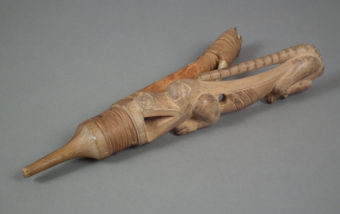
This Tlingit halibut hook with a wolf spirit was slated for auction. (Photo courtesy of Karen Kramer/Peabody Essex Museum)

A Massachusetts college that planned to liquidate its Native art collection has called it off. The pieces are from 52 tribes, including Tlingit and Haida items that might be sacred. Now the country’s oldest theology school could get dinged with penalties as feds investigate.

Over the summer, the Andover Newton Theological School, or ANTS, quietly decided it would sell 80 pieces of Native art from their collection. But their plans didn’t stay quiet for long. The museum that’s housed the collection since the 1940s alerted hundreds of tribal leaders.

Sealaska Heritage Institute was one of the organizations contacted because the school intended to auction off a Tlingit halibut hook, an item that SHI President Rosita Worl says is sacred.

“The halibut hook has spiritual dimensions to it and in this particular case, we have a halibut hook with a wolf,” she said.

Worl believes the school also has a Southeast shamanic doll. If a college or museum receives federal funds, then federal law dictates that certain items in their collection are subject to repatriation.

So, how did Andover Newton wind up with such a vast collection of Alaska Native, Native American and Hawaiian art?

“It was through their own missionaries going out into the field and collecting objects. Like, I tell the story over and over again … they collected our sins,” Worl said.

What those missionaries considered “sins” could fetch the college a million dollars now if the legality of the sale hadn’t come into question.

Peabody Essex Museum President Dan Monroe says the school was confused from the jump. It didn’t file an inventory or summary providing tribes with information. And the college assumed the museum could cherry-pick what was subject to the law, but only tribes have say in that.

“No other party can make those identifications,” Monroe said.

Even so, the school claims that information came from Peabody Essex. Monroe lets out a big laugh before responding.

“OK. Number one: we could never tell them what objects in their collection are subject to NAGPRA. … Because we have no standing in the law and we perfectly well understand that,” Monroe said.

NAGPRA is the Native American Graves Protection and Repatriation Act.

In 2009, Monroe says the Onondaga Nation asked the school to give back a wampum belt. The school denied the request. As a private college, it thought it wasn’t subject to the law. But here’s the problem with that: some students pay their tuition with Stafford loans, which are funded by the government.

This tunic was repatriated from a museum in 2007. Although it's of Southeast origin, the tribe is unknown. (Photo by Elizabeth Jenkins/KTOO)
This tunic was repatriated from a museum in 2007. Although it’s of Southeast origin, the tribe is unknown. (Photo by Elizabeth Jenkins/KTOO)

“If the institution receives federal financial assistance, whether directly or indirectly, that would be receipt of federal funds,” said David Tarler.

Tarler works at the NAGPRA office in Washington, D.C. He said the school is being investigated, and in this case penalties can range from $5,000 for each failure to comply up to about $21,000, or .25 percent of the school’s annual budget — whichever is less. Then there are aggravating circumstances, like previously denying a tribe’s claim.

Monroe says he’s still not sure if the college gets it.

“On the plus side, they’ve made the commitment not to sell objects; they’ve made a commitment to comply with  NAGPRA and those are admirable and very positive decisions on their part,” he said. “Regardless of the means of how they arrived at them.”

Martin Copenhaver, the school’s president, said he was too busy to comment but forwarded a letter that said “we will proceed to repatriate artifacts … if feasible and appropriate ways can be found to do so.”  

“I mean, that sent up a red flag to me,” Worl said. “When I read that, ‘if feasible and appropriate.’ What does that mean? It should be if it complies with the law. Who makes that determination? If it’s feasible?”

Aside from the law, she says there’s a larger underlying issue the school doesn’t seem to understand about the collection.

“They keep referring to them as artifacts and they’re not artifacts. They’re at.oow. They’re living things to us; they’re spiritual things to us,” Worl said.

Andover Newton Theological School did recently reach out to the Onondaga about the wampum belt, Worl said. But Southeast tribes are still waiting.

Clarification: we’ve reworded details about how the school may be fined.

Village council organization elects first-ever female traditional chief

Bea Kristovich is the first woman Traditional Chief of AVCP. (Photo by Anna Rose MacArthur / KYUK)

In a historical election Bea Kristovich is the first woman to ever be elected Traditional Chief of the Association of Village Council Presidents.

“I think I’m still in shock,” she responded when asked about her new position.

On the second day of the 51st  AVCP Annual Convention association delegates elected Kristovich as 2nd Traditional Chief of AVCP.

“Women were always left out over the years,” Kristovich said. “The men were the leaders. But over the years, there’s been more women getting more active, going into active roles as leaders from the villages. And they’re still silent. But I think being the first one, it will show the other younger generation that they can do it.”

Kristovich has been active in working on Native and education issues for more than 40 years. She was also part of the effort to see the Alaska Native Claims Settlement Act passed.

The Traditional Chief acts as a figurehead — opening meetings, saying prayers and offering traditional knowledge. But Kristovich, who belongs to the Native Village of Napaimute, wants to do more than that. In her new position, Kristovich said she wants to encourage leaders to speak openly. To do that, they will have to challenge their cultural upbringing.

“We weren’t raised that way to be open or talk about people or argue or stuff like that” Kristovich explained.

She also says she wants older leaders to retire so younger leaders can step forward to learn about tribal issues.

“I want them to be united,” Kristovich continued. “You know, [there are] 56 villages, and they’re still separated by Yukon, Kuskokwim and our area, and I think if we were all united, we’d be so strong. We could stick together and fight for issues that are very important for our people and our villages. It would work.”

Panel at Bethel convention seeks solution to tribal child welfare problems

Valerie Davidson, commissioner of the state's Dept. of Health and Social Services, led the panel on tribal-state child welfare in the AVCP region. (Photo by Anna Rose MacArthur/KYUK)
Valerie Davidson, commissioner of the state’s Dept. of Health and Social Services, led the panel on tribal-state child welfare in the AVCP region. (Photo by Anna Rose MacArthur/KYUK)

Keeping tribal children in their tribal communities is the solution to improving regional child welfare, panelists said Monday at the Association of Village Council Presidents annual convention

The panelists represented a range of local, regional and state organizations and said the approach to keeping children in their tribal communities is two-pronged.

The first is by training more foster parents in each village. There is especially a need for therapeutic foster parents. Such parents receive extra training and an additional stipend to provide behavioral health services to foster children.

Panelist Fennisha Gardner, Southwest regional director of children services, said currently there are no therapeutic foster parents in the Bethel area. Without these parents, many children are removed from their homes because they require therapeutic services not available in their communities.

Panelist Linda Ayagarak-Daney, an AVCP social worker, said many foster parents are acting in a therapeutic way by engaging their foster children in cultural practices like berry picking, subsisting and boating.

Monique Vondall-Rieke. (Photo courtesy of South Dakota State University)

Another solution panelists offered was to continue establishing and empowering tribal courts. Many panelists said tribes, not the state, know best how to care for their children.

The AVCP recently hired Monique Vondall-Rieke to help establish tribal courts throughout the region. Her vision is to create 25 to 30 new courts. To do that, she will soon begin tribal court assessments in AVCP villages.

Vondall came from working with the Chippewa Tribe in North Dakota as a tribal judge and attorney. She was also responsible for writing tribal court code.

The convention goes until Thursday at the Bethel Cultural Center.

Grants boost Southeast tribal justice programs

Central Council of Tlingit and Haida Indian Tribes of Alaska President Richard Peterson. (Photo courtesy CCTHITA)

Three Southeast Alaska tribal governments will boost their justice programs under federal grants announced Wednesday. Fourteen others in Alaska will also get funding.

The Juneau-based Central Council of Tlingit and Haida Indian Tribes of Alaska will receive $1 million from the Department of Justice.

Council President Richard Peterson says about half of the money will go to a tribal court program targeting at-risk Native teenagers.

“The primary goal really is to enhance Southeast Alaska’s juvenile justice system by providing early intervention and indigenous restorative justice offerings in a culturally appropriate forum for the at-risk youth,” he says.

The rest of the money will expand programs targeting child abuse, neglect and sexual abuse involving tribal members in the Juneau area.

Peterson says both grants are for three years.

The Justice Department also awarded about $350,000 to the Organized Village of Kake for alcohol and substance abuse programs. Another $170,000 is going to Metlakatla Indian Community public safety programs.

The grants are part of nearly $100 million to tribal governments and programs around the nation.

Denali Commission faces internal hurdles ahead of threatened villages effort

President Barack Obama meets with Kotzebue residents during his three-day tour of Alaska. (Photo by Eric Keto/Alaska Public Media)
Obama meets with Kotzebue residents during his three-day tour of Alaska. (Photo by Eric Keto/Alaska Public Media)

The profile of the Denali Commission was elevated earlier this month, after President Barack Obama announced during his visit to Alaska that the commission would coordinate the flow of resources to communities threatened by erosion, flooding and permafrost degradation.

The president also announced that the Denali Commission would receive $2 million to begin planning and coordination efforts.

With the money in hand and needing to be allocated by Sept. 30, the Commission is trying to figure out its next steps.

At a public meeting and teleconference on Tuesday, Bob Glascott with the U.S. Army Corps of Engineers suggested that updating existing databases would be helpful, since the most recent information about communities threatened by erosion comes from 2009, and flood maps on file are often more than 40 years old.

“Go out and talk to these communities, find out historically where the impacts have been, look at high water marks in these communities and survey them in – some sort of scope that would allow us to prioritize and figure out, if you have to make a list, and say ‘this is the number one community today with this snapshot’, and kind of go from there,” Glascott said.

Commissioner Julie Kitka, President of the Alaska Federation of Natives, said the Denali Commission needs internal reforms before it can expand to fulfill its new role as the lead agency directing responses to climate change in Alaska.

That includes reinstating a 5 percent cap on the administrative fee that the Denali Commission takes out of any incoming grant money.

“Our number one thing that we could be doing better at the Denali Commission is keeping that cap and keeping accountability on that,” Kitka said. “When that exploded and increased on that, it really weakened our argument for having resources flow through the Denali Commission.”

Kitka also argued for a greater decision-making role for commissioners. Denali Commission Federal Co-Chair Joel Neimeyer was open to the suggestion but admitted that having more meetings may not be enough to tackle the challenges ahead of the Commission.

“If that is what commissioners want, I will work with stakeholders and program partners so that we can get you the information so you can make these choices. But my challenge has been: how do I get you all together for a long period of time to truly appreciate what this issue is?” Neimeyer said. “And I can tell you, I have been looking at this issue now since June, and I’ve spent a lot of time on it, and I am at a loss at trying to figure out how to move forward with the $2 million. I am at a loss at how we engage with our friends at DC.”

The Denali Commission’s new role as a coordinating agency for projects related to coastal erosion, flooding and permafrost degradation will be overseen by the White House’s Arctic Executive Steering Committee, which President Obama created in January.

The next scheduled meeting of the Denali Commission is in November.

Feds: B.C. mines won’t go before international commission

Secretary of State John Kerry arrives in Anchorage Aug. 30. Lt. Gov. Byron Mallott, in suit, and First Lady Donna Walker are among those greeting the secretary. (Photo courtesy Office of Gov. Walker)

The U.S. State Department will not propose putting Southeast Alaska’s transboundary mine conflict before the International Joint Commission. That’s the U.S.-Canada panel that addresses cross-border water issues.

Critics of transboundary mining have been lobbying the federal government to put the issue before the commission. They include tribal, fisheries and environmental groups, as well as local governments.

The International Joint Commission is part of the century-old U.S.-Canada Boundary Waters Treaty. It’s charged with resolving conflicts involving waterways that flow from one country into another.

The critics say the commission is the best way to keep British Columbia mines and exploration projects from polluting salmon-rich rivers that flow into Southeast Alaska.

Lt. Gov. Byron Mallott asked for a sit-down meeting with Secretary of State John Kerry during his recent visit to Alaska.

“I didn’t get to meet with him. I did have the opportunity to mention it to him, that it was an issue,” he says.

Lt. Gov. Byron Mallott sits at his desk, beneath the state seal Feb. 26. mallott heads up a new administration transboundary mines working group. (Ed Schoenfeld, CoastAlaska News)
Lt. Gov. Byron Mallott heads up a state working group focusing on transboundary mines issues. (Photo by Ed Schoenfeld/ CoastAlaska News)

Mallott heads up a state working group looking into transboundary mines. He planned to lobby Kerry to request involvement of the International Joint Commission.

“I mentioned that I was going to follow up with the State Department and then I saw that he was later asked a question and commented on the importance of the transboundary river issues,” he says.

Mallott says he’s not sure that means Kerry is ready to take action, “but it does mean hopefully that the State Department has this issue on its radar.”

And it does.

The department, in responoce to our inquiry, says it’s concerned about British Columbia mining’s impacts on Alaskans, including Native groups, commercial fishermen and the tourism industry. It added that it had shared those concerns with senior levels of Canada and British Columbia’s governments.

But State Department officials say they do not anticipate referring the issue to the International Joint Commission at this time. Instead, they’re relying on increased cooperation between Alaska and British Columbia.

Guy Archibald, works on mining issues for the Southeast Alaska Conservation Council, says he’s surprised.

“The IJC has over a century of action that has been very effective everywhere from Washington State to New York State in avoiding disputes across the boundary,” says Archibald,  who coordinates the Inside Passage Waterkeepers group.

One tribal leader says he’ll pursue another avenue.

Fish and Game Department Commissioner Sam Cotten speaks while Rob Sanderson Jr. listens during a meeting with tribal leaders in Juneau. ES photos.
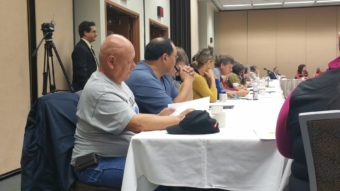
Fish and Game Department Commissioner Sam Cotten speaks while Rob Sanderson Jr. listens during a meeting with tribal leaders in Juneau. (Photo by Ed Schoenfeld/CoastAlaska News)

“If the State Department isn’t willing to step in and help us, then this is something that we have to step up and take on ourselves,” says Rob Sanderson Jr.,  a member of the Central Council of the Tlingit and Haida Indian Tribes of Alaska’s Executive Committee.

He also co-chairs the United Tribal Transboundary Mining Work Group.

“We do have that relationship with the federal government that we need to exercise. Basically, when they say ‘We’re not going to seek a referral,’ we are going to have to take matters into our own hands,” he says.

The transboundary work group includes about a dozen tribal governments in Southeast Alaska.

Sanderson says they’ll seek additional support before using their role as sovereign governments to ask the State Department for International Joint Commission involvement.

Site notifications
Update notification options
Subscribe to notifications