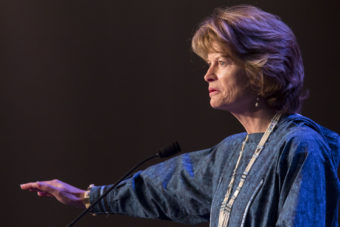
Sen. Lisa Murkowski addresses the Alaska Federation of Natives Convention, Oct. 16, 2015. (Photo by Mikko Wilson/KTOO)
At the Alaska Federation of Natives Convention on Friday, Sen. Lisa Murkowski kept her speech focused on Alaska Native heroes. While Sullivan mostly discussed military veterans, Murkowski emphasized civic and cultural leaders.
She reeled off scores of names — Sidney Huntington, John Baker, Poldine Carlo, Georgianna Lincoln, Rosita Worl, among others. Murkowski recognized leaders in community health, suicide prevention, education, engineering and business, and one pair of exemplary parents.
“These are heroes, each and every day making a difference,” the senator said. “One person, making a difference. One person saying, ‘I can do something to change the direction.’”
Murkowski also endorsed a passionate cause permeating this year’s convention: “My list of heroes includes friends in the Interior and across the state who seek justice for the Fairbanks Four. We will continue with that.”
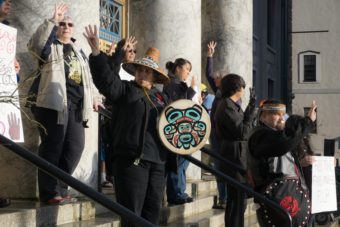
During her speech, a dozen or so demonstrators came in, some in animal costumes. They held subsistence- and climate-related signs, like “Don’t roll the dice with my ice” and “Ichthyophonus is upon us.” (That’s a fish parasite.) They told reporters they were protesting the senator’s support of Arctic drilling.
Murkowski did highlight some of her work in the Senate, including a provision in an education bill that would require school districts and the state to let Native communities weigh in on what and how their children are taught.
Murkowski also spoke of her support of a bill to restore the Voting Rights Act. Last month, she was the first Republican to co-sponsor the Senate bill. According to the congressional bill database, she’s still the only one.
KBBI reporter Daysha Eaton contributed to this story.
Protesters during Sen. Lisa Murkowski’s speech to the Alaska Federation of Natives Convention on Friday. (Photo by Mikko Wilson/KTOO)
During Sen. Lisa Murkowski’s speech at the Alaska Federation of Natives Convention in Anchorage Friday, protesters marched dressed as a salmon, a caribou and a walrus. It was part of an effort to call out Murkowski for her support of Arctic oil drilling. It was the second protest at AFN in two days.
Among the protesters in costume was George Pletnikoff Jr., originally from St. Paul Island, and who now lives in Palmer.
(Photo by Mikko Wilson/KTOO)
“We are here to make a statement that Lisa Murkowski needs to address our demands that we refuse fossil fuel use as continuing it. No drilling in the arctic, no drilling in the National Wildlife Refuge and we must switch towards renewable energies and create a sustainable future.”
Pletnikoff said the protest was organized by members of Alaska Rising Tide and REDOIL, which stands for Resisting Environmental Destruction on Indigenous Lands.
“The walrus said, ‘Eat me, Murkowski, don’t roll the dice with my ice!’”
That’s Faith Gemmill, with REDOIL. AFN officials escorted Gemmill and a protester out after a few minutes.
“We’re losing walrus habitat and their numbers are in decline because of melting ice. We wanted to send her a message that as a decision maker, she can do something to promote and protect indigenous peoples way of life here.”
The senator chairs the Senate’s Energy and Natural Resources Committee. Murkowski said she didn’t hear or see the protest, but she defended her record.
“I challenge people who suggest that my focus is all on development of fossil fuels. Look at what we have been doing to build out renewables not only in this state but from a national perspective. Look at what we’re doing here to encourage microgrids, so that our communities will be sustainable.”
Gov. Bill Walker addresses the 49th annual Alaska Federation of Natives conference in Anchorage. The AFN called on Walker to free the Fairbanks Four. (Photo by Mikko Wilson/KTOO)
The first day of the 49th annual Alaska Federation of Natives convention in Anchorage featured hundreds of attendees yelling their support for four men who say they have wronged by the justice system. As the AFN crowd showed their support, one of the men, George Frese, was preparing to head back into court in Fairbanks.
The Fairbanks Four is Eugene Vent, Marvin Roberts, Kevin Pease and George Friese. The men — three are Alaska Native and one is American Indian — were convicted for the 1997 murder of 15-year-old John Hartman but have maintained their innocence throughout their 18 years in prison.
Supporters sporadically yelled out “No more four!” throughout Gov. Bill Walker’s address to the convention. Just before Walker began to mention issues he felt the state hadn’t made enough progress on, about a dozen people entered the main room at the Dena’ina Center with a large cloth banner that read “Justice Fairbanks Four.”
After Walker’s address, AFN co-chair Ana Hoffman took to the podium and invited the organization’s board of directors to the stage. She motioned to Walker — who’d stepped back — to move toward the front of the stage.
“Gov. Walker, we have, on behalf of the board of directors and all of the delegation, we have a very important message for you,” Hoffman began. “Free the Fairbanks Four.”
The Alaska Federation of Natives asks Gov. Bill Walker to free the Fairbanks Four at the organization’s annual convention in Anchorage.
Each member of the board of directors stretched their arm up into the air and displayed four fingers to represent the four men they believe are wrongly convicted. Most of the crowd followed the board’s lead. Chants of “No more four!” strengthened for a for a minute. Lt. Gov. Byron Mallott stepped forward to join Walker.
As Hoffman continued to speak, Walker acknowledged the audience by nodding his head as he scanned the room.
“As you know Gov. Walker, the Fairbanks Four — Eugene Vent, Marvin Roberts, Kevin Pease and George Frese — have spent the last 18 years in prison for a crime that they did not commit and they deserve to be exonerated,” she said. “With the utmost respect for you, governor, we ask you to make things right and just. We put our faith, hope and love in your wisdom.”
Hoffman invited co-chair Jerry Isaac, former president of the Tanana Chiefs Conference, to take the podium to share a traditional song he’d composed for the demonstration.
“In our Native way, when death suddenly happens we are shocked, we are saddened and we grieve. In this case, there’s no physical death but the forceful taking away of freedom from four young men,” Isaac said. He continued: “We are shocked and saddened and grieving because the facts prove them innocent. The long years of shock and sorrow and the want for freedom and equality fill us with a grief. A grief that is so crippling by its power our only way to express our frustration, our sadness, is to grieve, grieve by a song to express our grief, sadness and sorrow.”
Afterward, Rob Sanderson, Jr. — the village chair for Southeast and 2nd vice president of the Central Council of Tlingit and Haida Indians of Alaska — told the crowd donations were being collected for the men’s legal expenses. The Alaska Innocence Project has been working to secure the men’s freedom for several years.
Victor Joseph, president and chairman of Tanana Chiefs Conference, spoke last before the board left the stage.
“It’s time that these young men come home,” Joseph said. “It could have been any of our children. I want everybody to know I place my trust in the governor to do the right thing and I believe he will. Thank you and ana basee’.”
In an interview with KSKA’s Zachariah Hughes, Walker said he admired the passion of the Fairbanks Four supporters and that he follows the case daily. He said, however, that anything he could do at this point would undermine efforts to have the men exonerated in a court of law.
“Whatever I would do in the way of releasing them from jail, they would still carry with them the question of (whether they’re guilty or not),” Walker said. “What they’re doing now is they’re having an opportunity to have their name cleared, assuming the evidence supports that.”
U.S. Sen Dan Sullivan addresses the Alaska Federation of Natives Convention, Oct. 15 (Photo by Mikko Wilson/KTOO)
What a difference a year makes.
At its convention last year, the Alaska Federation of Natives endorsed Dan Sullivan’s opponent in a tense campaign, and Congressman Don Young apologized to the audience for remarks he’d made about a teen’s suicide.
Sullivan on Thursday addressed the audience as their junior U.S. senator, and Young was all smiles.
Sullivan focused his speech on one of his political strengths: military issues. More specifically, veterans.
“We have in this room, we have a room full of heroes,” he said. “We have state full of heroes. We have a country full of heroes.”
It was right in line with the convention theme, Heroes in our Homeland. Sullivan mentioned that he’s a lieutenant colonel in the Marine Reserves and just finished five days of reserve duty. But he used much of his speech to highlight the military service of Alaska Natives.
“Think about that,” he urged the audience. “Alaska Natives serve at higher rates than any other ethnic group in our military … that deserves another round of applause, doesn’t it?”
He named a few Native leaders who are vets — Bill Thomas, Emil Notti, Oliver Leavitt, Sam Kito, Walter Soboleff, both junior and senior. Some, Sullivan said, came home to racial discrimination and lack of opportunity.
“No matter how poorly you were treated by your government, when you were called to serve, you did it,” he said. “That is a special kind of patriotism.”
Sullivan said he wants to re-establish National Guard units in rural Alaska, a goal he shares with Gov. Bill Walker. But the senator warns it will be a long, tough fight.
He drew applause when he spoke of a bill he sponsored to let Native vets of the Vietnam era apply for 160-acre allotments. The Alaska delegation to Congress has argued for years that many vets missed the deadline for applying in 1971 because they were serving their country.
“What’s a little bit disturbing to me is the Obama Administration is opposed to my bill, saying that it’s not equitable, that it’s not fair,” he said. “Let me tell you what’s not fair: Penalizing Alaska Natives for serving their country during one of the most controversial conflicts in our nation’s history when many other Americans did their best to avoid military during that time. That’s what’s not fair! ”
The administration also objects because the bill would allow claims on National forests and wildlife refuges. And the Interior Department said it’s finally finishing the claims of Native Vietnam vets who filed the last time Congress re-opened the application period for them, in the late ‘90s.
In an interview after the speech, Sullivan didn’t focus on last year’s AFN.
Young spoke briefly and, though cheerful, made several references to his own mortality. Or maybe just to the end of his career. It was hard to tell. But he did talk about being at the dawn of AFN.
“And I’m beginning to see the sunset, personally,” Young said. “But every time I think about it, I’m so happy what is coming behind me. The young people, the people who’ve gone to college, the people who are working, the people helping run the corporations (and) the village corporations, the people that have the belief and the pride in being an Alaska Native.”
Young is 82, but he just got married and closed by saying he’d always be there for Alaska Natives, as long as God and Alaskans want him to stay.