Alaska Native Government & Policy

Tlingit leader Robert ‘Bob’ Loescher dies at 68

Former Sealaska CEO and longtime Native rights activist Robert “Bob” Loescher has died at the age of 68.

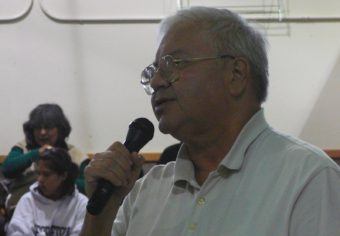
Robert 'Bob' Loescher speakers during a meeting in June of 2011. The former Sealaska CEO dies at the age of 68. (Photo by Ed Schoenfeld/CoastAlaska News)
Bob Loescher speaks during a Juneau meeting in June of 2011. The former Sealaska CEO has died at the age of 68. (Photo by Ed Schoenfeld/CoastAlaska News)

Loescher worked for the Southeast Alaska regional Native corporation for about 25 years. He became Sealaska’s CEO in 1997, a job he held until 2001.

“Bob’s mentoring nature and passion for Native land ownership and management had a profound impact on Alaska’s natural resources. He supported state policy that was guided by science and research,” Sealaska CEO Anthony Mallott said in a press release.

Loescher served on the Juneau Assembly in the early 1970s.

He also held leadership roles in the Central Council of Tlingit and Haida Indian Tribes of Alaska.

Council President Richard Peterson said Loescher ran the organization’s housing and electrical authorities.

“He put himself forward and worked for our people and we owe a great debt of gratitude for anybody who’s doing that and Bob did it in a very impactful way,” Peterson said.

Loescher, who died Nov. 11, recently served as a tribal judge. He was recognized as the central council’s tribal citizen of the year in 2012.

He was often described as a strong spokesman for Native subsistence rights.

In a 2009 speech, Loescher called for the state to stop citing indigenous people harvesting traditional foods. He pointed to what he called unreasonable limits on subsistence-caught salmon.

“What we have is a disproportionate allocation between the commercial fisheries and the traditional and customary hunting-fishing-gathering access to our resources, which we’ve used for thousands of years. That is not right,” he said.

The sometimes controversial Tlingit leader spent many years working with the Alaska Native Brotherhood, including heading up its Subsistence Defense Fund and Traditional Foods Security Council.

But other ANB officials alleged he illegally took about $21,000 from the groups. That led to a 2013 indictment on two charges of felony theft.

He challenged those charges, which were dropped last year.

Tlingit and Haida’s Peterson said he saw Loescher’s passion as a child growing up in the Prince of Wales Island village of Kasaan.

“One thing I got to know about Bob is when he was involved, he was really involved and he put a lot of effort into those initiatives, whether it was subsistence or others,” he said.

Loescher also worked as a consultant and lobbyist. .

A Tlingit-Haida Central Council biography says Loescher is of the Eagle Moiety, Chookeneidi Clan, the people of Glacier Bay and Hoonah. His Tlingit name is Kahtushtu’.

Editor’s note: This report was updated with additional information Nov. 17, 2015.

Fairbanks 4 closing arguments wrap; decision in judge’s hands

The Fairbanks Four exoneration case is in the hands of Superior Court Judge Paul Lyle.

Closing arguments were heard Tuesday in a five-week hearing to consider innocence declaration requests by George Frese, Kevin Pease, Marvin Roberts, and Eugene Vent, the four men convicted of the 1997 murder of John Hartman.

The Fairbanks Four petitions focus on alternative Hartman murder suspects William Holmes and Jason Wallace, two men already imprisoned for unrelated 2002 drug killings, who peg the Hartman attack on one another.

In closing, Fairbanks Four attorney Bob Bundy maintained that the Hartman murder secret held by Holmes and Wallace helped fuel their later cocaine ring killing spree.

“Holmes trusted Wallace, trusted Wallace to carry out his murderous plot to kill their competition in the cocaine business,” Bundy said. “I don’t suppose there’s a reason for that other than he knew that Wallace would keep his mouth shut and that Wallace was capable, capable of brutality on that scale.”

State attorney Adrienne Bachman painted a much different picture in her closing comments, arguing that Holmes and Wallace had no role in the Hartman attack, and are using it to leverage leniency in their own imprisonment, a blame game Bachman maintains has become one of the tools the Fairbanks Four are wielding to challenge their own murder convictions.

“We all understand what the agenda is here,” Bachman said. “The agenda is to somehow undermine the court’s confidence that due process was served in the four trials, the three trials in which 36 jurors deliberated and came to unanimous verdicts based on the highest standard of proof in the land.”

The standard of justice Judge Lyle must apply in considering the Fairbanks Four post-conviction relief requests is less than the “beyond a reasonable doubt” requirement the men were convicted under.

Post conviction relief requires clear and convincing evidence. Lyle cautioned that he has thousands of pages to read before a six-month clock for him to rule begins ticking.

White House Tribal Nations Conference kicks off in Washington DC

The seventh White House Tribal Nations Conference begins in Washington, DC Thursday, and each of Alaska’s 229 tribes was invited to send a representative. Interior Secretary Sally Jewell told reporters the Obama administration has improved how government works with tribes.

“And a big part of this conference is to discuss how we make these gains permanent,” Jewell said.

Among the successes Jewell named is better collaboration with tribes to address the high suicide rate, settling old lawsuits and paying tribes fairly when they contract with the federal government to provide services.

“I’d like to underscore that the president’s budget calls for full mandatory funding of contract support costs,” Jewell said. “When we contract work with tribes, there’s a cost associated with that.”

Jewell also credits the White House initiative called “Generation Indigenous” for bringing Native youth together and elevating their voices. The secretary says she knows tribes are concerned the improvements could disappear after President Obama’s term ends in 14 months.

“We hear the sense of panic,” Jewell said. “But I will also say we have bipartisan support in Congress for a lot of the work that we’re doing, on Indian education, on support for tribes, on sovereignty and self-governance. This is not a Republican or a Democratic issue.”

President Obama was scheduled to address the tribal conference Thursday.

How 3D printing helps preserve and return sacred Tlingit objects

This Tlingit rattle was scanned and 3D printed with the beads inside. (Photo by Elizabeth Jenkins/KTOO)
This Tlingit rattle was scanned and 3D printed with the same size beads inside. (Photo by Elizabeth Jenkins/KTOO)

The Smithsonian is using 3D printing and scanning technology to preserve and repatriate Hoonah Indian Association items.

But because they’re culturally sensitive objects, being able to make infinite copies isn’t necessarily a good thing. At last week’s Sharing Our Knowledge” clan conference in Juneau, participants learned how tribal members are adapting the new technology.

A group of people crowd around a small table in the back of the conference room at Centennial Hall. The 3D printed objects are carefully laid out. They’re gray and beige. Most are not painted yet.

Eric Hollinger and Robert Starbard put the replicas away. KTOO obtained permission to photograph the objects. (Photo by Elizabeth Jenkins/KTOO)
Eric Hollinger and Robert Starbard put away the replicas. Photography can be a sensitive subject when it comes to shamanic objects. These were photographed with permission. (Photo by Elizabeth Jenkins/KTOO)

Although these items are replicas, we are advised we can look but can’t touch. Robert Starbard, the tribal administrator for the Hoonah Indian Association, handles the copies with gloves.

The original items are yéik: objects that have a spirit embedded in them.

Eric Hollinger, a repatriation case officer at the Smithsonian, said traditionally they would have been left at the above-ground grave houses of Tlingit shamans.

“Some shamanic objects have actually been passed on from multiple shaman. They may be hundreds of years old before they were removed and sold into museums illegally,” Hollinger said. “And that’s what happened with these objects.”

After a repatriation request, the ownership was transferred back to the Hoonah Indian Association in 2013. But the items remain in the Smithsonian.

“They’re on a five-year loan to us while we explore this project together and CT scan it, but they own and control everything about ‘em,” Hollinger said.

That’s right. A CT scan, like the medical machine that shows the inside of your body. Except, this scan creates 3D digital renderings that can be printed or studied.

In 2005, the National Museum of Modern History repatriated a killer whale hat belonging to the Tlingit  Dakl’aweidí. With the clan’s permission, the hat was recreated. It’s now used for educational purposes and in the museum’s exhibition.

Robert Starbard said, during the panel, that most of Hoonah’s cultural items were lost in a fire in 1944.

“In one of the few places that we had access to some of these cultural objects, that were otherwise stolen from us, were in the museums,” Starbard said.

https://www.youtube.com/watch?v=P7MndvEcUcQ

He said the partnership with the Smithsonian provides two things: copies of the items in case something happens, and educational opportunities.

“Where we could take these objects and with our elders and our youth actually start sharing some of the stories and some of the histories and some of the techniques that went with them,” Starbard said.

Throughout the process, Starbard has been consulting with the elders and will continue to do so about the items’ sensitive nature.

He said it’s never easy to take a new technology and start using it for something that’s culturally and historically significant to the clans.

“And so there is a level of suspicion, there’s a level of distrust, and there is an apprehension to move forward, which is why we’re doing it in an incremental, very slow process.”

The Hoonah Indian Association is involved in another repatriation claim with the University of Pennsylvania. So far, Starbard said the college hasn’t been receptive. But he hopes the partnership with the Smithsonian can serve as an example.

“Even if they are replicas for display or in the case of UPenn they’re sitting in the backrooms, perhaps we’d be able to move that relationship off of the standoff that we have now,” Starbard said.

Tlingit artists in Hoonah will be painting the items and milling their own paddles and masks from the scans.

AFN looking into blood quantum requirement for marine mammal subsistence users

At the Alaska Federation of Natives convention earlier last month, the AFN Subsistence Committee delivered a report on their work. Subsistence Committee Co-chair Rosita Worl said blood quantum is an emerging issue that the committee is looking into. She said that the Marine Mammal Protection Act requires that marine mammal hunters be at least one-quarter Native.

“One of the issues that really has been emerging is the issue of blood quantum,” said Worl. “We are now hearing from parents (and) grandparents that they are no longer able to take their children, grandchildren with them hunting. We realize that under the Marine Mammal Protection Act that the regulations state that you have to be one-fourth Alaska Native blood.”

Worl reported that the AFN Subsistence Committee is working on a memorandum of agreement with the Indigenous Peoples Council on marine mammals. She also said AFN will be coordinating a study on the issue and holding focus groups in villages to learn more.

Kuskokwim village could serve as model for community development in rural Alaska

Oscarville is a short trip down river from Bethel. (Google Maps screenshot)

Over a decade ago, Oscarville’s community well broke down. Then, this summer, the school well failed too. Residents in the small Kuskokwim village have reverted to using rain and river water. Last week the community landed a major grant to fix that. The funding is part of a larger vision for rural Alaska and could pave the way for additional infrastructure.

In August, the Oscarville school staff showed up at school, ready to begin the semester, and found the building’s well had collapsed.

“Basically this metal pipe, quote unquote, went back to nature,” said James Mikesell, plant facilities manager for the Lower Kuskokwim School District.

“We have very ferrous, iron-bearing soil all throughout Alaska, so you put a piece of metal in the ground, and it’s going to rust away.”

To prevent the school from shutting down, Mikesell and his crew mobilized. They emergency shipped a 500-gallon tank and a high-volume pump from Anchorage and loaded it all on the LKSD boat. It’s called The Ark. They’d drive it to Napaskiak, located across the Kuskokwim, and back to Oscarville.


“And that had to be done on a daily basis. At least one or two trips a day,” Mikesell said.

Meanwhile, the school was limiting its water use, and Mikesell and company were rigging an alternative solution.

The village has two wells — the community well and the school well.

The community well collapsed in the early ‘90s, and residents have been using rain and river water ever since. The school well water is restricted to school use. The community and school district have never merged resources to fund and manage one water well, so the community and school have never shared a water source.

That might change. Oscarville recently landed a federal grant of almost a half million dollars to rebuild their water system.

“What this has done is opened the opportunity for the school to share their watering point with the whole community, which has not happened in the past,” Mikesell said.

Jackie Schaeffer is a project specialist with design company WH Pacific and is helping facilitate what’s being called “The Oscarville Pilot Project.”

Last year, about a dozen organizations from across the state came together to figure out how to make life better in rural Alaska — this means safer, more comfortable and less expensive. They want to see how community development can happen as a whole instead of through siloed projects and how that process can empower communities. Ultimately, they want to replicate this system across the state.

The team designated Oscarville, located five miles from Bethel, as their test case.

“The holistic approach is really to change the perspective of how we do community development, and allowing the community to start seeing how these components all tie together,” Schaeffer said.

Those components include power, housing, transportation, waste and water.

“So it’s everything that binds that community together,” she said.

This recent grant is bigger than just water, because it could help develop additional infrastructure by acting as a match to future grants.

But before any of that can happen, the school needed to fix its water issue.

Mikesell and his team salvaged the old community well and stretched a 400-ft. pipe from that well to the school’s water treatment plant to provide the school and two faculty houses with water for the winter.

The solution is temporary. The well could breakdown and the line could freeze.

“We’ve done everything we can think to do to insulate that line from cold temperatures. But there’s no guarantee with Mother Nature how cold it’s going to get,” Mikesell said.

If the well fails this winter, then it’s back to hauling water from Napaskiak.

The school district and community have from now until spring thaw to figure out how to merge water systems. Meanwhile, the pilot project crew will be working in Oscarville this winter, increasing energy efficiency in the town’s 20 buildings, changing electric meters to deliver lower cost electricity, and hoping the school’s water pipe doesn’t freeze.

Site notifications
Update notification options
Subscribe to notifications