Alaska Native Government & Policy

Recovery from addiction led Haines carver to healing art

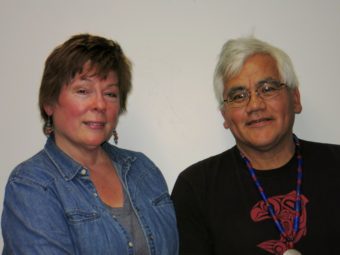
Cherri and Wayne Price. (Courtesy StoryCorps)

“My wife and I, she came into my life right after I sobered up,” Wayne Price said. “And we have dedicated our whole life and business to the creation of monuments.”

Many of those monuments are healing totems or dug-out canoes.

“They became a healing totem as a result of a vision in a sweat lodge that led to my recovery,” Wayne said. “The creator told me I had to do a few things … make a healing dug-out and healing totem.”

He says the healing monuments bring awareness to important subjects. For example, a totem pole he carved in Whitehorse was meant to bring healing to First Nations people who were taken into boarding schools, or residential schools, set up by the government and religious organizations. Similar things happened to indigenous people in the United States, including in Alaska and in Australia.

“These were not very great places,” Wayne said. “The healing totem in the Yukon, we said, ‘this is our past, it is not a good story. This is the present, there is only one race, it’s the human race. We’re all here now, we’re all being aware of each other.’”

Price thinks if there is going to be a wider healing among Natives in America, the U.S. government needs to apologize for the devastating toll the boarding schools took.

“It has to be acknowledged, what happened. It was government-backed, through faith-based religion, for the destruction of First Nation people — colonization. Until that happens, then this wound will never heal.”
He sees the impacts reverberating today.

“A lot of the issues that are in Indian Country now, are a direct result from what happened to them through the boarding schools. It’ll keep coming back. The suicide rate in Alaska is the highest in all the nation, and the majority of that is Native people. There has to be an awakening and an apology. It has to be recognized what really happened, and then a healing can occur.”

Wayne says even if you don’t know the history of the boarding schools, you can sit next to the totem in Whitehorse and ‘feel something.’ He thinks back to the vision that prompted his recovery from alcohol addiction and his focus on healing art.

“The creator told me when you hear the songs of your ancestors coming across the water, you’re done.”

Wayne led a class in the Yukon in which he carved a traditional dug-out canoe with First Nations youth.

“When the kids paddled away singing, I looked at my wife and I said, ‘there it is, I have lived to see my vision complete.’”

The audio interview was produced by KHNS’s Emily Files with the Juneau Public Libraries and StoryCorps in partnership with the Haines Borough Public Library. StoryCorps a national nonprofit whose mission is to provide Americans of all backgrounds and beliefs with the opportunity to record, share and preserve the stories of our lives. More information at storycorps.org.

Sitka Tribe pens letter to FBI, requests consultation regarding local police department policies

In its letter to the FBI, the Sitka Tribe of Alaska says it's believes prejudice may have influenced police conduct last year when an Alaska Native teenager was arrested. (Photo by Emily Kwong/KCAW)
In its letter to the FBI, the Sitka Tribe of Alaska says it’s believes prejudice may have influenced police conduct last year when an Alaska Native teenager was arrested. (Photo by Emily Kwong/KCAW)

The Sitka Tribe of Alaska recently wrote a letter to the Anchorage Division of the FBI about the questionable arrest and detainment of an 18-year-old man.

On Sept. 6, 2014, Franklin Hoogendorn was stripped, held down and then tased in his cell. The letter alleges that prejudice exists within the Sitka Police Department and asks the FBI to consult with the tribe during the investigation.

The letter asks for a few things. The first is to consider racial bias as a factor in the case.

The letter reads, “This incident is symptomatic of other actions by the Sitka Police Department which have alarmed citizens of this Tribe for many Years. Many of our citizens believe such prejudice does exist within the local police department.”

The tribe also asks in the letter to be consulted on any further changes to the Sitka Police Department’s policies. The letter cites the Clinton-era Executive Order 13175, which requires federal agencies to consult tribal governments when considering policies that would impact tribal communities.

“The Sitka Tribe of Alaska is ready, willing and able to do government-to-government consultation,” reads.

Tribal Chairman Mike Baines wrote the letter. He says, “I’ve heard of a lot of Natives getting assaulted by the police and that kind of thing. It’s pretty common. That’s one of our main concerns and it’s been coming out nationwide. … We want to do what we can to stop it growing locally.”

The tribe currently has 4,000 enrolled tribal citizens. Hoogendorn is a citizen of the Native Village of Koyuk, outside of Nome. Baines would not give details about the incidents described in the letter, nor would the Tribe’s attorney.

Baines did say that while he’s had some “respectful” and “successful” interactions with the Sitka police, he’s still bothered that the police chief said no department rules were broken during the incident.

“I think that’s a pretty big concern that the policies allowed for them to (tase) a young man is a pretty big issue,” he said.

After the arrest, Sitka Police Chief Sheldon Schmitt reviewed the footage and determined that the actions of the three officers complied with department policies. Despite that, some policies were changed. KCAW’s public records request for those policies was denied.

Schmidt the video does not depict Hoogendorn’s alleged level of resistance before being taken into custody.

City Administrator Mark Gorman and Lieutenant Jeff Ankerfelt said the City and the Police Department would not comment on the case, citing the pending FBI investigation.

Gorman previously said that the police department informed the city of the event shortly after it happened.

The FBI also would not comment on the tribe’s letter, but said that the agency follows up on all leads.

Organization aims to establish tribal court in every YK village

An Alaska nonprofit wants to do something new — set up courts for about one-fourth of Alaska’s tribes. The Association of Village Council Presidents, or AVCP, is a nonprofit representing 56 villages across the Yukon-Kuskokwim Delta, and they want each village to develop its own tribal court. Before they can do that, AVCP has to develop a model for something that has never existed.

Tribal courts exist in the Lower 48 but are rare in Alaska. There are 10 courts in the YK region.

Monique Vondall-Rieke, AVCP Tribal Justice Center Director, with a map of the YK Delta. (Photo by Anna Rose MacArthur/KYUK)

Monique Vondall-Rieke is working to change that.

“It’s a really big order to fill, but it’s part of history,” Vondall-Rieke said.

AVCP has tasked its Tribal Justice Center with developing a court in each of its 56 villages. Right now, Vondall-Rieke is the director and sole member of the department. She comes from North Dakota where she served as a tribal court justice for the Turtle Mountain Band of Chippewa Indians.

“Through the development of tribal courts, you’re saying, we are empowering ourselves to be able to deal with our own issues,” Vondall-Rieke said. “And it increases your exercise of sovereign immunity.

Tribal courts often deal with civil issues like disputes between tribal members, between businesses and members, and between tribes and agencies. They handle child custody cases, adoptions, and juvenile cases. They also try and prosecute misdemeanors committed within the tribe’s jurisdiction.

Because this process operates without law enforcement, it protects tribal members from racking up criminal records and it saves the state money.

The current hitch is that in Alaska lands cannot be taken into trust, which makes it difficult to define a tribe’s jurisdiction and impossible to secure federal funding to run the courts.

But AVCP is moving forward anyway with the hope that Gov. Walker’s administration will drop the lawsuit fighting trust status.

AVCP received a multimillion-dollar federal grant that allows the Bureau of Indian Affairs to fund the court assessments without taking land into trust. Last month, Vondall-Rieke and a group of consultants from the lower-48 traveled to two YK villages — Emmonak and Kongiganak — to begin creating the model, which they will roll out at the annual BIA Providers Conference in Anchorage this December.

“The plan is that once we have this assessment model tool designed, then the BIA can take that to the other nonprofit organizations that represent tribes in Alaska, and do the same thing there. So their turn will be coming,” Vondall-Rieke said.

What makes the assessment model unique is that it is being solicited by a tribal organization rather than a tribe, as what usually happens in the lower-48.

After the conference, people can begin applying to conduct the assessments.

The Lower 48 consultants are looking for specific credentials — Yup’ik speaking, local, Alaska Natives with law degrees.

“That’s kind of a tall order for our area. We’re very limited in the law degrees that are held by tribal members in our area, especially Yup’ik speaking tribal members,” Vondall-Rieke said.

Even if the assessors don’t carry law degrees, they’ll need specialized education.

“Certainly you have to have some knowledge of tribal courts or law. You have to probably have to have at least a Ph.D., be a good researcher,” she said. “It’s a lot of data gathering and it’s a lot of footwork, but it’ll leave a legacy behind.”

Vondall-Rieke hopes the assessments will begin in January.

“I’m looking for updated tribal constitutions, updated tribal codes, the case load of each court that’s in existence already,” she said.

She also wants to begin training court judges, clerks, and staff as well as law enforcement and tribal council members at that time.

Vondall-Rieke hopes the 56 assessments will be completed by late 2018.

Alaska Supreme Court rules in favor of Kookesh, Angoon subsistence fishermen

Charges against three Southeast subsistence fishermen — including former Sen. Albert Kookesh — have once again been dismissed. In an opinion issued Friday, the Alaska Supreme Court found that because the regulation used to cite the men was not created lawfully, it’s unenforceable. The decision could have a major impact on Department of Fish and Game bag limits across the state.

Estrada v. the State of Alaska concerned three men accused of taking more fish than their permits allowed. A fourth man, Scott Hunter, eventually pled guilty to an amended charge of fishing without a permit.

Hunter, Rocky Estrada, Stanley Johnson and former Angoon Sen. Albert Kookesh were cited in July 2009 for harvesting 148 fish; their permits only allowed for 15 sockeye salmon harvested per family from Kanalku Bay near Angoon. Kookesh — who’s served in both bodies of Alaska’s Legislature and as chairman of Sealaska — says he wasn’t even fishing that day.

“When I saw Fish and Game come in and start giving them citations, I was looking for something that would challenge the bag limit,” Kookesh said. At the time of the citations, he was representing Senate District C, which included a number of Southeast villages. “When I saw them giving my brothers a citation, I went over and said, ‘Here’s my permit; I want to get a citation, too.’”

The charges were dismissed by a judge at first, but the state appealed.

The fishermen saw the citations as unfair. Kookesh said no one in Angoon recalled the Department of Fish and Game consulting with locals informally — which the department claims it did — let alone officially. If they had, Kookesh says the resulting regulation that set the bag limit may have been more agreeable to locals. He says the department erred in not establishing a definition for “family” or explaining how they decided on 15 fish.

“Less than a mile away from where we got cited, commercial fishermen were fishing, catching all the fish they wanted,” he said.

In 2013, the Alaska Court of Appeals reinstated the charges. Their reasoning was that because the Legislature knew the Board of Fisheries was enacting this kind of regulation, their inaction to amend or clarify the board’s power indicated that they believed the board acted within its authority.

That’s a conclusion the Supreme Court found to be beside the point.

For the justices, the question wasn’t about the authority to create regulations; it was about whether those regulations were established according to the Administrative Procedures Act — a law that defines the process for creating a regulation.

How extensively this decision will affect bag limits across the state is still unknown.

“This may not just be for the bag limit in Angoon. There are bag limits for everything in the state — for moose, for deer, for everything. And we don’t think that this is going to be such a small Angoon case; it’s going to be an Alaska case,” Kookesh said.

Fish and Game Deputy Commissioner Kevin Brooks says the department is also trying to figure out what the decision means for their subsistence management regime.

“We’re going to pull together our directors on Monday morning and with the Department of Law just walk through it,” Brooks said. “It has resource management implications and they’re pretty varied. It’s commercial, sport, subsistence and wildlife. We’ve got to spend some time and figure it out.”

A spokeswoman for the governor said the Walker administration is still reviewing the case.

Kookesh says this is just one of many issues surrounding subsistence management in the state that will be challenged over the coming years. He says this case was really about making the department consult with people in rural Alaska.

“We intended to fight this,” he said. “We intended to challenge it and we did. And today after all those years and all that heartache and all that stress, we finally got a result that we think is right.”

Correction: The Alaska Supreme Court opinion issued Friday states that the fishermen were arrested at the time of their citations. A previous version of this story included that detail, which is not true.   

Nome Native corporation sells mining equipment, reclaims land

Muskox grazing on the reclaimed land of Rock Creek Mine. (Photo courtesy of Bering Straits Native Corporation)

It’s been a long and unproductive road for the Rock Creek Mine. But now that it’s being liquidated, money will finally flow into the pockets of its current owner, Bering Straits Native Corporation.

The mine was originally owned by Canadian mining company NovaGold and operated by its subsidiary, Alaska Gold. It opened briefly in 2008 before shutting its doors just months later. In the two years of preproduction and the two months of actual production, the mine went more than $20 million over budget, lost two of its workers in a construction-related accident, and violated the Clean Water Act, resulting in over $800,000 in federal fines.

There was a glimmer of hope that the mine’s doors would reopen when Bering Straits bought it from NovaGold in 2012. CEO Gail Schubert told KNOM in an interview at the time of the purchase that they planned to bring the mine back into production, albeit on a much smaller scale.

“Economic development opportunities are few and far between in rural Alaska and given the fact that this mine site has already been developed that NovaGold put several hundred million dollars into developing this site we just really felt that it was a good opportunity and kind of our responsibility to look closely at it to see whether it couldn’t be made operational,” Schubert said.

At the time, Schubert hoped the mine could be an economic engine for the region.

“You know we want to be able to provide some jobs and other opportunities to our shareholders and descendants and other folks that live in the region,” she said.

But what they hoped would be a source of revenue for locals, turned out instead to be a continuation of cleanup and reclamation. Now, it seems that along with ridding the land of toxins, Bering Straits will also be clearing out the facility’s interior. A news release published by another Canadian mining company, Almaden Minerals, revealed that it was entering into an agreement with Bering Strait to purchase much of the mine’s equipment.

Almaden will pay Bering Straits $6.5 million for the equipment over the next 30 months. Jerald Brown, Bering Straits’ vice president of Nome operations, has been working on the sale for a little over a year and says the initial investment in the failed mine turned out to be quite profitable.

“We’ve actually recovered 100 percent of the purchase price to date without including the proceeds from selling this equipment so it actually was a very good investment decision that Gail Schubert worked on a negotiated,” Brown said.

Along with the profitability of the purchase, Brown is optimistic that the land will eventually give back to Nome though this time in a different way.

“The land will be reclaimed, in fact, it already has been, and it will go back to being an area where people can go berry-picking and look at the muskox and everything they were doing before the mine was there,” Brown said.

The mine’s used equipment will be shipped south, where it will be put to work at a gold mine in Mexico.

British Columbia goes after leaking Tulsequah Chief Mine

Acid drainage from the Tulsequah Chief Mine, discolors a leaking containment pond next to the Tulsequah River in British Columbia in 2013. (Photo Courtesy Chris Miller/Trout Unlimited)
Acid drainage from the Tulsequah Chief Mine discolors a leaking containment pond next to the Tulsequah River in British Columbia in 2013. (Photo courtesy Chris Miller/Trout Unlimited)

British Columbia is telling owners of a leaky mine that it’s time to stop polluting a river that flows into Alaska.

Provincial officials on Nov. 10 notified the Tulsequah Chief Mine that it’s out of compliance with its permits.

The long closed project is on a tributary of the salmon-rich Taku River, which enters saltwater near Juneau. Fisheries, tribal and environmental groups have protested the ongoing discharges.

Owner Chieftain Metals plans to reopen the mine. But it continues to leak acidic wastewater containing metals that can harm fish.

Alaska Department of Environmental Conservation Deputy Commissioner Alice Edwards said British Columbia sent the state copies of the notices.

“We’re still in the process of analyzing what they found and what their plan is. But it does look like they are planning to take action. And it seems very similar to the type of process we would take on our side of the border if we were doing compliance action with the mine,” she said at a Monday meeting of the state’s Transboundary Waters Workgroup, chaired by Lt. Gov. Byron Mallott.

Chieftain Metals built an on-site water treatment plant that began operating in the fall of 2011. It was closed the following summer because it was too expensive.

Chieftain could not be reached for immediate comment.

Environmental critics say the notice will only have meaning if British Columbia fines or otherwise penalizes the mine owners.

B.C. Mines Minister Bill Bennett discusses the week's mine meetings as Lt. Gov. Byron Mallott and other state officials listen during a Wednesday press conference. (Photo by Ed Schoenfeld/CoastAlaska News).
B.C. Mines Minister Bill Bennett discusses transboundary mine issues as Lt. Gov. Byron Mallott and other state officials listen during an August press conference in Juneau. (Photo by Ed Schoenfeld/CoastAlaska News)

Mallott said British Columbia’s actions stem from Mines Minister Bill Bennett’s meetings with Alaska officials over the summer.

“Fish and Game and myself took him up to see the Tulsequah Chief Mine and see the water spewing into the river from a severed, 6-inch pipe. At which he took a very long look, with the helicopter hovering right in front of the pipe,” he said.

The Transboundary Waters Workgroup is made up of commissioners and other officials from six state departments.

Monday’s meeting was the first including a tribal representative, Rob Sanderson Jr. of the United Tribal Transboundary Mining Work Group and the Central Council of Tlingit and Haida Indian Tribes of Alaska.

The council’s Will Micklin, an alternate for the seat, also attended.

Mallott said the tribal seat reflects a cooperative approach to addressing common concerns. He said it also opens the door to new opportunities for monitoring water quality.

“We believe that tribes may have access to federal resources in the future for dealing with the transboundary issues. And opportunities that the state may not have access to,” he said.

Site notifications
Update notification options
Subscribe to notifications