Alaska Native Government & Policy

New bridge dedicated to Alaska Native Brotherhood

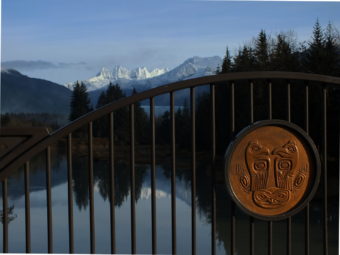
Glass-smooth Mendenhall River, Mendenhall Glacier, and the Juneau Icefield form the backdrop for one of the bronze medallions designed by Roy Peratrovich Jr. Tlingit moieties Eagle and Raven stand upon a rock that represents the Alaska Native Brotherhood. (Photo by Matt Miller/KTOO)
State transportation officials and Juneau Native leaders dedicated a new bridge crossing the Mendenhall River as the Brotherhood Bridge Saturday.

The new, wider structure was constructed for $25 million and it was designed to accommodate Glacier Highway’s future traffic needs. The bridge is the fifth crossing of the river at that location, and it replaces the former Brotherhood Bridge that was constructed in 1965 and dismantled last year.

A bright, rising sun shone on Saturday morning’s dedication, which featured a procession of Native leaders and comments from Roy Peratrovich Jr., designer of the original Brotherhood Bridge and the ten bronze medallions that were installed along the hand railing of the old bridge.

Roy Peratrovich Jr. (from left at front), Alaska Native Sisterhood Grand President Johanna Dybdahl, and Alaska Native Brotherhood Grand President Sasha Soboleff lead the procession to the new Brotherhood Bridge that includes Peratrovich's family and transportation officials. (Photo by Matt Miller/KTOO)
Roy Peratrovich Jr. (from left at front), Alaska Native Sisterhood Grand President Johanna Dybdahl, and Alaska Native Brotherhood Grand President Sasha Soboleff lead the procession to the new Brotherhood Bridge that includes Peratrovich’s family and transportation officials. (Photo by Matt Miller/KTOO)
Procession of builders and local Native leaders make their way across the bridge. (Photo by Matt Miller/KTOO)
The first Brotherhood Bridge was dedicated to honor and commemorate the Alaska Native Brotherhood, created in 1912, that advocated for civil rights for Alaska Natives.

After it was built, Lt. Governor Byron Mallott said he made a particular effort to visit it when he traveled to Juneau because of what it meant to Alaska Natives and to all people of Alaska.

“It occurred at a time that was very different from today,” Mallott said. “A time when Alaska’s peoples were still coming together.”

New Brotherhood Bridge features underpasses for pedestrians and cyclists on both banks of the Mendenhall River. (Photo by Matt Miller/KTOO)
New Brotherhood Bridge is more than double the width of the old bridge. (Photo by Matt Miller/KTOO)
Roy Peratrovich Jr., son of Alaskan civil rights pioneer Elizabeth Peratrovich, elicited a laugh from the audience when he mentioned that the former bridge was designed with drafting tables and slide rules.

“Maybe you don’t know what that is,” Peratrovich joked. “But it lasted 50 years. We want you to last 75.”

As the first registered Native civil engineer in Alaska, Peratrovich said the profession continues in his family. He said his grandson is designing rocketships for Space-X.

Ribbon is cut for the new Brotherhood Bridge. Shown from left is Federal Highway Administration's Sandra Garcia-Aline, Lt. Gov. Byron Mallott, original Brotherhood Bridge designer Roy Peratrovich Jr., Alaska Native Brotherhood Grand President Sasha Soboleff, Alaska Native Sisterhood Grand President Johanna Dybdahl, and Alaska Department of Transportation and Public Facilities Commissioner Marc Luiken. (Photo by Matt Miller/KTOO)
Ribbon is cut for the new Brotherhood Bridge. Shown from left is Federal Highway Administration’s Sandra Garcia-Aline, Lt. Gov. Byron Mallott, original Brotherhood Bridge designer Roy Peratrovich Jr., Alaska Native Brotherhood Grand President Sasha Soboleff, Alaska Native Sisterhood Grand President Johanna Dybdahl, and Alaska Department of Transportation and Public Facilities Commissioner Marc Luiken. (Photo by Matt Miller/KTOO)
“We owe you a great debt of thank you, Roy, for your insight , for bringing this particular bridge to serve Juneau,” said Alaska Native Brotherhood Grand President Sasha Soboleff.

“But it brings to mind one of the other things that we all work for, and that is the improvement in the quality of our life.”

Large concrete versions of the bronze medallions have been erected on the sides of the bridge abutments. (Photo by Matt Miller/KTOO)
New intepretive panels explaining the history of the Brotherhood Bridge have been erected in the trailhead parking lot adjacent to the bridge. (Photo by Matt Miller/KTOO)
The new four-lane Brotherhood Bridge features the restored bronze medallions that were recovered from the old two-lane bridge, and large concrete replicas that have been installed on the abutments.
The procession makes their way across the new Brotherhood Bridge. (Photo by Matt Miller/KTOO)
Lt. Gov. Byron Mallott (from left to right), Roy Peratrovich Jr., and Alaska Department of Transportation and Public Facilities Commissioner Marc Luiken pause for pictures before Saturday's ribbon cutting for the new Brotherhood Bridge. (Photo by Matt Miller/KTOO)
Lt. Gov. Byron Mallott (from left to right), Roy Peratrovich Jr., and Alaska Department of Transportation and Public Facilities Commissioner Marc Luiken pause for pictures before Saturday’s ribbon cutting for the new Brotherhood Bridge. (Photo by Matt Miller/KTOO)
Orion Marine Contractors was the general contractor for the project with construction getting underway in April 2014. They constructed the upstream span of two lanes while traffic continued on the old bridge. Traffic was diverted to the new span as the old bridge was being dismantled and replaced with another span that was two lanes wide. The bridge includes a 6-foot wide sidewalk on the upstream side, and underpasses at both ends for pedestrians and cyclists.
Editor’s note: The spelling of “Peratrovich” has been corrected. 

Protesters, lawmaker bring Fairbanks Four case to the Capitol

Fairbnaks Four protesters at the Capitol, Oct. 24, 2015. (Photo by Jeremy Hsieh/KTOO)
Fairbnaks Four protesters at the Capitol on Saturday. (Photo by Jeremy Hsieh/KTOO)

On the first day legislators were due back in Juneau for a special session, 20 protesters and one lawmaker brought the Fairbanks Four case to the Capitol.

It’s a sunny Saturday morning, and about 20 people are staggered along the steps leading into the state Capitol building. With their hands raised and four fingers pointed up, the protesters turn to face each pedestrian and car that passes in front of them.

Franklin Harvey James Jr. has a sign with a message: It’s not too late to exonerate.

Franklin Harvey James Jr. shows off his protest sign in support of the Fairbanks Four, Oct. 24, 2015. (Photo by Jeremy Hsieh/KTOO)

“None of us believe that the case was handled right up there,” he said. “There’s too much left open. And it was handled too quickly … to appease the public, I would say.”

The Fairbanks Four were young men when they were arrested and charged with the shocking and apparently random murder of a 15-year-old boy named John Hartman. He was found severely beaten in the streets of Fairbanks in October 1997, and later died from his injuries.

According to a 2008 investigative reporting series by the University of Alaska Fairbanks and The Fairbanks Daily News-Miner, the police investigators’ murder theory formed around a drunk teenager’s arrest on a different call that night. Over the course of about 11 hours in custody, Fairbanks police used coercive but legal interrogation methods on Eugene Vent, then 17. He confessed to the beating and identified three friends who also participated, George Frese, Kevin Pease and Marvin Roberts. Later, Vent recanted.

In three trials, three separate juries in Anchorage convicted the Fairbanks Four in 1999, despite lacking motive, eyewitnesses to the actual beating and physical evidence connecting the suspects and the victim. Three of the men are Athabascan and Kevin Pease is Crow Indian; the victim was white. The swift arrests and questionable case has fueled belief that racial prejudice was a factor.  

“Well, it’s just an example of inequality. It’s not right,” said Capitol protest organizer David Russell-Jensen. “And I think a lot of people are joining the movement, Free the Fairbanks Four.”

Russell-Jensen is a liberal arts student with an emphasis in Native studies at the University of Alaska Southeast.

“Alaska Natives make up 15 percent of the population but are 36 percent of the prisoners in the state. And it’s just unfortunate. It’s completely harmed their lives,” he said. 

Rep. David Guttenberg, a Democrat from Fairbanks, didn’t know about the protest, but addressed the Fairbanks Four on the floor of the House of Representatives. 

Rep. David Guttenberg - Fairbanks Four
Rep. David Guttenberg, D-Fairbanks, flashes the symbol of support for the Fairbanks Four. (Photo courtesy Alaska Independent Democratic Coalition)

“I don’t know whether they’re guilty or innocent, but I know everybody in this state wants to see justice done. Not only justice for those four people and their family, but also justice for the family of Mr. Hartman, the young man that died that night,” Guttenberg said. 

His colleagues on the floor didn’t have an overt reaction to the speech. Afterward, Guttenberg elaborated on his position. 

“There was always something wrong about it with me,” he said. “I thought the issue needed to be elevated a little bit higher into the state. And the opening day of this special session, to say  something about it, I thought was appropriate. It was an important social issue and criminal justice issue.”

The Alaska Innocence Project is representing two members of the Fairbanks Four, seeking their exoneration based in part on new evidence. Eugene Vent is represented by the Office of Public Advocacy. George Frese is represented by Anchorage attorney Bob Bundy. The state maintains its prosecutors’ case against the Fairbanks Four.

Editor’s note: The Fairbanks Four’s legal representation has been clarified. An earlier version of this story suggested the Alaska Innocence Project represented all four.

Victory for Sealaska Heritage underscores weakness in the law

Federal investigators have found that the country’s oldest theological college broke the law regarding its Native art. Andover Newton Theological School planned to sell off 80 pieces in its collection, including a sacred Tlingit halibut hook. Now some tribal leaders are wondering if repatriation laws should be tougher.

Rosita Worl has been fighting against the school’s Native art liquidation since June. She’s the president of Sealaska Heritage Institute and also served on the Native American Graves Protection and Repatriation Act (NAGPRA) review committee.

Worl said the feds’ decision was bittersweet. It reaffirms the private college is subject to the law because it receives federal student loans.

“We were happy that the federal government did find that they were obligated to comply with NAGPRA, but I was also saddened that we had to spend all of that time and effort to force them to comply with NAGPRA,” Worl said.

Back in July, the school’s president Martin Copenhaver claimed that the items in the collection weren’t sacred. Turns out, that’s wrong. David Katzeek, a Tlingit tribal member, identified the halibut hook as a sacred object that was used in religious ceremonies.

Copenhaver couldn’t be reached for comment, but the college has 45 days to contest the decision.

This Tlingit halibut hook with a wolf spirit was slated for auction. (Photo courtesy of Karen Kramer/Peabody Essex Museum)
This Tlingit halibut hook, Gooch Kuyéik Náxw, was slated for auction. (Photo courtesy of Karen Kramer/Peabody Essex Museum)

“To the best of my knowledge, we haven’t received any request for informal discussion and there has been no request for hearing at this time,” said David Tarler.

Tarler works at the NAGPRA office in Washington D.C. He said the college has reached out for “technical assistance,” but it should have filed a summary of its Native art years ago, which allows the tribes to see what’s in the collection.

Andover Newton might not be the only institution skipping this step. Worl says the process can lead to oversights.

“There’s no real teeth to the law,” she said. “If I didn’t file my income tax, you could be certain I would be hearing from the federal government and there would be immediate action to comply with the law. In the case of NAGPRA, we don’t have similar kinds of requirements.”

Because of this, the Alaska Federation of Natives recently passed a resolution. A group will work on proposing amendments to NAGPRA. They’ve already reached out to the congressional delegation.

Worl says the changes are necessary. Repatriation can be a long and costly endeavor for the tribes.

“In one case, I would say that we expended over a hundred thousand dollars in just direct expenses. With lawyers, other anthropologists compiling evidence,” she said.

And she says the NAGPRA laws are more than 20 years old.

“When museums and scientists were less sympathetic to Native American beliefs.”

Worl thinks there’s been a cultural shift. Recently, the Northern Light United Church sent a letter to Andover Newton Theological asking the school to return the sacred items. And with the advancements, she says the law should adapt, too.

“I do believe that we have a younger group of scientists and museum professionals with a greater understanding of Native American beliefs. I’ve seen this happen all around the country,” she said.

Worl hopes this case will encourage other schools and museums to step forward with their Native collections.

She says there are more legal hoops, but the Tlingit halibut hook is one step closer to coming home.

Wasilla lawmaker: Keep education spending in check, cut rural schools

It started as a rumor. Democratic lawmakers and some education advocates have heard about it.

That there are new ideas for changing how the state pays for education isn’t a surprise. That this cost-saving proposal could close 60 schools across the state is.

“Certainly there has been talk that 10 students is, quite frankly — with the technology that we have today and the options that are available — it’s just too expensive,” says Rep. Lynn Gattis.

Rep. Lynn Gattis applauds after introducing a guest on the House floor, Feb 26, 2014. (Photo by Skip Gray/Gavel Alaska)
Rep. Lynn Gattis, R-Wasilla, on the House floor in February 2014. (Photo by Skip Gray/360 North)

Gattis is a Republican from Wasilla and chairs the House Education Committee. She’s one of the lawmakers considering introducing legislation to change a number of things about how schools in Alaska are funded. One of her ideas is to increase the minimum threshold for schools to receive full funding. She’s considering proposing 25 students as the minimum, but she’s open to a number higher or lower than that.

“If I was in charge, I would open up those options whether it be virtual schools — I went to school when it was correspondence back in the day and we have come a long way,” Gattis said.

Jonathan Kreiss-Tomkins
Rep. Jonathan Kreiss-Tomkins, D-Sitka, on the House floor. (Photo by Skip Gray/Gavel Alaska)

Rep. Jonathan Kreiss-Tomkins represents a handful of Southeast Alaska communities. The three schools that were closed in Alaska in the last fiscal year were all in Southeast.

The Sitka Democrat said he unequivocally opposes raising the minimum threshold.

“Closing schools, depriving rural kids of a teacher and a traditional education that kids in cities and parents in cities would reasonably expect is not fair or equitable and it’s a complete nonstarter,” Kreiss-Tomkins said.

Hiking the threshold from 10 students to 25 could mean closure for 60 of Alaska’s schools. Typically once a school goes below the threshold and loses most of its funding, the district is forced to close the school, unless it makes the rare decision to siphon funding from other schools it administers. But in this case, pushing funds around may not even be an option. Many of Alaska’s smallest schools are in the same school districts.

The Southeast Island School District, for example, has nine schools; eight of them have fewer than 25 students.

“Even just talk about the possibility to go to 25 is enough to get parents jumpy. Just the talk will close a few schools because it’s hard keeping enough kids there,” Superintendent Lauren Burch said. “Who’s going to move to a community when they think the school might close?”

Burch said three of the district’s schools lost funding a few years ago because enrollment fell under the threshold. He said the district cut spending on basic school supplies and maintenance for buildings and buses to help keep the schools open.

Republican lawmakers say growth in education spending is unsustainable, and must be checked.

Education Commissioner Mike Hanley says it’s not fair to target education for cuts just because it’s one of the state’s biggest expenses. If cuts to the state budget must be made, he said, then education should be a priority to maintain. As an example, he questioned whether education funding was more important than funding for trail maintenance, or maybe as important as funding for law enforcement.

“At some point we have to say we’re not willing to go any lower in education and I don’t know what that number is,” Hanley said. “But at some point we have to (ask), ‘What’s our constitutional responsibility to provide an education? What’s our moral responsibility to supply and provide an education? And can we still meet that obligation with less money?'”

Comments on a possible change in the minimum threshold were included in several speakers’ remarks during the National Congress of American Indians conference with the Alaska Federation of Natives and during the AFN convention. Concerns were mainly focused on how such a change would make rural education less equitable.

New Brotherhood Bridge to be dedicated Saturday

Picture from last December shows traffic flowing across the first phase of the Brotherhood Bridge replacement project. (Photo by Matt Miller/KTOO)
Traffic flows across the first phase of the Brotherhood Bridge replacement project in December 2014. (Photo by Matt Miller/KTOO)

A century after creation of Alaska’s oldest known indigenous peoples’ civil rights organization, Native leaders and other local dignitaries will rededicate a new Juneau bridge commemorating the group.

Saturday morning’s ceremonies will include a procession over the wider, just-completed Brotherhood Bridge that spans the Mendenhall River. Speakers will include Lt. Gov. Byron Mallott, Alaska Native Brotherhood Grand President Sasha Soboleff, and Alaska Native Sisterhood Grand President Johanna Dybdahl. The designer of the original Brotherhood Bridge, Roy Peratrovich Jr., is also expected to attend.

This will be at least the fifth bridge crossing Mendenhall River at Glacier Highway. According to a fact sheet issued by the Alaska Department of Transportation, the first road crossing at the river was constructed in 1903 for a combined cost of $1,700. The first bridge was replaced in 1919, and again in 1931.

The original Brotherhood Bridge was constructed in 1965 and stood for nearly 50 years until it was recently dismantled. A $25 million replacement bridge designed to handle increased traffic has been under construction for the last 18 months.

Jeremy Woodrow, spokesman for the Alaska Department of Transportation, said it’s important that they continue to honor the ANB and the organization’s advocacy for Alaska Native civil rights.

“It was named as a way to show the importance of the Alaska Native Brotherhood to break down the racial barriers that were so prominent across the nation in the ‘50s and ‘60s,” Woodrow said. “That name holds true today and renaming the bridge, the new Brotherhood Bridge, shows that and carries that cultural importance on.”

Round, bronze medallions designed by Peratrovich and displayed on the side of the old Brotherhood Bridge were recovered, restored and installed on the new bridge. They’ll be unveiled just before Saturday’s ceremony.

“They look beautiful,” Woodrow said. “They really do shine right now and they’ll look great once they’re revealed.”

The Alaska Native Brotherhood was created in 1912 and the Alaska Native Sisterhood was created in 1915.

The Brotherhood Bridge rededication ceremony starts at 9 a.m. Saturday, Oct. 24, with the procession starting at 8:30 a.m. at Vintage Business Park. Woodrow said spectators and participants can park in the Carrs/Safeway parking lot.

First of its kind joint tribal-state court established

A disproportionately high number of Alaska Natives are incarcerated in the state of Alaska. In 2014, nearly 32 percent of the prosecuted criminal offenders in Alaska were Alaska Natives; they only constitute less than 20 percent of the population. Recidivism rates are higher for that group as well. Now, the state is working on new ways to partner with tribes to help solve both problems.

For the first time in Alaska, there will be a joint tribal-state court. A Kenaitze tribal judge will sit side-by-side with a state judge and have equal say in decisions. It will be a wellness court that hears criminal cases involving substance abuse, and will start taking up to 20 participants in March. Currently, tribal courts only have jurisdiction over civil matters, like adoptions, divorces, domestic violence petitions, and child protection cases.

Kenaitze Chief Judge Kimberly Sweet, who will be one of the two judges who preside over the court, said it will be run like most tribal courts. Everyone will sit together around a large conference table to talk about the problems.

“Parties are allowed to seek legal counsel,” she explained. “They can bring their legal counsel to court with them. Legal counsel are allowed to advise them, but we don’t speak to their legal counsel, we hear directly from the parties themselves.”

Sweet said the process helps get to and treat the root of the problem. Program developers are currently working on a handbook of procedures so the model can be repeated throughout the state.

“It’s not just based on personalities of people who have big hearts that are driving this,” she said. “(We’re writing the manual) so that it actually becomes institutionalized, so it can be picked up and taken by anybody.”

Sweet said having the tribes involved in substance-related criminal charges will also help them when working on child protection cases. The majority of those involve substance abuse and sometimes criminal charges which aren’t known to the tribal courts. The joint court can help solve some of those disconnects.

“So being able to collaborate and cooperate and work in the best interest of these families will do nothing but create a healthier community,” she said.

Similar joint courts already exist in Minnesota and California.

A 2014 change in court rules also allows the state’s court system to use collaborative methods for sentencing adults, like circle sentencing. The Kenaitze tribe and others are already using the method with juvenile offenders. Sweet explains that circle sentencing brings the offender, community members, family members, and sometimes the victim into the same room to discuss the issue and the solution.

“Nobody is an authority in the circle. The circle collaborates and works together as a little mini-community to come up with a plan to put that youth or the adult on the right path with as much input from the youth and the adult as possible.”

For adult cases, the state judge would make the final sentencing decision.

The state is also working on a plan to improve the outcomes for Alaska Natives who end up incarcerated. The Department of Corrections is convening an Alaska Native Focus Group for reducing recidivism.

Alaska’s recidivism rate is 63 percent for everyone leaving the prison system. For Alaska Natives, it’s 74 percent. DOC Commissioner Ron Taylor discussed the formation of the group during AFN.

“We’re concerned about the higher rates of recidivism among that group and looking for ways to improve those outcomes,” he said. “How do we do a better job of providing programming and resources? Of linking them to services once they get released? And how do we do a better job of ensuring they go back to their communities if they chose to do so?”

The group will be chaired by Lt. Gov. Bryon Mallott and meet for the first time next week in Anchorage. It’s unclear why recidivism rates are higher for Alaska Natives, Taylor said. It could be linked to cultural and language barriers with the department’s reentry and treatment programming.

Site notifications
Update notification options
Subscribe to notifications