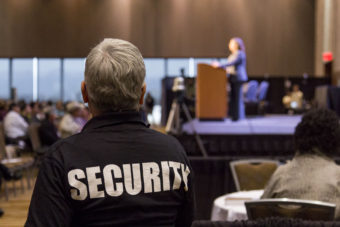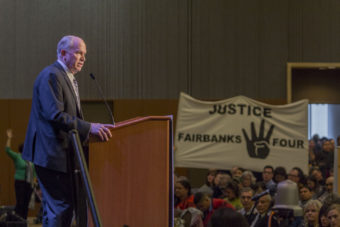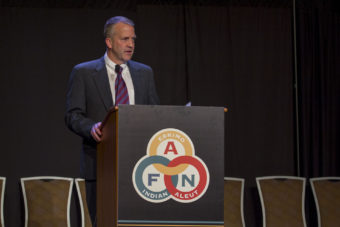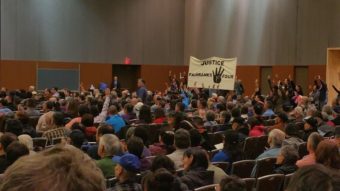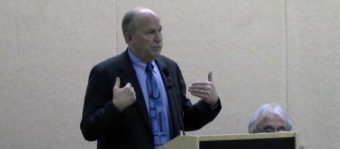
Gov. Bill Walker addresses the fourth annual Alaska Federation of Natives and National Congress of American Indians conference at the Egan Center in Anchorage. (Photo by Jennifer Canfield/KTOO)
Gov. Bill Walker announced Wednesday the creation of an 11-member tribal advisory council.
“We need to do things differently. We need to do things collaboratively. We need to have the vehicle to have a discussion and bring things to us, and so when we have an issue we have a mechanism to go out to the village leaders to solicit your input,” Walker said.
The council will advise on education, health care, subsistence, energy, public safety, justice, wildlife and fisheries, economic development, housing, language and culture and transportation. There will be one representative for each issue.
Richard Peterson, president of the Central Council of Tlingit and Haida Indian Tribes of Alaska, said he was excited about the announcement. Of all the issues covered by the council, Peterson said energy should be a priority, but land into trust is also something he’d like to see addressed before too long. He thinks it’s an issue of the state recognizing the tribes’ rights.
“Obviously they recognize tribes and our importance, but there’s never been a formal recognition and I think that needs to take place,” Peterson said. “What I would hate is to have all this great forward movement under this administration and then another administration comes in and just ignores (it), and it’s back to the way it was previously when tribes didn’t have the impact that we have now.”
Walker made the announcement Wednesday at the Alaska Federation of Natives and National Congress of American Indians annual conference in Anchorage. Several cabinet members addressed the conference that morning. Walker said he’d like for the meeting with AFN and NCAI to become an annual event for his administration.
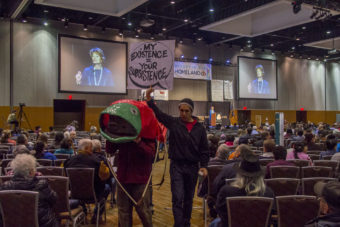
The 4th annual Alaska Federation of Natives and National Congress of American Indians conference at the Egan Convention Center in Anchorage. (Photo by Jennifer Canfield/KTOO)
A dancer with the Gajaa Heen Dancers wears a wooden wolf mask during the grand entrance for Celebration in 2012. (Photo by Heather Bryant/KTOO)
Alaska is now the first state to recognize Oct. 12, 2015, as Indigenous Peoples Day.
Gov. Bill Walker signed the proclamation today and First Alaskans President Liz Medicine Crow made the announcement at the Elders and Youth Conference.
The one-time declaration came on the heels of a similar announcement by Anchorage Mayor Ethan Berkowitz. The city now also recognizes the holiday. First Alaskans board member and former state lawmaker Willie Hensley reacted to the declaration.
The move is largely symbolic. The second Monday in October is annually Columbus Day, a federal holiday, and state and city employees are required to report to work. But First Alaskans board member and former state lawmaker Willie Hensley says the declaration is important.
“This is a historic moment considering all the trials and tribulations our people have experienced over time,” Hensley said. “A lot of not so good stuff, historically speaking. But finally, after all these years of work, by a lot of people and a lot of understanding by people who didn’t know a lot about our people, we’re being to understand each other a little bit better.”
At least nine other cities nationwide recognize the holiday. South Dakota and a few other states have replaced Columbus Day with Native American Day.
Editor’s note: This story has been expanded and clarified to note the declaration only applies to Oct. 12, 2015, and acknowledge South Dakota’s Native American Day.
Street-level view of the Dena’ina Civic and Convention Center. (Creative Commons photo by Paxson Woelber)
The First Alaskans Institute’s 32nd annual Elders and Youth conference begins Monday in Anchorage at the Dena’ina Convention Center. Hundreds of Alaska Natives from across the state, young and old, will meet over the next two-and-a-half days to learn about and discuss a diverse set of issues. This year’s theme is “Not in our smokehouse!”
On the first day, attendees will elect members to the Statewide Elders and Youth Council, participate in regional dialogue sessions and discuss Native languages and conference resolutions.
This year’s elder keynote speaker is Gregory Fratis Sr., who is Unângax from St. Paul Island. (Unângax is traditional alternative to Aleut.) According to the institute, Fratis is involved in teaching his Native language, cultural values and traditions to youth in his village.
The youth keynote speaker is Lacayah Engebretson. The Tlingit, Yup’ik and Athabascan college student from Glenallen is studying education at the University of Alaska Anchorage. She’ll speak to the conference about the importance of Alaska Native educators.
The conference, which is held each year during the same week as the Alaska Federation of Natives convention, is an opportunity for youth to learn about leadership and how to participate in policy discussions and group decision making. Last year about 1,100 people attended the conference.
A live feed of the Elders and Youth conference and the Alaska Federation of Natives convention can be seen on 360 North. Follow KTOO’s coverage of both events here.
Full disclosure: The First Alaskans Institute organizes and funds a volunteer group unrelated to the conference of which Jennifer Canfield is a member.
Alaska Native Sisterhood Grand President Freda Westman and Alaska Native Brotherhood Grand President Eric Morrison address Grand Camp delegates in Wrangell on Wednesday. (Photo by Katarina Sostaric/KSTK)
The Alaska Native Sisterhood is celebrating its 100th anniversary this week in Wrangell, where it was founded.
The Native rights group is honoring its past while contemplating its future. The theme for the anniversary celebration, which is being held in conjunction with the Alaska Native Brotherhood and sisterhood Grand Camp annual convention, is “building on the strength and wisdom of our founding mothers.”
A group of women in Wrangell founded the Alaska Native Sisterhood in 1915 as an auxiliary to the Alaska Native Brotherhood, which was established three years earlier. The two organizations worked toward equal rights and citizenship for Alaska Natives, and they played a major role in starting the land claims settlement.
But after 100 years, ANS executive committee member Ethel Lund says the sisterhood’s biggest challenge will be recruiting younger members and adapting to fit into the 21st century.
ANS Executive Committee Member Ethel Lund enters the Grand Camp meeting room with a procession at the beginning of the annual convention. (Photo by Katarina Sostaric/KSTK)
“And that means equality between the brotherhood and the sisterhood, and a more energized, informed delegation,” she said. “It’s evident that our median age right now is probably about 60. And we really are hard-pressed for input by the younger generation.”
Lund was the keynote speaker on the first day of the 103rd ANB-ANS Grand Camp annual convention. She joined ANS in Wrangell nearly 50 years ago and was president of the Southeast Alaska Regional Health Consortium for 25 years.
Lund said she feels energized by the 100th anniversary of the sisterhood, but she doesn’t want that century of work to just fade away.
“It’s very evident that we have to update our constitution to meet the needs of today, because it needs to become a forward-looking organization rather than counting on our past history,” Lund said.
Sandy Churchill is president of ANS Camp No. 1 in Wrangell. She says the Wrangell group is up to the challenge of attracting younger people to ANS and is including young girls in Grand Camp activities.
“We have young junior ANS members joining. And I think once their friends see all the enthusiasm and the community, the connection that they have, I think they’re going to attract more members,” Churchill said.
Churchill says she agrees with Lund’s call to get young people involved.
“We’re thinking, yes we need to get these girls involved and let them grow up in ANS the way we did,” she said.
Several members recalled their mothers being active in the sisterhood, and some women joined the organization when they were as young as 16.
ANS Grand President Emeritus Mary Jones of Ketchikan talked about a committee of ANS members who went into homes and made sure children were taken care of and prepared for school.
The Alaska Native Sisterhood worked with ANB to lobby for Native citizenship, voting rights and integrated public schools. But the sisterhood still isn’t fully equal to the brotherhood, and some members want that to change.
It wasn’t until almost 15 years after ANS formed that sisterhood delegates were allowed to vote with the brotherhood at Grand Camp conventions. Between conventions, the decision-making committee consists of all of the brotherhood’s executive officers and the sisterhood’s grand president. Some members want the sisterhood to have equal input when important decisions are made for ANB-ANS.
In his report to the delegates, ANB Grand President Eric Morrison announced a new step toward equality for the sisterhood.
“We’ve started a sisterhood endowment, and we received our first check,” Morrison said. “We’re off to a flying start. We want our sisterhood to have a trust fund equal to ours. And that we can work equally together with funds and work as we see fit.”
The ANS and ANB plan to continue working on resolutions about subsistence issues, transboundary mining and landless legislation.
The U.S. House on Thursday passed the Native American Energy Act, sponsored by Alaska Congressman Don Young. Young said the bill would encourage resource development on Indian land by expediting permits and limiting legal challenges.
It would apply to Lower 48 Indian land held in trust, and to land owned by Alaska Native corporations.
“The judicial review provision is crucial for Alaska Natives, whose ability to develop their own settlement lands has been abused by special interest groups filing lawsuits,” Young said on the House floor before the vote.
The White House issued a veto threat this week, saying the bill would undermine public oversight and set unrealistic deadlines. Young likened arguments against his bill to government paternalism.
“And those that oppose this, it’s the same old story: Don’t get to smart. We’ll give you a side of beef and a blanket. Don’t let us help ourselves. Let the government tell you what to do,” Young said. “This is a good piece of legislation. This did not come from me. This came from the Native tribes themselves.”
Rep. Raul Grijalva, an Arizona Democrat, spoke against the bill. He said it would weaken a bedrock environmental law, the National Environmental Policy Act. And, Grijalva said, it could apply on non-Indian lands, too.
“If an energy company is developing natural resources anywhere in the United States and they get a tribal partner they could fall under this provision,” Grijalva said. “This could incentivize energy companies to partner with tribes simply for the benefit of skirting NEPA and profiting from restricted judicial review.”
The bill passed with 254 votes, including those of 11 Democrats.
Editor’s note: Rep. Raul Grijalva’s home state has been corrected. The congressman is from Arizona, not New Mexico.
Close
Update notification options
Subscribe to notifications
Subscribe
Get notifications about news related to the topics you care about. You can unsubscribe anytime.