Alaska Native Government & Policy

State, Native interests also ride on hovercraft case in Supreme Court

Lady Justice at the U.S. Supreme Courthouse in Washington, D.C. (Public Domain photo)

The Sturgeon case to be argued in the U.S. Supreme Court on Wednesday is about hovercraft, and whether the Park Service can ban them from rivers flowing through Alaska’s national parks and preserves. But the case has alarmed a lot of people with no interest in hovercraft, and it splits Alaska Native stakeholders: Some subsistence advocates say a decision for Sturgeon could threaten subsistence rights while Native corporations say if the Park Service wins, it could cripple their ability to develop their own lands.

Aside from the actual parties – John Sturgeon and the National Park Service – ten other groups have written briefs telling the Supreme Court how much they have riding on the case. Chief among them: the State of Alaska, which is backing Sturgeon. Long-standing federal law says states own the land under navigable waters, like the Nation River, where Park rangers confronted Sturgeon. Gov. Bill Walker says the feds shouldn’t infringe on state sovereignty.

“Our waterways are our waterways,” Walker says. “What’s under our waterways is our land …. So it’s an important case.”

The state’s lawyers argue that because the state owns the riverbed, it also has the right to regulate what happens in the waters above. And the governor says river transportation is vital.

“When … 60 percent of your state is, we’re having a challenge getting access to, that’s a pretty significant handicap we have,” the governor says. “So really that has a lot to do with access, to me.”

Two coalitions of Native corporations are also supporting Sturgeon. Some 18 million acres of the land within Alaska’s federal conservation units are Native corporation inholdings. These are islands of private land within the borders of parks, preserves and refuges. Lower court rulings in favor of the feds would allow the Park Service to impose a lot of its regulations on these inholdings.

“This was never part of the deal of ANILCA,” says Doyon President and CEO Aaron Schutt, referring to the landmark 1980 law that created and expanded parks and refuges across Alaska. Schutt says Doyon, the Native corporation of the Interior, has about 2 million acres within federal conservation units.

“We are inholders only because these conservation units were placed around our lands,” he said. “We are not inholders in our own country, in Interior Alaska, by choice.”

ANILCA is a package of compromises, and Schutt says if the Park Service wins, it would undo the law’s key promise to inholders.

“The deal was we would be able to have economic development, hunting and fishing opportunities, free from national conservation unit regulations,” he says.

But the way the lower courts interpreted a key paragraph of ANILCA in favor of the Park Service, the agency’s power would spread well beyond rivers, onto Native corporation and state inholdings.

“That’s what’s most problematic and got people very concerned, and frankly alarmed.”

Attorney Jon Katchen filed a brief supporting Sturgeon, on behalf of Alaska’s congressional delegation.

“Right now, they haven’t done this, but the Park Service has the authority to say to a Native corporation, ‘You can’t build a lodge on your lands. You can’t build a trail. You can’t do berry-picking. You can’t land a plane.’ If the Ninth circuit’s decision in Sturgeon doesn’t get overturned they will have that authority.”

The concern that the Park Service could extend its reach is not just hypothetical. Last year the Park Service proposed new national oil and gas regulations. The agency wrote that they’d apply to non-federal land within park boundaries in Alaska, too, because the 9th Circuit’s ruling against Sturgeon allows it.

Most of the amicus briefs are stacked up on Sturgeon’s side. But conservation groups wrote one supporting the Park Service. So did attorney Bob Anderson, on behalf of subsistence users. Anderson, who represented elder Katie John in a milestone subsistence case, says if Sturgeon wins, the federal subsistence priority disappears for rivers across the state.

“If those arguments are taken at face value and endorsed by the Supreme Court that could result in the overturning of the Katie John decision, which the Native community has fought for over 25 years.”

Anderson says the court’s decision should only affect rivers, not land, and he doesn’t think the state’s ownership of the riverbed gives it final say in activity above them.

“Yes, absolutely the state has presumptive ownership of submerged land, the actual bed and banks of the river. But that doesn’t mean that they own the water column.”

Sturgeon and his allies say the court can decide this case in favor of Sturgeon without touching the Katie John decision because subsistence has special significance in ANILCA.

Leaked documents point to misallocation of federal funds at tribal group

In late December, the Association of Village Council Presidents laid off 30 employees. AVCP has made no official statement about why the layoffs occurred, but documents obtained by KYUK illustrate misappropriation of federal grant dollars spanning nearly a decade.

The week before Christmas the Association of Village Council Presidents abruptly laid off 30 employees– about seven percent of their workforce.

In a press release, AVCP cited current economic trends.

But, confidential documents obtained by KYUK through a former AVCP employee illustrate years of mishandling of grants to fund administrative salaries and workforce programs.

The money is from AVCP’s Temporary Assistance for Needy Families fund, or TANF. TANF is a federal program under the Dept. of Health and Human Services, aimed at helping economically disadvantaged families.

Email transcripts from 2008 show then-AVCP grants compliance officer, Hansel Mathlaw, raising concerns after a financial report revealed 25-percent of AVCP’s Social Services Director Pat Samson’s salary was being paid with TANF funds.

Samson didn’t work for the TANF program, but then-AVCP Vice President Zach Brink responded to Mathlaw’s email saying, “he [Pat Samson] has done a lot of tanf [sic] work.”

Documents indicate Samson’s salary was more than $96,000 at the time.

Email correspondence regarding Pat Samson’s salary.

Samson left AVCP a few years ago, citing exhaustion. He worked for the department for more than two decades.

“I did not work for any TANF programs,” Samson said, adding he wasn’t aware that’s how his salary was paid for.

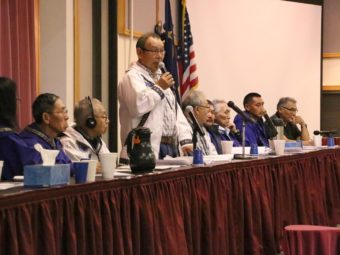
AVCP’s Myron Naneng addresses the panel at the Chinook Symposium in Anchorage. (KYUK file photo)

Then, in 2009, AVCP President Myron Naneng and the nonprofit’s senior chairperson formally requested the organization use up to “$500,000 each year in TANF funds to sustain” the corporation’s aircraft maintenance and flight school.

Former AVCP TANF director Jolene Geerhart, says the request was denied by a federal agent.

But, between 2010 and 2011 at least three checks totaling $250,000 each went from the AVCP TANF account to fund the flight school.

Minutes from a 2010 board meeting show that John Amik, the flight school’s director, asked the board for the funds. According to minutes, he said the money “would allow funding to be spent and not returned to the Federal Government. This falls in line with the Economic Development requirement under this grant.”

Email correspondence regarding Pat Samson’s salary.

In 2010, Larry Barnes, then-AVCP vice president of finance, wrote in an email that the “federal TANF agency has reimbursed AVCP for the funds, and that the monies will cover operational costs that student revenue won’t cover.”

But, federal directors repeatedly told AVCP administrators that TANF monies couldn’t be used to fund the school’s operating costs.

Screenshot of email transcript regarding appropriate uses of federal TANF money, sent from former Tribal TANF Region X Program Specialist Judy Ogliore to former AVCP Director Lynn Kassman, and later forwarded to Jolene Geerhart.

Geerhart was the AVCP TANF program director from 2010-2013. She says during her time at least two of these checks were signed.

“There were checks that [were] made out, but I didn’t authorize those monies,” Geerhart said.”

Geerhart says she started digging into previous years, and estimates the amount of TANF money used to fund the flight school is much higher than $750,000.

“What I found,” she said, “it was a little more than a million dollars while I was the director. It was $500,000 total two separate times.”

In mid-2011 AVCP grants compliance officer, Hansel Mathlaw, raised concerns about the use of TANF child support money. Larry Barnes, then-AVCP Vice President of Finance, addressed Mathlaw’s concerns, writing, “unspent child support funding was deemed unrestricted funding, because there were no reporting requirements tied to prior year funds.”

It’s unclear what AVCP used the funds for, but Geerhart says unused federal TANF funds rollover; they don’t just become a free-for-all. State TANF funds don’t rollover either, and if not used, have to be returned.

Geerhart says it’s hard to misuse federal TANF grant money–there is extensive training, and even annual conferences directors can attend.

“I’m pretty sure the past director and deputy director would’ve advised them [of] the correct use of TANF monies,” Geerhart said. “The TANF program has been with AVCP since 2000, or shortly before that.”

During that same month, Naneng awarded the TANF department the, ‘Department of the Year Award.’

As the director of AVCP’s TANF program Geerhart says she repeatedly raised concerns about the use of TANF monies to her superiors, Naneng and AVCP Vice President Mike Hoffman. In one particular meeting with Naneng, Geerheart says he dismissed her concerns.

“I really didn’t appreciate that kind of response, because my concerns, to me, were really important misuse of TANF monies,” she said.

On a different occasion, she says she was asked to resubmit the letter Naneng sent to TANF in 2009. When a federal TANF representative told her the funds couldn’t be used to cover flight school operating costs, she applied for funds to cover school tuition for TANF-eligible students.

Email transcripts show that this is allowed, but Geerhart says when she looked over the paperwork, the number of TANF eligible students in the program compared to the amount of TANF funds taken didn’t match up.

Geerhart was fired from AVCP in early 2013. She says her supervisor, Hoffman, told her it was due to insubordination.

“I continued to let my supervisor know these are inappropriate uses and it needs to stop,” Geerhart said, ” and I believe I was terminated because I didn’t stop and keep my mouth quiet and walk away and let it continue to happen.”

Later that year, the flight school, which had been open for about a decade, shut down due to what Naneng described as “diminished federal funding and high operational costs.”

A spokesman from the federal TANF departments says they are currently not investigating AVCP regarding the misuse of funds and did not respond to any further questions.

After more than a dozen interview requests, Naneng declined to comment and referred all questions to Hoffman. Hoffman declined to comment as well.

Now, less than a year after Naneng’s reelection as AVCP president, leaders of four Unit 4 village tribes-Akiak, Akiakchak, Kwethluk and Tuluksak, are calling for a special meeting ahead of the annual conference, an investigation into AVCP and for the organization’s top directors to be placed on administrative leave.

Mike Williams is the leader of the Yupiit Nation, and helped draft the resolution.

“They need more explanation rather than [saying it’s] because of economic conditions,” Williams said. He says tribes just want to see the region working together.

If there’s no response from AVCP by Jan. 15, the proposed resolution calls for Naneng’s resignation.

Williams says tribal leaders who filed the resolution are still waiting to hear back.

Arctic Native leaders: Paris climate agreement didn’t address indigenous rights

Reggie Joule says the plan to reduce global greenhouse gas emissions that emerged from the Paris climate talks last week didn’t include some very important provisions.

“We were definitely trying to get in the binding part of the agreement the recognition of the rights of indigenous people,” said Joule, mayor of Alaska’s Northwest Arctic Borough. He said it was disappointing that it didn’t make it in.

Joule sat in on the climate talks as an observer with the Inuit Circumpolar Conference, or ICC, which represents Native peoples of northern Alaska, Canada, Greenland and northeast Russia.

The ICC and Saami Council, which represents indigenous peoples of northern Scandinavia and Russia, were among many indigenous rights groups and thousands of other delegates whose main objective was a broad agreement to slow global climate change.

“The rights of indigenous peoples wasn’t one of the major issues of a lot of the countries,” he said.

That’s unfair because the Arctic is suffering rising temperatures and other climate change impacts much faster than the rest of the planet, says Jim Gamble, executive director of the Aleut International Association. The organization represents Natives in the Aleutian Islands and far eastern Russia.

“Any agreement that doesn’t take into account that people live in the Arctic and indigenous people are really on the front lines of this change — that’s a missed opportunity,” Gamble said.

Indigenous people didn’t cause climate change, says Evon Peter, a Gwich’in Athabaskan and University of Alaska-Fairbanks vice chancellor.

“Other observers say it’s ironic that the climate agreement gives indigenous peoples such a small voice,” Peter said, “and yet it assigns a huge role to the mainly wilderness areas in which they live, which would serve as ‘carbon sinks’ to absorb and offset emissions from developed and developing countries.”

Joule says he hopes indigenous peoples will be given greater accord in the next global climate change conference to be held three years from now.

Village police officer accused of raping teen previously celebrated at AFN convention

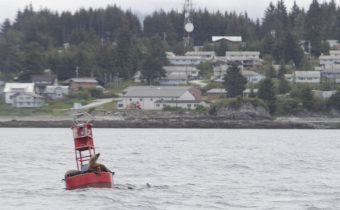
The community of Selawik, near the mouth of the Selawik River, is home to over 800 people. The site of the village, spread between riverbanks and an island, is also called Akuligaq, meaning "a river fork." (Photo by Steve Hillebrand/USFWS)
The community of Selawik, near the mouth of the Selawik River, is home to over 800 people. (Photo by Steve Hillebrand/USFWS)

A substitute village police officer from the dry village of Selawik is in jail in Nome awaiting trial. Brent Norton is charged with supplying alcohol to a minor and raping her while she was unconscious. The 16-year-old girl was found dead hours later.

One month earlier Norton received an award at AFN for his dedication to public safety. His case brings up important questions about how VPOs are vetted in villages throughout the state.

Norton was presented with a President’s Award at the Alaska Federation of Natives convention in Anchorage this October.

The Glen Godfrey Law Enforcement Award is given each year at the annual AFN convention to an Alaska Native law enforcement officer who has shown “outstanding dedication to the safety of the public in Alaska.”

Norton was recognized for his response to a shooting in Selawik this summer. He had less than six months of experience at the time but was first on the scene. While a victim died from gunshot wounds, Norton risked being shot at to retrieve the body.

One month later, 29-year-old Norton allegedly supplied a 16-year-old girl, Lois Cleveland, with alcohol and later raped her while she was unconscious.

According to an article published by the Arctic Sounder, the Selawik Clinic received a call from Norton just before 1 a.m. on Nov. 18. Norton described Cleveland as cold and not breathing. Emergency responders spent 20 minutes trying to resuscitate her before she was declared dead.

But Norton’s record was far from clean prior to this year.

In 2006, he was arrested and pleaded guilty for transporting alcohol to a dry village. He was arrested for the same charge again in 2012. Then in June of this year, he was arrested and pleaded guilty for giving alcohol to a 13-year-old girl.

So how did a man with a record for importing and supplying alcohol to minors get hired as a substitute VPO in the dry village of Selawik?

“According to Alaska statutes, only a village can hire a village police officer. They’re the only ones who can hire a VPO,” explains Chris Hatch, program coordinator for Village Public Safety Officers in the Northwest Arctic Borough.

To be clear, a VPSO is different in many ways from a VPO. A VPSO goes through extensive training and vetting compared to a VP, but there are some safeguards in place.

According to the statutes Hatch mentioned, a person with misdemeanor convictions in the last 10 years will be “judged on his or her moral character, at the council’s discretion.” A person convicted of a felony in the last 10 years is ineligible. The incident in February of this year, in which Norton supplied alcohol to a minor was a Class C Felony. But he was a substitute VPO and under less scrutiny.

“What happens in a lot of communities is they hire a VPO and then they’ll hire someone to fill in,” Hatch explains. “You have a guy who works 20-30 hours a week, but when he leaves for some reason they have someone to fill in for him. In this case, they’re calling him a substitute VPO.”

While VPOs must pass a background check, the hiring of substitutes is at the discretion of the village. The city of Selawik had no comment for this story. Neither did AFN regarding Norton’s award.

According to his introduction at this year’s AFN conference, Norton’s reputation outshone his record.

“Residents describe him as dedicated to helping and he is known for his courteousness and kindness. He is an example of responsibility, courage, and respect.”

Norton’s involvement in the death of Selawik teen Lois Cleveland will add another felony to his record if he’s convicted. He’s being held at the Anvil Mountain Correctional Center in Nome, with bail set at $50,000.

Correction: A previous version of this story said Norton was arrested in February; he was actually arrested in June. We regret the error.

Education reform bill keeps some elements of No Child Left Behind

The U.S. Senate passed an education reform bill Wednesday, which the president is expected to sign this week. Both Alaska senators voted for it, as did Representative Don Young in the House. Many lawmakers say they’re happy to dump No Child Left Behind, but the new education bill leaves in place major elements of the law, and that may not be a terrible thing.

Before No Child Left Behind, school districts didn’t really have to come clean about their failures. Bad schools were just swept under the rug, hidden among the averages. Sen. Lisa Murkowski is a big critic of the 2001 law, but she says the law’s mandated tests did produce important data on specific schools and populations.

Lisa Murkowski at AFN 2015
Sen. Lisa Murkowski addresses the Alaska Federation of Natives Convention, Oct. 16, 2015. (Photo by Mikko Wilson/KTOO)

“No Child Left Behind, for all of its warts, for all of its problems, what it did deliver to us was a level of accountability,” she said.

In her pre-Senate days, her own sons’ school, Government Hill Elementary in Anchorage, was labeled a failing school at first. Murkowski says it was devastating to the parents and the neighborhood. The problem, she says, is that too few students from a small subcategory showed up on test day. But Murkowski says the bigger Alaska picture was disturbing.

“It was pretty tough to take, to see that in many of our rural schools, to see that so many of our Alaska Native students were being left behind,” she said. “It caused us to look critically at how we were providing for that level of education. That was important.”

Trouble is, Murkowski says, after the law found the weak spots, it also dictated how to fix them, with mandates from Washington.

“Identifying the problem was key. It was critical. It was necessary. NCLB allowed us to do that,” she said. “But once you’ve identified the problem you can’t assume there’s a one-size-fits-all solution. “

What works in New York City or even Anchorage might not work in rural Alaska, she said. For instance, one common Washington mandate for a failing school is to fire the principal.

“Well, what happens if you’re a small school in a rural community?” she said. “Let’s just pick a community, like Kobuk. Might not be easy to get a principal out into the school there in Kobuk. And it might not be the principal that can fix it.”

Murkowski was on the House-Senate conference committee that wrote the final bill. Sen. Lamar Alexander, a Tennessee Republican, was one of the main authors. He said on the Senate floor he thought he wanted to get rid of a much-despised hallmark of No Child Left Behind: the federal test. Actually, 17 of them over a child’s education. In the end, Alexander concluded the problem wasn’t really the tests, but that No Child Left Behind put too much emphasis on them.

“The results of these tests count so much in the federally mandated accountability system that states and school districts are giving students dozens of additional tests to prepare for the federal test.”

The new law lets states and school districts decide how much weight to give the 17 tests. It has states setting their own standards and saying when and how to intervene if schools don’t meet them.

The legislation also includes a million-dollar annual grant program for Native language immersion schools, authored in part by Murkowski. And it has money for sexual abuse education in states like Alaska that have passed legislation known as Erin’s law.

Nunavik Inuit mourn the passing of Juneau mayor Greg Fisk

Recently deceased Juneau mayor Greg Fisk was a senior negotiator on the James Bay and Northern Quebec Agreement, an agreement analogous to the Alaska Native Claims Settlement Act. Makivik Corp. just released a documentary on the signing of the agreement, which featured interviews with Fisk. (File image courtesy of Nunatsiaq News)

Makivik Corp. is mourning the death of one of the negotiators of the James Bay and Northern Quebec Agreement.

Greg Fisk, an Alaskan consultant and politician, died at his home in Juneau, Alaska this week. He was 70 years old.

“I’m in shock,” said Senator Charlie Watt, who first met Fisk in the early 1970s.

“When I met Greg more than 40 years ago I saw a person who was motivated and not a submissive person,” Watt said. “He’s definitely in the history books of the Inuit of Nunavik.”

As president of Makivik’s predecessor, the Northern Quebec Inuit Association, Watt hired Fisk during a trip to Alaska to study the Alaska Native Claims Settlement Act in the early 1970s.

Fisk’s experience with the land claim as a consultant for Arctic fisheries made him a natural fit for the NQIA at the negotiating table.

Fisk’s death comes just weeks after the 40th anniversary of the signing of the JBNQA, and the release of Makivik-produced documentary on the land claim process.

Fisk actually flew to Montreal last summer to be interviewed in the film Napagunnaqullusi, which was recently premiered in Kuujjuaq and Montreal.

“Many of our youth are just learning about the trail blazers who negotiated our land claims agreement in 1975,” said Makivik president Jobie Tukkiapik in a Dec. 2 release.

“To hear one of the negotiators has died during this time is unexpected and we want his family in Alaska to know his legacy in Canada will live on.”

Fisk had only just been elected to serve as mayor of Juneau, when he was discovered dead in his home Nov. 30. His cause of death has yet to be determined.

Republished with permission from Nunatsiaq Online, a news service based in Iqaluit, Nunavut
Read Original Article – Published December 02, 2015 – 1:15 pm
Nunavik Inuit mourn the passing of a land claim negotiator

Site notifications
Update notification options
Subscribe to notifications