Alaska Native Government & Policy

State legal opinion on tribal protection orders ‘a step in the right direction’

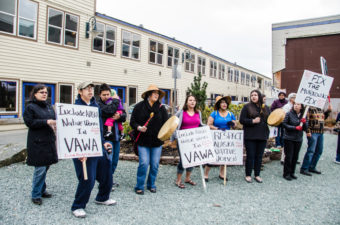
Ishmael Hope and a group of concerned people carried signs asking representatives to address issues with VAWA. (Photo by Heather Bryant/KTOO)
A group of concerned Juneau residents in 2013 protest the Alaska exemption in the Violence Against Women Act. Advocates have previously taken issue with the State of Alaska’s resistance to implementing VAWA. (Photo by Heather Bryant/KTOO)

Law enforcement must uphold tribal protection orders the same as state protective orders, whether the order has been registered with the state or not, the attorney general announced in an opinion Thursday. Attorney General Craig Richards also encouraged the legislature to amend state law to comply with the Violence Against Women Act.

Tlingit-Haida Central Council President Richard Peterson addresses the tribal assembly in March 2014. Peterson just announced the council has OK'd same-sex tribal marriages. (Courtesy THCC)
Tlingit-Haida Central Council President Richard Peterson addresses the tribal assembly in March 2014. Peterson just announced the council has OK’d same-sex tribal marriages. (Courtesy THCC)

“I’m very excited to see this,” says Richard Peterson, president of the Tlingit-Haida Central Council. “I think it’s a step in the right direction in rural, tribal justice. It’s going to really, I think, have great impact and effect on our tribal court system and will have a great impact on tribal courts.”

Peterson says Tlingit and Haida is looking forward to more positive action from the Walker administration on tribal issues such as putting land into trust and transboundary mining.

The attorney general says the Violence Against Women Act clearly supersedes Alaska’s conflicting law requiring registration of tribal court and so-called “foreign” protection orders. The opinion basically affirms VAWA’s provision that tribal court and out-of-state protective orders need not be registered with the state to be enforced — a provision with which the Parnell administration refused to comply.

Nick Gasca, a lawyer for the Tanana Chiefs Conference based in Fairbanks, says the opinion is an indication of the thawing relationship between the state and Alaska tribes.

“This again no doubt reflects his position that with applicable law — instead of fighting tribes at every case, despite the fact that the law says otherwise, at least in this case — that he’s moving forward to correct the department’s previous position and reconcile relationships with tribes,” Gasca says.

The provision in VAWA requiring states to honor protective orders issued by other states and tribes was included when the act was first passed in 1994. When Congress reauthorized the act in 2013, a disagreement between the state and the Department of Justice regarding the validity of unregistered protective orders intensified.

In a December 2013 letter to the Indian Law and Order Commission, then-Attorney General Michael Geraghty said that while tribal court protective orders must be registered with the state to be enforceable, Alaska State Troopers could — “without the formality of State court registration” — choose to enforce the order if “confronted with an emergency or tense situation.”

After a June 2014 meeting with Tony West — then an associate attorney general with the Department of Justice — Geraghty sent a follow-up letter listing things the federal government could do to “help address public safety issues affecting Alaska Natives” and Native youths. The letter requested more funding for tribal courts, prevention efforts and support for village public safety officers, among other things.

About a month later West responded to Geraghty’s letter. He acknowledged Geraghty’s suggestions, but focused on how Alaska’s law requiring registration of tribal protective orders directly contradicted federal law. West offered to discuss a way to bring Alaska into compliance and offered training on the provisions of VAWA.

Jacqueline Schafer, an assistant attorney general with the State of Alaska, says the opinion intentionally doesn’t address the sticky issue of tribal jurisdiction. The opinion also makes clear that officers can enforce tribal court directives that are clearly intended to be protective orders. Tribal court orders aren’t necessarily standardized.

“It’s really just saying that as long as the order is clear that the issuing court says that it had jurisdiction and that they provided due process and that the order meets the requirements of VAWA, then the officer will enforce that order on the ground. It doesn’t matter if the order was registered or not,” Schafer says.

She says there is no set protocol for a situation in which a victim claims to have a tribal protection order, but doesn’t have a copy of it on hand and hasn’t registered it with the state. Schafer says she could imagine the officer simply contacting the tribal court in that case to ensure that the order exists.

“That would be an easy resolution but it would be most protective (for) the victim to have the order registered with the state court, and that’s a fairly simple process, you just fax the order to the state court,” she says.

The opinion does mention that orders must meet the requirements of VAWA in order to be valid. One condition is that the order must provide the other party due process. The opinion also points out, however, that the U.S. Supreme Court has indicated a tribal court’s obligation to provide due process does not mean tribal courts must use the same procedures as state or federal courts. What constitutes due process could be a point of contention for someone who wants to challenge a protective order issued against them, but Schafer says this area of the law is also to be determined.

AFN Convention keynote speakers announced

The Alaska Federation of Natives on Wednesday announced the keynote speakers for the 2015 annual convention.

This year renowned Haida weaver Delores Churchill and her grandson Haida master carver Donald Varnell will then deliver the keynote address Oct. 15, the first day of the convention.

Both Churchill and Varnell hail from Ketchikan. Their works appear in collections around the world.

“AFN is pleased that Delores and Donald have accepted our invitation. Having two keynoters is a way for AFN to showcase the actual sharing of our cultural traditions between generations and they are an inspiration to the entire Native community,” AFN President Julie Kitka said in a statement.  “This year’s theme was chosen as a way to recognize and celebrate the many heroes living among us, the people working humbly to strengthen our communities.”

The AFN annual convention is one of the largest Native gatherings in the United States. The convention and the Alaska Native Customary Art Show are both open to the public.

The convention will be held October 15-17 at the Dena’ina Convention Center in Anchorage.

Subsistence Board vote makes Saxman rural again

Subsistence fish camp on the Koyukuk River. (Public Domain photo by U.S. Fish and Wildlife Service)

The Organized Village of Saxman is now officially rural again.

The Federal Subsistence Board voted during a work session Tuesday in Anchorage to return communities to the status they held before 2007. That’s the year the board decided to make Saxman non-rural, an action that Saxman residents and other Native leaders have fought against ever since.

Theo Matuskowitz works for the Office of Subsistence Management in Anchorage. He says the board took three actions Tuesday related to rural determination.

The first adopted a proposed rule that simplifies the rural determination review process. The third action starts the ball rolling on options for determining communities’ rural statuses in the future.

The middle action is the one that makes an immediate difference to Saxman.

“They decided to go back to the pre-2007 final rule because, basically, everyone seemed pretty happy with the non-rural determinations there. It was after the 2007 final rule that people expressed unhappiness with their action. So, by the board deciding to go back to the pre-2007 rule, this makes Saxman rural once again.”

Matuskowitz says there are still some administrative actions that need to be taken before the action is published, but Tuesday’s vote makes it official.

Rural status for an Alaska Native community allows residents to subsistence hunt, fish and gather traditional foods and other materials.

Forgiving without forgetting: A Tlingit village up in smoke

John Morris remembers the spot where his house once stood. (Photo by Elizabeth Jenkins/KTOO)

In 1962, the Douglas Indian Village was set ablaze to make way for a new harbor. This month marks 53 years since the city displaced households of Tlingit T’aaku Kwáan families. Little to no restitution has ever been offered.

The Douglas Indian Village was a winter spot for the T’aaku Kwáan people. Water flowed underneath a row of about 20 structures on pilings. There was a saying, “this was where the sun rays touched first.”

The village had no running water or electricity. But to John Morris it was home.

“That was the trail I used to walk to go to school right here. But my house was right where that truck is right now,” he says.

Where we’re standing has been filled with gravel. The water no longer comes up to this point. It’s been turned into Savikko Park, a place where children play Little League and families grill out hamburgers.

Morris remembers seeing his childhood home here going up in smoke.

“We left everything as is in the house with the thought that if they saw that we hadn’t moved anything out that they would maybe prolong the burning. It didn’t stop them.”

Fishing nets, clothing, dishes–everything.

“There are no pictures of my childhood. It was all burned up in that house,” he says.

Morris is a carver, teacher and tribal leader. At 75 years-old, he’s also one of the last living members of the tribe to witness the burning of the village in 1962. He remembers, back then, racial tensions were high. He delivered newspapers as a kid.

“And I had a paper sack that had Juneau Empire on it. And as long as I had that paper sack I could go anywhere in Douglas. Once I took that sack off people would tell me, ‘Get down to your village.’”

This photo shows the Douglas Indian Village and railroad to the Treadwell mines in 1900.
This photo shows the Douglas Indian Village and railroad to the Treadwell mines in 1900. (Courtesy Juneau-Douglas City Museum)

In 1946, the Douglas Indian Association was looking for boat loans. At the time, boats were kept under the house. But that wasn’t deemed suitable. So the city and the Army Corps of Engineers were asked to build a harbor where the village stood–with the understanding the village would be rebuilt.

That plan didn’t go anywhere.

“But the plan for the harbor stayed on the books and in 1962, the City of Douglas destroyed the Indian village to build that,” says attorney Andy Huff. He put together a formal report in 2002 on what happened for the Montana Indian Law Resource Center.

Back in the 60s, the City of Douglas found a loophole to condemn the Native village: Most of its occupants were gone to fish camps in summer.

“Even so, the city didn’t have jurisdiction over the houses in the first place. It was a federally protected enclave.”

Huff  says when he was doing his research, two more red flags stood out. One was the Bureau of Indian Affairs, the agency that’s supposed to help, did nothing to intervene.

“They just flatly refused to get involved even though there was this plan to kind of destroy the village,” Huff says.

The other red flag was a possible conspiracy.

“I found that two members on the city of Douglas zoning commission, which was the entity in charge of destroying this village, were also members of the Bureau of Indian Affairs at the same time. ”

They were Charles Jones and A.W. Bartlett. Both men resigned from the zoning and planning committee citing conflict of interest. But the plans to burn the village were already underway. Huff says that’s an obvious breach of trust. When he put the report together 13 years ago, he thought it would affect change but no restitution has been offered. He thinks, even after all this time, there’s still a legal case.

“I don’t think the federal government can argue it doesn’t know exactly what happened and what the issues are in light of the report coming out and being released by the tribes,” he says. “Something should have happened by now.”

The Bureau of Indian Affairs could not be reached for comment.

Morris says his uncle wasn't going to leave. He had to pull him out before the fire began. (Photo by Elizabeth Jenkins/KTOO)
Morris says his uncle wasn’t going to leave. He had to pull him out before the fire began. (Photo by Elizabeth Jenkins/KTOO)

After the controlled burn in 1962, the village was never rebuilt. The Douglas Harbor and eventually the park were constructed in its place. Morris, who was on military leave at the time, says he went back to Fort Hood, Texas, changed.

“I went back with a bitterness. A bitterness that I’m not going to have anything to come back to. I don’t have a home. The people I grew up with, I got to see firsthand, how they treated us people, us Natives,” Morris says.

It took years for him to come back to the Juneau-Douglas area but he did. He says sometimes friends tell him he should file a lawsuit; he could be a millionaire.

“My response is that’s not what I’m after. I do want to see that corrected but it will never leave me. It will never leave me. It lays dormant and I don’t like to touch it unless I have to,” he says.

Morris says he forgives but he doesn’t forget. He would like to see restitution for the T’aaku Kwáan people.

2015 Marks a summer of flexibility for Kuskokwim subsistence fishermen

Marie Andrew was busy this July at her Napaskiak fish camp. (Photo by Ben Matheson/KYUKl)

Subsistence fishing is open indefinitely on the Kuskokwim River. But that hasn’t been the norm this summer, as the river underwent two management regimes —state and federal—and strict closures for two species. Lower river fishermen are adjusting to the new reality of Kuskokwim subsistence, where conservative management is now the status quo.

On a sunny Saturday after a four-hour subsistence opener, Joe Green and his two children shuttle salmon up the steep banks at the Bethel small boat harbor from the skiff to the back of their pickup.

These openers are critical for Green as he fishes for four families.

“This year we’re shooting for anything. The feds and the government shock you. They screw up everything for you. So we get what we can,” said Green.

On top of his chums, he caught just shy of a dozen red salmon and says he’ll be freezing fish for the first time this summer. It’s a summer of flexibility on the Kuskokwim. Unprecedented king salmon restrictions were followed up by more closures to protect a weak chum run, which so far at the Bethel Test Fisheryranks among the lowest in recent history.

Alissa Joseph works on the fisheries staff for Bethel’s Tribe, Orutsararmiut Native Council , and is traveling the river to talk with fishermen in fishing camps throughout the Bethel area.

“We don’t go to fish camps to look at their racks, we go to get their information and how they did. We don’t need to know how many fish they got. We just want to know how subsistence is going, how it’s working for them, and how we can be of assistance as advocates for them,” said Joseph.

The information goes to state and federal managers and the Kuskokwim Working Group.

Joseph was checking in on subsistence fishermen like Nicholai Evan. At his Napaskiak fish camp, his whole family is cutting and preparing caught in the opening. He normally catches 100 kings every summer. So far this year, he’s only caught 10. How he plans to make up the deficit?

“Caribou, moose, seal, geese, swans. My part of life is subsistence, I hardly go to the store, once in a great while,” said Evan.

Nearby David Nicholai reports that his family also got significantly fewer kings than normal—but it’s enough for them to get by.

“Enough, good enough for fish, there are lots of fish out there. Lots of chums, lots of reds, some king salmon,” said Nicholai.

Besides being large, rich and historically abundant, king salmon are also prized for their immaculate timing. They’re first, when the weather is clear and dry. But this point in the season, it’s clear that things have changed.

Under the roof of Marie Andrew’s drying rack, the Napaskiak resident is busy putting chums and reds up to dry. The Kuskokwim red salmon fortunately this year came on strong, and relatively late. But this time of year, Andrew is starting to see flies.

“During that smoky time, when the wild fire smoke was around there wasn’t that much, but lately I’ve seen lots, like today when the sun was out,” said Andrew.

She says that she’s typically done by now in a normal king year. Near Bethel, Sugar Henderson is looking forward to silvers. She says her family took part in the limited community permit system at the start of the year and was allocated a dozen kings.

“I normally do strips with my kings and dryfish with my silvers. But knowing I’d only get 12 kings I did all dryfish. And then with our pressure cooker, we figured we would try strips with silvers. Kind of backward,” said Henderson.

After several rocky years of poor king returns and the stop and go restrictions, Henderson has had to adapt.

“We’ve learned to adjust to what we get. I’m not one yelling and screaming ‘we need our kings, we need our kings’! We do need our kings, but I understand the fact they need to replenish, so we’ve just adjusted ourselves, our lifestyle, to what we could get,” said Henderson.

And as long as Kuskokwim salmon runs and regulations defy prediction, summer fishing plans will remain a moving target.

Federal bill would change rural designation process for subsistence

Subsistence fish camp on the Koyukuk River. (Public Domain photo by U.S. Fish and Wildlife Service)
Subsistence fish camp on the Koyukuk River. (Public domain photo by U.S. Fish and Wildlife Service)

Saxman resident Lee Wallace testified Wednesday in Washington, D.C., during a hearing in front of the House Subcommittee on Indian, Insular and Alaska Native Affairs.

The subcommittee is chaired by Alaska Rep. Don Young, who has sponsored a bill that would change the Federal Subsistence Management Program’s process for designating a community’s rural status, which allows community members to harvest subsistence food.

Wallace heads up the Saxman IRA, and has been outspoken about reinstating the Organized Village of Saxman’s rural designation.

Saxman lost its designation during a 2007 Federal Subsistence Board review. The board decided that Saxman’s connection to the larger community of Ketchikan meant that Saxman can’t be considered rural.

Saxman has about 400 residents, compared to about 7,000 in the City of Ketchikan.

Wallace recalls coming home after the board’s vote to make Saxman non-rural.

“Upon arrival, the Cape Fox dancers and elders, they came and met the plane from Anchorage,” he said. “They knew I was sad and downhearted. They wanted to lift me up. They greeted me with a song and prayer for encouragement that we should continue on to fight our battle to regain our rural determination status.”

Since then, the Federal Subsistence Board has proposed a rule change that would allow more flexibility when determining rural designations, and has conducted public hearings on that rule. Numerous Southeast Alaska residents – including Wallace — commented during those hearings in support of Saxman’s claim to subsistence rights.

The Saxman Clan House. (Photo courtesy KRBD)

Wallace told the subcommittee that while a rule change would be a step in the right direction, Young’s proposed bill would provide more security.

“Saxman supports this legislation because it creates permanent and procedural protections for rural communities,” he said. “It eliminates the fear and anxiety caused by the unnecessary process in which the FSB essentially evaluates whether we can carry on our traditions and our way of life.”

Young’s bill would require congressional approval before a community’s rural designation could be removed in the future. Alaska Sen. Lisa Murkowski has sponsored a similar bill in the U.S. Senate.

Young said during Wednesday’s hearing that removing Saxman’s rural status didn’t make any sense.

“Saxman was a Native village long before Ketchikan was ever created. And then Ketchikan became a fishing town and a timber town and sort of grew up next to them,” Young said. “Then for some reason, someone had an issue that they weren’t rural anymore, because the city grew to them.”

Rep. Don Young’s bill has not yet passed out of subcommittee. If it does, its next stop would be the House Natural Resources Committee.

Site notifications
Update notification options
Subscribe to notifications