Alaska Native Government & Policy

East Coast theology school selling off Alaska Native art, feds to investigate

Chuck Smythe unrolls the tunic from storage. (Photo by Elizabeth Jenkins/KTOO)
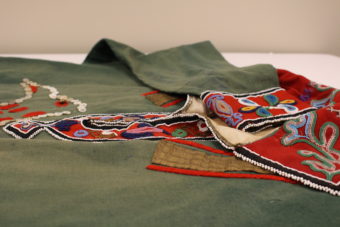
Chuck Smythe unrolls the tunic from storage. It’s kept this way to avoid damage. (Photo by Elizabeth Jenkins/KTOO)

The country’s oldest theological school is selling off its Native art collection, and Sealaska Heritage Institute is asking the feds to investigate. Tlingit and Haida pieces are among the works–some of which might be sacred.

At Sealaska Heritage Institute, culture and history director Chuck Smythe walks down a flight of cedar steps to the basement, the place where Native artifacts are kept.

Behind a locked door are some of the pieces in the collection.

“We’re going into the conservation room. You hear the freezer going,” he says.

Items that arrive at the institute are cooled to 40 below to kill insects before the pieces go into long-term storage in a temperature controlled room. Smythe shows me a Southeast Native tunic, probably from the 20th century.

“It’s a green tunic with red border and it has flowers and designs.”

It has delicate beading on the sleeves and collar, a raven on the front. But that’s all we know. The tunic was repatriated from a museum in 2007. Information about which tribe and clan it belongs didn’t follow it back home.

“It’s hard. A lot of museums have very generalized identification of objects,” he says. “I used to work at the Smithsonian in the repatriation office and they have hundreds of objects that are just ‘Northwest Coast.’”

SHI is looking for the tribe the tunic belong to. (Photo by Elizabeth Jenkins/KTOO)
Sealaska Heritage Institute is looking for the tribe this tunic belongs to. (Photo by Elizabeth Jenkins/KTOO)

Even harder to track are the Native artifacts that fall into private collectors’ hands. That’s what the Peabody Essex Museum in Massachusetts says could happen to 80 pieces in its care because the owner wants to sell.

The museum has housed the collection since the 1940s; The Andover Newton Theological School is the owner.

Dan Monroe, the museum’s director, says the school informed him a few months ago.

“The 80 works are works that they’ve selected that have the greatest monetary value,” he says.

The college says it’s not an art curator; it’s an educational institution.

Sealaska Heritage Institute is questioning whether the artifacts are sacred–pieces used in ceremony.  A federally supported entity, like a school or museum, is barred from selling those and obligated to return them to the tribes.

Items in storage at Sealaska Heritage Institute. (Photo by Elizabeth Jenkins/KTOO)
Items in storage at Sealaska Heritage Institute. The Andover Newton Theological School’s collection contains works from 52 tribes. (Photo by Elizabeth Jenkins/KTOO)

Rosita Worl, the president the institute, says the spirits of her ancestors are associated with those objects.

She notified the feds that some of the Tlingit and Haida pieces in the theological school’s collection could be subject to repatriation laws–particularly a halibut hook with a wolf crest and shamanic doll.

“We believe that everything has a spirit and that includes animate and inanimate objects,” she says.

Worl is Tlingit of the Eagle moiety and Thunderbird clan. She says she’s been trying to “get over the history” of how the theological school acquired these artifacts in the 19th century.

“We know they were well meaning in terms of trying to Christianize us, but we went through a lot of difficulties with that,” she says. “And I really want to respect all different religions but having the history of that overt suppression of our beliefs was difficult to take again.

The college is estimated to turn a million dollar profit. But Martin Copenhaver, the school’s president, says the pieces for sale are not sacred items. He believes the museum is engaging in an “ugly disinformation campaign.”

“I think the status quo works for them. They have the pieces. They’re able to display them for free. They did not pay for those,” he says. “I think it doesn’t work for them now if those pieces are in other museums.”

He says the school plans to sell to other museums, not private collectors.

“Unless those are ones who intend to then in turn donate them back,” says Copenhaver.

But museum president Dan Monroe says it typically doesn’t go that way.

“I would say it’s fair to summarize the frequency of that happening as highly infrequent,” says Monroe.

Appraisers have already been sent to assess the items but there’s no date for the sale yet. Worl says the willingness to sell the artifacts contradicts the school’s mission statement: “We will strive to be good stewards of the sacred tradition we have inherited.”

“My first wish is that they would say, ‘OK we recognize that Native people have these spiritual relationships to these objects.’ That they are significant,” Worl says. “I would hope that they would recognize that.”

Federal repatriation agents have opened an investigation.

Sen. Murkowski pushes change to ACA’s Alaska Native, American Indian exemption

Sen. Lisa Murkowski. Official photo.

The Affordable Care Act has special provisions for American Indians and Alaska Natives.

They’re exempt from the individual mandate requiring Americans to purchase health insurance, since they’re already entitled to health care through the Indian Health Service.

If they do sign up for health insurance, they pay lower out-of-pocket fees in some cases. But the law’s definition of who qualifies is narrow. A person has to be enrolled in a tribe or hold shares in an Alaska Native corporation.

Sen. Lisa Murkowski says a significant number of Alaska Natives who are eligible for IHS benefits don’t meet that definition, particularly if they were born after most Native corporations stopped enrolling members in the 1970s. Murkowski last week wrote a letter to Health Secretary Sylvia Burwell to protest the narrow definition.

At a hearing this spring, an administration official told her the definition is part of the law, so the change would have to come from Congress. Murkowski, though, says the administration has made dozens of changes that appear to contradict the statutory language of the Affordable Care Act, particularly to stretch deadlines. She asked for one more administrative change, to benefit Alaska Natives.


Federal spending bill fully funds tribal healthcare’s contract support costs

SEARHC serves from about 17,000 Alaska Natives and American Indians in Southeast Alaska. (Photo by Lisa Phu/KTOO)

A spending bill advancing in the U.S. Senate includes full funding for Alaska Native health care providers’ contract support costs, an area of Native health care that’s been underfunded even though the Supreme Court has repeatedly ruled in favor of tribes. Those costs include items like legal and accounting fees, insurance and workers’ compensation. Contract support costs were fully funded for the first time in 2014.

Sen. Lisa Murkowski chairs the appropriations subcommittee that wrote the bill. She says the spending plan fences off funding for contract support to prevent the government from taking from other programs, which has happened in the past.

“They basically dipped into existing Indian programs, shortchanging them. That’s not how to do it. You don’t rob Peter to pay Paul. What we’ve done is put in a separate appropriations account that will prevent this cycle that’s occurred at the IHS,” said Murkowski.

Contract support costs have been the subject of lawsuits and recently brought multimillion dollar settlements to tribal health care groups for overdue reimbursement. Murkowski says the new bill provides clarity.

“That’s significant. It’s significant in that the assurance going forward, full support for contract support costs, is going to be there and there’s not going to be a shortage in other accounts to pay for that full coverage,” said Murkowski.

The bill would also provide the first federal funds for tribal courts in so-called PL 280 states, which includes Alaska Native villages and states in which the state government has extensive criminal and civil jurisdiction in Indian Country. The bill has $10 million for tribal law enforcement and justice pilot projects.

“That will help insofar as how we deal with these perpetrators who seemingly time and time again inflict this level of violence and basically get away with it. Because we have not been able to collect evidence, prosecute and bring to some level of justice those offenders,” said Murkowski.

The Senate Appropriations Committee approved the bill earlier this month. It still must advance though the full Senate, which is in the midst of a larger budget gridlock.

Tlingit and Haida boycotts FedEx over Redskins support

Washington Redskins training camp. (Creative Commons photo by Keith Allison)

Central Council Tlingit Haida Indian Tribes of Alaska is boycotting FedEx.

The Juneau-based tribal organization announced Thursday that it has sent notice to all employees to stop using FedEx services, citing the national delivery company’s sponsorship of the Washington Redskins football team.

In a news release, Central Council says FedEx is a top sponsor of the football team, and economic pressure might encourage the delivery service to reconsider financial support of the Washington, D.C.-based team.

The issue is the team’s name. The word “redskins” dates back to colonial times, and refers to Native Americans. It is considered offensive by many with Native heritage.

Tlingit Haida Central Council President Richard Peterson says he understands that the team name has a long history.

“There’s debate even among Native Americans on whether it’s derogatory,” he said. “But I think most people feel like the name Redskins is derivative of racial slurs against Native Americans.”

According to the Central Council, other tribes and tribal groups also are boycotting FedEx, including the Native American Rights Fund and National Congress of American Indians.

Central Council Tlingit Haida is a federally recognized tribe with a membership of about 30,000, and Peterson says he hopes the membership will join tribal employees in the boycott.

“Who better to take a stand and to exercise our concerns and voice that through our spending?” he said. “Just saying, we’re not going to spend our dollars with folks that are going to be supportive of what we consider racism.”

Peterson stressed that this move isn’t an attack on FedEx or the Washington Redskins.

“We would just ask that they really take a look at what they’re doing,” he said. “If I’m doing anything that has a negative impact on people, I would certainly take a look at that and do some self-examination. I’d hope that the ownership of the Redskins would do that, and the corporate sponsors that endorse them would realize it’s time to take down our Confederate flag, so to speak.”

A message sent to FedEx public relations resulted in a written email statement. It says “FedEx has closely followed the dialogue and difference of opinion regarding the Washington Redskins team name, but we continue to direct questions about the name to the franchise owner.”

Ongoing gear restrictions, wildland fires lead to empty fishracks along the Yukon

 smokehouse and fish rack in Emmonak. (Photo courtesy of Alaska Department of Fish and Game)
smokehouse and fish rack in Emmonak. (Photo courtesy of Alaska Department of Fish and Game)

King and chum salmon are still slowly building a run up the Yukon this summer — and fishermen are contending with everything from gear restrictions to wildland fires in their efforts to fill their racks.

During the weekly teleconference with fishermen and managers from the state and federal level in U.S. and Canada — organized by the nonprofit Yukon River Drainage Fisheries Association — fisherman all along the river say Alaska’s intense fire season is definitely hampering their season, turning an afternoon boating on the river into a day choking in a smoke-filled oven.

Norma in Marshall said the local “firefighters are still out at the Card Street Fire (near the Kenai Peninsula community of Sterling), so a lot of our subsistence activities were lower than in previous weeks.”

Fred Huntington in Galena said “lots of forest fires” were likewise impacting fishing in his community.

While the fires may have hindered fishing, they haven’t stopped the fish. The first pulse of Chinook entered the river in early June, and is now as far upriver as Koyukuk, but overall the numbers remain low: roughly 13,000 fewer kings have passed the Pilot Station Sonar project near the river’s mouth when compared to this time last year.

It’s a different story for summer chums: they also began running just a week into June, and now two pulses have made it as far upriver as Holy Cross. Compared to last year, there are nearly 20,000 more chums in the water now.

Even with hundreds of thousands of chums swimming alongside thousands of Chinook, runs are still just average, and that means gear is still limited to dipnets, beach seines, and the occasional live-release fish wheel. An unfamiliar tool for many on the Yukon, dipnets have been for the most part ineffective—and many fishermen hoping to user smaller 4-inch mesh nets say they simply can’t get that gear in their communities. That’s turned what should be a busy summer along the river into a slow and frustrating season with little fishing.

Sven in St. Mary’s said, “reports are people haven’t been able to get most of their, or a lot of their, subsistence needs done.”

Martin in Pilot Station said “very little subsistence activity (is happening in the community). Most racks along the riverfront have a few salmon hanging; we should be usually hanging and drying salmon in Pilot.”

Ken Chase in Anvik said, “subsistence fishing for salmon right now is just about nil, there’s no one out fishing.”

Bill Alstrom in St. Mary’s added that the “dipnet fishing, for subsistence … it just ain’t workin’ out.”

While subsistence has been slow, commercial chum fishing was open in the lower river with dipnets and beach seine gear. As of Sunday, commercial fishermen harvested almost 62,000 chums and released over 3,000 Chinooks.

Sven in St. Mary’s told Fisheries Managers the gear limits—and overlap with commercial fishing—should be reason enough to allow for a ‘round-the-clock opening for subsistence.

“Since we are doing subsistence and commercial at the same time, what are the chances having subsistence going 24/7?” he asked. “With the little amount of fish in the river, and people still have to meet their subsistence needs, I imagine it should give them more chance for subsistence opportunities, for these fishermen here, just to give folks a chance to have their subsistence needs taken care of.”

Alaska Department of Fish and Game managers said that’s not likely, as they already hold subsistence-only openings in the mornings prior to the subsistence and commercial openings in the afternoon and evening. They said openings might happen for subsistence-only fishing in the lower river, but for now, limited chum salmon openings continue.

But what does the goal of protecting kings really mean for people living along the river?

For Janet in Rampart, the spiritual connection to the Chinook is what’s being lost with the king closures, and it’s something she fears will be lost to new generations if they can’t harvest the sacred fish.

“We’ve been doing due diligence of trying to preserve the king salmon,” she began. “And we keep saying ‘for our grandchildren,’ but when you think about it, our grandchildren are not even getting … or we’re depriving them of eating king salmon … of the taste of such a wonderful food … then how are they even going to know?”

If the tight conservation on kings continues, Schmidt said they’d be on track to meet escapement goals for Chinook this year. That could mean very limited openings for incidental take of kings. That’ll help fishermen meet subsistence needs without a significant impact to the Chinook population, Schmidt said, but she emphasized no final decisions have been made.

Gov. Walker’s new adviser to focus on rural economy, local governments

Gov. Bill Walker has named Gerad Godfrey as his senior advisor on rural business and intergovernmental affairs. (Photo courtesy Native American Contractors Association)

Gov. Bill Walker named his new rural affairs adviser Tuesday at the Alaska Federation of Natives winter retreat in Kotzebue. Gerad Godfrey’s full title is “Senior Advisor on Rural Business and Intergovernmental Affairs” — a title that Godfrey says is meant to communicate that much of his work will focus on economic development in villages and bringing tribes to the table when the state consults local governments.

Godfrey is an enrolled member of the Native Village of Port Lions tribe and has worked as a director of corporate affairs for Kodiak-based Afognak Native Corporation. He also serves as chair of Alaska’s Violent Crimes Compensation Board and on the Native American Contractors Association board of directors. Godfrey says he excited to be part of a change in how the State of Alaska, tribes and corporations interact.

“I’d say one of the first things I was intrigued by is the opportunity to be involved in a reset between tribal interests and Alaska Native interests and the State of Alaska and the government. That obviously is something that animates me, and I think animates a lot of people, if there’s potential to create a more fruitful relationship and a relationship that reciprocally beneficial to both the state and the Alaska Native community and tribes,” Godfrey says.

Willie Hensley, a former state representative and senator who’s been active in the Alaska Federation of Natives since its inception, says he is pleased with the governor’s choice. Hensley says Godfrey needs to focus on maintaining services and jobs in rural Alaska and working with coastal villages impacted by climate change. Godfrey is coming into the role at an important but difficult time, Hensley says.

“I think it’s wonderful that he’s willing to take on the challenge, because it’s not going to be easy,” Hensley says. “Things have been hard in Alaska, it’s just the way of life up here, but we’ve had 35 good years in which people have enjoyed a much improved life, many conveniences, many services, programs, facilities that could hardly even be dreamed of in my youth. Now, of course, all of that’s under jeopardy because of the nature of our economy and our dependence on oil, so he’s going to have his hands full.”

Godfrey’s access to the governor will be limited for now as the legislature is in session and lawmakers are tackling a major budget deficit. Meanwhile, he says, Lt. Gov. Byron Mallott is very accessible.

“The lieutenant governor, who is an extraordinary authority and resource on Alaska Native issues, will be highly, highly available in the absence of the availability of the governor. So, there will be more access without a doubt and nobody has the governor’s ear any more than the lieutenant governor does as an Alaska Native leader for decades himself,” Godfrey says. “One way or another there will be a good deal of access to the administration between the governor and the lieutenant governor.”

Godfrey will be based in Anchorage and is spending his first month on the job taking meetings and making contacts. He says he may convene a summit of Alaska Native stakeholders in the near future.

Site notifications
Update notification options
Subscribe to notifications