Alaska Native Government & Policy

Qayassiq’s walrus hunt, once banned, now carries traditions of sharing and management to the next generation

A group of walruses on a flat rock at Qayassiq. June 2022. (KDLG photo)

Thirty miles off the coast of the village of Togiak in Southwest Alaska sits Round Island, known in Yugtun as Qayassiq. Surrounded by the Bering Sea, the island’s steep, grassy slopes are covered in shrubs, lichen, and wildflowers, ending in rocky beaches. Seabirds like kittiwakes, murres and cormorants nest here in the spring and summer. During that time, the island becomes home to thousands of massive white-tusked Pacific walruses, which swim to its beaches to rest after the breeding season.

Frank Woods, who is Yup’ik, first hunted walrus at Qayassiq in 1997, though his family has harvested walrus there for generations. “It was an El Niño year, it was really warm in October. Beautiful weather,” recalled Woods, who lives in Dillingham and now works at the Bristol Bay Native Association.

Qayassiq had “the most concentrated herds of walrus in the Bay, and that’s where they traditionally hunted,” Woods said. During that season, 15 walruses were harvested, and the hunts didn’t seriously disrupt the haulout.

Native people in Bristol Bay have harvested walrus at Qayassiq for thousands of years for food, clothing, tools and artwork. But they weren’t always able to hunt there. For decades, starting in the 1960s, the state banned hunting at the island as part of its efforts to preserve walrus habitat. It did so without consulting the tribes, even though state policy cut off their access to traditional hunting grounds. As a result, tribal leaders had to fight for years to regain access to the hunt and in doing so, created a model for communities to act as equal management partners that still exists today.

Woods’ 1997 hunt came soon after the ban was lifted. It was one of the first in more than 30 years. He wanted to go because of his family.

“My family still loves walrus,” he said. “And it was like a spiritual experience to actually have that – being able to take an animal, harvest it efficiently, and then dish it out to the community when you get back.”

Walruses rest on one of Qayassiq’s beaches. June 2022. (Izzy Ross/KDLG)

A sanctuary for walrus

Over the past two centuries, Alaska Native walrus hunting traditions like those in Woods’ family have faced acute threats. In the 1800s, commercial hunting – especially by non-Native whalers – decimated the species, and as a result the federal government banned commercial hunting in 1941. After Alaska became a state in 1959, it also took extreme measures to conserve walrus habitat – without differentiating between who was responsible for the plummeting populations.

In 1960, the Alaska legislature created the Walrus Islands State Game Sanctuary in Bristol Bay and took over management of seven islands in the area. The state banned all hunting at Qayassiq, one of the main walrus haulouts in North America.

During this process, however, the state didn’t hold hearings in Togiak or any other Bristol Bay village before making the decision. This was consistent with the state’s approach to conservation at the time, according to State Lands and Refuges Manager Adam Dubour, who stepped into the role in 2022.

“I think opinions and attitudes and practices in the 1960s were a lot different than they are now,” he said. “I wouldn’t be surprised if there wasn’t any formal consultation with those groups.”

Peter Lockuk Sr, who serves on the Togiak Traditional Council, recalls how the sanctuary was created with no communication between the state and the tribe.

“The community of Togiak never knew Qayassiq Island became a sanctuary. People never knew of it, and some folks got arrested,” he said. “They got in trouble for it, to go down and get walrus.”

The closure lasted for over 30 years.

Read more: The Round Island Walrus Hunt: Reviving a Cultural Tradition

A community effort

Walrus hunting revolves around the community — providing food, but also teaching new hunters how to harvest safely and efficiently. Hunts are grounded in cakarpeknaki, or “with respect and without waste.”

Lockuk said if crews haven’t hunted for a time, the excitement to go out can be palpable.

“You could notice when people are getting restless: ‘When, when, when is that walrus hunt going to be happening?’” Lockuk said.

People used to travel in skin-covered kayaks to hunt walrus at Qayassiq, which means “a place to kayak” in Yugtun.

Now, 18-foot skiffs are common, and depending on where they are, some hunters even use 32-foot power boats to get the walrus back to town. Anywhere from five to 20 people can make up a hunting crew, and they need to decide ahead of time who will shoot, who will drive the boat, and how exactly to wrangle the carcass of a two-ton walrus.

“You got to have everything planned, because to us, it’s a big thing. And it’s only seasonally,” said Mickey Sharp, a Twin Hills hunt captain and a commissioner on the Qayassiq Walrus Commission. (Sharp hunts at another island in the sanctuary and hasn’t been hunting at Qayassiq yet, though he hopes to go one day.)

It takes about two hours to get to Qayassiq from Togiak, riding out into the Bering Sea across open water, which means calm conditions are best.

Daryll Thompson, who has participated in Togiak’s community hunts on and off for years, said it’s better to show newer hunters how to hunt on beaches. It’s easier, and they can choose which animals to kill and butcher quickly.

“It’s a little bit more adventurous when they’re all in the water,” he said. “You got to take your boat and get up and get the good shot, and then you got to harpoon them. With a harpoon, you keep them from sinking, and you can retrieve the animal.”

Hauling a walrus onto a boat can be like “dead weight lifting,” Sharp said. It’s also important for the crew to start gutting the walrus immediately. Otherwise the meat can spoil. Working nonstop, several crew members can butcher a walrus in a few hours.

“It’s just really a lot of work,” Sharp said. “Holy, yeah. It makes butchering a moose like a piece of cake.”

After a successful hunt, the crew will bring the meat back to the village, where it can feed people all year. “We help each other and cut it up into smaller pieces. So we could distribute first of all to the elders, and to the folks that can no longer hunt,” said Lockuk.

Mickey Sharp’s son, Ivan, quartering walrus meat to give away in Twin Hills. (Photo courtesy of Mickey Sharp)

Fighting for the hunt

In the decades following the 1960 hunting closure at Qayassiq, the Togiak Traditional Council and other tribes in the region went through the state’s regulatory system and federal courts to regain access to walrus hunting.

The state limited walrus hunting in western Bristol Bay until 1972, when the federal Marine Mammal Protection Act passed. That act acknowledged Alaska Natives’ right to hunt walrus and other marine mammals as long as the populations were healthy.

But the state regained management authority of Pacific walruses several years later, and again limited hunting outside the sanctuary in western Bristol Bay. The people of Togiak sued, challenging the state’s authority to do so. They won in 1979, when the court ruled that the federal law means Alaska Native people must be allowed to hunt. Because the state held that its constitution couldn’t include such exemptions, walrus management in Alaska returned to the federal government.

Peter Lockuk Sr. stands outside the Togiak Traditional Council office in Nov. 2022 (Izzy Ross/KDLG)

Still, because Qayassiq was in the state game sanctuary, the state was able to keep it closed to hunting.

In 1991, Togiak’s elders petitioned the state Board of Game for a limited hunt on Qayassiq. They had to petition three times to get the hunt authorized. Larry Van Daele, who worked as the regional wildlife biologist in Bristol Bay at the time, said some of his superiors told him not to work with people there. But he thought there was room to compromise.

Recalling the state’s hardline approach, Van Daele said his supervisors would say “they’re going to tell you that they have to be able to hunt on Round Island, because that’s their traditional area. Say no, you can’t have that. Hunt anywhere else you want, but don’t come to Round Island, because that’s illegal to go there.’”

After one rejection of a proposal to establish a subsistence hunt on the island from the state Board of Game, two Togiak residents – Marie and Adam Arnariak – went out to the island and shot a walrus in civil disobedience. That became known as the Arnariak Case, which challenged the state’s authority to regulate walrus hunting at the sanctuary. The case — and the potential of an unauthorized hunt at the island — further pressured government agencies to negotiate with hunters.

Finally, in 1995, tribal leaders from Togiak and other villages successfully advocated for the state to reopen a subsistence hunt. Now, Alaska Native commissioners on the Qayassiq Walrus Commission manage a fall hunt every year on equal footing with state and federal agencies.

“Co-management meant you had equal say in what was going on,” Van Daele said. “That’s what walrus on Round Island ended up being, was a true co-management program.”

A work in progress

At last May’s Qayassiq Walrus Commission meeting at the Bristol Bay Native Association in Dillingham, commissioners gathered around a conference room table near a large screen that displayed the names of the co-management partners. At the far end of the room was a Ziplock bag of herring eggs on kelp that someone had brought from Togiak. A hunter had supplied fresh beluga muktuk, and there was also soy sauce, crackers and salmon dip.

The commission was working to change the hunt dates so that hunters could go out to Qayassiq earlier in September – an effort to avoid some of the stormy fall weather. Members were also re-upping a resolution to restrict the trawl fishery near Togiak to address long-standing concerns about the fleet’s impact on clambeds that walrus feed on.

Understanding how to be part of decision-making within co-management is vital, said the Dillingham hunter Frank Woods, who sat in on the May meeting.

“This type of activity is just as important as the subsistence activities outside the room,” he said in an interview after the meeting.

The Eskimo Walrus Commission is another Alaska Native organization pursuing that work. It was part of the task force that examined the potential of renewing a hunt at Qayassiq in the 1990s and eventually signed the co-management agreement when resurrecting the hunt.

Randy Alvarez speaks during a Bristol Bay Marine Mammal Council meeting, as Moses Toyukak and David Williams, right, listen. May 2023. (Izzy Ross/KDLG)

As communities adapt to the changing climate, the need for Alaska Native organizations to have sufficient support and funding is greater than ever. Sea ice is melting, meaning that female walruses must travel further in order to calve on ice floes. Along with a shrinking habitat, less sea ice means more shipping traffic.

“The issues that we’re facing are becoming bigger and more broad, because we’re also experiencing climate change effects on our communities and the environment,” said Vera Metcalf, the executive director of the Eskimo Walrus Commission. She had just returned to Nome after a June trip to Washington, D.C. to talk with the congressional delegation about funding for co-management agencies.

Read more: 2019 Marine Mammal Commission co-management report

Renee Roque, subsistence outreach specialist for the Bristol Bay Native Association, coordinates the Qayassiq Walrus Commission meeting in May 2023. (Izzy Ross/KDLG)

The ability to meaningfully participate in co-management – traveling to meetings, giving public comments, and conducting research – is closely tied to capacity as well. For instance, Metcalf has sometimes been the commission’s only full-time staff member. She said the responsibilities of co-management must be shared equally by partners in order to best serve Alaska Native communities and the species they rely on.

“We’re facing harmful algal blooms, shipping disturbances and all these things that are affecting us, and we want to ensure that the walrus population and other marine mammal resources are healthy,” she said. “If the environment is healthy, so will our communities remain healthy.”

A hunter looking toward a group of walruses on Hagemeister Island, off the coast of Togiak. (Photo courtesy of Mickey Sharp)

Looking ahead

At 27 years old, David Williams of Ekwok is the youngest member of the Qayassiq Walrus Commission. At the May meeting, he and other members talked about organizing a joint hunt between Bristol Bay communities and involving more young hunters.

“If we could get 20 hunters within the region as one joint hunt, and get 20 walrus for all of our communities, I think that would definitely help everybody here, especially the elderly,” Williams said. “Personally, I would love to get my very first walrus and provide my community with my very first walrus.”

Another key part of sustaining co-management is teaching and involving young people. Last October the Eskimo Walrus Commission held the Young Hunters Walrus Summit, the first of its kind.

Metcalf, the executive director, said the idea for the hunters summit came after she heard about a young fishermen’s summit at the Alaska SeaGrant Advisory meeting.

Along with a focus on laws around co-management, Metcalf said, she also wanted the discussions at the summit to help prepare the young hunters to respond to environmental changes and meaningfully engage in management.

The fundamental purpose of the walrus commission, Metcalf said, is to protect their right to harvest walrus for food and ivory for artwork. She said there are extensive traditional practices around harvesting and sharing the harvest, and doing those things helps to strengthen communities’ traditional values.

“One of our goals is local self-regulation of walrus harvest management,” Metcalf said last year. “Helping to ensure our Indigenous food sovereignty and security is there for us for many years, well into the future.”

Three walruses in the water around Qayassiq. June 2022. (Izzy Ross/KDLG)

This story was made possible through a field reporting grant from the Institute for Journalism and Natural Resources.

Kake breaks ground on Alaska’s first modern clam garden

Kake’s northern shore, close to where volunteers laid the foundation of the community clam garden. (Shelby Herbert/KFSK)

The Organized Village of Kake laid the foundation for Alaska’s first modern clam garden in early August. The community hopes the project will preserve an important food source and keep traditional knowledge alive.

A group of eight Kake community members got up at the crack of dawn to beat the tide. They needed to pile a line of stones 60 feet long on the village’s shoreline. They’ll slowly add to it over the course of the summer until it’s about two feet high. That wall, they hope, will eventually house thousands of clams and cockles.

Aiden Clark is a junior at Kake High School, and a member of the Alaska Youth Steward Program. He was all in to spend a morning out of his summer vacation hauling around big rocks for the clam garden.

“It’s a lot of rock to move, but it’ll do good for the community,” said Clark. “The clam population is starting to go down a lot…”

Clark is right — the clam population is starting to go down — by a lot. The EPA projects that shellfish harvests across the U.S. could fall by nearly a half by the end of the century. The administration said human-caused climate change is the culprit: warming waters are inviting predators into bivalve habitat, and that ocean acidification is dissolving their delicate shells.

Simon Friday is the natural resources coordinator for the Organized Village of Kake, the village’s tribal government. Friday said the garden will help make local shellfish more resilient to climate change in three ways. The first: by helping them weather the storms that tend to tear up the coastline.

“So, shellfish gardens provide protection to the beach from erosion due to storms,” said Friday. “That’s something that’s likely to occur [more frequently] with climate change.”

The second reason: clam gardens increase the number of shell fragments in the area, boosting the minerals baby clams need to create their shells.

“We’re hoping that will help out with the ocean acidification, due to the calcium in the shells,” said Friday.

And the third reason: the rock fortress could help trap food for the clams.

“The gardens change the drainage of the beach, which allows more phytoplankton to be readily available,” said Friday. “So they have more food to eat, which allows them to grow faster and stronger and bigger — and all that good stuff.”

However, Friday said Kake’s clam garden isn’t just for the benefit of local marine life. During the COVID-19 pandemic, shipments of food weren’t coming in on time, and the shelves of the village’s only grocery store were laid bare. Now that things have settled down, Kake is preparing for the next crisis.

“We also realized that with climate change that we needed some sort of localized protective measures, to ensure that we continue to have the foods that we enjoy,” said Friday. “One of those being: clams.”

They’re also hoping it’ll help fix the limited and expensive food options available to them right now. Eloise Peabbles manages the Alaska Youth Steward Program in Kake, and she’s helping rally youth volunteers to move boulders for the garden. Supporting local food security is a huge priority for her.

“[And that’s] particularly because of the fact that we are already limited in our food — by having a small grocery store, and then having those prices be extremely expensive,” said Peabbles. “In order to have a healthy diet, we need to rely on the land and water around us.”

For thousands of years, many Indigenous communities up and down the Pacific Coast gardened shellfish. Over time, their practices not only increased shellfish production, but also expanded their habitat and improved species diversity according to a study of ancient clam gardens from Simon Fraser University.

The Swinomish Indian Tribal Community of Washington State built the very first modern clam garden in the United States last year. Friday visited it a few times to learn from the garden-builders and help with some construction tasks. Now, he’s thrilled to see his community invested in building a shellfish garden of their own.

“You’re literally just moving heavy rocks,” said Friday. “You need as many hands on deck as possible. So when it comes to constructing these gardens, it’s a community event. It just requires a lot of work — and a lot, a lot of people to move rock.”

With the foundation laid out, the last thing left for them to do is stack it all the way up to two feet. Friday said the main point of the exercise is education. So the bivalves that do take up root in the garden are just a bonus.

Alaska delegation re-introduces “landless” legislation to include Southeast communities in federal claims law

The mouth of the Stikine River, near Wrangell, one of the five ‘landless’ communities. (Sage Smiley/KSTK)

Alaska’s Congressional delegation has re-introduced legislation that would make the five so-called “landless” communities of Southeast landless no more. The communities have long argued being left out of the Alaska Native Claims Settlement Act is an injustice, but inclusion has remained elusive.

It’s been more than half a century since Congress passed ANCSA. It put millions of acres of land in the control of more than 200 newly formed local and regional Alaska Native corporations, while extinguishing aboriginal land title in the rest of the state. But five Southeast Alaska Native communities were left out of the deal.

“We were literally involved from the very, very beginning, going back to the very first part of land claims,” says Tashee Richard Rinehart. He is Lingít – Kiks.ádi from Wrangell, which is one of the five communities excluded from ANCSA.

“To be left out was a surprise to us,” Rinehart says.

Alaska’s Congressional delegation has been trying to change that by submitting and re-submitting bills over the past two decades. The bills are aimed at amending the 1971 legislation to include Wrangell, Petersburg, Ketchikan, Haines and Tenakee Springs.

“We see this as correcting an oversight from Congress that resulted in unfulfilled promises to the landless communities of Southeast,” says Sam Erickson, press secretary for Rep. Mary Peltola (D-AK), Alaska’s sole representative in Congress. “It’s been a priority of the Congressional delegation for decades, and we’re carrying on the legacy of Don Young and others who’re struggling to fix this injustice.”

Peltola filed a bill in the U.S. House of Representatives in late July. It’s a bipartisan bill, co-sponsored by Rep. Pete Stauber (R-MN). It is functionally the same as many others proposed in the past by Alaska legislators.

“ANCSA was intended to address Alaska Native land claims by conveying land that can be used for economic, social and cultural well-being,” Erickson says. “Because they’re left out, these communities (Wrangell, Petersburg, Ketchikan, Haines and Tenakee) never got the opportunities for economic development and cultural preservation that the other communities did.”

Erickson continues: “We think that this is a matter of fairness and of the federal government keeping the promises that it makes to Alaskans. Providing these lands is an important step to empowering these communities.”

It’s a matter of longstanding discussion why the five communities were excluded from the initial 1971 law. A report by University of Alaska’s Institute of Social and Economic Research in the mid-1990s found no clear reason why the communities were excluded, other than Congressional intent.

At a Congressional hearing in 2015, the late Rep. Don Young speculated it was because of the thriving logging in and around the five communities at the time of the law’s passage in the early 1970s. At the time, Young said timber groups lobbied hard against the communities’ inclusion, fearing it would impact future logging claims.

“It is so impactful for the five communities that were left out,” says Aaltséen Esther Reese, the tribal administrator for the Wrangell Cooperative Association, Wrangell’s federally-recognized tribal government. “This was our land since time immemorial. And it is recognizing that and giving our tribal citizens, some of our land back that we had stewarded for tens of thousands of years. On a philosophical level, I think that’s very important.”

Not only does Wrangell’s exclusion from ANCSA keep it from receiving a township of land – just over 23,000 acres, spread out over the vicinity of the community – it also means community members have been barred from forming a local corporation, although many members of the local community are shareholders in the regional Native corporation, Sealaska.

Alaska Native corporations are a huge chunk of the state’s economy, and the largest type of private employer in the state.

“What could it do [for Wrangell]?” asks Rinehart. “I think the sky’s the limit.”

Rinehart explains it’s unlikely a Wrangell Native corporation would go down the logging route of many original ANCSA corporations. He says village corporations are now looking at carbon credits, contracting jobs, and other economic endeavors.

“It’s been a long, long time, it’s way overdue,” Rinehart says. “It’s over 50 years past due. And it’s just a matter of justice at this point, really. It’s the right thing to do to fix a past wrong.”

He adds: “I believe that each and every community will benefit. And when I say that, I don’t mean just the Native community. Of course, the Native community would benefit but the entire community of Wrangell would benefit and Ketchikan, Petersburg, Haines and Tenakee. They would all benefit – non-Natives as well as the Native shareholders.”

The people who would be shareholders in a Wrangell Native corporation wouldn’t be exactly the same as the WCA tribal citizenship in town. Reese explains it would be an entirely separate entity with its own board of directors and management: “So it isn’t necessarily related to the tribe as far as our membership rolls,” she says, “But WCA is very supportive of all the efforts to get Wrangell, and the other four communities their land.”

Reese agrees with Rinehart: a local corporation could be a significant boon for the community.

“You’re talking about economic development, more opportunities for jobs in the community, being able to bring some of our people home, so that they can help in significant positions with the corporation, whatever the board decides,” she says.

If an ANCSA amendment to add the communities passed Congress, shareholder enrollment for the five communities would be the same as the original enrollment under ANCSA. It would allow shareholders and their descendants of the regional Native corporation Sealaska to receive a mirrored number of shares in a newly formed community-based corporation.

Members of the five communities have banded together to advocate as “Alaska Natives Without Land,” a campaign backed by Sealaska, and the “Southeast Alaska Landless Corporation,” a nonprofit also focused on organizing the five communities.

The years-long effort to include the five communities under ANCSA has faced pushback. Last year, Petersburg’s borough government narrowly approved a letter to Congress opposing a previous version of the bill after years of divided town discussions.

Some have concerns about specific sites included in proposed maps of the parcels that would be transferred to the landless communities. A few proposed tracts of land have come under criticism for falling outside areas where the landless tribes have direct historic ties.

Landless legislation has also, in the past, faced opposition from some environmental groups, because of potential development at the sites. Still others are concerned about the potential for restricted public access.

Senator Lisa Murkowski (R-AK) acknowledged the difficulty of establishing land plots and negotiating potential use and access conflicts during an interview with KSTK last fall (September 11, 2022).

“It’s hard,” Murkowski said, “Because every acre in the Tongass is already committed or loved in some way.”

But, she said that she still believes Congress should honor the obligation of ANCSA. She re-introduced a bill in the Senate in June that would include the five landless communities.

“What we’re trying to do is to resolve a long-standing inequity,” Murkowski said, “And do so in a manner that brings about consensus rather than conflict.”

Reese, Wrangell’s tribal administrator, says the years-long campaign to include Wrangell and the other landless communities speaks to how important it is.

“I think it is indicative of how passionate our people are, to be able to receive that recognition and to be able to receive that land and to be able to receive those rights,” Reese says. “My hat is off to those who just continue to work tirelessly, because this has been going on, […] for quite some time. So a recognition of Richard Rinehart, of all of those who are passionately working on this, because it’s not easy to keep going.”

Alaska’s delegation has introduced a handful of other bills aimed at amending ANCSA this term as well – in all, the law has been amended over 100 times.

Alaska asks judge to determine whether federal officials can create Indian country in the state

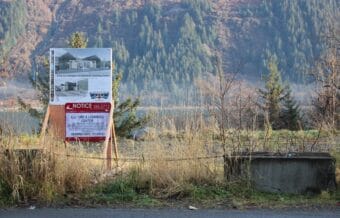
Jurisdiction over this small plot of land, seen Jan. 20, 2023, is being disputed between the state of Alaska, the federal government and the Central Council of the Tlingit and Haida Indian Tribes of Alaska. (James Brooks/Alaska Beacon)

The state of Alaska has formally asked a federal judge to decide whether the Bureau of Indian Affairs may create the equivalent of reservations in Alaska on behalf of Alaska Native tribes.

On Tuesday, the state of Alaska filed for summary judgment in an ongoing lawsuit against the federal government and the Central Council of the Tlingit and Haida Indian Tribes of Alaska.

Under a briefing schedule published earlier this year, the state, Tlingit and Haida, and the federal government will trade written arguments through Jan. 10, whereupon the case will be considered by U.S. District Court Judge Sharon Gleason.

At issue is a 787-square-foot parcel of land in downtown Juneau that the Bureau of Indian Affairs took into federal trust on behalf of Tlingit and Haida earlier this year.

On trust parcels, tribal governments — rather than the state — generally have legal jurisdiction over what’s known in federal law as “Indian country.”

“Whether (the Department of the Interior) has the authority to shift the balance of territorial jurisdiction in Alaska by creating Indian country presents a significant political question,” state attorneys wrote.

The state is arguing that the 1971 Alaska Native Claims Settlement Act prohibits the federal government from creating new trust land in Alaska. That act awarded land to Alaska Native corporations, not tribes, extinguishing Indian country in the state with the exception of the Metlakatla Indian Community’s Annette Island Reserve.

The federal government disagrees with the state’s assessment, and Tlingit and Haida has filed to intervene in the case on the side of the federal government.

The land in question is small, but the state noted in this week’s request for summary judgment that a ruling could have broad implications.

“There are currently 227 federally recognized tribes in Alaska; that is potentially 227 different sovereigns exercising territorial jurisdiction in the state,” state attorneys wrote.

Tribes in Ninilchik and Fort Yukon have already submitted land-into-trust requests, and Tlingit and Haida has submitted additional requests for other land in downtown Juneau.

This story originally appeared in the Alaska Beacon and is republished with permission.

Thousands respond to Karluk’s viral ad for cost-free living

Karluk Spit and village of Karluk. (U.S. Fish and Wildlife Service)

Fishing, camping, kayaking, and a year of all-expenses-paid living: those are some of the promises that the Karluk Tribal Council made in an advertisement that went viral this month.

The community is looking to pay two families with four children each to move to the village in an effort to get state funding and re-establish a school.

Within a week, between four and five thousand people responded to the poster. Kathryn Reft is the Karluk Tribal Council’s secretary and treasurer. She said they never could have anticipated the response.

“We just figured we tried to do something like this just to see if we get any kind of attention,” she said. “We never knew it was gonna blow up to be this huge!”

The Native Village of Karluk is on the southwest end of Kodiak Island. The village has just 37 year-round residents. There’s two children there now, but villages need at least 10 students in order for the state to fund a school. That’s why the Tribe is looking for two families with four children each to move there.

Reft said the remote village has been looking to grow for a while now.

“We had our feelers out there,” she said. “We tried going through agencies and we just couldn’t find any interest and then somebody brought up ‘Why don’t we get a poster out there?’ and that’s what we did.”

The Tribe has heard from families across the country as far as Florida and even internationally from Canada and the Philippines about its ad.

“Our main focus right now is to have the 10 students here in Karluk,” she said.

Karluk’s school closed back in 2018 due to low enrollment and continued to dwindle since.

The Kodiak Island Borough has kept maintaining the former school building by paying for its heat and electricity. Borough staff recently visited the building to assess its condition, and with minor maintenance, it could reopen and host classes again.

In order to get more students, the Tribe is willing to pay housing, utilities, moving expenses, and even a food stipend for a full year. For the right family, they’ll also train them for jobs to become a more permanent fixture in the community.

Cyndy Mika is the Kodiak Island Borough School District superintendent. She said the district was caught off-guard by the poster but is open to helping the village.

“If they make those 10 students, we’ll have to do something,” Mika said. “But at this point, it’s going to be very difficult staffing at this late of a date and it’s not part of this budget at all.”

The school district struggled to fill rural positions last year, and faced huge budget cuts last month.

Mika said she understands the struggle Karluk is facing without a school.

“I know that the villages need schools and that the schools are what makes them be able to grow in population,” she said. “It’s really hard to grow if you don’t have a school for your students or your children out there.”

The clock is ticking, though. The state counts student populations for schools in October. Reft, the Tribe’s secretary and treasurer, said they hope to bring new families soon.

“We’re going to try to get families here before the end of August, before the school year, have them settled in their house, and ready for school,” she said.

The Tribal Council will start looking over applications next week.

Hoonah set to try again to form new Alaska borough

A view from Front Street in Hoonah, Alaska’s largest Lingít village, on Aug. 7, 2021. Hoonah is again trying to form a borough encompassing a 10-million-acre region in Southeast Alaska. (Sean Maguire/ADN)

JUNEAU — The city of Hoonah is again attempting to form its own borough across 10 million acres of land and water in Southeast Alaska.

Alaska’s largest Lingít village, with a population of roughly 900, has sought to create a borough for the past 30 years, with Hoonah as the hub and seat of government. The last attempt in 2019 was put on pause, due largely to the COVID-19 pandemic.

Dennis Gray Jr., Hoonah’s city administrator, said with the pandemic in the rearview mirror that the city is set to redouble its efforts to form a borough. He said it would be “a great accomplishment” for the local community if the proposal is approved.

Hoonah Indian Association and Huna Totem Corp. — the local village corporation — have both submitted letters in support of the city’s efforts, citing one of the expected benefits of incorporation: additional state funding for the city’s public school.

Hoonah School District, which has just over 100 students, has an annual budget of $3.8 million. Incorporation as a borough is expected to net Hoonah’s school an additional $350,000 per year from the state, due partly to having a larger tax base, Gray said.

Nathan Moulton, Hoonah Indian Association’s tribal administrator, wrote in February that the additional funding would allow for more “scholastic opportunities, and provide other support for the K-12 student body that is so direly needed.” There could be more high school and middle school courses offered and vocational training could be reestablished after that had been pared back in recent years, Gray said.

Included in the city’s packet is the proposed charter for the new home-rule borough — a type of municipal government that has the maximum level of local control allowed under the Alaska Constitution. Gray said the charter was written to create “a truly libertarian borough.”

There would be no property taxes to fund local government; instead, Xunaa Borough would have a 6.5% sales tax inside the city of Hoonah and a 1% seasonal sales tax borough-wide. Much of that seasonal sales tax revenue is expected to be paid by visiting cruise ship passengers.

Icy Strait Point, a cruise destination owned and operated by Huna Totem Corp., boasts an adventure park and gondolas on Aug. 7, 2021. (Sean Maguire/ADN)

Just outside Hoonah sits Icy Strait Point on the site of a restored salmon cannery. The port, owned and operated by Huna Totem Corp., boasts two cruise ship docks, two gondolas, an enormous zipline over old-growth rainforest, and an adventure park.

Meilani Schijvens, owner of Juneau-based consulting firm Rain Coast Data, submitted documentation earlier in the year that described how the new borough would be economically viable. More than 500,000 cruise ship passengers are expected to visit Icy Strait Point this year and spend $52 million — four times as many visitors as came by cruise ship 10 years ago.

Cruise ship passengers pay the 6.5% sales tax and they would be subject to the extra 1% seasonal sales tax, which is expected to raise around $400,000 annually for the new borough.

“That’s kind of the ideal situation — where you can bring in money from the outside to supplement your local government,” Gray said. “That’s the best way to run a government, we think.”

Hoonah’s tiny outlying communities like Elfin Cove, population 24, and Game Creek, population 23, would be included in the new borough’s boundaries. Other nearby communities, like Tenakee Springs, Pelican and Gustavus, were invited to join the borough petition, but declined. Gray said the intention is that they could join the borough in the future.

The latest Xunaa Borough proposal would be over three times smaller than previous efforts. Xunaa Borough supporters have previously claimed tracts of land that are now part of Haines Borough and the City and Borough of Sitka — but not this time.

That change was made “so we could have a more easy approach with the (Local) Boundary Commission,” Gray said.

Hoonah (Wikimedia Commons)

Xunaa is pronounced like Hoonah, but has a more Lingít-stylized spelling so the new borough name would reflect the region’s Alaska Native heritage. The borough’s boundaries would include the picturesque Glacier Bay, which is an area considered to be the spiritual homeland of the Huna Lingít.

The National Park Service says that Lingít cultural practices were severely curtailed within what is now Glacier Bay National Park, which strained relations with the Huna Lingít. A memorandum of understanding was signed by the park service in 2016 to establish government-to-government relations with the Hoonah Indian Association to work cooperatively on managing cultural sites and educating visitors.

In establishing a borough, the hope is that residents would have more of a voice in what happens in Glacier Bay, Gray said.

There could be challenges in getting the application approved. The Local Boundary Commission, the state board charged with considering proposals for incorporation by municipalities, gave Hoonah’s proposal an informal review in February and flagged several concerns.

Alaska regulations state that boroughs need a minimum permanent population of 1,000 people, and the Xunaa Borough would currently just be shy of that. Supporters have said that the borough would be viable — shown partly by the major expansion of Icy Strait Point and the jobs it has created locally.

Hoonah officials are planning to submit the petition for incorporation by the end of the month, with the hope of setting up the new borough government in 2025. Voters who live within the area would need to approve the creation of the new Xunaa Borough and its new charter.

The last Alaska borough to be incorporated was Petersburg Borough in 2013.

This story originally appeared in the Anchorage Daily News and is republished here with permission.

Site notifications
Update notification options
Subscribe to notifications