Alaska Native Government & Policy

Tribes organize ‘First Indigenous Sovereign Habitat Tribal Conservation District,’ from Bering Sea to Interior Alaska

The tribe of the village of Holy Cross, near the Yukon River, has won a $1.2 million dollar federal grant to organize a multi-tribe conservation district across a wide swath of Alaska, from the Bering Sea to the Central Interior.

The proposal goes by a long name: The First Indigenous Sovereign Habitat Tribal Conservation District – Mountains to Sea – Alaska.

Holy Cross tribal chief Eugene Paul said the 38 tribes that make up the new Bering Sea-Interior Tribal Commission are seeking co-management agreements with the Bureau of Land Management and other federal agencies.

“We want to be at the table and making those decisions that would impact our villages,” he said.

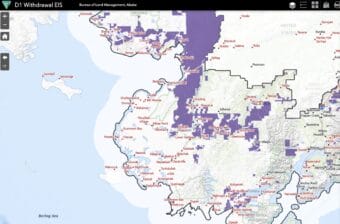
The co-management initiative is an attempt by tribes in the area to gain more say over some of the millions of acres of federal land that were set aside under section D-1 of  the Alaska Native Claims Settlement Act of 1971. These so-called D-1 withdrawals were meant to last 90 days so that the federal government could decide what to do with them, but they’ve been in land-use limbo ever since.

The Trump administration tried to revoke the D-1 withdrawals. Holy Cross and other partner tribes asked the BLM for additional protection. The Biden administration is collecting public comments about whether to lift the D-1 status, which could open the area to potential mining. More than 13 million acres of D-1 land are in the Bering Sea-Western Interior area.

Chief Paul said the Bering Sea-Interior Tribal Commission wants to co-manage some of the land and resources in the area, particularly in watersheds and other zones important for subsistence, hunting, fishing and berry-picking.

“We wanted just these sections of lands around our community, because we’re really close to BLM land. I could step out my back door and step right on BLM land,” he said.

Paul said he’s particularly concerned that the land might be opened to mining or other extractive industries.

The Alaska Outdoor Council, a sportsmen’s organization, has raised objections to the tribal co-management proposal. It is leery of tribal management of public resources. In a blog post, Outdoor Council policy director Rod Arno said fish and game management belongs to the state and wonders where the co-management arrangement leaves non-tribal members.

The governor’s office and media contacts at state agencies did not respond to emails on the subject.

‘Landless’ legislation passes committee for the first time in history

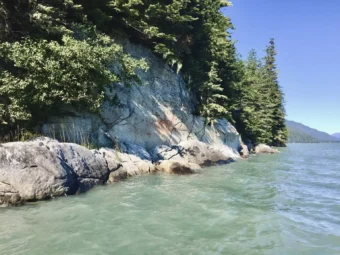
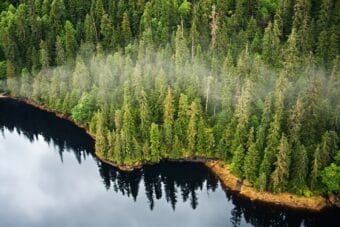
Thomas Bay and Frederick Sound near Petersburg, one of the five “Landless” communities. (Courtesy of Cindi Lagoudakis)

“Landless” legislation passed a new milestone on Dec. 14  after winning approval of the Senate Energy and Natural Resources committee.

The bill still has a long way to go to become law. But if it does, it would return land to the original occupants of five Alaska Native communities in Southeast Alaska. Those communities were left out of the Alaska Native Claims Settlement Act of 1971.

Senator Lisa Murkowski, who sponsored the bill, said in a statement that the omission was “hampering their ability to support development and opportunity while protecting their traditional ways of life. Alaskans have been trying to right this wrong for 51 years.”

ANCSA put millions of acres of land in the control of more than 200 newly formed local and regional Alaska Native corporations.

Cecilia Tavoliero is the Landless delegate for Petersburg and Chair of the Southeast Alaska Landless Corporation board. She was in the room when the bill passed through committee.

“Everybody was elated. We were so happy,” she said. “But we understand there’s a lot more work to do.”

There has never been a clear explanation as to why Petersburg, Ketchikan, Wrangell, Haines, and Tenakee Springs were not included in ANCSA.

Senator Dan Sullivan cosponsored the bill. Representative Mary Peltola has introduced similar legislation in the house. Alaska’s congressional delegation has been bringing similar bills to the legislature for roughly two decades.

Opponents have voiced concerns that the new corporations would log their land, clearcutting swaths of what had been the Tongass National Forest.

But supporters say the timber industry has changed in recent years. Nicole Hallingstad sits on the SeaAlaska board and is a Petersburg representative of the Landless. She said Native Corporations are moving toward more sustainable business ventures.

“The industry in the Tongass is no longer focused on huge harvest of timber.” she said. “And we’ve had such long, engaging conversations with the conservation community, that many of the largest conservation societies in the nation are moving either to neutral or to support our legislation.”

The Wilderness Society recently reversed years of opposition to voice their support for the legislation.

Some are also concerned about public access. But Hallingstad says that public input has helped the Landless delegation refine the bill.

“We’ve got such strong language, ensuring public access, in perpetuity, for recreation activities, your favorite hunting spot where you like to pick berries, that will still be available,” she said.

Public access was not guaranteed by ANCSA.

If the house bill passes committee, the two versions would be combined in a process called “mark-up,” and then would proceed to the house floor for a vote.

Plan for Alaska’s first tribally operated public schools inches closer to completion

An empty classroom
An empty classroom at Juneau-Douglas High School: Yadaa.at Kalé in Juneau on Wednesday. With the new school year approaching, school districts throughout the state are struggling to properly staff schools and classrooms. (Photo by Lisa Phu/Alaska Beacon)

Alaska’s Board of Education has approved a draft report that’s a step toward the state recognizing tribes’ authority to operate and oversee K-12 schools.

The board approved a Department of Education and Early Development report on what’s known as the State Tribal Education Compact at its meeting last week. Ultimately, the report is intended to be the basis of legislation.

Education Commissioner Deena Bishop said the report would be sent to the governor’s office to be drafted into a bill. The state’s plan requires funding to get the first tribally operated state schools up and running.

The Department of Education and Early Development developed the framework for tribally operated public schools after the state’s 32nd Legislature approved a bill directing it to do so. DEED Director of Tribal Affairs Joel Isaak led the process.

“State-Tribal Education Compacting is critical to successfully fostering positive transformation by focusing on system-based changes that empower Tribes to become educators once again,” the report reads.

The proposal is in alignment with one of the department’s five strategic priorities: Inspire Tribal and Community Ownership of Educational Excellence.

Introduction to Public Education in Alaska and Tribal Compacting from Alaska DEED on Vimeo.

Board member Bob Griffin praised the department’s work and suggested the board endorse the yet-to-be-written bill that would come from the report.

Member Lorri Van Diest asked if there would be enough teachers for the additional schools proposed by the plan, considering the state’s difficulty with hiring and retention. Isaak said the process was likely to attract a new pool of educators.

“The stresses that the system experiences by having a limited number of educators, this doesn’t magically make that go away,” he said. “But I do think that it will encourage an additional pool of educators who don’t choose, for whatever reason, to come through the current route, who are excited about this and want to align their life and professional goals, to join this process.”

Five tribes are anticipated to be part of the five-year pilot program for the first tribally compacted public schools: Central Council Tlingit & Haida Indian Tribes of Alaska, Inupiat Community of the Arctic Slope, Ketchikan Indian Community, King Island Native Community and the Knik Tribe.

Those tribes will have one to three years to develop schools if the plan is approved and funded by the Legislature. The schools will be open to any student; tribes may choose whether or not to enter into a compact.

The board will vote to approve a final draft of the plan at its Jan. 17 meeting.

This story originally appeared in the Alaska Beacon and is republished here with permission.

With bison herds and ancestral seeds, Indigenous communities embrace food sovereignty

Sophia Moreno (Apsáalooke/Laguna Pueblo/Ojibwe-Cree) plants crops in the Indigenous gardens outside American Indian Hall on the Montana State University campus in Bozeman, Montana. (Adrian Sanchez-Gonzalez/Montana State University)

BOZEMAN, Mont. — Behind American Indian Hall on the Montana State University campus, ancient life is growing.

Six-foot-tall corn plants tower over large green squash and black-and-yellow sunflowers. Around the perimeter, stalks of sweetgrass grow. The seeds for some of these plants grew for millennia in Native Americans’ gardens along the upper Missouri River.

It’s one of several Native American ancestral gardens growing in the Bozeman area, totaling about an acre. Though small, the garden is part of a larger, multifaceted effort around the country to promote “food sovereignty” for reservations and tribal members off reservation, and to reclaim aspects of Native American food and culture that flourished in North America for thousands of years before the arrival of European settlers.

Restoring bison to reservations, developing community food gardens with ancestral seeds, understanding and collecting wild fruits and vegetables, and learning how to cook tasty meals with traditional ingredients are all part of the movement.

“We are learning to care for plant knowledge, growing Indigenous gardens, cultivating ancestral seeds, really old seeds from our relatives the Mandan, Hidatsa, and Arikara: corn, beans, squash, and sunflowers,” said Jill Falcon Ramaker, an assistant professor of community nutrition and sustainable food systems at Montana State. She is a member of the Turtle Mountain Band of Anishinaabe.

“A lot of what we are doing here at the university is cultural knowledge regeneration,” she said.

But it also has a very practical application: to provide healthier, cheaper, and more reliable food supplies for reservations, which are often a long way from supermarkets, and where processed foods have helped produce an epidemic of diabetes and heart disease.

Many reservations are food deserts where prices are high and processed food is often easier to come by than fresh food. The Montana Food Distribution Study, a 2020 paper funded by the U.S. Department of Agriculture, found that the median cost in the state of a collection of items typically purchased at a grocery store is 23% higher on a reservation than off.

“With food sovereignty we are looking at the ability to put that healthy food and ancestral foods which we used to survive for thousands of years, putting those foods back on the table,” Ramaker said. What that means exactly can vary by region, depending on the traditional food sources, from wild rice in the Midwest to salmon on the Pacific coast.

Central to the effort, especially in Montana, are bison, also referred to as buffalo. In 2014, 13 Native nations from eight reservations in the U.S. and Canada came together to sign the Buffalo Treaty, an agreement to return bison to 6.3 million acres that sought “to welcome BUFFALO to once again live among us as CREATOR intended by doing everything within our means so WE and BUFFALO will once again live together to nurture each other culturally and spiritually.”

Nearly a decade later, dozens of tribes have buffalo herds, including all seven reservations in Montana.

The buffalo-centered food system was a success for thousands of years, according to Ramaker. It wasn’t a hand-to-mouth existence, she wrote in an article for Montana State, but a “knowledge of a vast landscape, including an intimate understanding of animals, plants, season, and climate, passed down for millennia and retained as a matter of life and death.”

Ramaker directs both the Montana Indigenous Food Sovereignty Initiative and a regional program, the Buffalo Nations Food Systems Initiative, or BNFSI — a collaboration with the Native American Studies Department and College of Education, Health and Human Development at Montana State.

With bison meat at the center of the efforts, the BNFSI is working to bring other foods from the northern Plains Native American diet in line with modern palates.

The BNFSI has received a $5 million grant from the U.S. Department of Agriculture to carry out that work, in partnership with Nueta Hidatsa Sahnish College in New Town, N.D.

Life on reservations is partly to blame for many Native people eating processed foods, Ramaker said. Food aid from the federal government, known as the Commodity Supplemental Food Program, has long been shipped to reservations in the form of boxes full of packaged foods.

“We were forced onto the reservations, where there was replacement food sent by the government — white flour, white sugar, canned meat, salt, and baking powder,” she said.

From left to right, James Vallie (Apsáalooke/Anishinaabe), Angela Bear Claw (Apsáalooke), and Jill Falcon Ramaker (Anishinaabe) plant Native seeds in the Indigenous gardens at Montana State University on June 4, 2021. (Adrian Sanchez-Gonzalez/Montana State University)

Processed foods contribute to chronic inflammation, which in turn leads to heart disease, cancer, and diabetes, which occurs at three times the rate in Native Americans as it does in white people.

Studies show that people’s mental and physical health declines when they consume a processed food diet. “In the last decade there’s a growing amount of research on the impact of good nutrition on suicide ideation, attempts, and completion,” said KayAnn Miller, co-executive director of the Montana Partnership to End Childhood Hunger in Bozeman, who is also involved with the BNFSI.

All Native American reservations in Montana now have community gardens, and there are at least eight different gardens on the Flathead Reservation north of Missoula, home to the Confederated Salish and Kootenai Tribes. The tribe is teaching members to raise vegetables, some of it made into soup that is delivered to tribal elders. This year members grew 5 tons of produce to be given away.

Ancestral seeds are part of the effort. Each year the BNFSI sends out 200 packets of seeds for ancestral crops to Indigenous people in Montana.

Creating foods that appeal to contemporary tastes is critical to the project. The BNFSI is working with Sean Sherman, the “Sioux Chef,” to turn corn, meat, and other Native foods into appealing dishes.

Sherman founded the award-winning Owamni restaurant in Minneapolis and in 2020 opened the Indigenous Food Lab, through his nonprofit, North American Traditional Indigenous Food Systems. The lab, in downtown Minneapolis, is also a restaurant and an education and training center that creates dishes using only Indigenous foods from across the country — no dairy, cane sugar, wheat flour, beef, chicken, or other ingredients from what he calls the colonizers.

“We’re not cooking like it’s 1491,” Sherman said last year on “Fresh Air,” referring to the period before European colonization. “We’re not a museum piece or something like that. We’re trying to evolve the food into the future, using as much of the knowledge from our ancestors that we can understand and just applying it to the modern world.”

Among his signature dishes are bison pot roast with hominy and roast turkey with a berry-mint sauce and black walnuts.

In consultation with Sherman, Montana State University is building the country’s second Indigenous food lab, which will be housed in a new $29 million building with a state-of-the-art kitchen, Ramaker said. It will open next year and expand the ongoing work creating recipes, holding cooking workshops, feeding MSU’s more than 800 Native students, and preparing cooking videos.

Angelina Toineeta, who is Crow, is studying the BNFSI at Montana State as part of her major in agriculture. “Growing these gardens really stuck out to me,” she said. “Native American agriculture is something we’ve lost over the years, and I want to help bring that back.”

KFF Health News, formerly known as Kaiser Health News (KHN), is a national newsroom that produces in-depth journalism about health issues and is one of the core operating programs at KFF — the independent source for health policy research, polling, and journalism.

Copyright 2023 KFF Health News. To see more, visit KFF Health News.

Biden to sign order promoting tribal self-determination

President Biden holds 2-year-old Mancuaq Mann, of Dillingham, Alaska. Her mom, Alannah Hurley, says Mancuaq did well at the White House event despite missing nap time. (C-SPAN screenshot)

President Biden will sign an executive order Wednesday that White House officials say will demonstrate the government’s respect for tribal sovereignty and self-determination.

The order comes as the 11th White House Tribal Nations Summit begins in Washington, D.C.

Interior Secretary Deb Haaland told reporters the administration has focused on tribal co-management of federal resources, and seeking tribal input on decisions before they become policy.

“We will announce 190 co-stewardship agreements have been signed this year by our administration,” she said. “Tribes from coast to coast are playing a greater role in the management of the lands and waters they have cared for since time immemorial.”

The statement is sure to rankle on the Arctic Slope of Alaska. A delegation of tribal, local government and Alaska Native corporation leaders from there have complained to Congress in recent weeks that Haaland wouldn’t meet with them to hear their views, which generally favor oil development in their region.

The executive order includes provisions intended to make it easier for tribes to access federal funds while adding flexibility and eliminating onerous reporting requirements.

Tom Perez, senior advisor to President Biden, told reporters the administration has made record-breaking investments of some $46 BILLION to tribal nations.

“Tribal communities know best what is in their community’s best interest,” he said. “And through that partnership, they continue to make much needed updates to tribal roads, bridges, delivering clean water, (and) high-speed internet to indigenous communities and to ease the impact of climate change.”

The tribal nations summit began in 2009 and was an annual event during the Obama administration. Donald Trump did not continue it during his years at the White House. This is President Biden’s third summit.

The story behind the transfer of Klukwan Presbyterian Church to Chilkat Indian Village

Lani Hotch passes a jar of chowder to pastor Al Giddings, who recently took over pastorship of Klukwan Church. (Lex Treinen/Chilkat Valley News)

In Klukwan, a village 20 miles northwest of Haines, a Presbyterian Church was just returned to the Chilkat Indian Village after a century of ownership under Presbytery USA. 

KTOO’s Yvonne Krumrey spoke with Lex Treinen from the Chilkat Valley News about what this change means for Klukwan. 

This transcript has been lightly edited for length and clarity.

Lex Treinen: It’s a place that people just went to, especially a few generations ago. It was just sort of standard that you went there. One church elder I spoke with, Lani Hotch, talked about her earliest memories and in life being going to the church with her grandmother. She described her grandmother’s blue polka-dotted dress and walking along the wooden boardwalks that used to serve as sidewalks in Klukwan. And so it seems to me that it’s a pretty important part of this small community.

Yvonne Krumrey: And in your story, you wrote about how some of the leaders in the church have been reckoning with the negative impacts that the church has caused in the community in the past. Can I ask what negative impacts were caused by the Presbyterian Church in the area? 

Lex Treinen: Yeah, so it’s sort of an interesting question, because there is a Presbyterian Church presence in Haines that has what some consider to be a darker influence with the boarding school that was in Haines, the Haines House. And that school, like many other residential schools, took Alaska Native children from their homes from different areas around the state and brought them here to get a Western education. 

In Klukwan, there wasn’t that explicit negative history. I asked some of the elders about that. And they said, interestingly, that in Klukwan itself, there never was sort of that animosity about what the church was doing there. 

But it always did feel a little bit, I think, foreign for some of the people to have this outside influence of a denomination that was coming from outside. In that sense, there’s sort of this overarching, negative idea about some of the aspects of the church at least. And I think that was what Klukwan was trying to reckon with here, during this deed transfer.

Yvonne Krumrey: I know that some of the leadership in the church has been looking into reparative work for a while now. Can I ask what initiated that work? And who started looking into what could be done to kind of reconcile with the Presbyterian Church’s role in Southeast Alaska?

Lex Treinen: The person that got interested in it was a pastor who arrived in Klukwan in 2017. Her name is Jami Campbell. She served as pastor for a few years, and she said it was a little bit after she arrived that she became aware of an apology that Presbyterian USA — that’s a denomination within the Presbyterian Church — that those leaders made to the Alaska Federation of Natives conference in 2016.  

In May of 2019, Pastor Campbell decided to give a sort of a local apology on behalf of the Klukwan church or the leadership of the Klukwan church. She sort of apologized generally. As I mentioned before, there weren’t specific abuses, per se in the Presbyterian Church in Klukwan. But she sort of spoke to the physical, sexual and emotional abuse that happened as a result of assimilation practices. 

And it seemed like it was a pretty meaningful event in the church’s history. Campbell said that she had members of the community approach her years later and recite portions of that apology to her, even though they hadn’t been there at the time. 

Yvonne Krumrey: And can I ask what’s now happened with the church?

Lex Treinen: All this sort of reckoning led to this idea of returning the property of the Presbyterian Church to the tribe of Klukwan, the whole area is owned by the tribe without one exception of the church. Pastor Campbell reached out to the Presbyterian leadership. And interestingly enough, the Presbyterian leadership was all on board. They didn’t even give it a second thought. 

At the time, it wasn’t really a marked event. It was a time that there were still some COVID concerns. And so they decided not to hold a ceremony. But that changed this last year, and they finally decided to recognize it formally.

Yvonne Krumrey: What does it mean for it to be owned by the village now?

Lex Treinen: Pastor Campbell spoke of sort of how it was a ceremony of healing. She talked about how it just felt like a deep emotion of broken things being put back together. And it’s sort of interesting to compare her account of it to some of the other perceptions from other community members.  Lani Hotch, who I mentioned earlier, one of the elders, when I spoke with her, the 2019 apology, she sort of talked about that, as something that she had actually already moved on from. Not to say that she can’t agree with it, but she thoumght it was something that was sort of already in the past. And here is what she had to say about that.

Lani Hotch: So do you just wait and suffer? Because so-and-so did me wrong and they never apologized? No, you gotta just let go of that and move on. It was great that there was an apology after the fact. But in my heart, I’ve already moved on.

Lex Treinen: So there were sort of some interesting feelings going on, from some of the church members, I think.

Site notifications
Update notification options
Subscribe to notifications