Alaska Native Government & Policy

Federal judge considers lawsuit that could decide Alaska tribes’ ability to put land into trust

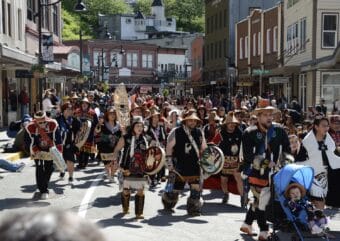
Lingít, Haida and Tsimshian people gather in Juneau for the opening of Celebration on June 5, 2024. (Photo by James Brooks/Alaska Beacon)

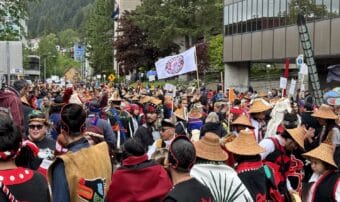
This month, hundreds of Lingít, Tsimshian and Haida tribal members gathered in Juneau for Celebration, a four-day, biennial cultural festival.

As they walked to Juneau’s convention center, attendees passed a black banner advocating “LandBack,” or the return of land to Alaska Native tribes.

Hundreds of miles away, in Anchorage, a federal judge is considering a legal case that could allow tribal governments, rather than Alaska Native corporations, to take authority over significant amounts of Alaska land.

Attorneys argued the case, known as Alaska v. Newland, in early May, and U.S. District Court Judge Sharon Gleason is preparing a ruling.

At its heart, the case involves a straightforward question: Can the federal government take land into trust on behalf of Alaska Native tribes?

Doing so would allow those tribes to create “Indian Country,” giving tribes the ability to exert their sovereign governmental powers. It would also prevent the land from being sold or given away.

The state of Alaska, which filed the lawsuit, has argued that when Congress passed the Alaska Native Claims Settlement Act in 1971, it did not intend to allow the creation of new Indian Country in Alaska.

Arguing in court, Alaska Solicitor General Jessie Alloway asked Gleason to consider what has changed in the past 50 years.

“It’s certainly not any legislative intent on the part of Congress,” she said.

But the federal government’s view on existing law has changed. In November 2022, the Department of the Interior concluded that ANCSA did not forbid the federal government from taking new land into trust here.

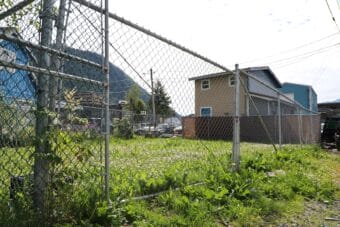
The Central Council of the Tlingit and Haida Indian Tribes of Alaska was among the first tribes to take action based on that conclusion, petitioning to have the federal government put a small, 787-square-foot parcel into trust.

The Tribe hopes several adjacent parcels will follow.

Speaking in court last month, attorney Charmayne Staloff represented the federal government.

Rhetorically, she asked whether a 90-year-old federal law gave the Secretary of the Interior the ability to take land into trust within Alaska.

“The answer to that question is yes,” she said.

“Second, does the secretary retain that authority today? The answer is also yes,” she said.

Attorneys for the federal government and Tlingit and Haida have argued that while ANCSA did erase some tribal trust land, it didn’t prevent the creation of new trust land.

The state of Alaska has argued that the issue is a “major question,” a key term in federal jurisprudence.

Under a 2022 U.S. Supreme Court opinion, if something is a major question — involving issues of “vast economic and political significance” — a federal agency can’t act without explicit direction from Congress.

Staloff argued that the issue doesn’t apply here. Tribes in the 49 other states have long been allowed to place land into trust, and Alaska is the only exception.

“This is simply not a case in which an agency relied on some vague language or ancillary provision to discover unheralded power,” she said.

Judge Gleason also sounded skeptical of the suggestion that the issue is a major question, asking Alloway if she can think of a prior example where a major question involved just one state.

“I’ll be honest with the court that I think that that would be an issue of first impression, but I don’t think that there’s no support for it,” Alloway said.

Gleason questioned both attorneys intermittently and at one point said that based on her reading of federal law, she “isn’t persuaded” that any given tribe is entitled to put land into trust.

Gleason didn’t say when she may rule on the case, but she appeared to hint at the direction of her thinking when she asked both attorneys what they would think about a decision that declared the issue was not a major question but put limits on the federal government’s ability to put land into trust.

This story originally appeared in the Alaska Beacon and is republished here with permission.

What happened to the village, gardens and fish camp at Auke Rec?

People walking at Aanchg̱altsóow, or Auke Recreation Area, on March 24, 2024. (Photo by Yvonne Krumrey/KTOO)

Every other June, canoes — or yaakw — arrive at a beach in Juneau. With carved formline paddles in hand, Southeast Alaska Native people row for days to get there. 

They come for Celebration, the gathering of Lingít, Haida and Tsimshian people honoring the survival of traditional dancing, art, language and community. 

Do you have a Curious Juneau question? Submit it at the bottom of the page.

Seikoonie Fran Houston is a spokesperson for the Áak’w Ḵwáan. She spoke in a 2022 Central Council of Tlingit and Haida Indian Tribes of Alaska video from the landing.

“The first one I saw that occurred — it brought tears to my eyes to witness this. And it also kind of gives you a little vision as to what our ancestors did,” Houston said. 

But yaakw have been landing at this beach for much longer than the 40 years that have passed since the first Celebration. It’s the site of an old Lingít village called Aanchg̱altsóow. That means “the town that moved.” 

A KTOO listener asked about the Áak’w Ḵwaan Village, fish camp, and garden that were once where Auke Recreation Area — or Auke Rec —  is now. 

Three yaakw built by Lingít carver Wayne Price arrive at the beach at Aanchg̱altsóow, also known as Auke Rec, on June 5, 2018 for Celebration. (Screenshot from KTOO video)

Aanchg̱altsóow:  ‘It’s a good place, it has plenty of what we need.’

Auke Rec is a park along a beach north of the rest of Juneau, with stone picnic shelters and fire pits. On clear days, the beach is dotted with couples on walks, dogs sniffing around, and families having picnics.

Thereʼs a section of the beach thatʼs sandier and smoother, down an unofficial trail in the middle of the beach. Oral tradition says it was cleared of boulders and large rocks for easier yaakw launches and landings. 

By the time Seikooni Fran Houston was growing up, Áak’w people weren’t living at the village site, but she knows the story of how they first got there. 

“When we migrated, that was the first area — so in other words, we were the first Indigenous people of the area,” she said. 

The oral history has it that the Áak’w people migrated from the south and deeper in the interior. From a distance, the clan leader saw Aanchg̱altsóow and sent scouts to it, Houston said.

“And they came back and they told the leader, ‘It’s a good place, it has plenty of what we need,’” she said. “So that’s the real short story of a long story.”

For hundreds of years, Áakʼw people lived at Aanchg̱altsóow.

An 1890 photo of Aanchg̱altsóow, the village that stood where Auke Recreation Area is today. (Alaska State Library ASL-P39-1172 Case & Draper Photo Collection)

The Forest Service takes over

Houston said that around the turn of the 20th century, people had started moving away from the village to Douglas and downtown Juneau to work as miners, and so their children could attend school.

But she said the land at Aanchg̱altsóow was always in use.

“There was a time, too, that there were some people who stated that we abandoned Auke Rec,” she said. “We didn’t. We still use it. Not only do we use it — we take what we need in the area — we use it for ceremonies. We didn’t abandon it.” 

In the 1920s, the United States Forest Service claimed the land was unoccupied. They began to make campsites, trails and other infrastructure in the area. Then, in 1931, the Forest Service claimed full ownership. 

Juneau researcher Peter Metcalfe wrote “A Dangerous Idea: The Alaska Native Brotherhood and the Struggle for Indigenous Rights.” He said settlers claiming that land was “abandoned” was a common land-grab tactic. 

“That has been used in a legal sense against Native Americans from the beginning of contact in the Lower 48, as well as Alaska,” he said. “Most Native Americans would say ‘We never abandoned our land.’ And it’s true, in a moral sense. If we own something, and we haven’t sold it, we still own it. It doesn’t matter if we live there or not.”

During the same year when the Forest Service took control, over a dozen Áak’w Ḵwáan built cabins on the old village site to stake claim to the land. It didn’t work. In January 1932, a federal judge ruled that Lingít people had given up ownership by not occupying the land. 

The judge gave the families a month to remove their cabins. Afterward, the Forest Service expanded their construction at the site, and by the 1940s, it looked much like it does today. 

Metcalfe said the way the federal government claimed Auke Bay wouldn’t hold up today.

“The Forest Service was wrong about Auke Bay. When they thought they had won, they hadn’t really. They just put off a decision that was finally resolved in the Alaska Native Claims Settlement Act of 1971,” he said. 

People dipping with Haa Tooch Lichéesh Coalition at Auke Recreation Area on March 24, 2024. (Photo by Yvonne Krumrey/KTOO)

‘Thereʼs no trace, except for those footprints’

Sitting on the beach on a sunny March day, Saan Jeen Jennifer Quinto was getting ready to lead a traditional ocean dip. After setting an intention and reflecting around a fire, Quinto guided participants into the water a little bit at a time. 

Quinto said that, to her, Aanchg̱altsóow is a direct connection to her identity as Alaska Native. 

“For me, thereʼs different layers of not only sacredness, but all the different emotions of life,” she said. “The way that this was also likely a place of joy for a lot of people, but also the heartache of the fact that weʼre not allowed to be connected in that way any longer to this place.”

She said the word “recreation” in “Auke Recreation Area” can cause people to treat the beach like itʼs a playground.

“I don’t think the way that itʼs currently used or represented just doesnʼt — people donʼt understand all of those layers that are happening here for those of us from the Native community,” Quinto said

Quinto said sheʼs often picking up trash from the sites of old longhouses. Indentations are still present in the trees along the shore. 

“It always crosses my mind that people are respectful of gravesites, and in a lot of ways this area has that same sort of sacredness,” she said. 

And Aanchg̱altsóow is a gravesite. In a 1987 Alaska Department of Natural Resources cultural resources survey, archeologists reported finding at least one set of human remains there.

Quinto said that if people could only see what it looked like when it was a lived-in village, they might treat it differently. 

“You would have seen the house fronts, you would have seen the kootéeyaa, you would have seen our people out here. And now thereʼs no trace, except for those footprints,” she said.

She said that erasure was the start of a long history of reducing the footprints of Lingít people in Juneau — including the gradual shrinking of Juneau Indian Village downtown in the middle of the last century and the burning of Douglas Indian Village in 1962.

Rosa Miller (center), Fran Houston (left) and Angie Hunt (right) prepare to sing a traditional song to the spirits of the land at Auke Recreation Area, April 1997. (Photo courtesy of Dr. Thomas Thornton)

But events like traditional dips in the ocean and the canoe landings at Celebration bring Lingít traditions back to the land, and back to life, Quinto said. 

“For Lingít people, we believe that everything has its own spirit, and has its own life,” she said. “And so, to me, when weʼre able to gather here for cultural events, those are moments that we get to restore that life to this area, and I donʼt think it happens enough.” 

Seikoonie Fran Houston said that when she stands on the beach now, it fills her with gratitude for her ancestors. 

“I go out there and I talk to my ancestors and I thank them every time I go out there,” she said. “Saying thank you for choosing this area, because it’s so pretty and so peaceful.” 

Next week, paddlers will once again ask the Áak’w Ḵwáan for permission to come ashore, in recognition for the history and life of this piece of land.


Curious Juneau

Are you curious about Juneau, its history, places and people? Or if you just like to ask questions, then ask away!

Native advocates celebrate passage of bill to address Alaska’s MMIP crisis

A group sings on the steps of the Alaska Capitol in Juneau for Missing and Murdered Indigenous Persons Awareness Day on May 5, 2022. (Paige Sparks/KTOO)

One of the bills that crossed the finish line in the final hours of the Alaska Legislature is what advocates for missing and murdered Indigenous people call a major milestone.

The bill was launched by Sen. Donny Olson, an Inupiaq and a Democrat from Golovin, but it was Rep. C.J. McCormick who shepherded the bill in the House.

“I want to be sure that I convey this epidemic is impacting every region of the state. Urban. Rural. And in between,” said McCormick, a Democrat from Bethel, who told lawmakers Senate Bill 151 will help address the crisis of missing and murdered Alaska Natives.

McCormick told lawmakers that the issue is personal to him and more than a list of unsolved cases.

“There’s individuals that I went to school with. Unfortunately, my staffer who helped work on this bill, has family members that are part of these lists as well,” McCormick said. “I’m sure that members of this body, who even have family members, that are part of this list.”

Alaska has the fourth highest rate of missing and murdered Indigenous women and girls in the nation, and Anchorage is third highest among cities. The bill aims to reduce these numbers by requiring the Department of Public Safety to:

  • Hire two permanent MMIP investigators to focus on unsolved cases.
  • Offer police training that includes cultural education.
  • Conduct a one-time needs assessment to identify ways to provide more resources for identifying and reporting MMIP cases within the state criminal justice system. DPS must include tribes and other Alaska Native organizations in the process.
  • Report MMIP cases to the National Missing and Unidentified Persons System (NAM-US) database, if a person has not been located within 60 days of the initial report.

Work with a new nine-member commission to review unresolved MMIP cases statewide.

“For advocates and families, this is a huge moment for us,” said Charlene Apok, director of Data for Indigenous Justice.

Apok said it took years of effort to achieve these policies, and the passage of the bill is astounding, when you consider that only a few years ago, it was a struggle for advocates to get state leaders to meet with them to discuss the MMIP crisis.

But today, Apok says there’s a broad-based coalition of state lawmakers and other officials who helped to champion the bill.

She said she’s even more pleased to see that Alaska Natives gained their support by tapping into their traditional values to build relationships and using the power of storytelling to get their message across.

“And as we carried those stories, collected the data, and said it, over and over and over again, and then we have our collective voices, that’s the power of that,” Apok said. “A collective truth that cannot be denied.”

Apok says with strong relationships in place, the bill’s provisions will have a better chance of success, but there’s still a lot of work ahead to bring about lasting change.

The bill did not pass unanimously. Rep. David Eastman, a Wasilla Republican, cast the lone no vote. He questioned the need for cultural training and said he’s concerned the bill might place additional burdens on police.

Alaska lawmakers support push to investigate, document forced assimilation in boarding schools 

Jan Bronson of Anchorage and Cathy Walling of Fairbanks, representing the Alaska Friends Conference, apologize to Alaska Native communities for the boarding schools it ran in Alaska and the United States. The apology took place at Sayéik Gastineau elementary school, the former site of a Quaker mission school in Juneau, during Orange Shirt Day, Sept. 30, 2022. (Photo by Lisa Phu/Alaska Beacon)

Alaska lawmakers overwhelmingly voted to support a federal proposal that would investigate and document the forced assimilation of American Indian, Alaska Native and Native Hawaiian children in government-funded boarding schools.

House Joint Resolution 17 acknowledges the trauma Indian boarding schools inflicted on Indigenous communities in Alaska and across the country, said the bill’s sponsor, Rep. CJ McCormick, D-Bethel. There were more than 100 government-funded, church-run Alaska Native boarding schools in Alaska from the late 1800s through the 1960s, according to research presented by his office and the Alaska Native Heritage Center. They separated young children from their families and forcibly immersed them in Euro-American traditions and the English language.

McCormick said the legacy of abuse and intergenerational trauma continues to haunt Alaskans and requires acknowledgement.

“I think a lot of my colleagues were honestly kind of taken aback by the extent of these atrocities,” he said and described how research and testimony changed their minds.

The Senate unanimously approved the resolution and it had overwhelming support in the House. Rep. David Eastman, R-Wasilla, was the lone vote against it.

The lack of comprehensive documentation of this period limits our ability to address intergenerational trauma caused by the policies that supported the federal Indian boarding school system.

– Sen. Forrest Dunbar, D-Anchorage

The resolution puts Alaska lawmakers in support of a U.S. Senate bill that would direct a federal commission to gather evidence of assimilation practices and human rights violations in the nation’s boarding schools for Indigenous children. Alaska Republican U.S. Sen. Lisa Murkowski has led the bipartisan effort with U.S. Sens. Brian Schatz, D-Hawaii, in Washington, D.C. It has 32 cosponsors.

‘Threaded through our community’

Callan Chythlook-Sifsof, staff who worked on the bill for McCormick’s office, shared that her grandfather and most of the elders in her family attended the Aleknagik Mission School in Southwest Alaska, where she is from. She noted that the buildings and memories are present, but largely unacknowledged in official records.

“This is a phenomenon I’ve known about my whole life. And I can just look across the lake and look at the Mission School,” Chythlook-Sifsof said.

There is not one Alaskan Native alive today who has not been directly or indirectly affected by this history. It still walks with us.

– Benjamin Jacuk, Indigenous researcher for the Alaska Native Heritage Center

While first-person accounts of boarding school abuses are becoming more common, official documentation is scarce. The resolution supports a change that can help Alaskans heal, explained Sen. Forrest Dunbar, D-Anchorage, who carried the bill in the Senate.

“The lack of comprehensive documentation of this period limits our ability to address intergenerational trauma caused by the policies that supported the federal Indian boarding school system,” he said.

He said the resolution “is a step towards addressing a trauma that is threaded through our community and our Alaskan culture.”

Notable Alaskans who experienced boarding school abuses spoke out about their experiences in committee meetings with lawmakers this year. Rosita Worl, widely known as the president of Sealaska Heritage Institute, the nonprofit arm of Sealaska Corp., and as a community leader in Southeast Alaska, shared the story of how she was taken from her home in Petersburg and taken to an orphanage and Alaska Native boarding school in Haines, without the knowledge of her family members. She said she was ridiculed for speaking Tlingít instead of English and tearfully confirmed that sexual abuse took place there.

“Another memory that haunts me is seeing girls who are almost comatose. They would walk without ever talking or smiling. They would walk like zombies. I often wondered what happened to them, for one day I would see them and then the next day I wouldn’t,” she said.

Worl recalled being rented out by the Haines House for various jobs as an underage, unpaid laborer. She said on good days her grandparents would “rent” her and take her berry picking instead of forcing her to work.

Walkie Charles, now the director of the Alaska Native Language Center at the University of Alaska Fairbanks, recounted being stripped of his name and reidentified by a number at Wrangell Institute where he was taken for boarding school. “The kids in the generation before me were so beat up that upon their return home to their communities, they either couldn’t speak their heart language anymore, or refused to, because they were ashamed enough to choose the language of our oppressors,” he said.

Charles now teaches Yup’ik, the language the boarding school tried to erase.

New research

Even as the resolution moved through the legislative process, researchers found documentation that reinforces the memories of boarding school survivors.

Alaska Native Heritage Center Indigenous Researcher Benjamin Jacuk offered lawmakers a history of Alaska Native boarding schools in the state, and evidence of abuses that took place in them. He said Alaska was “ground zero” for national boarding school policies.

“There is not one Alaskan Native alive today who has not been directly or indirectly affected by this history,” he said. “It still walks with us.”

Last Monday he said he found evidence of the unpaid labor Worl recounted in previous testimony.

“We actually found contracts, which they would have parents — who at the time did not know English — sign, that are labeled as ‘indentured servanthood children,’ from infants to 14 years old,” he said. “Making the conversation not only about assimilation, but also for all intents and purposes, slavery.”

Jacuk said that revealing the darker truths of abuse within the state’s boarding schools is essential to moving forward.

“In order to understand what healing even looks like, we first need to know the truth,” he said. “And when we understand the truth, and we’re able to actually tell it, it brings healing to not only the people that are here today, or even the next generation, but also that to bring healing to the stories of those who came before us who are never able to tell their story.”

Sudden ANTHC leadership change: Valerie Davidson no longer at the helm

Valerie Nurr’araaluk Davidson, former president of the Alaska Native Tribal Health Consortium, speaks at a press conference on June 14, 2021. (Jeff Chen/Alaska Public Media)

Valerie Nurr’araaluk Davidson was not only head of one of the largest tribal health organizations in the nation, but also recognized as a trailblazer in Native health care. But Davidson is no longer president and CEO of the Alaska Native Tribal Health Consortium.

In a statement on its website, ANTHC announced she had left the organization, but gave no explanation why, other than to say she was “transitioning” out of the job that oversees more than 3,000 workers. ANTHC is Alaska’s second largest health employer.

The news is puzzling to those familiar with Davidson’s track record, who call her departure shocking in that it was so sudden and abrupt.

The news traveled fast to her old boss, former Gov. Bill Walker, who is on a trip to London. Walker said he’s both surprised and dismayed.

“It’s just such an awkward situation, I’ll put it that way, because she’s so gifted,” said Walker, who initially tapped Davidson to be his Health and Social Services commissioner.

Walker said she successfully led the Alaska’s push to expand Medicaid, which saved the state millions.

“I witnessed her literally move mountains on health care issues that benefited Alaska,” Walker said. “There’s nothing she wouldn’t do, if it helped provide health care in Alaska.”

Davidson, who is Yup’ik and raised in Southwest Alaska, was known as the “Kuspuk Commissioner,” because she dressed in kuspuks, a traditional Yup’ik overshirt. Davidson’s colorful kuspuks were usually handsewn by family and friends. The bright patterns made her stand out in the governor’s office and the halls of the state Capitol, as well as her jokes about how the big pockets in kuspuks are useful for carrying things like baby diapers.

Davidson’s trademark humor masked her skills as a savvy lawyer and negotiator, who helped tribal organizations win battles in Congress.

Walker later tapped Davidson to serve as his lieutenant governor, after Byron Mallott resigned in a scandal.

It was a similar scenario when Davidson took over the Alaska Native Tribal Health Consortium, after its president, Andy Teuber, disappeared in a solo helicopter crash in March 2021. Teuber’s fatal flight came just as accusations of sexual harassment were about to emerge.

While the statement from the tribal consortium gives no reasons for the decision to replace Davidson, it heaps praise upon her for guiding the organization through what it described as a “leadership crisis.”

In the statement, the consortium’s Board of Directors credited Davidson with numerous successes during her watch, which included major investments and meaningful improvements that supported what it called the “remarkable transformation of the organization.”

Gary Ferguson, a former colleague of Davidson’s, said she’s one of a kind.

“She has been a solid leader wherever she’s gone,” Ferguson said, “and has been a changemaker.”

Ferguson is an Unangan, who currently works as a researcher at Washington State. He’s a licensed naturopathic doctor, who spent 10 years at ANTHC, when Davidson served as the consortium’s attorney.

Ferguson said he has long admired her integrity and passion for bringing traditional Native values to health care.

“Val has been a pioneer, speaking her truth,” Ferguson said, “which I think is very difficult to do in those high-level positions.”

Ferguson said the health consortium has “an incredible mission and does incredible work, but also has an incredibly challenging environment” that pits Native values against the bottom line. Ferguson believes this constant tension has led to high executive turnover.

“There’s a lot of political pressure. There are a lot of regions and peoples to serve, some of which have more resources than others,” Ferguson said. “So delivering health care equity across the state can be challenging.”

Those challenges now fall to Natasha Singh who, like Davidson, is a lawyer — also with a reputation as a tribal government changemaker. Singh has taken over as interim president and CEO.

According to the ProPublica Non-profit Explorer database, which looked at tax forms for the 2012-2022 fiscal year, the statewide tribal health organization had revenues of almost $840 million. It listed Davidson’s salary at $806,000.

Repeated requests for comment from ANTHC, Davidson and Singh were not returned. For now, the political undercurrents of this change in leadership remain unclear.

Tidal Network works to meet FCC’s timeline for Hoonah broadband license

A wireless tower in Wrangell. (Courtesy of Tidal Network)

The Central Council of Tlingit and Haida’s broadband service is working to expand access to a federally awarded broadband service in Hoonah, to ensure they can keep the license.

“It’s important to defend and keep wireless spectrum in Tribal communities to help uphold and preserve sovereignty and infrastructure,” said Chris Cropley with Tidal Network, the broadband service run by Tlingit and Haida. 

He says that digital sovereignty helps keep tribal communities strong. 

Hoonah Indian Association won a broadband bid from the Federal Communications Commission in 2020, thanks to a program that allowed rural tribes to get licenses.

Cropley says high-speed internet from this spectrum service — which uses radio waves to deliver information to and from households — will have to reach 80% of Hoonah’s population in just a couple of years. That’s a timeline set by the FCC.

SnowCloud Services — a Southeast Alaska internet provider — already provides Hoonah with access to high speed internet. 

Chris Ruschmann owns SnowCloud Services. He said the city of Hoonah, tribal organizations, and corporations have worked together since 2014 to build the service for the community.

“Because there’s just never money for it, so we grew it our own,” he said.

Ruschmann says they’ve been able to provide strong and fast connections to everyone in the city. That’s made it easier for kids to go to remote classes, for people to use telehealth, and to retain seasonal employees. 

“We’ve put a lot of effort into allowing people coming from outside of Hoonah, when they come to Hoonah, they still have the amenities that they have elsewhere,” Ruschmann said. 

If Tidal Network doesn’t meet the FCC’s timeline for the federal bid, the awarded spectrum could go back out to auction. Cropley said the network will coordinate with existing services like SnowCloud to get the service out to people. 

Correction: A previous version of this story inaccurately stated that Hoonah doesn’t currently have access to high-speed internet. We’ve added comment from Snowcloud Services and changed the headline.

Site notifications
Update notification options
Subscribe to notifications