Alaska Native Government & Policy

New lawsuit seeks to limit Alaska Native tribes’ authority, stop Eklutna gambling hall

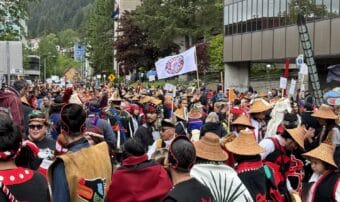
Tlingit, Haida and Tsimshian people gather in Juneau for the opening of Celebration on June 5, 2024. (Photo by James Brooks/Alaska Beacon)

The state of Alaska has filed suit against the federal Department of the Interior in an attempt to overturn a legal opinion that allowed the Native Village of Eklutna to open a federally regulated gaming hall near Anchorage.

The lawsuit, filed Tuesday at the U.S. District Court in Washington, D.C., alleges that the legal opinion — issued by the Interior Department’s top attorney under the Biden administration — was “arbitrary and capricious, an abuse of discretion, and not in accordance with law.”

If the court rules in the state’s favor, it could force the closure of the gaming hall, which has been operating since January. More broadly, it could deny all of Alaska’s 229 federally recognized tribes the ability to exercise jurisdiction over as much as 2.7 million acres of land held in trust for individual Alaska Natives by the federal government.

“This challenge isn’t about gaming. This is about jurisdiction over lands. We are asking a court to reaffirm what it has already said — the State maintains primary jurisdiction over Alaska Native allotments,” said Alaska Attorney General Treg Taylor in a written statement announcing the lawsuit.

Allotments are parcels of land up to 160 acres in size that the federal government holds in trust for individual Alaska Natives and their families.

For decades, federal officials said that those parcels were not considered “Indian country” and thus not subject to the jurisdiction of tribes in the way that Indian reservations are.

Eklutna and other tribes have repeatedly questioned that idea. In 2021, following a lawsuit by Eklutna, the U.S. District Court for Washington, D.C., ruled that allotments do not count as tribal land for the purposes of opening a gaming hall.

But in early 2024, the Interior Department’s top attorney changed a legal interpretation that the department and courts had used for decades.

Using that new legal interpretation, the department and federal Indian gaming officials approved Eklutna’s plans for a gaming hall. It began operating on a limited basis last month.

Aaron Leggett, president of the Native Village of Eklutna, said in a written statement on Tuesday that the tribe is “saddened and disappointed” that the governor and attorney general would take the tribe to court over an economic development project.

“This is not only an unnecessary expense for NVE and the State, but also a time-consuming, unwarranted federal lawsuit that will increase the financial strain on the Eklutna people and create another barrier to economic benefits for Tribal members and the broader community. This is a burden the Tribe, the local community and the State of Alaska’s citizens should not have to bear,” Leggett said.

“Fifteen days ago, the Native Village of Eklutna opened its Chin’an Gaming Hall to the public. Already, over 60% of our Chin’an employees are Eklutna Tribal members. They are proudly working alongside colleagues who are neighbors from the local community,” he said.

The gambling hall has already been the subject of a different lawsuit, filed in the U.S. District Court for Alaska, by several neighbors. Tuesday’s filing by the state says that since the D.C. District Court previously ruled on the Eklutna issue, that case should take precedence.

The Eklutna case is also part of a larger trend by the state, which has been fighting to restrict the ability of tribes to exert governmental jurisdiction over land in Alaska.

The Alaska Native Claims Settlement Act of 1971 put most Alaska Native land here under the control of Native corporations — which are not sovereign governments — instead of tribes, which are.

Just as the state filed the Eklutna case, state attorneys were also at work on arguments in a separate lawsuit now in the 9th Circuit U.S. Court of Appeals about the ability of tribes to put land into federal trust on their own.

Last year, an Alaska judge said they have the right to do so, but the state is continuing to fight the case, with oral arguments possible later this year.

Complicating matters is the switch from the Biden administration to the Trump administration. In the first Trump term, the Interior Department opposed Alaska tribes’ ability to take land into federal trust. The Biden administration strongly supported that right. It remains to be seen whether the second Trump term will mark a return to the policies used in the first.

Juneau officials say rumors about detained tribal citizens are unsubstantiated

The Andrew Hope Building, pictured here on Feb. 10, 2021, houses the headquarters of the Central Council of Tlingit and Haida Indian Tribes of Alaska.
The Andrew Hope Building, pictured here on Feb. 10, 2021, houses the headquarters of the Central Council of Tlingit and Haida Indian Tribes of Alaska. (Photo by Jeremy Hsieh/KTOO)

Rumors have been circulating on social media that U.S. Immigration and Customs Enforcement, or ICE, agents have detained tribal citizens in Juneau, but local officials say that is not true. 

City and Borough of Juneau Mayor Beth Weldon says some of the speculation is due to a miscommunication. 

“We as a collective, we – including the chief of police and the city attorney – we have not heard of anybody being detained or even questioned about their immigration status, for that matter, not to say that won’t change, but that’s what we know right now,” Weldon said. 

She said the city doesnʼt have information about ICE agents in town or anyone being detained by them.

Juneau Police Department Deputy Chief Krag Campbell said in an email that the department has received calls asking about ICE presence in Juneau, but they havenʼt received any reports of Juneau residents being detained. 

He said federal agencies not stationed in Juneau will usually notify the department when they are in Juneau. He asked residents to inform JPD if they encounter ICE officers in town.

Campbell says that U.S. Customs and Border Protection agents are in town for drug enforcement support. That agency is separate from ICE, though both are under the Department of Homeland Security. 

These agents could have been mistaken for ICE officers. 

The Central Council of the Tlingit and Haida Indian Tribes of Alaska President Chalyee Éesh Richard Peterson issued a statement saying that there is no substantiated evidence that tribal citizens have been detained in Juneau. 

Nevertheless, Peterson encouraged tribal members to make sure their tribal IDs have not expired and to carry them when out in public.

Jimmy Carter’s Alaska legacy, and how he got the name Nahóowoo

Angoon elders Matthew Fred, William Nelson, and Martha Nelson with President Jimmy Carter at a ceremony for the protection of Admiralty Island through the Alaska National Interest Lands Conservation Act. (Photo by Peter Metcalfe/Courtesy of Sealaska Heritage Institute)

A series of remembrances for former U.S. President Jimmy Carter began in Georgia on Saturday, culminating on Thursday with a national day of mourning. Carter, who died on Dec. 29 the age of 100, was known in Southeast Alaska as Nahóowoo — a name he was given when the Deisheetaan of Angoon adopted him sometime in the late 1970s.

Matthew Fred of the Daisheetan gave Carter his Lingít name. It belonged to Billy Jones, who witnessed the bombardment of Angoon by the U.S. Navy in 1882. Jones was only 13, but his account eventually became the basis for an apology the Navy secretary made to the village last October, 142 years after the bombardment.

Rosita Worl, president of the Sealaska Heritage Institute, says the Navy’s formal apology had its roots in President Carter’s efforts to bond with the people of Angoon.

“Although he was not able to do anything about their apology,” Worl said, “he was the first president, actually, that listened to their story.”

Protecting subsistence

Angoon is on Admiralty Island, or Kootznoowoo. The island’s Lingít name means Fortress of the Bear, a sacred place with the highest concentration of brown bears in the world.

In 1978, Carter used his authority under the 1906 Antiquities Act, a novel legislative tool, to designate Admiralty Island and other wilderness in Alaska as national monuments.

More protections were added when the president signed the Alaska National Interest Lands Conservation Act into law in 1980. ANILCA also doubled the size of Alaska’s national parks and refuges, classified more than 50 million acres as wilderness and created 25 wild and scenic rivers.

Conservationists hailed the legislation as one of Carter’s greatest achievements, while proponents of resource development said it locked up too much land.

Worl says Alaska Natives were caught in the middle. They wanted to develop their land but also protect it for subsistence. She says developers and conservationists both believed they had primacy over Alaska Natives, despite their long history of stewardship and ties to the land.

Jimmy Carter’s Lingít namesake, Nahóowoo, a name given to Billy Jones who witnessed the U.S. Navy’s bombardment of Angoon. Nahóowoo is on the left. His brother, Billy Johnson, is seated in the front, holding canoe paddles. Their sister Yíktusaan is on the far right. (Alaska State Library Historical Collections)

She said neither group understood the Lingít concept of Haa Aaní, which translates into “Our Land” but also incorporates core cultural values of reverence for the land, as well as the need to utilize it.

Worl says that’s a common theme in Alaska Native cultures that Carter appeared to understand, even though he seemed firmly planted in the conservationist’s camp.

“I believe that President Carter gained a deep appreciation and understanding of Lingít culture when he met with the Angoon Lingít traditional leaders,” Worl said. “I believe this meeting and ceremony influenced President Carter’s actions.”

The leaders, she says, were dressed in their finest regalia with crests of animals, birds and fish, which showed their close relationship to the environment and dependence on the land — a cultural experience for Carter that may have helped him recognize the need for ANILCA to address subsistence hunting and fishing rights.

“It’s not perfect,” Worl said, “but without it, we wouldn’t have had the protections we had.”

Worl says the subsistence policies outlined in ANILCA continue to be debated and litigated today, so it’s important for Alaska Natives to find new ways to protect their subsistence lifestyle.

“You have to work for your people”

Worl believes Carter’s most important legacy is the example he set as a leader, including his decades of service after his term as president.

“He cared for humanity. And he proved it by doing the work himself,” Worl said. “That’s a trait we admire.”

Worl said Carter saw leadership through the eyes of a servant, and to the Lingít, he exemplified their values.

“When a person becomes a clan leader down here, they go through a ceremony,” Worl said. “You become a leader. And then they’ll say, now you’re a worker for your people. You have to work for your people.”

Worl said Garfield George of the Deisheetaan will represent the Lingít at President Carter’s memorial service in Washington D.C. George also worked with the Navy on their apology to Angoon.

Lawsuit challenges Eklutna Tribe’s right to build and operate a gaming hall near Anchorage

Concept rendering of the Chin’an Gaming Hall, proposed by the Native Village of Eklutna. (Concept rendering by Marnell Companies of Las Vegas. Courtesy of the Native Village of Eklutna.)

A group of homeowners in Birchwood have filed a lawsuit against the Native Village of Eklutna over a small-scale casino planned near Anchorage. The tribal gaming hall would be built on about eight acres of land, a few miles off the Birchwood exit on the Glenn Highway.

Sharon Avery, the acting head of the federal National Indian Gaming Commission, was also named in the lawsuit. Earlier this year, Avery signed off on the tribe’s plans to build the project on a Native allotment leased from the Ondola family.

“There’s a lot of horses and dog mushing, and that kind of activity out here,” said Debbie Ossiander, who lives about a mile from the site.

Ossiander is co-chair of the Birchwood Community Council and supports the lawsuit. She says the council worries that the Eklutna Tribe’s project will destroy the rural character of the area.

“People are fearful of what kind of a traffic impact that would engender. It would be a draw certainly,” Ossiander said. “People would drive from Anchorage and all over the valley to come to this locale.”

Ossiander says there are some other big unknowns, like the impact of drainage from the casino’s parking lot into nearby Peter’s Creek, a salmon spawning stream. Ossiander says she’s also frustrated about the lack of information about the project.

The lawsuit was filed on behalf of eight people who live in the Birchwood Spur Road neighborhood, next to the proposed gaming hall. They are represented by attorney Don Mitchell, a longtime opponent of tribes in Alaska.

Mitchell would not comment for this story, but his lawsuit questions Eklutna’s tribal status as well as the existence of tribes in Alaska.

Aaron Leggett, the president of the Native Village of Eklutna, said in a statement that the litigation is disappointing.

He said Mitchell’s claim that there are no tribes in Alaska has repeatedly been rejected by the courts.

As for the complaints from neighboring landowners about the potential impacts on the Birchwood community, Leggett said the public will have a chance to comment on the project during a federal environmental review.

The land in question is under federal control on a Native allotment awarded to Olga Ondola in 1963. It’s also within the Eklutna Tribe’s traditional territory.

In 2016, the Eklutna Tribe asked the U.S. Department of Interior to make the property eligible for gaming under the Indian Gaming Regulatory Act. It also sought approval of the Tribe’s lease of the land from the Ondola family, but in 2018, the Department issued a decision against the Tribe and concluded that the property did not constitute “Indian lands.”

That decision was reversed earlier this year following a new interpretation of the law from Bob Anderson, the solicitor of the U.S. Interior Department.

Anderson, the agency’s chief legal officer, ruled that the Eklutna tribe has jurisdiction over the Ondola Native Allotment, which opened the door for the tribe to win approval from the National Indian Gaming Commission in July. The Bureau of Indian Affairs has not yet issued the final permit, pending an environmental assessment.

The lawsuit against the Eklutna Tribe cites a long legal history, going back to 1884. It cites past decisions from Congress and previous Interior Departments against tribes in Alaska.

Tribal proponents say the courts have long put those claims to rest. They point to a Federal Register which lists 574 tribes and Alaska Native entities, including the Native Village of Eklutna.

Tribal leaders like Richard Peterson say the lawsuit’s claims about the lack of tribal status in Alaska are ridiculous. Peterson is president of the Central Council of the Tlingit and Haida Indian Tribes of Alaska, the largest tribe in the state.

“When you attack tribes, you are attacking Alaska,” said Peterson, who called the lawsuit short-sighted.

He believes the community will benefit in the long run from the gaming hall, based on the Eklutna Tribe’s track record for environmental stewardship and its clean-up of abandoned military sites and other projects.

“They’re doing wonderful things for their community,” he said. “This has implications on all tribes. All 229 should get behind Eklutna,” Peterson said.

The Eklutna Tribe may face opposition from another quarter. Gov. Mike Dunleavy recently put out a list of priorities in preparation for the incoming Trump administration. One of those calls for reversing Anderson’s recent decision to greenlight the Eklutna Tribe’s proposed gaming hall.

Opponents of the project say Native allotments are not subject to state and local taxes and worry that they’ll have to shoulder the burden for paying for the potential impacts of the gaming hall, such as the need for increased public safety services and road upgrades. But supporters of the project say the Tribe could be an ally in bringing more services and road improvements to the area.

The Eklutna Tribe has said there will be two phases of the project, which will be called the Chin’an Gaming Hall. Chin’an means “thank you” in the Dena’ina Athabascan language.

On its website, the Tribe says it plans to open as a modest 50,000 square foot facility on about six acres of land. It would have no card or table games and but will start out with 350 to 550 electronic gaming machines and expand to 700. There would also be a full-service restaurant with plans to eventually apply for a liquor license.

Marnell Companies, a Las Vegas based firm run by the Marnell family, will design, develop and manage the gaming hall.

Supporters of the project say it will fit in with existing development, which includes an airport, railroad operations, a convenience store, a bar and a small wood panel manufacturing plant operated by Spenard Builders Supply.

The Tribe says it’ll use revenues from the gaming hall for scholarships, housing, healthcare, and cultural programs.

This story has been corrected. The public will have a chance to comment on the project during a federal environmental review.

Lingít veterans hold space for dual identities during US Navy apology in Angoon

Alan Zuboff in Angoon on Saturday, Oct. 26, 2024. (Clarise Larson/KTOO)

Last weekend, the U.S. Navy visited Angoon to apologize for the 1882 bombardment of the Lingít village.

Hundreds of people with ties to the community attended the event. For some in the crowd, the apology held another dimension.

When the Navy made its long-awaited apology inside Angoon High School, clan leaders responded one by one. One of them drew attention to the veterans in the room. 

“Today we have 45 living veterans in Angoon,” said Alan Zuboff, L’eeneidí Dog Salmon Clan Leader. He served in the Army during Vietnam.

Later, he said that this apology meant a lot to the community’s veterans.

“All our veterans have been waiting for this for a long time, even if we, you know, the military did this thing to us,” he said. “We still join because we still think we’re fighting for our land.”

According to the U.S. Department of Veterans Affairs, Indigenous Americans serve in the military at a higher rate than any other group. 

Ike Wilson is a former Army colonel based in Florida. He researches the militaryʼs relationship with civilians.

Wilson, who is Black, said that people who serve in the military as members of marginalized groups, or “hyphenated Americans” as he put it, have historically had a complicated experience.

In many cases, they put their lives on the line for a country that once oppressed them or their ancestors.

Angoon leaders listen during the official Navy apology for the 1882 bombardment of Angoon. Saturday, Oct. 26, 2024. (Clarise Larson/KTOO)

“We are living lives where the very principles and ideals that we’re promoting and protecting and defending we at home, maybe the marginalized victims of denial of those very rights,” Wilson said. 

Tlakwadzi Kahklen Selina Joy was raised in Washington, but her family is from Angoon. She served as an Army medic for 24 years. She visited for the apology, and brought a statement she wrote for the event. 

“Many of us wear the uniform of the United States militaries, not as an act of submission, but as a testament to our enduring strength and values,” it reads. “We are warriors, healers and protectors, just as our ancestors were. By standing in these spaces, we honor them and ensure their strength and values guide the actions of today’s armed forces and that our people have a say in the world we create.”

She said the Navy’s apology means that the young people in her family get to live in a new chapter of history. 

“We want to use this kind of launch them into a place where like ‘you don’t have to start your journey the way we did 142 years ago,” she said. “You can start this knowing that we are an equal people going forward in the eyes of the society and the government we live in.’”

And that journey started Saturday, with a 15-hour celebration and a new chapter for Angoon.

President Biden’s apology for abusive Indian boarding schools seen only as the beginning

President Joe Biden delivers remarks at the Gila Crossing Community School, Friday, October 25, 2024, in Laveen Village, Arizona. (Photo by Oliver Contreras/White House)

President Joe Biden did what no president has ever done last Friday. He apologized for the harm done to generations of Native American children, who were taken from their homes and forced to attend federal boarding schools.

From 1878 to almost a hundred years later, Alaska had more than a hundred federally funded schools for Native children – a time in which they were punished for speaking their language, as well as physically and sexually abused.

President Biden chose the Gila Reservation near Phoenix to make his apology. He said he was glad to hear the voices of young people singing traditional songs at the start of the ceremony — voices that boarding schools had once silenced.

“I formally apologize, as President of the United States of America, for what we did,” Biden said. “I formally apologize.”

President Joe Biden says he believes his apology for abuses at federal Indian boarding schools was 50 years overdue. (Photo by Oliver Contreras/White House)

The president told the gathering that his apology was among the most consequential things he’d ever done in his whole career as President of the United States.

“It’s an honor, a genuine honor, to be in this special place, on this special day,” Biden said.

“Quite frankly, there’s no excuse that this apology took fifty years to make. The pain it causes will always be a significant mark of shame, a blot on American history. For too long, this all happened with virtually no public attention, not written about in our history books, not taught in our schools.”

Jim LaBelle sat among the boarding school survivors in the crowd. LaBelle is an Alaska Native, and a member of the National Native Boarding School Healing Coalition. He says, before the president gave his apology, he and his Interior Secretary, Deb Haaland, together hugged Jim Labelle and his wife.

“It’s almost indescribable, how to express that feeling of acknowledgement. It was just a very spiritual moment,” Labelle said. “He just understood why we were there. “

LaBelle says the president’s apology was a powerful gesture, one that stirred memories of those who never recovered from boarding school trauma and died young, from addiction and suicide.

“When I heard the apology today,” he said, “I was thinking of them, hoping their spirits will feel the words and feelings.”

During his speech, President Biden mentioned Rosita Worl, who he recently awarded the National Medal of Arts for the Humanities in a White House ceremony. He talked about how she was taken from her family at the age of six and sent to a boarding school. He called her story one of truth and healing. The president said, as a leading anthropologist, she helped to usher in an era of understanding.

Benjamin Jacuk watched the livestream of the president’s apology from his office at the Alaska Native Heritage Center in Anchorage, where he’s the head researcher for Indigenous history.

Benjamin Jacuk says much of his research has focused on the connections between Indian boarding schools and the cross-pollination of cruel policies. (Photo by Rhonda McBride)

Across from his desk, you’ll find a wall covered with pieces of string connected to photographs and sticky notes, almost like what you see in TV detective homicide units.

Jacuk says the spider web of strings is, in a way, the map of a national crime scene.

“That’s exactly what we’re doing at this point, mapping out the genocide of not only Alaska Native peoples, but all, really, at the end of the day, all Indigenous peoples.”

Jacuk is currently looking at the connections between boarding schools and the ideas that flowed between them. Jacuk says it’s important to understand what shaped some of the cruel, militaristic policies that were designed to erase the children’s Native identity. Some of them, he says, stem from schools in Alaska.

Children from the Holy Cross Mission on the Yukon River, dressed in military-style uniforms. Boarding school researchers like Benjamin Jacuk say it reflects attempts to militarize the education of Native children. (Library of Congress, Frank Carpenter collection)

Jacuk calls the president’s unprecedented apology “a big deal” but still falls short of what’s needed.

“While an apology is welcome and amazing, the work should never end right here, because this is just the beginning.”

Jacuk says without truth there can be no healing.  And without action, there is no meaningful apology.

The Alaska Federation of Natives had praise for President Biden’s apology but called for tangible steps towards healing and justice

“We appreciate President Biden’s acknowledgment of the pain and trauma caused by the boarding school policies,” said AFN President Ben Mallott in a statement. “This apology is an important step forward, but it must be accompanied by meaningful actions addressing these historical injustices’ ongoing impacts.”

AFN has called for:

  • A comprehensive inquiry into the Indian boarding school era
  • Revitalizing the Native languages and cultures that boarding schools nearly destroyed.
  • Bringing home the remains of Alaska Native children who died at boarding schools, so they can be laid to rest with their families and in their communities.

Earlier this month at AFN’s convention, delegates passed a resolution in support of Senate and House bills that would establish a Truth and Healing Commission on Federal Indian Boarding School Policies Act. The legislation also addresses repatriation of children’s graves.

Site notifications
Update notification options
Subscribe to notifications