
CBJ Assembly Meetings

Juneau Assembly relaxes child care facility restrictions

Abigail Capestany said she probably wouldn't have moved to Juneau if she'd known childcare was so limited. (Photo by Jeremy Hsieh/KTOO)
Abigail Capestany said she probably wouldn’t have moved to Juneau if she’d known childcare was so limited. (Photo by Jeremy Hsieh/KTOO)

The lack of child care in Juneau has been a shock for Abigail Capestany and her 19-month-old toddler.

“My husband and I moved here about a month ago and we’ve been on a waiting list since February, with no end in sight,” Capestany said Monday. 

She moved from Louisiana where, while she was pregnant, she signed up for child care at a big, church-run center. She says the day care even had webcams so she could check-in on her son remotely.

“So then coming here, it was like, oh, there’s very limited options,” she said.

She told the Juneau Assembly that if she knew it would be this hard to get child care, she and her Coast Guard husband probably wouldn’t have come.

That could change soon. As the Assembly went through the motions to unanimously adopt an ordinance significantly relaxing land-use restrictions on child care facilitiesIsraa Kako-Gehring was beaming in the audience with a huge grin, fists clenched in quiet victory. It was an ordinance she began lobbying for months ago, after her plan to open a nursery school was stymied.

Israa Kako-Gehring beams after the Assembly adopts an ordinance relaxing land-use restrictions on childcare homes and centers, Aug. 10, 2015. (Photo by Jeremy Hsieh/KTOO)
Israa Kako-Gehring beams after the Assembly adopts an ordinance Monday relaxing land-use restrictions on childcare homes and centers. (Photo by Jeremy Hsieh/KTOO)

“Currently in the code, schools and churches are allowed to operate in any residential zone, but day cares are not,” she said. 

She and her husband had bought an old church to convert to the nursery school.

“We weren’t allowed to operate. And we wanted to change that, so I called the Assembly members,” she said. 

That was back in November. When the ordinance she lobbied for goes into effect in 30 days, the key land-use restriction that blocked her will be out of the way.

Kako-Gehring already has business cards made up that say “Gehring Nursery School.” She handed me one, which caught Abigail Capestany’s eye. She asked for one, too and then asked if she was taking applications for toddlers. 

Juneau Assembly nixes sales tax break on high-value jewelry

The view of South Franklin Street from aboard a cruise ship June 20, 2011. (Creative Commons photo by Jasperado)
Jewelry stores along South Franklin Street are one of the first things many Juneau cruise ship visitors see, as in this June 20, 2011, photo taken aboard the Golden Princess. (Creative Commons photo by Jasperado)

The Juneau Assembly adopted an ordinance Monday in a 6-3 vote that eliminated a sales tax break on high-value jewelry.

Beginning in 2016, individual jewelry items that sell for more than $12,000 will be taxed at the same rate as everything else.

Assemblyman Jerry Nankervis objected to the ordinance.

“I think this unfairly targets one industry for something that we don’t target anybody else on.”

Assemblywoman Debbie White and Mayor Merrill Sanford joined Nankervis’ no vote.

Assemblywoman Kate Troll responded to Nankervis.

“This is not about singling out a single business, this is about getting our policy back to its original intent. The original intent was to ensure that large, expensive ticket items purchased by locals would have an incentive to purchase them here.”

She said records indicated the original break was intended for locals buying cars and electronics, not jewelry.

The city is home to about 50 jewelry stores, according to the city Finance Department. No one testified during the public hearing on the ordinance.

Until recently, the taxable value of all big-ticket items and services was capped at $7,500. In April, the Assembly raised that cap to $12,000. The cap will adjust automatically for inflation beginning in 2018.

Which means a $15,000 piece of jewelry sold in April would have $375 in sales tax, $600 if it were sold now and $750 next year when Monday’s ordinance takes effect.

Under the old cap, the city lost about $275,000 in jewelry sales tax revenue a year.­

Juneau voters won’t be asked to fund new school debt in October

Juneau voters will not be asked to approve new debt to fund school facilities maintenance in the Oct. 6 municipal election.

Instead, the Assembly Finance Committee last week unanimously recommended partially funding the school district request with $800,000 in leftover sales tax revenue.

Superintendent Mark Miller  expects the next budget cycle to be just as rough as this year, if not rougher. (Photo by Lisa Phu/KTOO)
Superintendent Mark Miller. (Photo by Lisa Phu/KTOO)

The district anticipates spending about $300,000 to hire experts to write a comprehensive facilities plan. The balance will be used on deferred maintenance, says Superintendent Mark Miller.

“Clearly, safety of both our students and the environment, are very high on that list,” Miler says.

The particular projects haven’t been chosen, Miller says, but they’re likely to come from a list of about $2.6 million in priority projects school officials presented in June.

At the time, the school district asked the Assembly for $1.3 million in municipal bonds, subject to voter approval. The $800,000 isn’t what school officials were seeking but it will suffice, he says.

“It’s good for the school district. We can certainly use it to make sure that don’t have any catastrophic failures and that we kind of keep things up and running as best we can,” Miller says.

Though all members sit on the Finance Committee, they must meet as the full Assembly to finalize the transfer.

Assembly considers $1 million hit to Juneau seniors’ sales tax perk

City Manager Kim Kiefer charts out one solution to gradually raise the eligibility age for the senior sales tax exemption with Assemblywoman Mary Becker. (Photo by Jeremy Hsieh/KTOO)

The Juneau Assembly advanced a series of policy changes Thursday that would leave lower-income seniors entirely exempt from paying city sales tax, while reducing wealthier seniors’ benefit. Several other sales tax proposals failed.
The city’s finance officials forecast the changes will raise an extra $1 million a year from local seniors. Currently, all resident seniors are eligible for exemption from Juneau’s 5 percent sales tax.

The package the Assembly backed Thursday would keep the exemption in place for seniors with incomes below 250 percent of the federal poverty level. That cut off varies from year to year and by household size. For a single senior this year, it works out to $36,800.

Wealthier seniors would still be eligible to skip sales tax on essentials: food, residential electricity, heating fuel and municipal water and sewer fees.

“The low-income seniors, those on fixed income, are also protected by the measure we just took,” said Assemblywoman Kate Troll. “So the seniors have been very well taken care of.”

The sales tax changes were considered at the committee level and are not final. They still must be drafted as an ordinance, presented in a public hearing, and read and voted on twice by the Assembly.

Two other sales tax changes were considered that failed. Mayor Merrill Sanford proposed increasing the eligibility age of the senior sales tax exemption from 65 to 70 over five years. The phase-in was intended to soften the blow, and the Assembly initially backed Sanford’s motion in a 5-4 vote.

But, over the next 25 minutes, they worked out a logical problem with that phase-in; since we all age on pace with the phase-in, no one would actually be phased in.

They’d already moved on to other changes when Assemblywoman Karen Crane said, “They’re not getting a double whammy, they’ve had a total whammy. Nothing for the next five years.”

With a fresh, multicolored chart by City Manager Kim Kiefer on the white board, the Assembly voted unanimously to reverse on raising the eligibility age.

Another net-positive sales tax proposal by Assemblyman Loren Jones failed by one vote. He sought a ballot question asking voters to exempt everyone from paying sales tax on food while raising the overall sales tax rate to 6 percent.

Assemblywoman Debbie White voted no.

“There’s talk about an upcoming state sales tax. We’re going to increase the cost of living for everybody by doing that. And right now, I don’t see this getting past the voters.

Assembly members on both sides of the vote agreed that taxing food was regressive, meaning it puts a disproportionate burden on the poor.

Assemblyman Jesse Kiehl was the swing vote. He was sympathetic to eliminating the tax on food, but said raising the overall sales tax rate would put Juneau service providers and retailers at a greater disadvantage, particularly against tax exempt online retailers.

“I don’t want to push people any faster toward buying outside than we have to,” Kiehl said.

Next year, Kiehl said he intends to propose less capital spending so the sales tax can be lowered to 4 percent.

So far, only one newcomer in Juneau’s fall elections

voter at the JACC
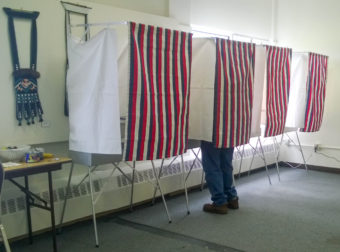
A primary voter fills out a ballot at the Juneau Arts and Culture Center on Aug. 19, 2014. (Photo by Jeremy Hsieh/KTOO)

Local voters could elect up to six new members to the Juneau Assembly and School Board this fall — if candidates step up.

The filing period for candidates in Juneau’s regular municipal election opens at the end of next week. Election day is Oct. 6.

So far only one newcomer has formally declared his candidacy.

Juneau Assembly

Merrill Sanford
Merrill Sanford

On the nine-member Juneau Assembly, the mayor and two others are up for re-election.

Mayor Merrill Sanford says he is seeking a second term.

“With the budget coming down from the State of Alaska and our budget situation, it could be very interesting, what we have to try to do to make our budget balance, for sure,” Sanford says.

He says he also wants to follow through with the city’s economic development plan. For now, he’s                                                              unopposed.

Jesse Kiehl
Jesse Kiehl

District 1 Assemblyman Jesse Kiehl shot down rumors from a political blog that intimated he was running for mayor.

“Nope, no plans to do that. I’m very happy serving in my current seat,” Kiehl says.

He won reelection to his second term on the Assembly unopposed last year.

Incumbent District 1 Assemblyman Loren Jones could not be reached for comment                                                                                              by press time. However, Jones filed a letter of intent in March to run again.

Loren Jones
Loren Jones

The only other candidate to formally file so far is newcomer Jason Puckett, who would face incumbent Jerry Nankervis in District 2.

“I figured it was time, cause we’re going through a lot of changes right now,” Puckett says. “Especially with, you know, tourism season is bigger and bigger every year, there’s a lot of new businesses downtown. Economy isn’t the best it’s ever been. We import most of our workers from other places as opposed to having people that live here have those jobs. So jobs are a big issue, affordable housing is a big issue for me.”

Jason Puckett. (Photo by Jeremy Hsieh/KTOO)
Jason Puckett

He also says he can help with the transition to legalized marijuana in Juneau. He says he lived in Colorado during the transition there, and saw what worked and what didn’t.

Puckett has lived in Juneau for about 2 years. He’s a GCI retail store manager, marshmallow entrepreneur and has served in the U.S. Marine Corps.

Jerry Nankervis could not be reached for comment.

Juneau School Board

School Board candidates Michelle Johnston, Phyllis Carlson, and Andi Story answer questions posed during a Chamber of Commerce candidates forum on Sept. 20, 2012. Photo by Matt Miller/KTOO News
Phyllis Carlson

Three incumbents on the Juneau School Board are finishing their fourth term.

Board President Phyllis Carlson says she hasn’t decided if she’ll run again.

“I do have time, but I do have grandkids,” she says. “And I just have things that I, that my family would probably like me around for more, but I am still also very passionate about our district and our public education system.”

Destiny Sargeant is also undecided. She cited concerns about caring for an elderly relative.

The final incumbent, Andi Story, is seeking her fifth term. She’s also finishing up a one-year term as president of the Association of Alaska School Boards.

“We really have to have a good budget process and plan at the state level so we can plan, you know, effectively at the local level, and so I’m really committed to keep working on that,” she says. “We’ve made some headway over the years. ”

More candidates?

Election info

For more information about Juneau’s municipal elections and how to run, visit www.juneau.org/clerk/elections/.

Candidates for Juneau Assembly and Juneau School Board must collect at least 25 qualified voters’ signatures and turn them in to election officials by Aug. 17. Candidates also must file a letter of intent, a financial disclosure and campaign finance paperwork with the Alaska Public Offices Commission.

Write-in candidates have until Oct. 1 to file their paperwork.

Assembly and School Board members serve 3-year terms. The mayor is paid $30,000 a year and regular Assembly members paid $6,000. School board members are paid a monthly stipend that amounts to $3,240 a year.

To vote in Juneau’s local elections on Oct. 6, you must be registered by Sept. 6.

UCLA report examines sexual orientation and gender discrimination in Alaska

(Photo by Mel Green)
An Alaska Pride flag. The image is based on a double-faced eagle design from Alaska before Russian contact. (Creative Commons photo by Mel Green)

Last Wednesday, the University of California, Los Angeles, published a report on employment discrimination in Alaska based on sexual orientation and gender identity. Alaska is home to more than 19,000 lesbian, gay, bisexual and transgender adults, according to a Gallup poll.                                                                             

The report, published by UCLA’s Williams Institute found that 17 out of Alaska’s 25 largest employers have corporate policies that prohibit discrimination based on sexual orientation. At least 11 of them list gender identity as a protected class. Some of these employers include Providence Health and Services, Wal-Mart, Fred Meyer and the Arctic Slope Regional Corporation.

Christy Mallory co-authored the report, and says it took about a month to compile.

The report predicts that if non-discrimination laws were expanded, approximately six complaints of sexual orientation or gender identity employment discrimination would be filed annually in Alaska.

“So, six complaints is pretty low,” Mallory said, “that’s mostly because there’s a smaller population in Alaska than many other states.”

The report also cites a 2012 web survey on LGBT discrimination in Anchorage.

According to the Anchorage survey, 44 percent of the respondents had experienced harassment and nearly a fifth had been turned down for a job or promotion. The survey found that transgender people are more at risk for housing and employment discrimination.

The report found that straight male workers’ income was 30 percent higher than gay male workers.

Mallory says their reports focus on the 28 states that don’t offer LGBT legal protection in the workplace.

In a 2011 poll, nearly 80 percent of Alaskans said Congress should pass a law to prohibit LGBT employment discrimination.

In 2002, Gov. Tony Knowles issued an administrative order protecting state employees from employment discrimination and harassment. There are no restrictions on the private sector.

Neither the Alaska State Commission for Human Rights or the Anchorage Equal Rights Commission processes discrimination claims based on sexual orientation or gender identity. But the Williams Institute says that this discrimination does take place, citing legislative testimony.

Site notifications
Update notification options
Subscribe to notifications