CBJ Assembly Meetings

Assembly addresses Juneau’s growing housing problem

(Photo by Elizabeth Jenkins/KTOO)
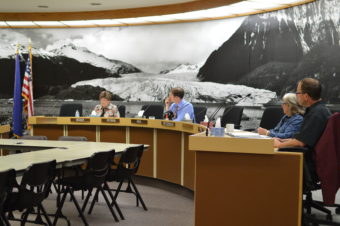
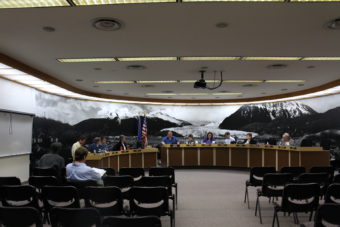
The Juneau Assembly on Monday. (Photo by Elizabeth Jenkins/KTOO)

Much of the conversation at Monday’s Juneau Assembly meeting centered on housing and how Juneau could grow as a city.

The Assembly approved $72,000 for a grant incentive program which gives homeowners cash to construct accessory apartments. Assemblyman Jesse Kiehl called the plan a “premature” use of limited funds.

“We haven’t heard from the public about what the recommendations are. We haven’t heard from the consultants about what the recommendations might even be and we’re using money quite frankly probably to incentivize things that are already, probably going to happen,” he said.

Kiehl said a housing action plan is already in process, further input is needed to make sure the funds are used wisely.

“An old saying is keep your powder dry. In this case, I think we need to keep the taxpayers’ cash dry,” he said.

In 2012, the Juneau Economic Development Council found the city needed hundreds of new units to improve the tight market for renters.

Assemblywoman Kate Troll said there is nothing in the housing action plan that suggests this is not a good move.

“The affordable housing commission is very engaged in this issue,   and they still feel very strongly in terms of trying to make a difference, a big difference on the ground for the smallest amount of money, this is a very worthwhile program,” she said.

Kiehl was the only Assembly member to vote no.

Later, zoning changes near mile 7 of Glacier Highway were discussed–a move some said could help with Juneau’s housing problem. The area is zoned for single-family homes. The ordinance would more than triple the density.

Dave Hanna testified it would “unfairly change the character of the neighborhood.”  Not fix Juneau’s housing problem.

“Now we’ve heard density is the answer to our housing problem here in Juneau but we also hear Juneau is sorely underserved in the single-family market. We really need more single-family homes here,” he said.

At an April meeting, the planning commission recommended denying the proposed rezone. The Assembly approved the ordinance with Assemblywoman Kate Troll and Assemblyman Jerry Nankervis voting no.

Editor’s Note: An earlier version of the story attributed a quote to Assemblywoman Karen Crane but it was Assemblywoman Kate Troll who said it. We regret the error. 

City looks to amend land use code to address child care crisis

AssemblyMeeting
The Juneau Lands and Resources committee met Monday evening to push forward an amendment to the city’s land use code that would allow child care providers to care for more children. (Photo by Lakeidra Chavis/KTOO)

The Juneau Assembly is working on amending child care permit regulations in an effort to increase child care availability in Juneau.

On Monday evening, the city’s Land and Resources committee forwarded an amendment that would change part of the land use code, allowing at-home child care facilities to take in 12 children instead of eight.
The Association for the Education of Young Children, or AEYC, provides resources and advocates quality child care in the Southeast. Coordinator Nikki Love says the organization is in full support of the amendment.

“There’s enough licensed care for 1 in 4, or 1 in 5 children, under the age of 5, so the need is really high,” Love said.

In the past few years waitlists have increased but remain at a steady rate, according to Love.

“We’d like to see a decrease in barriers to child care facilities and businesses in town since there is such a great need for child care, and changing the zoning would help open the door to potential businesses,” she said.

The amendment also provides a clear definition of child care home-facilities, requires at home providers to have sufficient parking and if state fencing requirements apply, the city may require the fence to meet neighborhood aesthetics.

If passed, the amendment would not affect any child care facilities currently operating.

The amendment is a part of a larger comprehensive plan to fix the child care crisis Juneau.

Gold Creek Child Development Director Gretchen Boone says she’s in favor of the permitting — the more childcare, the better.

Boone says the waitlist at Gold Creek has 75 children on it — the highest she’s ever seen it despite working at the facility for nearly two decades.

“Having more child care out there would benefit the entire community. There are families on our waitlist who have been on our waitlist for over a year and will probably never obtain space with us,” Boone said.

Lisa White, former owner of Little Bear Daycare, says she also had long waitlists.

“Usually by the time I would get back to some names they had long since found a place, but sometimes it would a year or two,” White said.

White cites over-regulation as the reason she closed her child care center in 2007.  Nearly finished with the re-licensing process she called it quits as a child care provider in Juneau after 17 years, a profession that she cherished.

While speaking about the lack of childcare in Juneau, White got emotional. She looks forward to the situation improving for Juneau’s families.

“It’s just going to keep getting worse unless they do something about it. There are all these families — they need this, and they don’t need this years from now, they need it years ago,” White said.

The amendment was forwarded on to the full assembly, and will be considered at a future meeting.

Editor’s note: We’ve clarified the amendment’s fencing requirement.


Juneau Assembly votes to raise penalty for unpermitted signs

downtown Juneau
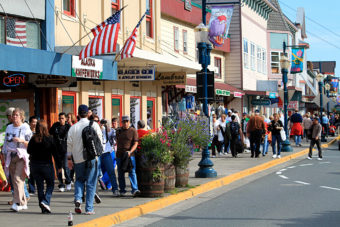
Downtown Juneau. (Creative Commons photo by Kyle Rush)

The Juneau Assembly voted Monday night to amend the signs code, adding a penalty that’s at least five times higher for unpermitted signs outside businesses.

Violators could pay $500 a day per offense; however, they may be eligible for a “fix it” period said Assemblyman Jesse Kiehl.

“If you get a citation for one of these sign violations, within 15 days, you can fix it,” he said. “You can get a permit, you can take it down–whatever it is. And your citation gets dismissed.”

Violators can only get one “fix it” period. After that, they can incur the penalty. The ordinance is based on one used in Skagway’s historic district.

Assemblyman Jerry Nankervis disagreed with the high fine, suggesting it should be lowered to $300. But Assemblywoman Karen Crane said there’s already been an enormous amount of discussion on the topic.

“There’s been agreement by a number of people. A lot of input on the $500 fine,” she said. “It’s worked well in other communities and I say, let’s go forward.”

Previously, business owners with unpermitted signs could be fined a staggered penalty of $25 to $100. It cost $50 to apply for a signs permit, only $25 for the violation. An advisory committee said that model discouraged compliance.

The new ordinance goes into effect at the end of July.

Police chief: Secondhand goods ordinance ‘extremely successful’

The crime rate in Juneau went down in 2014, according to an annual report released by the local police department.

Juneau Police Chief Bryce Johnson (left) and Deputy Chief Ed Mercer (right). File photo.
Bryce Johnson

Police Chief Bryce Johnson presented the report to the Juneau Assembly on Monday and noted that the underlying crime statistics show two clear trends.

“Property crime is down significantly, but violent crime is up,” he said.

In property crime cases, Johnson said an ordinance the Assembly adopted last August to curb fencing of stolen goods through certain businesses has become investigators’ primary tool.

“So on average, twice a month, the secondhand ordinance is the main reason we’re able to clear a criminal case,” Johnson said. “So from our perspective, it’s an extremely successful ordinance. We’re still working a little bit on the compliance part for some secondhand dealers. But it has been as productive or more productive than we actually thought it would be. It’s really helping us to clear some crimes.”

Since it took effect in September, Johnson said the ordinance has led to recoveries of jewelry, electronics and firearms in 11 separate cases.

The ordinance targets shops that buy and sell secondhand goods and is similar to state laws requiring pawn shops document and hold inventory.

Loren Jones
Loren Jones

Assemblyman Loren Jones said jewelry taken from his household ended up in the new system.

“When the police officer was in our entryway getting the information from my wife, a picture of the pawned item showed up on his phone. So she could identify it. It’s now sitting in the PD’s property,” Jones said. “It worked as it was supposed to.”

A massive spike in heroin seizures also drew attention. Police seized $4.7 million of heroin in 2014, about eight times more than in 2013. Meanwhile, OxyContin and oxycodone pill seizures fell to about 1 percent of 2013 levels.

Johnson said the spike in heroin seizures is likely driven by addiction, and partially from increased police presence at the airport. Juneau police replaced private firms for round-the-clock security at the airport in October 2013. The airport is a primary point of entry and hub for regional trafficking.

Another trend Johnson mentioned to the Assembly was the use of body cameras.

“Every agency in the country is trying to get body cameras right now. So I may come back at some point to talk body cameras. It’s the future; I don’t see how we don’t go forward with that,” he said.

Finally, Johnson also noted that the department had lost its professional accreditation because the credentialing organization it used no longer exists. The department is seeking a new credentialing agency. Accreditation essentially means that a third party can verify that a department meets professional police standards.

Assembly adds $673K to current year’s budget

The Juneau Assembly last night unanimously approved more than $673,000 in additional spending for the current fiscal year that ends June 30.

The bulk of that is $500,000 for the Juneau School District, bringing the city’s local contribution for the current year to the maximum allowed under state law.
The Assembly also approved additional spending for the Juneau Airport, Eaglecrest Ski Area, the city law department, and downtown parking.

The money to cover the increased expenditures will come from various reserve funds.

Juneau Assembly approves city, school district budgets

The Juneau Assembly approved both the city and school district’s 2016 operating budgets last night.

The City and Borough of Juneau budget totals more than $321 million next year. That includes city enterprises like Bartlett Regional Hospital, Docks and Harbors and Eaglecrest Ski Area.

The Juneau Assembly meeting (photo by Elizabeth Jenkins/KTOO)
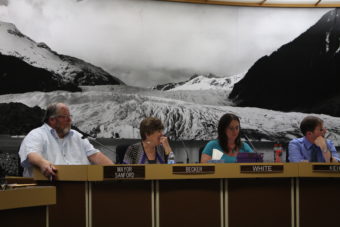
The Juneau Assembly approved the 2016 city and school district budgets Monday night. (Photo by Elizabeth Jenkins/KTOO)

The Juneau School District budget totals more than $85 million. Mayor Merrill Sanford was the only Assembly member to vote no on both items. He said he would have preferred CBJ have more control over how the money set aside for the school district be spent.

“In my mind that money should have went into our budget, the city and borough, and be then be doled out to whoever needs it. And it very possibly could be the school district in the next year or two. But by forwarding it to the school district, we do not have that money available to us for the next two years or the next one year,” Sanford said.

The city unexpectedly received about $600,000 from the federal Secure Rural Schools program recently. Sanford says that money could have offered some security for the the city in uncertain economic times.

“So it takes it off the table for us and gives it to only one part, one segment of our total budget,” he said.

The Secure Rural Schools funds will be counted as revenue in this year’s school district budget, which was the first in recent memory that the Assembly did not fund to the maximum allowed under state law.

No one from the public stepped forward to testify on behalf of either budget item. Both the city and school district budgets take effect July 1.

Site notifications
Update notification options
Subscribe to notifications