Auke Lake reflection. (Flickr Creative Commons photo by Alaskan Librarian.)
Juneau’s Parks and Recreation Advisory Committee last night (Tuesday) recommended the CBJ Assembly adopt an Auke Lake Management Plan developed by Parks and Rec staff largely as written.
The PRAC made minor changes to the plan, unveiled in early January. The panel also made an alternative recommendation that would mean fewer restrictions on motorized use, but require additional city funds for enforcement and boater safety education for Auke Lake users.
The recommendations now go to the Juneau Assembly Committee of the Whole for its consideration.
Sixteen-year-old Savannah Cayce was being towed in an inner tube by a jet ski and collided with another jet ski. She died two days later. While the investigation did not result in any charges, the city manager promised a review of management at the small lake.
Current law limits the size of water craft to 16 feet. Motorized use is prohibited between shore and a buoy line; several areas are no wake zones, in fact only 70 acres of the 165-acre lake are considered useable. Refueling is also prohibited.
Enforcement is the problem, according to most of the public comments. Some lakeshore residents say the sunny warm days are so busy that it’s “mayhem out there.” And that it’s not safe.
But many say the lake does not get that busy.
The draft plan would replace vessel size regulations with a 10-horse power limit; no towing would be allowed, more highly visible buoys would be placed and a seasonal park ranger would be responsible for enforcing regulations.
As written, the draft plan would eliminate jet skis, water skiers and wake boarders, and any vessel with a motor above 10 horsepower.
Alaska Native Brotherhood Grand President Bill Martin and Alaska Native Sisterhood Grand President Freda Westman testify to the Juneau Assembly on January 28, 2013. Photo by Casey Kelly/KTOO.
The Juneau Assembly on Monday voted to change the boundary of the city’s historic district, clearing the way for Sealaska Heritage Institute’s proposed Walter Soboleff Center to be built as designed.
The four-story, 29,000 square foot education and cultural facility will be constructed on a vacant lot at the corner of Seward and Front Streets downtown. The property was right on the edge of the historic district until Monday, when the Assembly voted to remove it.
While the district honors the late 19th and early 20th century architecture of Juneau’s original mining period, plans for the Soboleff Center call for traditional Tlingit, Haida and Tsimshian designs with modern flourishes.
The city’s Historic Resources Advisory Committee recommended the Assembly keep Front Street as part of the historic district, a move opposed by Sealaska Heritage officials.
SHI President Rosita Worl said forcing the nonprofit to redesign the building would be costly and delay the project.
“It would take up to 20 variances in order to meet the direct district standards,” Worl said. “The architectural and engineering costs alone, those changes and modifications would require an additional $120,000 and a two to three months delay, just in the design.”
Worl also called any changes a “serious challenge” to SHI’s cultural values.
“We believe that the design of the center compliments the historic district and the history of Juneau by highlighting Native inspired architectural design and the heritage of the Tlingit Indians that is largely absent from the historic district and all other areas of Juneau,” she said.
Rosita Worl. Photo by Casey Kelly/KTOO.
Alaska Native Sisterhood Grand President Freda Westman added that the building would not just be for Juneau residents to enjoy.
“Visitors coming from the surrounding villages. They are going to want to see this building be presented intact, in the way it was designed,” Westman said. “It will honor them, and it will honor us.”
The Assembly approved the boundary change without any debate.
SHI has secured most of the estimated $20 million needed for construction. That includes $3 million in sales tax revenue approved by city voters last year. The project could break ground as soon as this year.
The facility will be named for the Reverend Doctor Walter Soboleff, a renowned Tlingit elder and scholar who passed away in 2011 at the age of 102.
The property where it will be built is the site of the former Skinner Building, which was destroyed by fire in 2004. It subsequently fell into disrepair and was known as “The Pit” until Sealaska bought it in 2010.
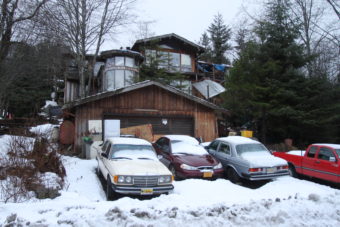
Red security tape strung by the CBJ and debris clutter the entryway to Ronald W. Hohman’s house at 3101 Nowell Avenue in West Juneau. Photo by Annie Bartholomew/KTOO News
West Juneau residents are expressing concern that the first deadline in a new agreement for a repairs to a dilapidated home may have already been missed.
The house on 3101 Nowell Avenue has been deteriorating for years and has been deemed unfit for human occupancy. The owner, Ronald W. Hohman, has said that he’s been attempting repairs and clean-up of the yard and interior. But neighbors say the structure is still a safety hazard and an eyesore with junk and debris both inside and out.
City Attorney John Hartle briefed the Assembly about the agreement during a recent meeting.
“It will provide an enforceable contract between the City and Mr. Hohman to accomplish the things that need to be done,” Hartle said. “He’s hired a contactor. The contractor has power of attorney for him. It’s actually the contractor that signed this agreement. We think that it’s a step forward.”
The settlement agreement specifies that the litter, junk, and debris in the yard must be cleaned up by January 22nd, or two weeks from the signing of the agreement on January 8th.
All of the trash, rotting food, garbage, and other items with rodent feces, moisture, and mold must be cleared out of the interior of the house by February 8th.
The garage, which is believed to still contain sewage after a sewer line was erroneous severed by city crews, must be cleared out thirty days after Hohman returns to Juneau.
Portions of the house declared to be in imminent danger of collapse must be demolished within sixty days, and repairs must be made to interior framing. Fumigation and repairs must be made to the roof of the house and roof of the garage within two months.
Other junk, household appliances, personal items, and trash must be cleaned from all exits to allow for safe access to the house within 180 days. Outside decking and stairways must be repaired or removed by then as well.
The clock temporarily stops ticking as any applications for required building permits are reviewed by the CBJ.
All of the work will be done at Hohman’s expense with the exception of cleaning up the garage or replacing any carpet in the garage. That expense will be picked up by the City.
Under terms of the agreement, a lawsuit filed by the City has been stayed or set aside. Trial in the case was scheduled for this coming August. Satisfying the terms of the agreement could mean dismissal of the suit. But if Hohman or his contractor Leitoni Tupou, who is acting on his behalf, fails to meet the agreement’s various deadlines for clean-up and repair of the property, then the stay will be lifted and the lawsuit will proceed to trial as earlier scheduled.
Ronald W. Hohman’s house at 3101 Nowell Avenue in West Juneau. Photo by Annie Bartholomew/KTOO News
One of Hohman’s West Douglas neighbors, Sioux Douglas, said she hasn’t seen much going on at the property lately.
“There’s been no sign of any kind of activity or clean-up associated with that first deadline,” Douglas said. “That’s a big a step. It will be hard to believe the contractor hired to do this will be able to accomplish that and meet that first deadline.”
Douglas said she’s glad that city staff and the Assembly are now committed to resolving the issue. But she notes the agreement gives Hohman most of 2013 to make repairs while neighbors have been enduring the deteoriating property for years.
“How long is this going to occur when we have the same health and safety problems?” asks Douglas.
CBJ Building Official Charlie Ford indicated last week that he’s in near-regular contact with contractor Leitoni Tupou.
Hohman is apparently out of state and out of contact. But Tupou said that he had workers at the house for two days last week assessing the property. He was also waiting for financial arrangements to be finalized by Hohman’s bank and waiting for inclement weather – including heavy rainfall – to subside before working on the property. Tupou said he didn’t want to endanger his workers on the sloping lot.
Hohman has contended his house was a million-dollar home before it fell into disrepair. He has partly blamed former tenants for all of the trash and debris. The property is now valued by the CBJ Assessor at a little over $125,000, with the structure valued at about $35,000.
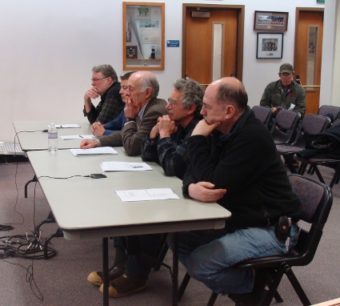
Local developers from left to right: Murray Walsh, Richard Harris, Wayne Coogan, Dave Hanna, and Jeff Grant. The Assembly is asking members of the local housing industry for recommendations on housing. The developers’ panel was the first to present at a Committee of the Whole work session Monday night. Photo by Casey Kelly/KTOO.
The City and Borough of Juneau should relax its planning and zoning regulations and implement tax incentives to encourage more home building.
That was the message a panel developers had for the Juneau Assembly Monday night in the first of series of discussions assembly members hope to have with representatives of the local housing industry.
Wayne Coogan of Coogan Construction did most of the speaking on behalf of the developers. He acknowledged that a lot of factors go into the cost of housing — land, materials, labor, and insurance to name just a few. But he said planning and zoning influence all of them.
“Housing is regulated by all branches of government, federal, state, etc,” Coogan said. “However, the most influential and overreaching regulations are the local zoning and building codes administered by the city.”
The developers gave the Assembly a list of 18 recommendations to make it easier to build homes in Juneau. They range from eliminating the city-led plan review, which is required even when a licensed architect or engineer is involved in a project, to tax incentives for subdivision amenities and new multi-unit construction.
General contractor and consultant Dave Hanna urged the Assembly to look into a new state law that allows municipalities to defer property tax increases on new subdivision lots until those lots are sold.
“The difference between the property taxes on a raw piece of land and a subdivision that’s about to be built is atrocious,” said Hanna. “It would go from a few thousand an acre to maybe $150,000 for a large subdivision. This basically doubles the carrying costs for a developer who’s trying to bring a new subdivision on line.”
Assembly member Jesse Kiehl noted that much of the city’s building code is based on national and international standards. He asked the panel if there was a better approach for Juneau.
Coogan didn’t give any specifics, but encouraged the Assembly to pursue it.
“You’re raising a point that should be looked into,” he said. “Spend a few dollars on some legal research and find out how much liberty the city has to surgically modify the code for its own use.”
Other members of the developers’ panel included Murray Walsh, Richard Harris and Jeff Grant.
Juneau has some of the highest costs and one of the tightest markets in the state when it comes to housing. The Assembly also plans to meet with property owners, lenders and realtors to find solutions to the problem.