CBJ Assembly Meetings

CBJ water rate study underway

A Water Supply Plan that considers Salmon Creek as the best opportunity for expanding Juneau’s water system does not mention conservation.

While conservation may well be important, CBJ Engineering Director Rorie Watt said it probably wouldn’t happen in Juneau until customers are metered.

“Conservation is going to happen with community-minded people who are disposed toward conserving, but the bulk of the public is going to need to see the economic impact of using more or less before they really embark on big conservation measures,” Watt told the Assembly Committee of the Whole on Monday.   

He said metering water customers would cost the city about $5 million.

While metering isn’t part of the Municipal Drinking Water Supply Plan, a rate study is underway. Watt said the study will look at equity and whether different classes of users are paying their fair share.

“What I hear anytime I go to the Utility Advisory Board is ‘pay for use.’  That’s what the utility board believes in; I think that’s what your staff believes in as well. Pay for the water that you use,” he said.

The rate study is being conducted by the CBJ Public Works Department. Watt said he expects it to recommend changes in the allocation between users groups “so that people pay the cost of what they use.”    The study will be finished in about a year.

The Assembly Committee of the Whole has moved the water plan forward to the regular Assembly.  It likely will come up for a public hearing sometime next month.

The plan is intended to guide Juneau’s water system and management in future years.

Assembly to schedule public hearing on water system plan

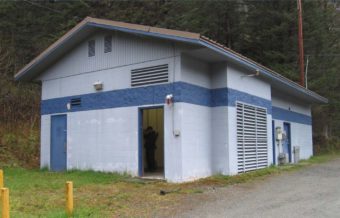
Last Chance Basin water treatment plant
Last Chance Basin water treatment plant. (Image courtesy CBJ)

The Juneau Assembly has given its tentative blessing to a Municipal Drinking Walter Supply Plan.
Meeting as a Committee of the whole Monday evening, the panel moved a resolution onto the regular Assembly, so the plan can be scheduled for a public hearing.

The plan grew out of the AJ Mine Advisory Committee’s work in 2011, when it considered the feasibility of re-opening the old gold mine near downtown.  A study of Juneau’s water system and a drinking water supply plan were the Committee’s top priorities, whether or not the old AJ Mine were to reopen.

The plan will guide the capital city’s water system and management for years to come.  It’s been before the Assembly on several occasions and each time CBJ Engineering Director Rorie Watt advises members to “read the report of the (AJ Mine) Advisory Committee and read the water study, and really understand them well.”

Watt told members it’s important they be able to discuss the water system policy with the public, “but in discussing the policy level, they want to talk about the details, and you need to understand what those plans and studies got into.”

Juneau’s water comes from five deep wells in Last Chance Basin. Salmon Creek is the second source, but interruptible, due to seasonal turbidity.

The 100-year-old dam is owned by Alaska Electric Light and Power.  The company recently completed a structural stability review. The report indicates the dam is safe to operate.

Assembly member Jesse Kiehl asked Watt if he considers Salmon Creek an expansion or redundant source of water.

“I think a little bit of both.  I think it’s good to have redundancy in our water system if we can afford it and if it gives us policy flexibility in how we manage our water system,” Watt said.  “And I think with decreasing well capacity, replacing supply in general is also not a bad thing.”

Juneau voters in October approved the use of $1.53 million  in sales tax revenue for water filtration at Salmon Creek.  The money is to be allocated over fiscal years 2016 and 2017.

Watt says there are five actions that would trigger a decision to construct a filtration plant at Salmon Creek, including growth in Juneau, increased demand for city water from cruise ships, regulatory requirements, declining well field production and turbidity in Salmon Creek.


Glacier Highway power resolution to go before Juneau Assembly on Wednesday

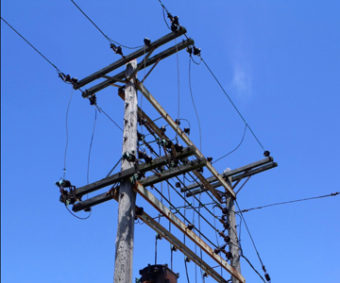
The Juneau Assembly will consider a resolution expressing support for electric power to the end of Glacier Highway at a special meeting on Wednesday.
A draft of the resolution was posted to the city’s website Monday afternoon. It mentions the economic benefits of electric power to residents and property owners in the area. It also says extending hydroelectric power to the end of the road would reduce carbon emissions and make the area more attractive to future housing development.

It does not mention potential benefits to the Kensington Mine and other mining development in the area, or the State of Alaska’s Juneau Access project.

This will be the public’s first and possibly only chance to comment on the resolution. The idea came out of discussions at two Assembly retreats, where public input was not allowed.

Members are trying to act fast, so Governor Sean Parnell can consider putting funding for a project in his state budgets for next fiscal year.

The special meeting will be held Wednesday at 5:30 p.m. in City Hall Assembly Chambers. It will be immediately followed by the Assembly Finance Committee meeting.

Link:
CBJ Resolution 2632

Juneau Assembly Housing Committee gets to work

Randy Wanamaker
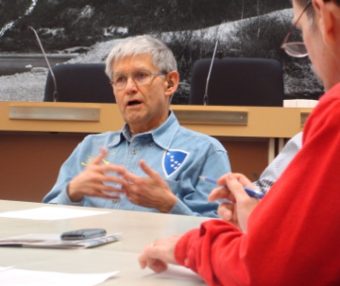
Juneau Assembly member Randy Wanamaker makes a point during the first meeting of the Assembly’s ad hoc Housing Committee. Photo by Casey Kelly/KTOO.

Calling all land owners, developers, lenders and realtors. The Juneau Assembly wants to hear from you.

The Assembly’s ad-hoc Housing Committee met for the first time on Thursday to lay the foundation for what members hope will be a day-long workshop on barriers to new housing construction in the Capital City.

The idea is to have three or four panels, each representing a segment of the housing industry, come together for a day to tell the Assembly what’s preventing construction of new units in Juneau.

It’s the brainchild of Assembly member Randy Wanamaker, who’s organizing the event.

“What are the problems that they face in trying to provide housing in this community from their perspective as lenders or builders or property owners or real estate people? And what do they think the Assembly can do about it?” Wanamaker says.

Housing is the number one reason the Capital City has the highest cost of living of the state’s three largest metropolitan areas, according to the Juneau Economic Development Council’s annual Economic Indicators Report.

The city has an Affordable Housing Commission. But Wanamker says the workshop should focus on all aspects of housing.

“There’s a need for all housing in this community,” he says. “There’s some housing that’s in less shortage than others. But we’re not limiting ourselves to studying one segment. We’re trying to learn what prevents housing from happening across a spectrum.”

Assembly member Carlton Smith is a commercial real estate broker. He says Wanamaker’s approach could benefit the industry just as much as the Assembly.

“All of these folks work well with each other in the industry,” Smith says. “But this will be the first time I believe that they will be brought together in this kind of a forum to talk about Juneau’s unique set of challenges when it comes to providing housing.”

Juneau’s Deputy Community Development Director Greg Chaney says the city has taken a number of steps in recent years to encourage new development.

“Between rezoning and the increase in density allowed in these various zoning districts,” says Chaney. “We have 18,000 potential units more than we did just two years ago.”

So what’s stopping people from building in Juneau? Chaney says financing is still hard to come by due to the national recession.

As for things the city can do better, he says education is key. For example, Chaney says a builder recently came to see him wondering if he was allowed to put more than 15 units on a Light Commercial lot.

“They were pretty sheepish about it, because they didn’t think it was allowed. And I said, ‘No, you can do 30.’ And that was really surprising for them, and these are active builders and property owners in town right now,” Chaney says.

“When I realized that they didn’t know about it, I was thinking, boy what about the folks that are just average folks? They don’t get notices in the mail. They don’t know that these are possibilities. So, I think we have a real opportunity for public education right now.”

Wanamaker agrees the city can do a better job of outreach.

“Sharing that information, letting them know that some solutions have already been implemented, is probably a very good idea,” he says.

For now, Wanamaker will focus on recruiting people to serve on the various industry panels. He hopes to schedule the workshop for some time in January to allow potential changes to be discussed before the 2013 construction season.

Juneau Assembly approves funding for three projects

The Juneau Assembly approved three ordinances Monday to fund ongoing projects in the Capital City.
A four-year effort to map low-grade wetlands will be paid for with a $1.6-million state Department of Commerce, Community, and Economic Development grant.

Deputy Community Development Director Greg Chaney explained that the project will use LiDAR, or light detection and ranging, and aerial photography to identify wetlands suitable for development. He said the imagery will be “ground-truthed” to ensure proper labeling of wetlands.

“That’s one of the big parts of this project,” Chaney said. “We’ll have the initial aerial photography, LiDAR, and then that remote sensing will be used by people who go in the field and actually verify on the ground.”

The project is scheduled to wrap up in February 2016.

Meanwhile, the Assembly appropriated another $7-million grant from the state Commerce Department to fund the Dimond Park Library project. That’s about half of the estimated project cost. The rest will come from the city’s temporary 1-percent sales tax, Friends of the Library fundraising, and the city’s Library Endowment Fund. Also included in the estimated project cost is the city’s donation of about $1-million in land where the new library will be built.

The final appropriation was a more than $177,000 grant from the Alaska Department of Transportation for the Juneau Airport’s runway safety area improvement project. The nearly $24-million dollar project is mostly funded by the Federal Aviation Administration.

The Assembly approved all three measures unanimously.

Juneau Assembly reaches decision on appeal of cruise ship dock permit

Cruise Ships
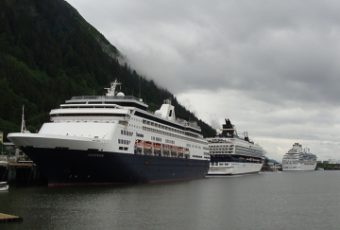
The Juneau Assembly has decided if a city Docks and Harbors project to build two floating cruise ship berths on the downtown waterfront can move forward. But the decision won’t be made public until after its in written form. Photo by Casey Kelly/KTOO.

The Juneau Assembly has decided if it will allow the city’s Docks and Harbors Department to build two controversial floating cruise ship berths on the downtown waterfront. But its decision won’t be known by the public for a few more weeks.

The Assembly met in executive session for more than hour Monday to discuss how to rule on an appeal of a Planning Commission permit issued for the project in June.

After emerging from the closed-door session, Assembly members declined to reveal their direction to the city Law Department, which will draft a written decision to be approved at a future meeting.

Earlier Monday, the Assembly held a public hearing to take testimony from a group of local residents opposed to the new docks, as well as staff from the city’s Community Development and Docks and Harbors Departments.

Linnea and Arthur Osborne appealed the Planning Commission permit in July, about a month after it was issued. The board of directors of the Juneau Commercial Fishermen’s Memorial and local resident Dixie Hood joined as interveners.

The Osbornes, who own and operate the fishing vessel Mongoose, argued the Commission failed to adequately consider the impact of the new cruise ship docks on Juneau’s commercial fishing fleet. Specifically, Linnea Osborne said the city did not study whether the floating berths would limit access to the nearby Taku Smokeries dock.

“If we can’t get to the dock, we’ll have to go elsewhere,” Osborne said. “And it’s not just a matter of running into Auke Bay. If we lose our downtown processor, everyone loses.”

Taku Smokeries did not join the Osbornes’ appeal.

Fishermen’s Memorial Board President Bruce Weyhrauch argued the floating docks would ruin the view of Gastineau Channel from the monument and compromise the annual Blessing of the Fleet ceremony.

“It’s going to block the historic purpose for locating the fishermen’s memorial there,” Weyhrauch said.

The Planning Commission was represented at the hearing by Deputy Community Development Director Greg Chaney. He declined to address Weyhrauch’s comments, because the location of the memorial was not part of the appeal.

However, Chaney noted the project has been the subject of significant scrutiny over the years, including several public meetings dating back before the Planning Commission’s involvement. When the Osbornes first raised their concerns in January, Chaney said the Commission delayed action on the permit in order to give the city’s Docks and Harbors Department time to address concerns about fishing vessel traffic.

“This project is better for the process,” Chaney said. “The Osbornes did come, they testified, they’re part of our commercial fishing fleet. The project was modified to address their concerns. Now, it didn’t address them maybe to the degree they would like, but I think it was an excellent example of the process at work.”

Docks and Harbors redesigned the project so the floating cruise ship docks would be further away from the Taku Smokeries dock. Port Director Carl Uchytil said the project as currently designed would provide 211 feet of clearance between the Taku dock and the southernmost cruise ship berth. Uchytil said that’s more than 2.5 times the clearance needed to meet the “reasonable access” standard for vessels less than 80 feet in length.

“We are also working with the Alaska Marine Exchange to develop technology, which will provide real time wind and current information at the facility to aid in safe navigation in this vicinity,” Uchytil said.

Assembly member Jesse Kiehl brought up the distance between the two docks in asking the Osbornes to clarify their objections.

“It seems to be a wider maneuvering room than just about any harbor we’ve got in Juneau,” Kiehl said. “Help me understand the safety concern.”

Linnea Osborne responded that navigating a boat into a harbor is a lot different than in an open channel.

“This is where I guess it’s so important that Docks and Harbors should have had an open, public meeting on these items and on these assessments to gain a better idea of this current and the navigation challenges that these guys deal with,” Osborne said.

In his comments Uchytil said mariners should always use caution and that nobody would be forced to use the dock when the weather wouldn’t allow it.

After the Assembly met to discuss the matter in executive session, Mayor Merrill Sanford and Assemblyman Johan Dybdahl, who presided over the appeal hearing, said they hoped a written decision would be ready in a couple weeks.

Two more appeals resolved

The Juneau Assembly resolved two other appeals of Planning Commission decisions on Monday.

Members voted to accept the findings of a hearing officer in a case pitting residents of the Montana Creek neighborhood against Coogan Construction. The Commission issued a conditional use permit allowing the company to operate a rock crusher in a nearby gravel pit.

Attorney Michael Lessmeier found substantial evidence supporting the Planning Commission’s decision. The Assembly discussed his ruling during its closed-door executive session. When members emerged, the vote was 8-1 to accept Lessmeier’s findings. Assemblyman Jesse Kiehl opposed the motion, saying he disagreed with Lessmeier’s interpretation of the law. Lessmeier ruled in the case after the Assembly recused itself, because former Assembly member Ruth Danner was among those who filed the appeal.

The other case was resolved before the Assembly meeting, when resident Janet Thrower agreed to dismiss her appeal of a decision allowing a second driveway at the Professional Plaza office complex near the airport. In return, the buildings’ owners agreed to install more signage.

The Assembly voted to refund Thrower’s $250 appeal fee to show good faith to those who choose to resolve appeals amicably.

Site notifications
Update notification options
Subscribe to notifications