CBJ Assembly Meetings

Juneau Assembly declines to get involved in Auke Bay speed limit issue

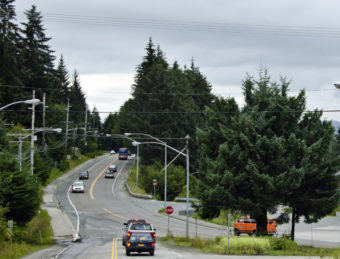
Cars heading approach the curve around DeHart’s as seen from Mendenhall Loop Road.

The Juneau Assembly this week decided not to request lower speed limits as part of an Alaska Department of Transportation project in the Auke Bay area.

That means the section of Glacier Highway from Auke Lake to the intersection with Back Loop Road will continue to be designed for a 40 mile per hour speed limit. However, DOT may consider other changes to encourage slower traffic in the area just north of the Auke Bay business district.

DOT Southeast Region Director Al Clough told the Juneau Assembly Committee of the Whole Monday night that it wouldn’t make sense to build a road that was either under or over design.

“If we were going to lower the speed limits we would readjust the road footprint accordingly to be the appropriate design standard for those speeds,” Clough said. “That would be a pretty significant change in the project as it’s already been scoped, as it’s been designed, and as it’s gone out to the public.”

Clough estimated up to a year delay if the project had to be redesigned and put out for further public review.

Pressure from the public was the main reason the Juneau Assembly asked CBJ staff in September to take a look at the project and recommend whether the city should get involved.

Glacier Highway from Auke Lake to Back Loop Road is currently posted at 35 miles per hour. Engineering Director Rorie Watt said an increase to 40 would be acceptable, because of the state’s plan to straighten the curve at the Auke Bay Laboratory.

“From our meeting with Planning, Engineering and Manager’s staff, we viewed their proposed improvements in that corridor as pretty good solutions,” Watt said.

The speed limit in the business district is also 35 miles per hour, except when kids from Auke Bay Elementary School are in the area. Then it’s a 20 mile per hour school zone. At about Waydelich Creek, it picks back up to 45 miles per hour.

Clough said a DOT study from two and half weeks ago showed people driving about the speed limit or little a faster through the entire area.

“Essentially right now people are driving 35 to 40 around the curve and within spitting distance of 35 through past the school and such, except when the school zone’s active,” he said.

Clough and Watt said it would be easier to make changes to the project north of the Auke Bay business district. One suggestion was to put a traffic island in the middle of the road to encourage drivers to slow down.

Clough said DOT would keep exploring its options, but offered no promises.

“We’re continuing to look at other traffic island or pedestrian island opportunities,” Clough said. “But with the driveways and such it’s not looking good to add too many more. But we’ll continue to look at that and some other potential changes.”

While some Assembly members still expressed frustration about the speed limits, there was reluctance to slow the process down.

The next step for the project is to go to the city’s Planning Commission for permits, and Assemblyman Randy Wanamaker said that’s the appropriate place to deal with the issue.

[quote]”We have city staff and DOT that can work together through the Planning Commission process to do whatever is necessary to hammer out the details. I do not believe this body needs to take official action and potentially cause delay.”[/quote]

Clough said the first phase of the project – a roundabout at Glacier Highway and Back Loop Road – is expected to break ground next spring. Construction on the area between Auke Lake and the intersection had been expected next summer, but Clough said it might be postponed by a few months due to what he called “other issues” unrelated to the speed limit discussion.

CBJ, Juneau Community Foundation to team up on ice rink study

Brent Fischer
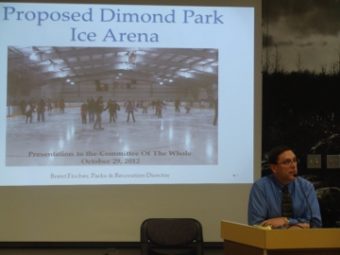
CBJ Parks and Recreation Director Brent Fischer talks about the proposed Dimond Park Ice Arena at the Juneau Assembly’s Committee of the Whole meeting Monday night. Photo by Casey Kelly/KTOO.

Juneau Parks and Recreation Director Brent Fischer says the city cannot afford to operate an ice rink at Dimond Park in the Mendenhall Valley.

In a presentation to the Juneau Assembly Committee of the Whole Monday, Fischer cited declining use at the city’s only current indoor ice facility – Treadwell Arena – plus the cost of running a new rink.

“Based on the declining user group membership and rink use, the demand just does not indicate a current need for an additional sheet of ice,” Fischer said. “If we were to operate a facility similar to the Treadwell Ice Arena at Dimond Park, based upon the current budget, the CBJ just cannot afford it.”

The nonprofit Juneau Community Foundation received a $650,000 legislative grant earlier this year for planning and design of a Dimond Park Ice Rink. The project was inserted into the state capital budget by Valley Representative Cathy Munoz.

The community foundation proposed building the facility on CBJ land at Dimond Park, then turning it over to the city to operate upon completion. A similar arrangement was used to build the Dimond Park Field House, completed in 2008.

But Fischer said an ice rink is not part of the city’s current plans for Dimond Park.

“In the original 1996 Parks and Recreation Comprehensive Plan, it did mention the rink in the valley, but it was taken out in the 2007 addition due to the addition of the Treadwell Ice Arena,” he said.

On the other hand, Fischer said the city’s plan for Savikko Park, where Treadwell Arena is located, refers to the “potential for a second rink to be added.”

Fischer said demand at Treadwell is highest during peak hours – defined as 4 p.m. to 10 p.m. on weekdays and all day on weekends. He admitted a second rink would help alleviate some of the pressure for ice time during those hours.

Assembly member Jesse Kiehl said he was sympathetic to users wanting more prime time skating opportunities.

“As we look, though, at what may or may not be possible to meet that demand, it seems to me that it would be worth it, if the city’s going to be involved in such a study, to look at more than one potential site,” Kiehl said. “And see if we can find, if a second sheet is justified, what’s the most efficient way to do it?”

A chart of the usage by different groups. Chart courtesy City and Borough of Juneau Parks and Rec.

The legislative grant to the community foundation can only be spent on the Dimond Park proposal. But the Assembly directed the city manager to work with the nonprofit to commission an independent feasibility study that would look at all possible options for a second rink. The city would cover the costs associated with studying the feasibility of the location next to Treadwell.

Community Foundation President Eric Kueffner said he was satisfied with that idea.

“The whole point of the community foundation is we don’t want to waste these funds,” Kueffner said. “We don’t want to start off down this avenue and use this money to study the construction of a facility if the city says, ‘Well, we have other plans for that location.’ That was our very first major concern.”

For now it appears the project will move forward, albeit cautiously, as the Assembly and city staff figure out the best way to proceed.

The city manager is expected to bring a draft request for proposals for the feasibility study back to the Assembly at some point in the future. No timeline was given.

Read the full presentation.

Juneau Assembly makes progress on “big picture” goals list

Merrill Sanford retreat
Juneau Mayor Merrill Sanford makes a point during the CBJ Assembly’s annual retreat on Saturday October 27, 2012. Photo by Casey Kelly/KTOO.

Juneau Mayor Merrill Sanford says the CBJ Assembly made good progress Saturday at its annual goal setting retreat. But he expects at least one more meeting before the annual list of Assembly and staff priorities for the coming year is finalized.

“I think we got a bunch of different topics addressed out there,” Sanford said. “There’s a few things that we have to get more in-depth to. And what we’ll do is get this all organized and typed up and clean it up for us.”

As expected, many of the goals on the initial list are longstanding Assembly priorities, such as housing, economic development, Juneau’s role as Capital City, and solid waste.

Assembly members worked with facilitator Scott Miller of the McDowell Group this year to try and focus the discussion. The result was a list of so-called “big picture” goals, each of which includes a sub-list of specific plans or actions. For instance, under the “Housing” priority one of the specific action items calls for convening a workshop with developers, property owners, and banks to find out what they see as barriers to new home-building in Juneau.

Sanford thinks many of the specific priorities can be accomplished in the near term.

“Almost every single one of them have been worked on for the past number of years,” said Sanford. “And I think what we’re trying to do is facilitate the different subcommittees and committees that have worked on all this stuff and getting that information to us as the Assembly and then making decisions on what our next steps are.”

City Manager Kim Kiefer thought the dialog was helpful. But she urged the Assembly not to lose sight of those over-arching goals. She reminded members that while they are elected to serve three-year terms, the average CBJ employee works for the city about ten years.

“What’s really helpful is to know that there’s long-term goals that go beyond that three years,” said Kiefer. “What’s the ten-year? What’s the fifteen-year? What’s the twenty-year? Each Assembly will take a different tact to get to that point, but that we’re keeping that ten or fifteen year plan out there.”

Sanford said he would like the Assembly to finalize its goals in the next month or two, but said it would take as long as it needs to get it right. He acknowledged that it could be difficult to work on during the upcoming holidays.

Juneau Assembly to set goals for next year at Saturday retreat

The Juneau Assembly holds its annual retreat on Saturday.

No action will be taken, no money appropriated, just a discussion of the Assembly’s goals for the next year. By the end of the day, the Assembly and city staff will have a list of new of priorities to work on.
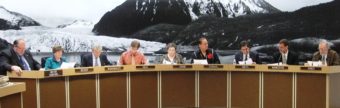
But just because an item makes it onto the list, doesn’t mean it will get accomplished in twelve months.

Of the Assembly’s top ten action item goals from last year, only one can be definitively crossed off the list. The Assembly successfully recruited and hired a new city manager when it decided in January to promote then-Deputy Manager Kim Kiefer.

The rest of the items range from some that are partially complete, such as support for a new state Library, Archives and Museums project, to longer-term goals like promoting Juneau as a world class climate research center.

New Mayor Merrill Sanford says he’d like to see this year’s list distinguish between those goals that can be accomplished in the next year, and ongoing projects.

“Maybe we do a ‘This years’ worth of goals,’ and then maybe we have things that are going to take us five to ten years out, and maybe we stick those in a different column,” Sanford said.

Sanford was an Assembly member from 2002 through 2011, so this won’t be his first retreat. The meeting is held every year, a couple weeks after the municipal, once the new Assembly has been seated.

In recent years, former Mayor Bruce Botelho led the retreat discussion. This year, Sanford asked Scott Miller from the McDowell Group to facilitate.

“This just gets a different perspective on it and lets us open up a little bit more and get ideas that we all support more of, instead of just individual ideas,” Sanford said.

Sanford gave the Assembly homework this week, asking each member to bring to the retreat some suggestions for the overall goals list. The mayor’s own ideas include increasing affordable housing, working on solutions to the city’s homelessness problem, and economic development. Sanford admits those are probably more long-term projects, but he says some things can be accomplished in the next year:

[quote]”There’s no one great answer to do all of these things. It’s going to take multiple actions to get to the end result of solving those big problems. “What I want to see is action started sooner than later now, because I think we’ve had many, many years of discussions and now we have to sit down and make some decisions.”[/quote]

Assembly member Carlton Smith says he wants to revisit one of last year’s goals, which largely ended up on the backburner – development of a financial transition plan for the potential decline of state and federal revenue.

While Smith says the decline may not be imminent, a plan would help ensure the city is prepared if and when it does happen.

[quote]”The time is right to do this, because there have been many cities and boroughs across the country that have been hurt really hard by the economic downturn. “We have not been hurt as bad, but they’ve had to make some sacrifices, and we have the advantage of doing this review now.”[/quote]

New member Loren Jones also wants to revisit a perennial goal that appeared on last year’s list. He says the Assembly needs a solid waste plan that will extend the life of the city’s landfill. Even though Arrow Refuse started offering curbside recycling this year, Jones thinks the city should resume negotiations with landfill operator Waste Management for a new municipal recycling center at the dump.

“Sitting through the Assembly meetings, I really haven’t heard much about it in the last six months,” Jones said. “That for me is I think it’s just a really important issue.”

Jones says another goal he has is getting more Juneau residents to vote, while Smith says he agrees with Mayor Sanford’s recent comments about reaching out to other communities in the state to enhance Juneau’s image as the Capital City.

The retreat is scheduled to start at 9 a.m. Saturday in City Hall Assembly Chambers, with presentations from the City Manager and department heads. Sanford says the facilitated discussion of goals will take place in the afternoon, and last at least a couple of hours.

Different standard for Assembly members and CBJ staff?

2012-13 Juneau Assembly

Elected officials should be held to a higher standard when it comes to conflicts of interest, says newly elected Assembly member Loren Jones.

But Jones was unsuccessful in getting an ordinance back to committee that would separate politicians from city staff.

The ordinance amends the CBJ Conflict of Interest Code.  CBJ manager Kim Kiefer said the key provision is this admonition:

“A municipal officer may not take or withhold official action to affect a manner in which the municipal officer has a financial interest,” Kiefer said.

 The ordinance before the Assembly Monday night defined financial interest as a business, property, professional or private relationship from which the person or a family member has received compensation within three years.

Jones said it wasn’t clear, particularly the three-year time period. When does it start?

“I think there’s a different standard for elected officials versus staff, or people on the advisory board(s),” Jones said. “A question that I was asked by a citizen  dealt with does it start when an Assembly member files a letter of intent to run, is that the three-year look back, or it after they’re elected and sworn in?”

Monday was Jones’ first meeting as an Assembly member.  He had already taken his concerns to City Attorney John Hartle.

“Assembly member Jones had several terrific questions on this,” he said, but noted that rewriting the ordinance so it applies differently to elected officials than to CBJ employees would take some time.   Hartle recommended the ordinance go to the Committee of the Whole for work.

Assembly member Randy Wanamaker said he was comfortable with it as is, since the definition of financial interest had been approved by the Assembly Human Resources Committee a few weeks ago.

On a four to five vote, Jones’ proposal to send the bill back to committee was shot down, and the ordinance passed as is.

Wanamaker said the ordinance could be amended at the next regular Assembly meeting, but there’s no guarantee that will happen.  No member called for reconsideration of their vote.

Juneau voters last year rejected an Assembly proposal to allow elected officials to opt out of state financial reporting requirements.

State law requires municipal officials annually report all sources of income over $100,000; all gifts over $250; capital gains, real property, loans, contracts and leases. Disclosure also applies to each official’s spouse, domestic partner or dependent children.

While the state allows municipalities and boroughs to opt out, the Assembly couldn’t convince Juneau voters to allow it.


Site notifications
Update notification options
Subscribe to notifications