CBJ Assembly November 26, 2012
Agenda
Two appeals of Planning Commission decisions could be resolved when the Juneau Assembly meets on Monday.
“Substantial evidence” supports the commission’s approval of a conditional use permit allowing Coogan Construction to operate a rock crusher at a Montana Creek Road gravel pit, according to attorney Michael Lessmeier, who reviewed the facts of the case.
Lessmeier was acting as a hearing officer after the Assembly recused itself from ruling on the appeal. That’s because former Assembly member Ruth Danner was a vocal critic of the Planning Commission’s decision. Danner joined her neighbors, Peggy and Richard Mattson, who appealed the decision because they said the rock crusher would threaten health, safety and quality of life in the Montana Creek neighborhood.
But in his decision Lessmeier said, “The [Planning Commission] carefully considered, revised and added to the conditions proposed by the [CBJ Community Development Department] in order to address the concerns of local residents.”
Restrictions include the location of the crusher, days and times of operation, sound levels, screening and berming, as well as reclamation and sloping.
The case now goes back to the Assembly, which can either accept or reject Lessmeier’s findings. If the Assembly accepts, the Mattson’s could choose to challenge the matter in court.

An agreement has been reached to dismiss the other appeal before the Assembly on Monday.
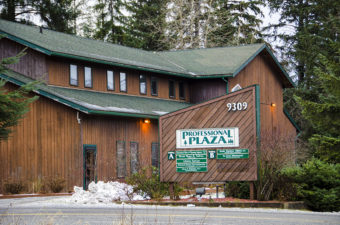
The owners of the Professional Plaza office complex at Glacier Highway and Berners Avenue near the airport will be allowed to build a second driveway. But they’ll have to install additional signage.
Area resident Janet Thrower appealed the Planning Commission’s decision based on traffic concerns. The dismissal agreement is between Thrower, and George Elgee and Fred Baxter on behalf of Professional Plaza. Assembly member Randy Wanamaker acted as hearing officer in the case.
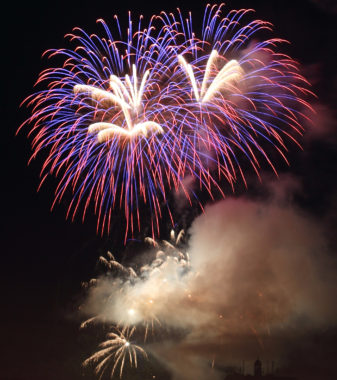
Fireworks are not a big enough public nuisance or safety risk in Juneau to warrant a partial or outright ban. That was the message Fire Chief Rich Etheridge and Assistant Police Chief Page Decker delivered to the CBJ Assembly Committee of the Whole last night, Nov. 19.
Etheridge said emergency responders don’t deal with a lot of fireworks related calls. In the last five years, he said only one person was treated at Bartlett Regional Hospital for a significant injury from fireworks, and they were medevac’d from another community. The chief also said the Capital City has not seen a fireworks related structure fire in more than five years.
[quote] “We don’t have the call volume. We aren’t having people injured. We aren’t having the structure fires that are being caused by fireworks. So, from the public safety end, fireworks aren’t a huge concern,” Etheridge said. [/quote]Decker said Juneau police respond to an average of 69 nuisance fireworks complaints each year. Not surprisingly, most of those occur around the 4th of July and New Years Eve. To put that in perspective, he said JPD responds to about 4,000 disturbance complaints a year.
An ordinance in city code prohibits the sale of fireworks within city limits, but possession is legal and there’s no law against setting them off. However, it is illegal to set off fireworks on federal land, such as within the Tongass National Forest.
Decker said local police do charge people with reckless endangerment or disturbing the peace if their use of fireworks becomes a problem.
“You do have recourse, and it’s all in the disturbing the peace statute talks about “reasonableness.” The farther you get away from the 4th of July or New Years, the more unreasonable it really becomes to have those kinds of sounds going off in your neighborhood,” Decker said.
The Assembly asked for the presentation after some members heard a spike in complaints from residents. Assembly member Karen Crane said she would support a partial ban on fireworks, with exceptions for days close to the 4th of July and New Years.
[quote] “It’s the same thing like with seatbelts or helmets. If the law is there, the majority of people would obey it, and it would cut down on the number of complaints,” Crane said. [/quote]Decker and Etheridge said Crane was probably right, but a partial ban would do little to change how the police and fire departments respond to fireworks calls.
Mayor Merrill Sanford – a former Division Chief with Capital City Fire and Rescue – said complaints about fireworks increase every so often and there isn’t much the city can do about it.
“Those of us who’ve been here awhile have sat through this stuff three or four times now. It comes up every two or three years, every four years, and we look at it and then make a decision on whether or not we want to get more enforcement or stay the same,” Sanford said.
In the end the Assembly decided it would be best to stay with the status quo. By unanimous vote the Committee of the Whole tabled the issue indefinitely.

Officials with Sealaska Heritage Institute and the City and Borough of Juneau are working on a deal to let SHI out of the city’s historic district standards for the proposed Walter Soboleff Center.
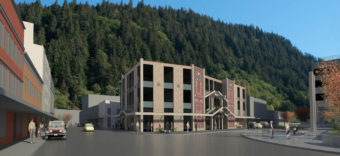
The four-story, 29,000 square foot education and cultural facility will be built on the edge of the downtown district, which celebrates the late 19th and early 20th century architecture of Juneau’s original mining period.
The Soboleff Center will also present a historic look. After all, the history of Southeast Alaska Native architecture goes back over 10,000 years.
Sealaska Heritage Institute Chief Operating Officer Lee Kadinger says the facility at the corner of Front and Seward streets downtown will pay tribute to that history, incorporating elements of traditional Tlingit, Haida and Tsimshian design. It also will take advantage of modern advances in building materials to meet LEED Gold standards.
A glass and cedar façade will give way to an interior that will include exhibits, work and performance space for artists, as well as offices for SHI’s staff, and climate controlled storage for the institute’s collections.
“We just feel that it celebrates the rich cultural diversity of Southeast Alaska,” Kadinger says. “And we feel that it really represents Juneau’s original habitants in a wonderful light.”
Kadinger says SHI is not looking to re-write the city’s historic district code. Rather, the institute would prefer the Juneau Assembly pass an ordinance providing an exception to the property where the center will be built.
“Native culture is part of the history of Alaska, and a non-code exemption would not change the historic district standards in the rest of the district,” he says. “But it would provide for an inclusion of what may have been an oversight.”
The Juneau Assembly this week directed the city law department to draft an ordinance fulfilling SHI’s request.
Mayor Merrill Sanford said the city could put conditions on its exemption. The only suggestion he made would be maintaining the same parking standard.
“The parking standard has been made more flexible in the past five to 10 years,” Sanford said. “And I think we’ve held everybody accountable to that standard within the downtown district that I don’t think that we should step out away from those rules.”
Design drawings for the Soboleff Center show no additional off-street parking. Surface parking would be available at the Sealaska Plaza lot directly across the street.
Other than that, Sanford said he was comfortable changing requirements for building materials, color schemes, architectural style and the like.
“Here we have our Native heritage that has a bright, diversified color scheme to what they do and all their arts and culture,” Sanford said. “They want to build that into this building, and right now that can’t be done.”
SHI’s Kadinger would like to hammer out details of the exemption in the next two months.
Juneau voters in October approved an extension of the city’s temporary one-percent sales tax, which included $3 million for the Soboleff Center. Kadinger says construction is estimated at $20 million, and that SHI has raised about 75 percent.
The facility will be named after the Reverend Doctor Walter Soboleff, a renowned Tlingit elder who passed away in 2011 at the age of 102.

The Juneau Assembly has cleared the way for a private shooting range near the airport, where customers will be able to fire machine guns and other automatic weapons.
Assembly members voted unanimously on Wednesday to exempt private gun ranges from a city ordinance that prohibits discharging a firearm within a quarter mile of a road.
Current exceptions exist for police officers in the line of duty, the use of shotguns in the Mendenhall Wetlands State Game Refuge, as well as other types of firearms at the Hank Harmon Rifle Range and Juneau Gun Club Range, both of which are operated by nonprofits. Facilities operated by the state or federal governments are also exempt.
Dan Miller is president of Juneau Mercantile and Armory, LLC, which is planning a 13,000 square foot indoor shooting range and gun store on the corner of Crest Street and Yandukin Drive.
“The first half of the range we’re building is going to have a static firing line,” said Dan Miller. “In other words, people will stand at one spot and shoot towards targets. We’ll have a total containment bullet trap. The entire basement is encased in concrete. Noise and safety won’t be an issue.”
Miller said every customer who rents an automatic weapon will have a handler making sure they know how to use it and are shooting it properly.
The Assembly also heard from Mark Miller – no relation to Dan – who read a statement opposing the type of range being proposed.
“AK-47s, machine guns, and other assault weapons are just that – assault weapons, said Mark Miller. They are designed and intended for assault operations. Assault is the stuff of police and military action, and as such requires a chain of command, ultimately responsible to elected officials serving the citizens for whom they are sworn to protect. Please do not place our police and military personnel, and our citizens in more danger by promoting assault weapons as casual entertainment for the general public.”
In his comments, Dan Miller of Juneau Mercantile and Armory said private shooting ranges in other communities are popular with off duty police and military employees.
The company applied to the Juneau Planning Commission for a conditional use permit. But city planners who reviewed the proposal noted that it would not comply with the CBJ gun ordinance.
The project must go back to the Planning Commission for approval before it can move forward.
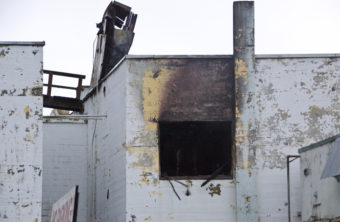
The former division chief with Capital City Fire and Rescue says the inferno could have gotten a lot worse.
“I was very worried about getting somebody hurt or killed, because in that situation you can’t foresee all of the possibilities,” Sanford said.
Fortunately, crews were able to contain the fire and keep it from spreading to adjacent buildings. Only four minor injuries were reported, though one cat apparently died.
Sanford says all things considered, the city’s firefighters did a great job, and everybody in Juneau should thank them.
“So if you know somebody, just stop ‘em. Say, ‘Hey, fireman, thank you very much,'” Sanford said. “That’s all you need to do and they’ll be very appreciative.”
Sanford’s comments came at this week’s Juneau Assembly meeting, which was originally scheduled for Monday night but cancelled due to the fire. It was rescheduled for Wednesday at noon.
City Manager Kim Kiefer told the Assembly she’s putting together a list of people to thank for the outpouring of support during the fire.
“Businesses, community members, people from throughout Southeast, the Governor’s office. Way too many people to note here,” Kiefer said. “But we are very touched by everybody’s support.”
Kiefer also said city staff would meet soon to debrief and talk about what went right and what went wrong during the response to the fire.
Assembly member Jesse Kiehl called the response “remarkable,” but suggested the city could better quell the social media rumor mill.
“I spoke with a friend who was married to a firefighter, and certainly the electronic media she monitors were spinning with news about the terrible number of firefighters who were dead,” Kiehl said. “Thank God that was wrong.”
Assemblyman Randy Wanamaker added that with dozens of residents displaced, the fire reinforces the need to find solutions to Juneau’s housing shortage.
“We not only have a problem with the people who lost their living places in the fire,” Wanamaker said. “But it makes the problem worse for when the legislature comes to town in just a very short while.”
Wanamaker suggested an Assembly subcommittee convene a meeting with developers and financial institutions to discuss barriers to housing development. Other members of the Assembly agreed, and Wanamaker, Kiehl and Carlton Smith were appointed to serve on the subcommittee.
Smith also asked the city manager to provide an update at some point in the future on the fire risk in the downtown area, where many buildings date to the early 1900s and are closely packed together.
Also Wednesday, Juneau Fire Chief Rich Etheridge said there’s still no determination on the cause of the Gastineau Apartments’ fire.
Etheridge said Fire Marshal Dan Jager believes he has pinpointed where the fire started, but is still trying to track down a key witness. Etheridge expects the investigation to wrap up in the next day or two.
He added that insurance investigators will do their own probe into what happened. Capital City Fire and Rescue will assist with the insurance investigation.