CBJ Assembly Meetings

Juneau Assembly OKs drinking water supply plan

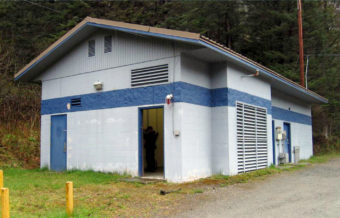
Last Chance Basin water treatment plant

The Juneau Assembly has adopted a Municipal Drinking Water Supply Plan that grew out of discussions about reopening the AJ Mine near downtown.

The centerpiece of the plan is an effort to build redundancy into the Capital City’s water supply, the bulk of which comes from Last Chance Basin, where the old AJ Mine is located. Salmon Creek is the secondary source, but is interruptible due to seasonal turbidity, or cloudiness in the water. A filtration plant would allow Salmon Creek to operate year round, giving Juneau two full-time water supplies.

In October, Juneau voters approved more than $1.5 million in sales tax revenue for Salmon Creek filtration. The drinking water plan identifies five actions that would trigger a decision to construct a plant, including growth in Juneau, increased demand for city water from cruise ships, regulatory requirements, declining well field production, and increased turbidity.

Tom Brice with the Juneau Building Trades Council urged the Assembly to adopt the plan.

“The Juneau Building Trades is very concerned that the Assembly take the responsible action to ensure that our community has a safe, viable water source that meets the needs of Juneau, not just now, but into the future,” Brice said.

In 2011, the Assembly appointed the AJ Mine Advisory Committee to look at the feasibility of reopening the old mine near downtown, which the city co-owns along with a sister company of Alaska Electric Light and Power. The committee recommended the drinking water supply plan, saying the threat posed to Last Chance Basin’s well field by mining activity was a significant barrier to mine redevelopment.

The Assembly has not yet decided whether to pursue reopening the AJ, and it remains a controversial issue that divides Juneau residents.

Guy Archibald with the Southeast Alaska Conservation Council told the Assembly it will be impossible to divorce the plan from efforts to restart the mine.

“This rather quick push to get the funding and get this resolution through to build a secondary water system or a redundant water system seems to be primarily pushed towards the promoting of the AJ Mine,” Archibald said. “If indeed there are millions of dollars worth of gold down there, I would ask that maybe the potential mining company pay for these threats to the infrastructure.”

Others questioned the plan’s accuracy, or why it doesn’t address other alternatives for adding redundancy to Juneau’s water supply.

Assembly member Karen Crane said the discussion made it clear to her that the plan needed more work.

“We would save ourselves a lot of time and a lot of grief, if we would put a little more time into this on the front end,” Crane said.

But Assembly member Jesse Kiehl said while it’s not perfect, the plan is at least a start.

“The future growth over the long term is better served by beginning to develop a filtration system for that massive reservoir at Salmon Creek than the aquifer we’re already tapping pretty near its capacity I believe in the Last Chance Basin,” said Kiehl.

The resolution passed 7-2, with Crane and Assembly member Loren Jones voting against it.

Assembly takes up another appeal

The Juneau Assembly has accepted yet another appeal of a Planning Commission decision.

At its meeting on Monday the Assembly agreed to hear an appeal filed by Juneau Veterans for Peace of a condition use permit for an indoor shooting range at a proposed gun shop near the airport. Assembly member Loren Jones will be the presiding officer for the appeal.

The Assembly also went into executive session to finalize a recent ruling in another appeal. In a draft written decision released last month, the Assembly upheld permits issued for an expansion of the city’s cruise ship docks.

Before the executive session, Assembly member Carlton Smith announced he would recuse himself from the final cruise ship dock vote. Smith last week came under fire from the couple that appealed the permits for not disclosing that he was the real estate broker for a property that could benefit from dock expansion.

Also during the executive session, the Assembly was set to discuss a personnel issue with City Manager Kim Kiefer, Deputy Manager Rob Steedle and City Attorney John Hartle.

The Assembly is allowed to discuss personnel matters behind closed doors so as not to risk disparaging an employee’s reputation.

Assembly authorizes GO bond sale

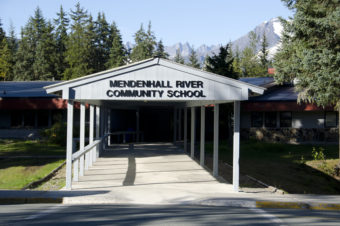
Mendenhall River community school
Mendenhall River community school. (Heather Bryant/KTOO)

The Juneau Assembly Monday night appropriated funds to the CBJ Emergency Management program, the Juneau-Douglas City Museum as well as Mendenhall River School, and authorized the sale of voter-approved bonds.

More than $138,000 in an emergency management grant comes from the state Homeland Security Program for training, equipment and practice response drills.  The city does not have to provide matching funds for the grant.

The National Endowment for the Humanities is providing $275,000 for a climate control system at the museum. It also does not require a local match.

Fifty-thousand dollars was appropriated to the Mendenhall River Community School renovation project. The school was built in 1983.  City Manager Kim Kiefer told the Assembly that it’s especially in need of a number of system improvements.

Major renovation has not occurred at the 58,000 square foot elementary school, with the exception of a roof replacement in 2000. The School District is particularly interested in potential energy efficiency improvements (lighting and HVAC controls), installation of security cameras, safety improvements to exterior fencing, improvements to special electrical systems (fire alarms, telephone, intercom, etc.), and replacement of worn-out finishes,” Kiefer said.

 Kiefer said a facility condition survey for the school building must yet be done.

The Assembly last night also approved an ordinance to issue $25 million in general obligation bonds for a 20-year period.

Juneau voters approved the bond issue in October.  It will fund eight capital improvement projects, including Centennial Hall renovation, Aurora Harbor reconstruction, renovation of the Juneau Airport terminal, and a so-called Learning Center at the city-owned ski area.

Ten million dollars of sale tax revenue will be used to cover the first five years of debt service.  The rest will come from a property tax levy of $39 per $100,000 of assessed property value.

Juneau Assembly hears about capital project funding schedule

When Juneau voters approved an extension of the city’s temporary one-percent sales tax and a $25 million bond proposition earlier this year, it created a dilemma members of the CBJ Assembly are probably happy to have: When to fund the nearly 20 projects identified in both ballot measures?

Eaglecrest Learning Center rendering
An artist’s rendering of what the new Eaglecrest Ski Area Learning Center will look like. The $3.5 million project will be funding with part of a $25 million bond package approved by voters this fall. Initial work will begin early next year. Image provided by Eaglecrest Ski Area.

Engineering Director Rorie Watt presented a preliminary funding schedule for the sales tax and bond projects to the Juneau Assembly Finance Committee this week.

The bond package contained six projects, including renovation of the old terminal at Juneau Airport, a new Learning Center at Eaglecrest Ski Area, and deferred maintenance at Centennial Hall. The plan is to do an initial $2.4 million bond sale in February to get those projects underway, and sell the rest of the bonds at a later date.

Watt says the sales tax funding schedule is a little more complicated.

“You can’t do it all in year one,” he told the Finance Committee.

The tax extension doesn’t take effect until October 2013. It’s expected to bring in about $44.5 million over five years. Ten million of that will be used to pay down debt on the bonds.

Of the remaining $34.5 million, Watt proposed funding three projects in the first year – the Juneau Airport’s snow removal equipment facility, a new Dimond Park Library and Sealaska Heritage Institute’s Walter Soboleff Center.

“All three of them, I think it’s fair to say are most advanced,” Watt said.

The library project is estimated at $14 million, and has secured all funding except sales tax. Watt says it’s ready to go to bid next winter.

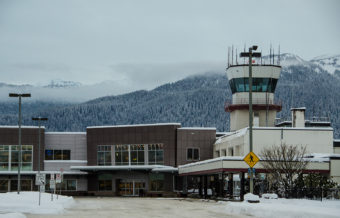
The Juneau International Airport. (Photo by Heather Bryant/KTOO)

Airport Manager Jeannie Johnson says she’s working with the Federal Aviation Administration to get $17 million for the snow removal facility. Ten million is available this year. But Johnson says if the Airport waits a year, when the sales tax dollars become available, she thinks she can get the full amount.

[quote]”The reason that they’re asking me to do this and I’m trying to make it work is that they’ve come up with other projects in the state of Alaska that they want to spend that $10 million on right now,” Johnson said.[/quote]

Of the three projects Watt proposes appropriating money to right away, Sealaska Heritage Institute has the most aggressive building schedule. SHI Chief Operating Officer Lee Kadinger told the Finance Committee the Soboleff Center will hopefully be ready to go to bid in early 2013.

“We have expectations of other gifts to come in in the next probably six to eight months,” Kadinger said. “We’ve been working a lot of these relationships with foundations for some time that are very interested in the project. It’s just more or less a formal public decision.”

Kadinger says the goal is to have the facility built by June 2014 in time for the heritage institute’s biennial Celebration festival.

Two other items from the sales tax initiative would get funding next year, under Watt’s proposed timeline. About a million dollars would go toward both deferred maintenance and the city’s rainy day reserve fund, with additional sales tax revenue set aside for those items in future years.

The rest of the individual projects, including a water filtration system for the Salmon Creek Reservoir and borough wide parks and trail improvements would be funded over the five-year extension.

The Assembly is expected to adopt the funding schedule as part of its Capital Improvement Projects list next year.

CBJ Finance Director projects budget surplus in FY14

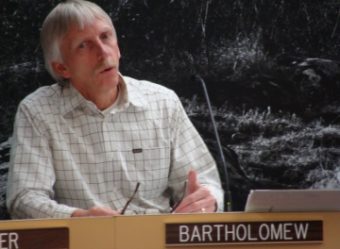
Bob Bartholomew
Juneau Finance Director Bob Bartholomew. Photo by Casey Kelly/KTOO.

The City and Borough of Juneau had a smaller than expected budget deficit last fiscal year, largely because of belt tightening by the city manager’s office.

CBJ Finance Director Bob Bartholomew on Wednesday told the Juneau Assembly Finance Committee that the city used $3.3 million in fund balance in fiscal year 2012, which ended in June. Fund balance is surplus money left over from previous years.

The original budget called for using $7.2 million in fund balance. Bartholomew said an updated estimate from March put the amount of rollover funds needed at closer to $4.9 million. So how did it get down to $3.3 million?

“That reduction is primarily coming through reduced expenditures,” Bartholomew said. “It was direction from the previous manager, the current manager, and department heads, looking for how to control costs.”

Bartholomew has been Juneau’s Finance Director for about six months. He replaced Craig Duncan, who retired at the end of May.

Duncan estimated the city would have just under $97.3 million in revenue last fiscal year. But it ended up with slightly more, at $97.5 million.

“The prior Finance Director was a very good estimator,” said Bartholomew. “We did collect what was budgeted and that’s a good sign.”

Most of the city’s revenue – about $84 million last year – comes from sales and property taxes.

In a perfect world, Bartholomew said the city shouldn’t have to use fund balance, because revenues would meet or exceed expenditures. For this fiscal year, the city has budgeted spending just $427,000 from fund balance. Next year, Bartholomew says there should be a $932,000 surplus.

“We have projected 3 to 4 percent growth in sales tax, which is a lot,” he said. “But so far in FY13 we’re on track. The FY14 revenue includes an approved increase in the mill rate.”

City Manager Kim Kiefer said this year’s budget and next year’s include more than $10 million in spending cuts made since the manager’s office started its belt tightening in response to revenue declines caused by the national recession. She says any more cuts would result in reduced city services.

“We know there’s no more money on the table,” Kiefer said. “We’re now to the point where we have to stop doing things.”

Kiefer said she would update the Assembly on union negotiations in an executive session on December 17th. Nearly half of city spending goes toward personnel services.

The manager also said she’d be seeking Assembly guidance on the FY14 budget. The Assembly approves the spending plan on a biennial basis, but is able to make some changes to the second year based on the latest information.

Juneau Assembly passes resolution supporting electrical power extension

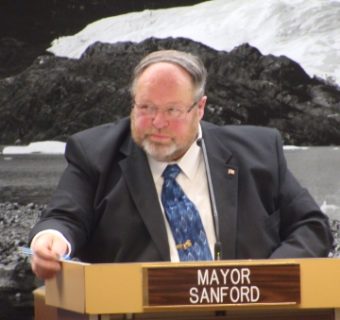
Mayor Merrill Sanford
Juneau Mayor Merrill Sanford backed a resolution expressing Assembly support for electrical power to Cascade Point at the end of Glacier Highway. Photo by Casey Kelly/KTOO.

The Juneau Assembly is now on record as supporting an extension of electric power to Cascade Point at the end of Glacier Highway, also known as Veterans Memorial Highway.

A resolution adopted at a special meeting Wednesday says an extension of power would support economic and housing development, as well as public safety out the road, while reducing dependence on diesel fuel for power generation.

But Auke Bay resident Karla Hart criticized the measure for what it doesn’t say. Namely that extending power would also benefit the Kensington Mine and other mining developments in the area, as well as major landowners like Goldbelt Corporation.

“I just don’t see that this is well thought out in terms of public policy,” Hart said during public testimony on the resolution. “It feels very much like its being pushed through for some private special interests.”

Hart also criticized the lack of public input on the resolution. The idea was first floated by Mayor Merrill Sanford at an Assembly retreat in October. Deputy Mayor Mary Becker made a motion requesting a draft resolution last week, and a copy was first made public on Monday. Hart said she first learned that the resolution was coming up for a vote an hour before Wednesday’s meeting.

“This is tying in with a lot of things that you realize are pretty controversial in the community,” she said. “To just push this through and ask for it in a big hurry without any understanding of what’s going on by most of the community is irresponsible in my opinion.”

Mayor Sanford pointed to letters written to Juneau’s legislative delegation last session seeking state funding for an extension of electrical infrastructure. Officials from Kensington, Goldbelt, and the Juneau Building & Construction Trades Council were among those who wrote the letters.

Sanford says the project has been discussed on and off in various forums for years.

“At Southeast Conference we dealt with it as one of the options of getting out to the mine,” Sanford said. “So, we’ve had lots of opportunity to go through, and you can see by the people who have written or have supported this that there is a lot of support within the community.”

Hart replied that she still felt the resolution deserved more scrutiny.

“Most of us who are private individuals in the community are not members of Southeast Conference,” she said. “It’s an expensive organization to join as an individual, and it’s expensive to go to their meetings. So Southeast Conference, while it’s a venue for some of you, it’s not a public venue in the sense of a public-Juneau-citizen-voter-community discussion.”

Assembly member Loren Jones objected when Sanford asked if the Assembly wanted to adopt the resolution unanimously. Jones asked two questions, including how much it would cost to extend power to the end of the road.

For the answer, Sanford called upon Duff Mitchell, Vice President and Business Manager of Juneau Hydropower, Inc., who said he thought it would be about $20 million.

Juneau Hydropower is seeking to develop a hydroelectric project at Sweetheart Lake about 30 miles southeast of the Capital City. The company’s website says Juneau Hydropower “hopes to produce green renewable energy for the wholesale/industrial market.”

Jones removed his objection, and the resolution passed unanimously.

Link:
Letters of support for extension of electric power along Glacier Highway

Site notifications
Update notification options
Subscribe to notifications