Local Government

A seasonal sales tax question will be on Juneau’s October ballot

Cruise ship tourists visit shops in downtown Juneau on Wednesday, July 10, 2025. (Photo by Clarise Larson/KTOO)

Juneau voters will decide whether the city should implement a new seasonal sales tax system. The Juneau Assembly approved the ballot question at a meeting Monday night. 

The city wants to take greater advantage of the 1.7 million cruise ship visitors that come to town every summer by increasing the local tax in those months. 

But, a handful of testifiers at the meeting, like Auke Bay resident Tom Williams, argued it’s not a good deal for year-round residents. 

“I have a question for you — what in the world are you doing?” he said. “I think you need to get back and start to go back and figure out who you work for, because all you’re doing with this seasonal sales tax approach is squeezing a balloon.”

Assembly members say the change is meant to capitalize on cruise ship tourism spending. Right now, Juneau has a fixed 5% local sales tax rate. It’s made up of both permanent and temporary taxes that help pay for general government costs, some specific voter-approved projects and community priorities like child care support. 

The proposed seasonal sales tax system would change that. It would bump the rate up to a 7.5% tax from April through September and then drop it down to a 3% tax from October through March. 

Nearby Southeast Alaska tourism towns like Ketchikan, Sitka and Skagway have already adopted similar seasonal tax structures. Deputy Mayor Greg Smith said he thinks Juneau would benefit by doing the same. 

“When we talked about doing this in December, it was to hopefully help people see and feel that ‘I’m going to be paying less in taxes, and my family will benefit due to tourism,’” he said. “A seasonal sales tax does that.”

Earlier this summer, Assembly members removed a part of the original proposal that would have used the additional revenue from the new system to offset the cost of removing local sales tax on food and utilities. That’s because an advocacy group called the Affordable Juneau Coalition gathered enough signatures this spring to put that question on the ballot already.

The coalition also got enough signatures for a ballot question asking whether to place a limit on the city’s property tax rate.

Angela Rodell, a member of the group, testified against the seasonal tax proposal on Monday. She argued it would financially hurt residents more than it would benefit them. 

“At a time when many in our community are already struggling with the rising cost of living, housing, food, childcare, and utilities, substantially increasing the sales tax for six months over the summer is not only ill-timed, it is fundamentally unaffordable for working families and individuals on fixed incomes,” she said. 

Assembly member Wade Bryson said the seasonal structure is needed to help recoup the estimated $9 million loss in annual sales tax revenue the city could face if sales tax is removed on food and utilities, which would happen if voters approve the measure. 

“Allowing the citizens to answer the questions at the same time gives the citizens — gives all the voters — a chance to say ‘yes or no,’ if they want a giant hole in the budget. Do they want all of our social services to go away?” he said. 

The city recently notified local organizations that receive city grants that it would be withholding a portion of their funding until the election due to “the potential of significant revenue loss” if the citizen initiatives pass. 

Those organizations include the Juneau Community Foundation, Juneau Arts and Humanities Council and KTOO. 

Voting in this year’s by-mail municipal election ends Oct. 7. Ballots will be mailed to registered voters beginning Sept.19.

Small pool of candidates file to run in Juneau’s local election this fall

A sign hangs outside City Hall as the 2024 municipal election nears on Thursday, Sept. 26, 2024. (Clarise Larson/KTOO)

There is a small pool of candidates running for the open Juneau Assembly and Board of Education seats in this fall’s local election. 

The candidate filing period closed on Monday. Half a dozen seats are open for the Oct. 7 municipal election — three on the Juneau Assembly and three on the Juneau School District Board of Education. 

Incumbent Assembly members Greg Smith and Ella Adkison are running uncontested for their seats. Assembly member Wade Bryson faces one other candidate, Nano Brooks, who unsuccessfully ran for an Assembly seat in the last two elections.

At an Assembly meeting on Monday, Bryson said he is excited to face some competition. 

I’m quite proud of all of my work that I’ve done here on the Assembly, so I look forward to being able to showcase that as we move some of the city topics forward,” he said. 

Both Smith and Bryson are finishing up their second full, three-year terms. Adkison is finishing her first partial term after she was elected in 2023 to serve the remaining two years in the term of Assembly member Carole Triem, who resigned. 

At the meeting, Adkison said she suspects that state and federal issues might be pulling people’s attention away from local politics. 

“It definitely does surprise me — I fully expected to have an opponent,” she said. “I think obviously when more people run, it’s a sign of a healthy local municipal democracy. But I think right now, frankly, there’s a lot of stuff going on.”

Four people are running for two full-term seats and one partial-term seat on the Juneau school board this election. The candidates are Jeremy Johnson, Jenny Thomas, Melissa Cullum and Steve Whitney. 

Thomas unsuccessfully ran for a seat last election and led a recall effort of the board’s president and vice president. She and Cullum were outspoken critics of the board’s decision to consolidate Juneau’s high schools and middle schools. 

Board president Deedie Sorensen and member Emil Mackey currently fill the open full-term seats. Both members told KTOO last week that they would not be running for reelection. 

The winner of the partial-term school board seat will complete the remaining two years of former member Will Muldoon’s term. He abruptly resigned this spring. Whitney was elected by the board to fill Muldoon’s position until voters elect a new, full-time member. 

Voting in this year’s by-mail election ends on Tuesday, Oct. 7. Ballots will be mailed to registered voters beginning on Sept. 19.

Juneau opens up application for $2.5M in affordable housing funding

Downtown Juneau on Wednesday, March 26, 2025. (Photo by Clarise Larson/KTOO)

Juneau is inviting developers, nonprofits and tribal governments to apply for grants or loans from its affordable housing fund.

The city created the fund five years ago to address the city’s lack of housing — specifically, low and middle-income rentals. There is $2.5 million available in the fund this year. The application period opened last week and runs through Aug. 22. 

“Things are getting more challenging with the landscape for housing on the federal level,” said Joseph Meyers, the city’s housing and land use specialist. “I’m really hopeful that we get a lot of people applying for these funds, and get more units on the grounds.”

The city then uses criteria like proximity to public transportation and long-term affordability to decide which projects get funding and how much.  

The city has awarded nearly $13 million in grants or loans from the fund since its establishment. But not all projects funded in the past have been required to offer affordable units. In 2022, the Juneau Assembly approved a $1.2 million loan from the fund for a development called Ridgeview. 

The Assembly initially approved the loan for the project with an affordability requirement, but later stripped those requirements after input from city leadership. The developer listed the units as condos available for purchase at market price to the dismay of many Juneau residents. Some testified at public meetings and others posted hundreds of comments on social media. 

Meyers said since then, the Assembly has required affordability for projects approved to receive funding. 

“If the application doesn’t meet that requirement, they’d have to go back to the drawing board,” he said. “We really do want to focus on providing some affordability, at least with all these projects.”

The application period closes on Aug. 22. Then, a committee will review them and make recommendations to the Assembly for final approval. 

Poor sound quality prompts Assembly to temporarily move meeting locations

Mayor Beth Weldon and Deputy Mayor Greg Smith speak during an Assembly meeting on Monday, July 14, 2025. (Photo by Clarise Larson/KTOO)

The Juneau Assembly is moving forward with a plan to temporarily move its regular meetings from City Hall to a new location due to persistent sound quality issues. 

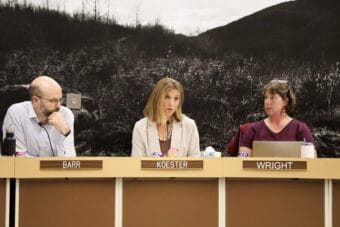
During a committee meeting on Monday, members asked city administration to search for alternative locations where the sound quality is better. City Manager Katie Koester originally suggested the idea. 

“The sound quality in this room is abysmal and I do think that it’s getting to the point where we’re disenfranchising our public,” she said. 

Mayor Beth Weldon also asked the city to move forward with a plan to replace the current audio infrastructure in City Hall, despite an estimated $60,000 price tag.

“I’ve been asking for over a year to do something about our sound system,” she said. “I am in full favor of spending money to fix the sound system, and in the meantime, if we need to meet somewhere else, that is fine with me.”

Members also considered changing Assembly meeting times after some recent meetings have run late into the night because of large agendas. That could mean regular meetings, committee meetings and executive sessions would start earlier in the evening or during the lunch hour. 

City leaders are currently negotiating the purchase of two floors of the Michael J. Burns building at the corner of 10th Street and Glacier Avenue. If approved, it would become the new City Hall and city employees would relocate there. 

Voters rejected the city’s requests to fund the construction of a new City Hall in 2022 and 2023. The city has sought to replace City Hall due to the extensive maintenance needs and limited space at the current location. 

On Monday, Koester suggested Centennial Hall as a potential temporary location to hold regular Assembly meetings. The city-owned building was recently renovated and is just a short walk from City Hall. She said it costs about $1,000 per meeting to rent the space and has booked it for the Assembly’s next regular meeting on July 28.

Some Assembly members were hesitant about the rental price tag at Centennial Hall, and suggested other locations that would be cheaper. Koester said the potential move to the Michael J. Burns building is still at least a year out if it’s approved. 

Juneau officials urge Mendenhall Valley residents to evacuate before annual outburst flood hits

People camp on grass outside of the former Floyd Dryden Middle School building the night before the 2024 glacial outburst flood on Monday, Aug. 5, 2024. (Photo by Clarise Larson/KTOO)

Listen to this story:

Juneau’s next annual glacial outburst flood will test a temporary levee the city installed this spring for the first time. Although city officials said they expect it will protect residents, they want everyone in the flood zone to evacuate anyway.

Suicide Basin is almost full. Once the glacial dam releases, the basin could unleash a torrent down Mendenhall River. As the flood approaches, the community is preparing for the worst-case scenario. 

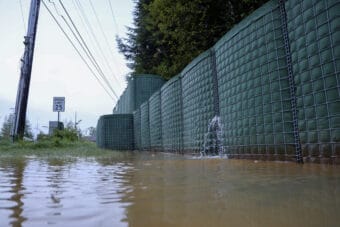
The levee that was installed to protect most neighborhoods in the Valley is made up of HESCO barriers — large metal baskets lined with fabric and filled with sand, which are stacked in backyards along the river.

Ryan O’Shaughnessy is Juneau’s emergency manager. He said an analysis the city commissioned from engineering firm Michael Baker International shows that the levee should hold back floodwaters properly. 

But he said people shouldn’t bet their lives on that. 

“We’re extremely confident in the HESCO barriers,” O’Shaughnessy said. “We’re still recommending that people evacuate. You just cannot be too careful with life and, you know, the potential for death or injury.”

If the levee fails, O’Shaughnessy said it would trigger a flash flood and people wouldn’t have much time to escape. 

“It will be difficult to extract anyone in a search and rescue operation with water moving that swiftly,” he said.

So he recommends that Valley residents pack go-bags in advance and arrange to stay with friends or family in areas outside the flood zone. 

The city and U.S. Geological Survey plan to watch how the levee performs during the flood using drones and other cameras. O’Shaughnessy said the city will bolster the levee with large sandbags called supersacks if they see extreme bank erosion. 

“Where there are those bends in the river, where we’ve historically seen that kind of activity, are the places that we’re prepared to respond to it,” he said. 

Those bends include the corner of Riverside Drive and Killewich Drive, along Meander Way and near Dimond Park. 

Evacuation Timeline 

The city plans to issue an evacuation warning as soon as the remote camera in Suicide Basin shows the water is draining out — that’s the same time that the National Weather Service will issue a flood warning. 

The evacuation notice will buzz on cell phones located in the Juneau area through a federal alert system. But to ensure you receive a warning — even if you’re not in the area at the time — O’Shaughnessy said residents should sign up for the city’s alert system.

From the moment the evacuation warning is issued, Valley residents will have an estimated 36 hours to get out of the flood zone before floodwaters reach the river.

City officials will publish a map of the flood zone when the National Weather Service issues a forecasted flood height. Forecast updates are likely to come about a day later. Residents can also see if their home is in the flood zone by plugging the forecasted height into the interactive map at juneauflood.com and toggling “HESCO Barriers OFF.”  

An interactive flood map on juneauflood.com allows residents to check if their homes are in the flood zone and compare flood stages. (Screenshot)

Floyd Dryden will serve as an emergency shelter during the flood. Its gymnasium can hold around 50 cots. Folks with RVs will be able to park in the lot and there will also be an area where people can pitch tents outside.

Britt Tonnessen is the community disaster program manager for the Red Cross of Alaska in Southeast. She said the shelter will be available for as long as Valley residents need it. 

“If it happens during the day and the flood clears out, maybe it’s just an evacuation point,” Tonnessen said. “If it happens in the night, it could be a sheltering situation.”

People who stay at the shelter can expect a cot, food and access to information and services. Tonnessen said that the Red Cross is prepared to assist elders and those with disabilities and medical needs.

“If people are separated from medication, durable medical equipment — we have disaster health services volunteers, and they try to more immediately reconnect those people with those services,” she said.

Ahead of the flood, Tonnessen is still accepting volunteers and said that those interested can sign up on the Red Cross website

In a Facebook survey, Valley residents affected by the floods said they need help filling sandbags and setting them up on their properties. 

The city, the Central Council of the Tlingit & Haida Indian Tribes of Alaska and volunteers with United Way will be handing out free sandbags at the Dimond Park field house this Saturday and July 26 from 11 a.m. to 3 p.m. 

Correction: A previous version of this story stated that the annual glacial outburst flood was forecast to begin Aug. 8. That’s when the National Weather Service projects Suicide Basin will be full. Also, NWS can only forecast when the basin will be full, not when it will release.

City proposes code change to make it easier to arrest people without housing in Juneau

Tents line the sidewalks along Teal Street in Mendenhall Valley on Tuesday, May 27, 2025. (Photo by Clarise Larson/KTOO)

The Juneau Assembly is considering changing city code to make it easier for police officers to arrest people without housing who are camping in public spaces. 

At a committee of the whole meeting on Monday night, Assembly members advanced a proposed plan to change the city’s disorderly conduct code.

The discussion on the proposed policy changes comes as city leaders say they’ve received a growing number of complaints from residents and businesses about the problems that people without housing are causing for surrounding neighborhoods where they camp. 

“This would give our officers a tool that they could quickly deploy when they’re seeking to address camping impacts on public paths, sidewalks, rights of way, garages, bus stops, those sorts of areas,” said Deputy City Manager Robert Barr at the meeting. 

That tool is arresting people. 

The changes would make it easier for Juneau Police Department officers to arrest people who are obstructing public spaces by camping. 

The proposed disorderly conduct code change would add standing, walking or camping to the list of actions that could prompt an arrest if someone is blocking public areas. It also adds public paths, parking lots and garages and stairwells to the list of locations it applies to.

Barr said that right now, arresting people without housing in these specific situations is complicated. Most of the time, officers arrest people for trespassing instead of disorderly conduct. But that requires additional steps.

“It is simply more challenging, takes more time, is more burdensome,” he said. 

Barr said the amendments would essentially get rid of some of those hurdles to arrest people.

Assembly Members also moved forward with a plan to draft an ordinance to establish a “shelter safety zone” surrounding the Teal Street neighborhood and Juneau’s Glory Hall homeless shelter after repeated reports of staff being threatened on the site.

But the proposed ordinance is still very preliminary. Details like the potential boundary of the area and what protections would be in place have not yet been decided. 

Assembly member Ella Adkison reluctantly agreed to move forward with the changes, but said they’re merely a stopgap for a larger issue.

“It’s not going to make the core of the issue any better.  I do not think it will in any way help our unhoused population,” she said. “What I see the use for this is to make it a little easier for our police department to do something they’re already doing.”

Last year, the U.S. Supreme Court ruled that cities can ban people from sleeping and camping in public places. Right now, Juneau city policy allows for dispersed camping but prohibits it on places like sidewalks or roads. In general, the city allows people to camp on unimproved public land as long as they keep their impact low on the surrounding community. 

However, Assembly member Wade Bryson said he thinks the city’s current status quo is not working and it’s putting people at risk. He said the Assembly needs to take action.  

“The sooner we get tough on this situation, the sooner we crack down or the sooner we say this is how you have to behave in our community, the sooner we will have less of these problems,” he said. 

Assembly members also briefly discussed reestablishing a summer campground designated for people without housing, like the one the city closed last year, but that idea didn’t move forward. The city closed the campground after an increase in reported illegal activities and complaints from the surrounding neighborhoods. 

Assembly members will take public testimony and vote on the proposed code changes at a regular meeting later this summer.

Site notifications
Update notification options
Subscribe to notifications