Local Government

Juneau’s temporary flood fighting plan is underway. Some riverfront homeowners don’t want it.

Ann Wilkinson Lind’s riverfront property is fortified with packed gravel, riprap and a wall of boulders along the perimeter. Now, it is also the starting lot for the city’s proposed flood barrier (Photo by Anna Canny/KTOO)

On a quiet afternoon in October, the Mendenhall River swirled lazily in an eddy at the corner of Ann Wilkinson Lind’s property on Marion Way.

But during this summer’s record-breaking glacial outburst flood, the river sent waves crashing onto Lind’s property.

Their house was spared, but the force of the water knocked down the chain-link fence, swept away garden boxes and tool sheds and tore up their beloved backyard, which the family has dubbed the “Lind oasis.” Lind’s husband Jeff, who had long struggled with a weak heart, was devastated by the damage.

“He was very, very stressed out about his yard,” she said. “That was, I think, sort of the straw that broke the camel’s back.”

Jeff Lind passed away less than a week after the flood. In his memory, friends and former coworkers from Green’s Creek Mine came together to protect the yard from future floods. They raised the edge of the lot with four feet of packed gravel and built a sturdy wall of boulders around the perimeter.

“We bite the bullet. It’s part of living on the river,” Ann Lind said. “But now, these floods are affecting so many other people.”

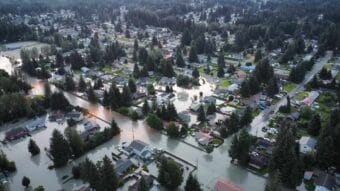
This year, floodwaters stretched far beyond the riverbanks and damaged nearly 300 houses in the Mendenhall Valley. To keep the people dry next year, the City and Borough of Juneau has made plans to install a wall of flood barriers to make a temporary levee along Mendenhall River, which begins on Lind’s property and stretches down along Killewich Drive and Meander Way.

The plan won’t work without the cooperation of more than 75 riverfront property owners. And some of them are feeling conflicted, balancing a pressure to protect their neighbors with their fears that the city’s plan is too risky, invasive and expensive.

“It’s put us, I would say, all riverfront property owners, in a very difficult position. I don’t want to be the one person that says no. I don’t want to be the hole in the wall,” said Sean Smack, a homeowner on Meander Way. “If we fight this plan, will we now be the bad guys in the community?”

Smack doesn’t doubt the barriers could work well against Juneau’s outburst floods, but he worries that the city’s plan will cost too much. 

A band-aid solution

The barriers, made by a company called HESCO, are basically massive heavy-duty sandbags in metal baskets. They’re used for flood fighting across the nation, and the U.S. Army Corps of Engineers gave them to Juneau for free.  

The proposed levee is only meant to be temporary — a way to buy some time for a more permanent flood prevention plan. But to build it, the city says they would have to connect a wall of HESCO sandbags across yards that are uneven, on soil that is unstable, along a riverbank that zigs and zags. And that will require a lot of prep work on private property, and a lot of money — possibly up to $10 million when all work is done. 

It’s not yet clear how that cost will be shared, but it is almost certain that property owners like Smack will be asked to contribute some funding. While he understands the desire to fight flooding in the short term, he worries all the work for the temporary levee might be a waste.  

“Right now, we’re just looking at spending up to $10 million as a city on a temporary levy that may or may not work, but then, once the long term plans done, all of that work is useless,” Smack said. “Are we throwing a bunch of good money at a short-term plan?”

Many riverfront property owners have already made hefty personal investments to fortify their properties. Lind, for instance, has spend hundreds of thousands of dollars on her lot. She thinks that work will be enough to protect her for now, but with the HESCO barrier proposal, she feels she’s being asked to pay for her neighbor’s protection, too.

“I don’t know how much those barriers are going to cost, or what they’re going to expect us to pay,” Lind said. “But for us to pay for the Valley is not right. It should be shared.”

The city has proposed cost-sharing options, like the creation of a local improvement district. If approved, a designated group of flood-affected homeowners would split up the cost of the project. Though a similar improvement district proposal for erosion prevention work on Meander Way failed back in 2018, when homeowners could not come to an agreement.

Lind is more concerned with finding a permanent solution, like draining would-be flood waters from Suicide Basin, or building a levee around Mendenhall Lake to divert water before it flows downstream into the river.

“Fix the problem. Fix the point of the problem,” Lind said. “We should not put bandaids all the way up and down the river.”

Deb Johnston stands next to the high water mark on her house. She says people in her neighborhood need a flood fighting solution sooner rather than later (Photo by Anna Canny/KTOO)

The cost of doing nothing

City Manager Katie Koester says the city fully intends to pursue a permanent fix, and has discussed many options with experts at the Army Corps. But they’ve pursued the HESCO plan at the Corp’s suggestion, and Koester insists that building something permanent will require more federal funding, and a lot more research to secure that funding.

In an interview, Koester acknowledged that the plan to install flood barriers is incomplete and imperfect. She emphasized that it is only intended to be a stopgap before the next flood comes, but she feels it is the best bet to protect life and property between now and next summer. 

“If the residents don’t want the project, it’s going to be hard for the project to proceed, and you know, I come back to the cost of doing nothing,” Koester said.

Deb Johnston, who also lives on Meander Way, worries that the pushback to this plan might ultimately lead to inaction. She supports the HESCO proposal, and though she’s one of the many Valley homeowners that’s not on the riverfront, she’s willing to share costs. 

No matter what flood fighting plan prevails, Johnston feels time is of the essence. 

“When I walk in this neighborhood, there are still houses that are unoccupied, that have demolition debris on their lawns,” Johnston said. “I don’t see how any of us can possibly wait three to five to six years for a permanent solution without this becoming, you know, a derelict neighborhood.”

Representatives from the U.S. Army Corps of Engineers will share more details about their HESCO project planning at Monday’s Juneau Assembly Committee of the Whole meeting. The city will roll out more details on the project’s budget and cost sharing at the next regular Assembly meeting on Nov. 16.

City and Borough of Juneau apologizes for 1962 burning of Douglas Indian Village

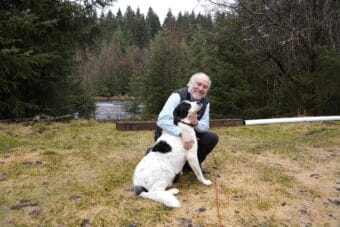
Butch Laiti responds to the City and Bureau of Juneauʼs formal apology for the 1962 burning of the Douglas Indian Village. Monday, Oct. 21, 2024. (Photo by Clarise Larson/KTOO).

The City and Borough of Juneau formally apologized for the 1962 burning of the Douglas Indian Village at a Juneau Assembly meeting on Monday. 

The apology was sudden, and not widely advertised, but it’s been on the mind of one Assembly member for years. 

Andrea Cadiente-Laiti is the Tribal Administrator for the Douglas Indian Association. She stood to receive the apology alongside other tribal members at the Juneau Assembly meeting. 

She said the burning of the village – where Savikko Park and the Douglas Harbor are now – happened more recently than many realize.

“People were shocked to find out we weren’t talking about 1862. We were talking about 1962,” she said.

That’s a little more than 60 years ago, recently enough that people who used to live in the village are still alive now. 

In 2018, the Douglas Indian Association raised a kootéeyaa – or totem pole – honoring the Yanyeidí Taku people who lost their homes. 

 “A kootéeyaa itself won’t heal the pain,” Cadiente-Laiti said. “The proclamation alone won’t but it’s a start, and it’s a wonderful start.”

The Yanyeidì Gooch (wolf) totem pole is raised in Savikko Park on June 6, 2018. (Photo by Adelyn Baxter/KTOO)
The Yanyeidí Gooch (wolf) totem pole is raised in Savikko Park on June 6, 2018. (Photo by Adelyn Baxter/KTOO)

DIA President Butch Laiti was also at the meeting to accept the apology. He said he wants more public awareness of the history of the site. 

“When I heard about this, I wrestled with this apology,” he said. “The problem I guess I have is the whole story is not out there, and I believe that to make this right, we have to tell the whole history of our relationship between Douglas, City of Douglas, Juneau, and the Lingít people.”

He said this history wasn’t taught when he was growing up, He had to learn about it through his own research.

Douglas Indian Association didn’t get much advance notice about the apology. Tribal administrator Cadiente-Laiti only heard about it days before. She said news of the apology was sudden, but welcome.

Mayor Beth Weldon said the reason for the timing of the apology is to honor the wish of departing Assembly Member ‘Wáahlaal Gidaag Barbara Blake. 

“‘Wáahlaal Gidaag said we never quite got to the apology for the burning of the village on Douglas Island,” Weldon said. “And so with that, we looked into it, and it took us a little long — longer than we thought — to get it going and everything so, but we wanted her to share in the formal apology to the Douglas Indian Association for the burning of that village.”

Blake later said this apology was fulfilling a campaign promise she made in 2021. It’s not nearly enough though. 

“It’s not okay,” she said. “We will do what we can to make it right, but this is at least the first step in that process.”

Blake chose not to run for reelection this fall, but said she plans to keep the pressure on the city to take this apology further and do more to commemorate what happened. 

“Just because I’m stepping off the assembly doesn’t mean I’m stepping away. I still live in Juneau,” she said. “I’m still going to be around and holding folks accountable. So I will be poking people if, if I don’t see some kind of movement.”

Blake said the other entities involved in the burning – like the Bureau of Indian Affairs – should also be apologizing. 

This weekend, a U.S. Navy Admiral will offer the Lingít people another long-overdue apology, for the 1882 bombardment of the village of Angoon. Sealaska Heritage Institute plans to livestream the event on their Youtube channel

Clarise Larson contributed to this story.

Juneau approves $2 million for flood barriers, despite opposition from some riverfront homeowners

Water rushes in the Mendenhall River on Sunday, Oct. 20, 2024. (Clarise Larson/KTOO)

The Juneau Assembly has approved $2 million in funding to construct a semi-permanent levee along Mendenhall River in order to prepare for future glacial outburst floods.

But at a meeting Monday night, members of the Juneau Assembly and the public expressed hesitation about the city’s flood fighting plan. Phase one calls for the installation of flood barriers along about four miles of riverbank from Killewich Drive and Marion Drive to Meander Way.

That would require 79 homeowners to agree to have barriers installed on their properties. The city has been conducting preliminary outreach to those homeowners over the last couple of weeks. According to a memo from City Manager Katie Koester, “most homeowners were favorable to the concept of Hesco barrier installation to protect their and others’ property.” But a few who testified at the meeting, like Meander Way homeowner Sam Hatch, are not excited about the idea. 

“I, among others in the neighborhood, oppose the HESCO flood barrier proposal because of the risks that come with a fully constrained river, and the ambiguities in this project,” Hatch said. “Burdening the 70-plus waterfront homes with the cost of a temporary solution, while benefiting hundreds of Valley homes, is wrong.”

The flood barriers, made by a company called HESCO, are basically large reinforced sandbags that last up to five years. They were given to the city free of charge by the U.S. Army Corps of Engineers.

But the cost of planning, site preparation and installation of the barriers falls to the city. Koester said Monday that the total project budget will definitely balloon beyond this initial $2 million investment, which was pulled from the city’s restricted budget reserves. It could cost an estimated $5 to $10 million by the time the work is finished, and it’s not yet clear where that will come from.

One of the main topics of the night was figuring out how to pay for that. It could come down to splitting costs across all Juneau taxpayers, or it could involve making individual homeowners along the waterfront take on some share of the preparation work on their properties.

The Assembly also discussed the possibility of creating a local improvement district, or LID, in the Mendenhall Valley. That could establish a cost-sharing system for some or all homeowners in the flood-affected neighborhoods.

View Drive resident Elizabeth Figus testified against the LID plan, though she supports the barriers. She urged the city to focus on proposed long-term solutions like dredging new channels for the river or building a levee around Mendenhall Lake, expressing concern about the effectiveness of the HESCO levee. 

“This is a temporary, experimental installation. So as we’ve heard, this could actually damage properties, both where it’s installed or downstream,” Figus said.

By the end of a meeting, Assembly member Wade Bryson echoed that sentiment. 

“The more that I listen, the less that I like these HESCO barriers. It is a temporary solution that could empty our piggy bank and literally use up the funds that we will need to do a more permanent solution,” Bryson said. “It seems more reactionary.”

According to Koester, the long-term flood mitigation proposals require more careful planning and study, along with even more funding. She said the city is pursuing those long-term flood mitigation plans. But the HESCO barriers have been championed by city officials as a way to do flood fighting quickly, before another outburst happens again next summer.

New Assembly member Maureen Hall said she supports the barriers, but also said the Assembly has to reduce the financial burden that might fall on homeowners along the riverbank. 

“The HESCO barriers may not be a perfect solution, but we’re looking for something temporary, quick. We can’t stand by and not do anything this coming year,” Hall said. “We need kind of a combination of sharing of the costs between CBJ and trying to figure out an equitable way among the homeowners that are impacted.”

Despite the opposition, the city plans to keep working on project plans for the barrier installation, and will continue to discuss ways to cover the remainder of the project costs at future meetings.

Update: A previous version of this article stated that the U.S. Army Corps of Engineers was planning a public meeting for the week of October 28th. Now, those meetings are tentatively planned for sometime in mid-November, 2024. 

Correction: This article has been updated to reflect that while Elizabeth Figus opposed the LID plan, she was supportive of the HESCO barriers.

Royal Caribbean apologizes for leaving Juneau city leaders in the dark prior to port announcement

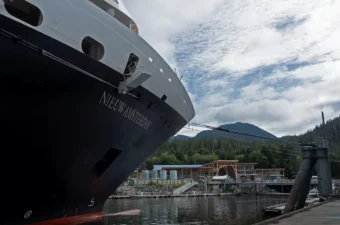
Celebrity Cruise President Laura Hodges Bethge gives a speech at the Alaska Travel Industry Association conference in Juneau on Tuesday, Oct. 22, 2024. (Clarise Larson/KTOO)

Juneau city officials say they are still “extremely unhappy” with a cruise line and a local Alaska Native corporation after they announced plans to develop a new cruise ship port on Douglas Island last week. 

Laura Hodges Bethge is the president of Celebrity Cruises, which is owned by Royal Caribbean Group. On Tuesday at the Alaska Travel Industry Association conference in Juneau, she said the proposed partnership between Goldbelt, Inc. and Royal Caribbean will help address congestion in downtown Juneau. 

“This project is an example of how we work with destinations to help disperse visitors across the geography,” she said during a speech. “We’ve just begun conversations with Mayor Weldon and other local stakeholders and residents, and we deeply value the input. We know we have a lot of steps to take to move this project forward, and we look forward to doing it with all of you.”

Goldbelt owns nearly 2,000 acres of land along the north coastline of Douglas Island, roughly between False Outer Point and Point Hilda on the island’s west side. The proposed two-ship port could be located anywhere along that coastline. 

After the speech, Juneau Mayor Beth Weldon said she wanted an apology for what she believes was a poorly-timed announcement. It came just a day after the city’s municipal election results were finalized. Juneau voters rejected a ballot proposition that would have banned all large cruise ships on Saturdays starting next year.

“We’re very displeased with what their actions have been thus far, and they have to prove to the community that what they’re trying to do is best for the community, because at this point, we don’t see any benefit to the community,” Weldon said.

The city’s Visitor Industry Director Alix Pierce echoed Weldon’s frustration. 

“As far as I’m concerned, having two meetings where we tell them how disappointed we are, and they evade and give excuses, is not really working together,” Pierce said. 

Hodges Bethge declined an interview after her speech. A Royal Caribbean Group spokesperson shared a statement instead.

“We formally apologize to the City and Borough of Juneau that we did not communicate with their team earlier on the planned port project,” the statement reads. 

According to Goldbelt, the companies hope to finish financial estimates and concept designs for the project by next spring and complete the project during the 2027 cruise season.

Neil Steininger and Maureen Hall officially join Juneau Assembly

Neil Steininger and Maureen Hall raise their hands as they are sworn in to the Juneau Assembly on Monday, Oct. 21., 2024. (Clarise Larson/KTOO)

Two new Juneau Assembly members were sworn in at City Hall Monday night. 

Voters selected Neil Steininger to represent Assembly District 1 and Maureen Hall to represent District 2 in this year’s municipal election. 

They will each serve a three-year term. They replace outgoing members ‘Waahlaal Gidaag Barbara Blake and Michelle Hale, who did not run for reelection. 

At the meeting, Assembly members congratulated and thanked both outgoing members for their dedication to the community. Christine Woll applauded Blake’s commitment to the Assembly, while also juggling other leadership roles in the community and state. 

“I’m just in awe of you every day. Everything that you do for your, our community, for your community, it’s so inspiring,” she said. “Your impact is large already in Alaska, and I’m really excited to see what you do next.”

Alicia Hughes-Skandijs thanked Hale for her leadership and kindness.

“I always will feel appreciative of how welcome you made me feel as a newbie who was in over her head, and your faith in me and we’re going to miss you around here,” she said. 

Blake served one term and Hale served two, with the latter as deputy mayor. At the meeting, the Assembly unanimously voted to appoint member Greg Smith to fill the position. 

Mayor Beth Weldon was sworn in last week for her third, three-year term as mayor. Before that, she also served two years as an Assembly member before resigning to run for mayor. 

On Tuesday night the Juneau School Board will swear in three incumbent members to serve another term. This election incumbents Elizabeth Siddon, Will Muldoon and Amber Frommherz all successfully defended their seats.  

City will provide sandbags for those affected by Juneau’s glacial outburst flood

Members of the Juneau Douglas High School hockey team also filled sandbags, in an independent operation over the past two weekends (Photo by Anna Canny/KTOO)

The City and Borough of Juneau will offer sandbags this weekend  for residents affected by August’s record-breaking glacial outburst flood. Every household that flooded is eligible for up to 200 free sandbags provided by the U.S. Army Corps of Engineers. 

Bundles of empty bags will be available at the Mendenhall Valley Public Library starting Saturday through Tuesday from 9 a.m. to 4 p.m. People should be prepared to share their contact information and street address when picking them up. 

Sand to fill the bags will be provided at Dimond Park and Melvin Park. Emergency Programs Manager Tom Mattice said the city is not providing staff to help people fill and transport sandbags, but they’ve put out a call to several volunteer groups for help. 

“You know, 200 sandbags to load them by yourself is a lot of work, so we know everyone is going to need a hand,” he said. “We’re just asking if people have time, stop by, load a sand bag or two and help be a part of the solution.”

Suicide Basin could drain and trigger an outburst flood at any time. Right now, the basin is full enough to trigger a moderate flood, but floods have never happened in the winter months before.

Mattice said sandbagging is an imperfect solution, but placing sandbags in front of low-lying areas can be an effective way to divert some floodwater. 

“The idea with the sandbags is you can sandbag around your doors and your openings and your low spots so that it prevents water getting in early on and really helps,” Mattice said. “If there’s a small flood it will be instrumental, if it is a big flood it’s probably not going to do a lot but the more you can slow the water the better off you are.”

Guidance on how to use sandbags can be found on the City’s flood response webpage. 

Sandbags degrade over time with exposure to sunlight or moisture. So if you’re picking up sandbags this weekend, Mattice recommends you have a good place to store them until the next flood comes. 

This will likely be the only time the city offers sandbags this year, and it could be the last chance to get sand until next spring. Cold temperatures cause sand to freeze up, making it hard to work with. If temperatures drop this weekend, it’s possible that the city will pack up the sand early.

Site notifications
Update notification options
Subscribe to notifications